Author: Brayden Quackenbush

  • Where Can Faith Take You?

    Where Can Faith Take You?

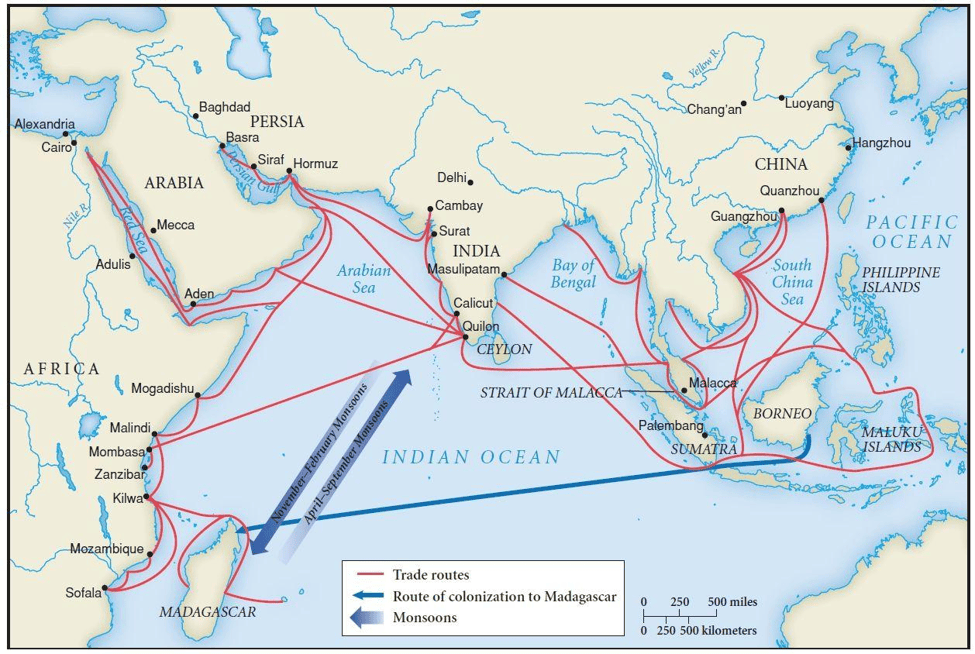
    I recently read a passage from a book titled The Sinbad Voyage. This book details a 6000-mile voyage from Oman to China in a replica of an ancient Arab ship.

    The passage that sparked this thought was:

    The Arabs took to the sea with that same philosophy of devotion which helped them cross the great deserts. They set out trusting in the destiny which Allah would provide them, and both camel caravaneer and Arab shipmaster used the same stars to guide them on their courses, believing that God had placed the stars there for that very purpose. [In a previous voyage across the sea], I had only to glance upwards to appreciate the heritage of Arabe seafaring: of the major navigation stars used by sailors, most bore Arabic names because it was Arab savants who had developed the art of astronavigation (p. 16).

    “The sea road was the great achievement of early Arab navigation. It was nothing less than the 6000-mile voyage by way of Ceylon and South-east Asia to the fabled ports of China (p18).” (emphasis added)

    So these Arab shipmasters navigated the oceans of their world. Exploring, adventuring, expanding the horizons of what they and the people around them thought were possible. Both in the deserts and the oceans. This image can help visualize this ocean exploration:
    From other passages I read that even at its most consistent and well-established, roughly 1 in 10 trips to China never returned.

    Can you imagine setting out into the ocean knowing there was a good chance you would never return?

    Why did they do this?

    Some people just have an adventurous death wish, hop on a raft, and push off into the ocean. This is true.

    Others have a view of what is possible and go for it. But there is still an immense amount of belief, trust, and faith in boarding a large ship and setting off on what is known to be an amazingly treacherous and dangerous journey. Why do it?

    The thought that occurred to me as I read that passage about the ancient Arab explorers was this: it was faith that allowed these Arab shipmasters to do amazing things. Many truly believed that Allah was watching over them and would safely guide them, by destiny, or by whatever else you want to call it, to their destination.

    Why did they believe it?

    Faith.

    Did some die? Yes. Was their faith misguided? Who knows. But that doesn’t take away the fantastic thing they did because they had faith.

    People with faith accomplish amazing things.

    What role has faith played in the discovery of the world? Without faith in something greater, people wouldn’t do fantastic things. Or they would do them less often.

    What does the role of faith play in our everyday lives?

    Why did your body move when you told it to get out of bed this morning? Do you even realize you told your body to get out of bed this morning? Why did you believe your body would move when you told it to this morning?

    The answer is faith.

    You can give all sorts of other answers if you’d like. But ultimately you had faith that if you told your legs to swing over the side of your bed and to walk, they would do it. You had to have faith that it was possible. Every living act is done with faith.

    The next time you venture out to do something difficult or scary ask yourself: do I have faith that I can accomplish this thing? If you have faith, you can do anything. And if you have faith and fail, you learn something.

    When you think about it this way, you can’t lose.
  • Discipline, Sharks, and Freedom

    Discipline, Sharks, and Freedom

    I watched a video recently. You can watch it here:

    In the video, some surfers are complaining about a barrier in the ocean. They’d travelled for a once in a lifetime surf trip and a barrier was keeping them from being able to surf the big waves.

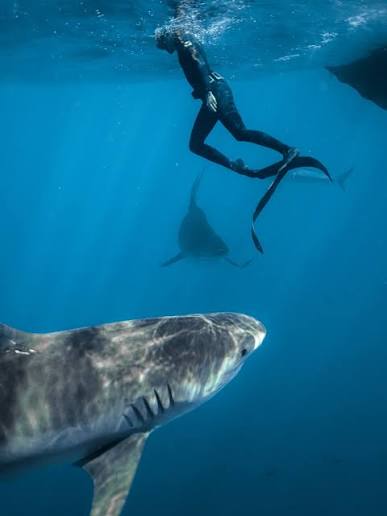
    As they were complaining, an older surfer walked up and let them use his binoculars. Through the binoculars, just beyond the barrier, the young surfers could see a feeding frenzy. Sharks were just beyond the barrier.

    What seemed like the worst thing in the world quickly turned into a great protection and a great blessing.

    How often do we look at life as though through a murky glass? If we only had binoculars, or could see and understand the bigger picture, the way God sees things, how differently this world would look.

    1 Corinthians 13:11-13

    11 When I was a child, I spake as a child, I understood as a child, I thought as a child: but when I became a man, I put away childish things.

    12 For now we see through a glass, darkly; but then face to face: now I know in part; but then shall I know even as also I am known.

    13 And now abideth faith, hope, charity, these three; but the greatest of these is charity.

    I think back on my teenage years. I wasn’t the most rebellious teenager. I was far from the most obedient. I pushed boundaries. I experimented with what I thought would bring me joy.

    As I’m now in my 30s, I realize just how stubborn and rebellious I am. This life is an opportunity for my spirit to prove whether or not I will choose God. I try my best. I realize that I am still just a child. Thinking I know best while God watches and lets me stumble around, making all the mistakes I need to so I eventually develop the humility, faith, and trust He knows I need.

    As I consider teenagers today, my heart fears for them. I remember when I thought I needed to drink, try drugs, do all the worldly things or else I would miss out. Or just to feel like I belonged.

    I think back on how lucky I was to try these things and escape with my free-will intact. Many are not so lucky.

    We look at so many destructive habits and activities from the perspective that they are fun and exciting. They are the big wave. But beneath the big wave are dangers we don’t perceive. Beer commercials always show the party. There is always a picture of abject excitement, freedom, liberation, and joy. What is never shown is what is lurking underneath: addiction, sadness, loneliness, emptiness, fear, doubt, dependance, despair, danger, suffering.

    The products of a worldly life are these things. I’ve seen it. We all have. And yet we think we want to be a part of these things, a part of this world.

    Thrilling and tantalizing waves.

    A feeding frenzy underneath. 

    Some quotes from that video –

    “The Lord’s commands do not constitute some grueling underwater barriers that we must learn to grudgingly endure in this life so that we might be exalted in the next.”

    “The Lord’s commandments are given out of love and caring. They are intended for our joy in this life just as much as they are intended for our joy and exaltation in the next.”

    There is this worldly perspective that restrictions and the commandments of God take away our freedom. Let me be free! Let me party! Let me eat, drink, and be merry!

    “Seek freedom and become captive of your desires. Seek discipline and find your liberty.”

    -Frank Herbert, Chapterhouse: Dune

    We think real freedom is drinking what we want to drink, not realizing we become a slave to that drink.

    Real freedom is eating what we want to eat, not realizing we become a slave to our appetites.

    Real freedom is going to the party, not realizing we are a slave to the fear of missing out.

    We are commanded to avoid things because those things take away our freedom, they do not liberate us.

    Real freedom is not being dependent on any substance, food, drug, or activity. Real freedom is discipline.

    Why does God give us commandments? Not to restrict us but to protect us. Not to hold us back but to let us fly to our highest potential.

  • Text to a Friend

    Text to a Friend

    I want to share an exchange with one of my oldest theological friends. I invited this friend to hear me speak in church. My topic was Ephesians 1:10 which reads:

    “That in the dispensation of the fulness of times he might gather together in one all things in Christ, both which are in heaven, and which are on earth; even in him”

    I may share that talk sometime in the future.

    My friend was invited to the talk and like the consistent and reliable friend he has been now for years whether across state lines or in the state of Arizona, showed up. I went about ten different directions before I settled on where I would go with my talk. The direction I finally settled on was one in which I knew this friend would disagree. I knew because it was a topic we had regularly disagreed on.

    Afterwards, this friend gave me expected thoughts regarding his side of things and how they relate to my talk. He was pointing out where he disagreed. This is why we have such good conversations! I already knew his points as we’d had the discussion before.

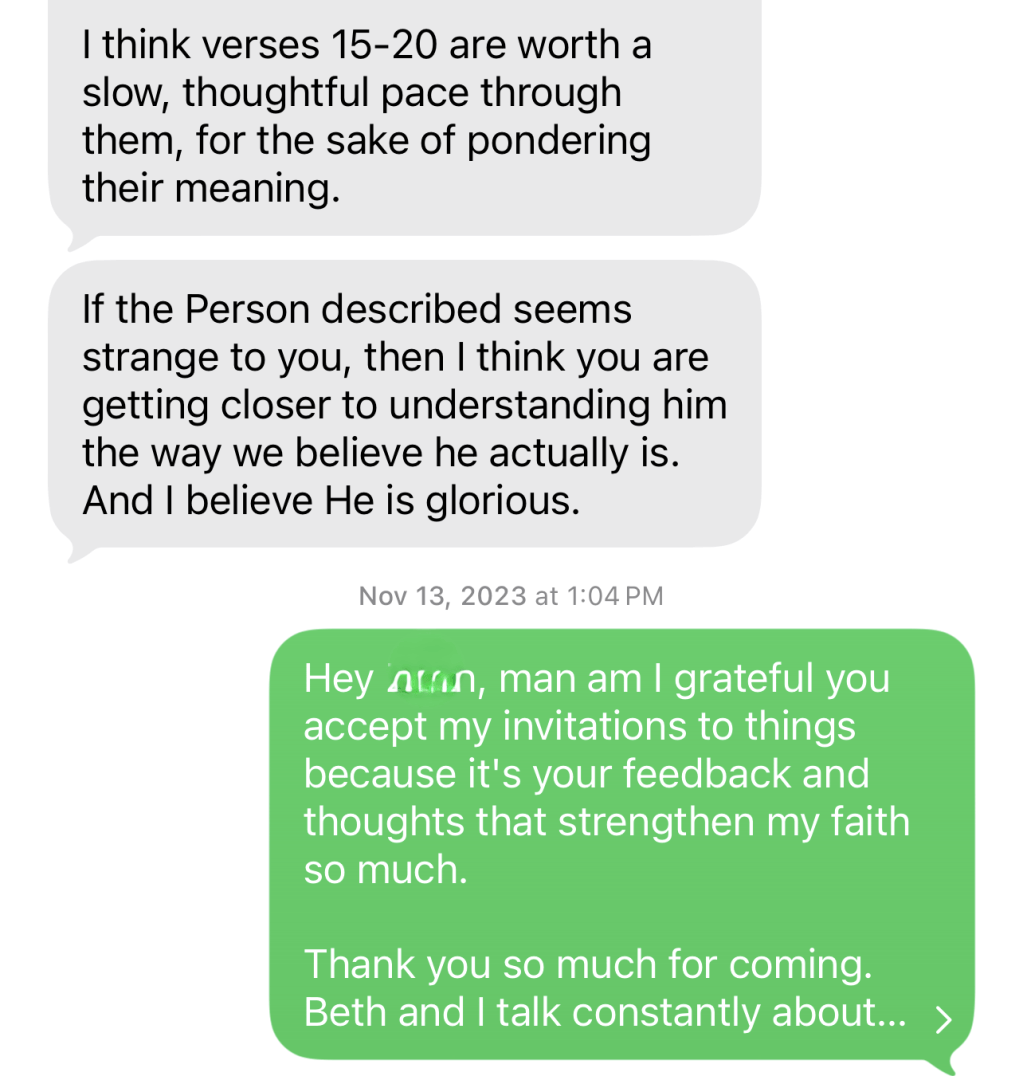
    It resulted in a text I got to send to him that I would like to share (yes, this was one text):

    “Hey, man am I grateful you accept my invitations to things because it’s your feedback and thoughts that strengthen my faith so much.

    Thank you so much for coming. Beth and I talk constantly about how we can’t trust people to keep commitments and do things they say they’ll do. You and [your wife] are one of two couples in our life (outside of family) that when you say you’re going to do something or be somewhere we know you will be. Thank you for that.

    I knew exactly what thoughts you’d have on my talk and I welcome them. I knew it would be somewhat, maybe inflammatory, to you, as I know it touched on things we’ve disagreed on from the beginning. I am glad that you appear to have not been offended by my words. Our disagreement really comes down to one thing, I think. And that’s if the Book of Mormon is true.

    I appreciated the exercise you gave me. As I did it, I came out more convinced that Jesus Christ is the literal Son of God, as the scriptures say. That’s the thing. You read the Bible and see God and Jesus Christ in one way. I see it, without a doubt in my mind, another way. Nothing will change that.

    But why do I see it another way? How can something so clear to you, and something so clear to me, be the opposite?

    As I said in my testimony, it comes down to a prophet. How can I know Jesus Christ is who He is? Because a prophet told me. How do I know he’s a prophet? He would have had to do something miraculous.

    I’ve concluded the Book of Mormon is the miracle God provided so I could know Joseph Smith was who he said he was. And if he was who he said he was, then Jesus Christ is who Joseph Smith said He is: the Son of God, on God’s right hand, as the scriptures say.

    It’s here that I finally thank you for giving me this great gift. It was years ago that you said you couldn’t accept the Book of Mormon because there was no proof the way there was with the Bible – archaeological and otherwise. I have spent the past years seeking “proof” that the Book of Mormon is what Joseph Smith claimed it to be. My list now is well over 400 items (*that was true in 2023 when this was written, now well over 800 individual items) and I am excited to share it with you one day.

    I have you to thank for that. You have built my testimony in a miraculous way and I thank our Heavenly Father, and you for that.

    Of course, “proof” is an interesting word. Despite all the records, eye witnesses, evidences, and testimonies, many still deny Jesus Christ existed, the Bible is the Word of God, etc. My “proof” may not do it for you. But when I review my list, there is not a shred of doubt in my mind that the power of God provided us the Book of Mormon. My faith has become knowledge.

    Until this life ends and we get to review everything, you will never understand how fruitful you have been to building my faith and testimony. Thank you, friend.

    Jesus Christ is the center of everything. He is my King, my Savior, my Redeemer. He is my advocate with the Father. Without Him I have nothing. Without Him I am nothing. I know we see Him differently. That doesn’t change who He is and what He’s done for us. Maybe one of us will change our minds one day. But ultimately, as long as we believe Jesus Christ is our Savior and King, one day we’ll both stand before Him and we’ll know. And it won’t matter who was right or who was wrong. Only He will matter. What a day that will be! Man, I look forward to it!”

    I share this because I think it’s important. The point of Christ is to bring us together. Though we disagree on many, many doctrinal points, this friend and I have fostered a relationship of discussion, debate, and disagreement, always founded on love and respect.

    I am truly grateful for how this person has strengthened me in Christ. That’s what this life is about. There can be good reason there is disagreement in the world – it can be for us to learn how to coexist with those we disagree with. We all have unique experiences in this life. Every moment shapes us and every experience we have changes the way we view the world. It’s through these experiences and listening to the viewpoints of others, someone who has had a vastly different life than we have had, that we can grow and become better.

    The world needs a little more of this.

  • Responsibility to Love

    Responsibility to Love

    I’ve written on this topic before. What to do With All the Love. Love Has Afforded Me Much. A slightly new thought came to me on this topic.

    There is a great responsibility for firstborns to love.

    Think about it.

    I was thinking about Sage. For her whole existence up to a point she will have shared, to some extent, the love and affection she receives with Ivy. Does this mean Sage is loved any less? No, absolutely not. She is endlessly loved.

    That said, she has shared her love with Ivy.

    It made me think, yet again, of all the singular love poured out on Ivy in her first 21 months.

    It made me reflect on the love I received in the 45 months before Adie joined our family.

    How did that shape me?

    Given the measure of love and affection I received from two loving parents, singularly focused attention and love for 45 months, does that increase my responsibility to love?

    Given this theory, I think firstborns have a higher responsibility to love. With great power comes great responsibility. There is no greater power in the world than love.

    Maybe this is why the firstborn gets the birthright (wink face).

    Thos of us who have experienced love, been given love, have felt love, it’s important for us to share that. There are so many in the world that don’t grow up in a loving household. If you’re reading this and you did grow up in a loving household, you’ve been given an advantage in life worth more than a huge inheritance. You’ve been given a huge leg up in this life if you were born into a loving home.

    Share it.

    Don’t waste the gift you’ve been given.

    Now, here’s some food for thought to counter my “firstborn love theory” (Trademark pending) –

    Other ideas to consider, did my love actually expand with the arrival of Adie (my little sister) because I had experienced love and now I got to share it with my little sister? Did my first learning experience of giving love outside of my parents who already loved me so much grow my capacity to love even more? Did getting to love somebody who couldn’t do anything for me help my capacity to love, learning at a young age to love somebody without getting anything in return? Does that add to my responsibility as the firstborn?

    Or is Adie’s capacity to love greater than mine because she was born into loving a 3 person family, unlike myself? Does that make Easton’s (youngest of 6) capacity to love 3x mine since he was born into a family 3 times bigger than the one I was born into? How does this balance with my personal capacity to love expanding every time a new baby joined our family?

    Love.

    We need to think about it more.

    Which leads to the ultimate, and powerful question: is love in limited supply?

    We all have an infinite capacity to love. I don’t believe there is any limit on how we can love. I think God is our example in this. Think about how much He loves you. Whether you come from a loving household or not, whether you’re the firstborn of 10, an only child, an orphan, the youngest of 2, and all examples in between, you have a divine capacity to love. Divine. Your Father is God. He loves you. Your capacity to love is infinite. Use it. Share it.

    Epilogue

    The above post was written in May of 2023. I kid you not, as I opened it to review and post in 2026, Beth sent me a video with a text attached.

    The text read: “Wren kept asking, “Where Ivy?” Then Ivy came down and Wren waved and said, “Good morning Ivy!” And gave her a hug. But Ivy was still waking up a bit so when she sat down to eat, Wren came over, gave her another gentle hug, and started gently rubbing Ivy’s back. It’s like Wren is teaching them how to love.”

    I replied, “Reminding them.”

    And Beth said, “Blog post!”

    She knows me too well. But I didn’t realize I was about to post this!

    We’ve been struggling a little with Ivy and Sage being gentle and loving with Wren as they get older. They are the older sisters, a lot more rambunctious and a lot more physical. Sometimes Wren messes up their “set ups” (toys they’ve setup). Wren wants to be with them and play with them but she’s very destructive. They struggle sharing with Wren. Wren is still little. So they’ve had a hard time.

    But I know that Ivy was sent here to be an example as the oldest sister. I know that Sage was sent here to be a peacekeeping, independent, strong second daughter to keep everyone connected. Maybe Wren was sent to remind us all how to love. Maybe she’s meant to teach us to be a little more patient with one another.

    EternalPerspective.

  • Who Will You Become?

    Who Will You Become?

    “You wasted it,” he said.

    I looked back, confused by what I was seeing. I considered a response. All that came was, “Who are you?” 

    “I’m all that you could have been,” he replied.   

    He looked just like me. I guess I couldn’t have been a bodybuilder. “What do you mean I wasted it?” I asked. 

    “You were given so much. So much opportunity. So much of a head start. You were raised to know God. You were raised to know Jesus Christ. You were raised to know why you were here and where you were going. And look what you did with it.” 

    I stared back dumbly. Ok, that was unfair. I got married late. Had one kid. Got divorced. Held down a decent job for most of my life. Maybe I drank a bit too much and I had a propensity to gamble. But my son loved me, despite my faults. My life wasn’t perfect by any means but a waste? This seemed over the top.  

    “I didn’t waste it. My life? It wasn’t wasted,” I finally said. I had no other defense than to repeatedly say it wasn’t a waste.

    “I’ve come to tell you that you did. I’m sorry,” the other me seemed to say with real compassion. Would I have been equally compassionate in his shoes? 

    “What did you do differently?” I asked. 

    A vision opened up to me. This must have been what so many near-death-experiencers describe as a life review, but this wasn’t my life. It was me I was seeing, but it wasn’t my life. It was my life for stretches. But then something changed. In a miraculous way I saw it all. The thoughts, the struggle, the fear, the doubt, and the triumph. I saw the grappling with faith.

    In my life, I’d never come back to God. It was too painful to feel like I’d let Him down. The focus of this vision was one critical moment.  A prayer to God begging Him to take this alternate version of me back. I’d never done that. 

    The vision flew through other minor and major events. The major events: Marriage, but not at the venue I got married at, this was performed at a beautiful white building. A temple. A wife he (the alternate version) was faithful to. Children that didn’t just “love” him but admired and adored him. Children that had their own faith that strengthened and guided them in a fallen world. A wife that appreciated him and stuck with him through it all. 

    Then seemingly minor but apparently important events: Service, church callings, prayers, books read, time spent studying, time spent writing, small discussions, small moments shared, smiles, gratitude, forgiveness, sharing, giving. I had to admit it was a much different life than the one I had lived. It sure had a lot less football on Sundays.

    Did I waste it?

    In 2021 when I wrote the above, I had heard the question, “If on the last day of your life you met the person you could have been, what would you say to each other?” 

    That inspired me to write the brief dialogue above. It’s what I thought that interaction could look like if I never turned back to God and reminded myself what is truly important about this life.