The Last Juror was written by John Grisham in 2004. It is his 18th novel written. I read a lot of nonfiction so a break into a fictional story is always a breath of fresh of air. But diving into a book from an experienced novelist like Grisham is particularly refreshing.
This is the first novel from Grisham based in Ford County, Mississippi since his first novel ever written, A Time to Kill which was published in 1989.
I enjoyed this book a lot and finished the 355 pages in a handful of sittings. It’s one of those books where it’s difficult to stop because at every stopping point there’s some sort of cliffhanger that keeps you reading. You expect something like that from such a great writer. It’s amazing to read a Stephen King or John Grisham and spend half the time enjoying the book and the other half marveling at their literary capabilities.
The plot of the story is an interesting one. It is based around a 23-year old college dropout that purchases a failing newspaper and the story that goes with his maturation as a small business owner and only provider of news in a small town. I wonder if the name “John Grisham” weren’t attached to this book if a publisher would ever give it a second glance. The plot doesn’t scream thriller, but when you’re a talented writer anything can become an entertaining journey. A name goes a long way when you’ve shown the sort of success Grisham has shown.
Like I said, I enjoyed the story. It kept me engaged. I was interested. I never felt bored or dragged along. I was always interested in what was going to come next. That said, I don’ think everyone would enjoy this book. I could easily see most readers becoming bored with the story. Some readers may feel the story is particularly slow through stretches in the middle. With reading so much nonfiction, I’ve become so used to reading through slow or dry parts of books. It’s hard to say if this is truly a page-turning fiction or if my perception has been skewed.
If someone is going to read one book a year, find another more acclaimed book. There are so many phenomenal books out there, options are endless. If anything, read Grisham’s first couple books. I haven’t read his first books (yet), but I imagine they are great given how many novels and movies have followed.
I wouldn’t read this book a second time but I’m glad I read it once. It was an interesting and engaging story to me. I look forward to reading some of Grisham’s earlier novels as time goes by.
After writing this my curiosity took me to the internet to see how others felt about this book. Obviously, feelings about a book will vary wildly depending on the source, but what I found is this novel is generally well received. Of the 3 dozen or so novels Grisham has written this is often rated as one of his better books.
Maybe my fiction-good-book-radar isn’t as messed up as I thought it was.
When I was watching General Conference and the Korean children’s choir started singing “I Love to see the Temple” in a language I did not understand, something amazing hit me.
I don’t know why this thought was spurred by this song from these children.
That feeling was this-
I am a member of the Church of Jesus Christ.
How blessed I am to not only be on this earth at a time when His church exists, but to be a member of that Church. Jesus Christ’s Church. His Church!
As I listened to words I didn’t understand but music I could never misplace, and as the spirit filled me and tears filled my eyes, I realized something.
If I lived during a time when the Church of Jesus Christ did not exist on the earth, I would have forever lived my mortal existence with a hole in my spirit and my experience. It occurred to me that if I lived in any other dispensation, I would have felt a distinct emptiness within me. Maybe this realization happened at that moment because at that particular moment, I was so filled to the brim with a spiritual feeling that I’ve come to rely upon so heavily.
What a challenge it would have been to live in a world without the Gospel of Jesus Christ in its fullness.
We live in a difficult and challenging world. But amidst that challenge I am a 30-minute drive from 3 different temples.
How blessed I am.
I am so grateful to live today, with the restored Gospel of Jesus Christ fully present, and His Church in full force.
What would I have done without it?
Maybe God knew I could not endure that emptiness. Maybe that’s why I’m here at this moment.
For whatever reason I am here now, today, I am grateful for it. Grateful beyond measure.
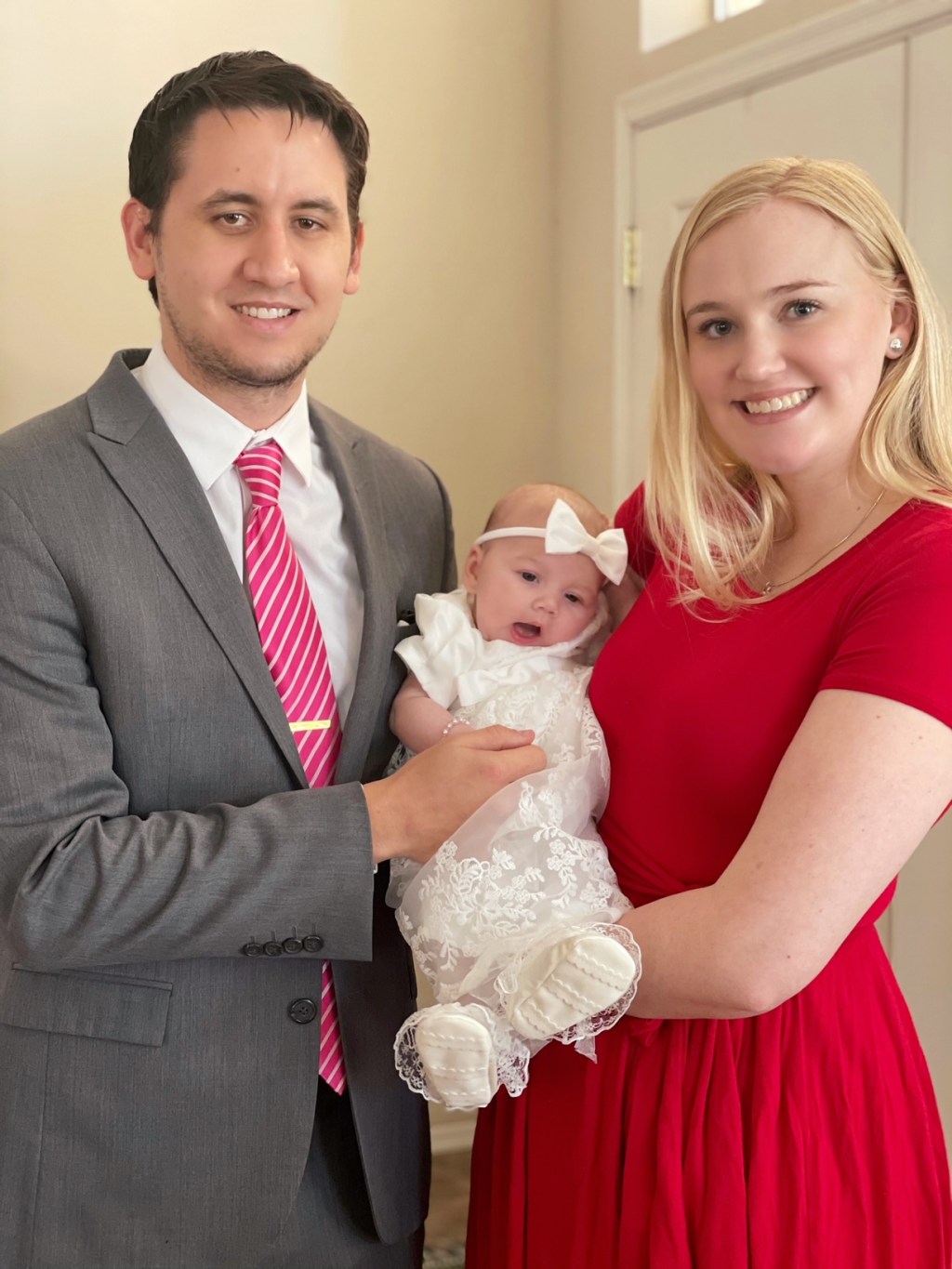
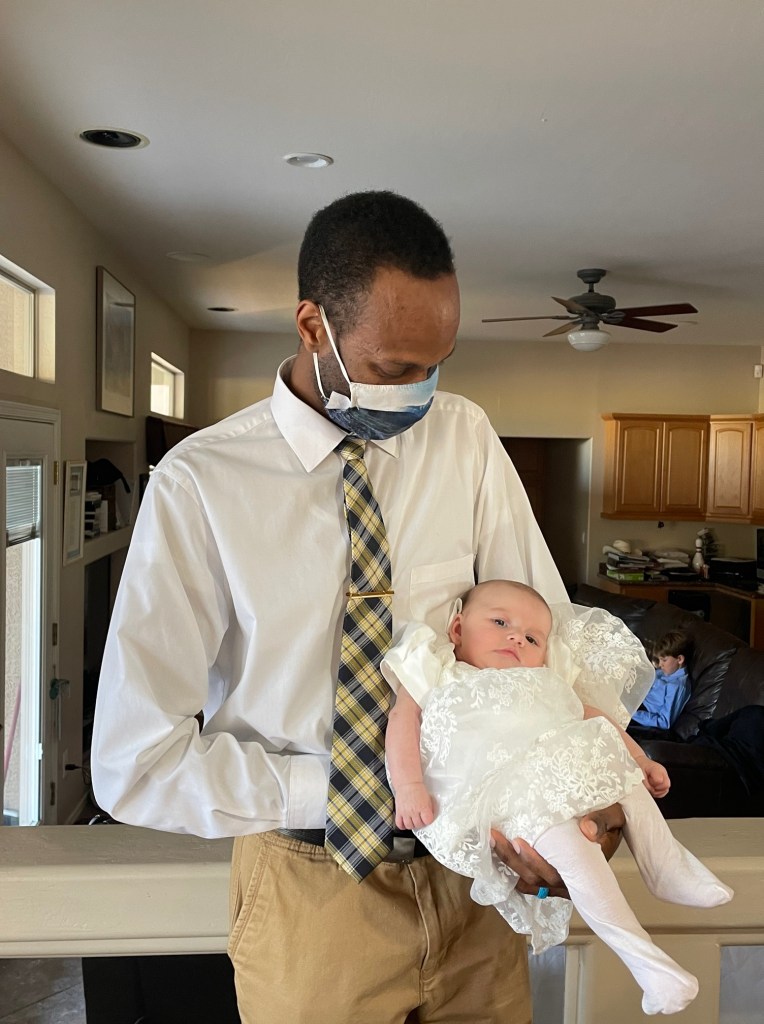
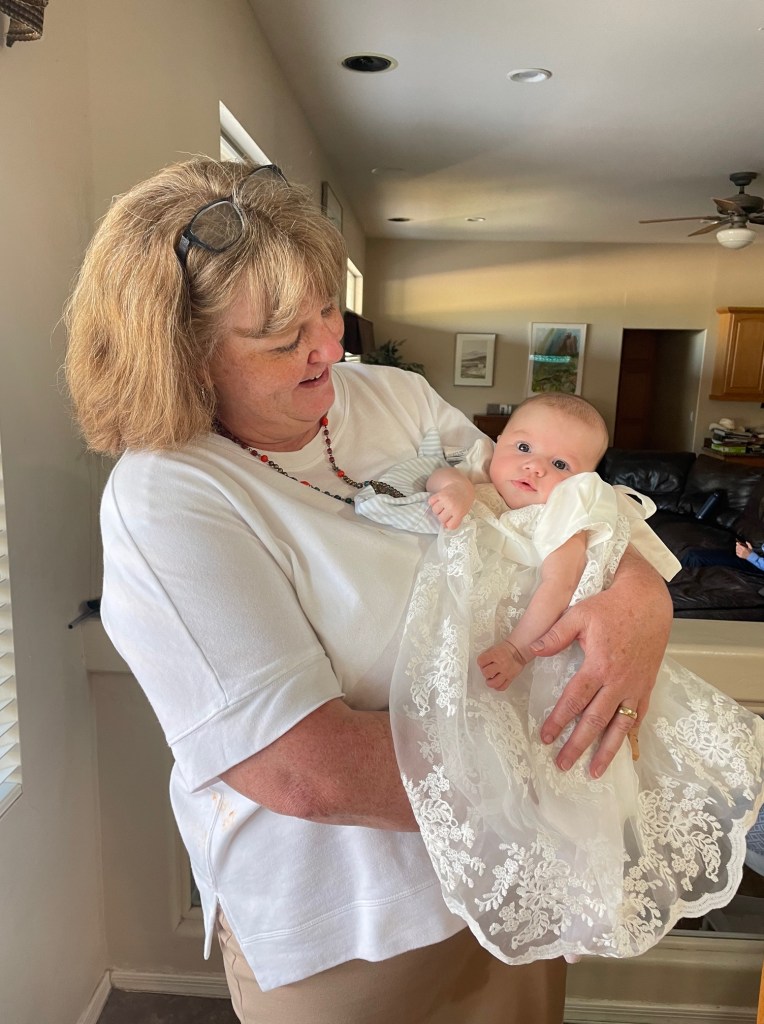
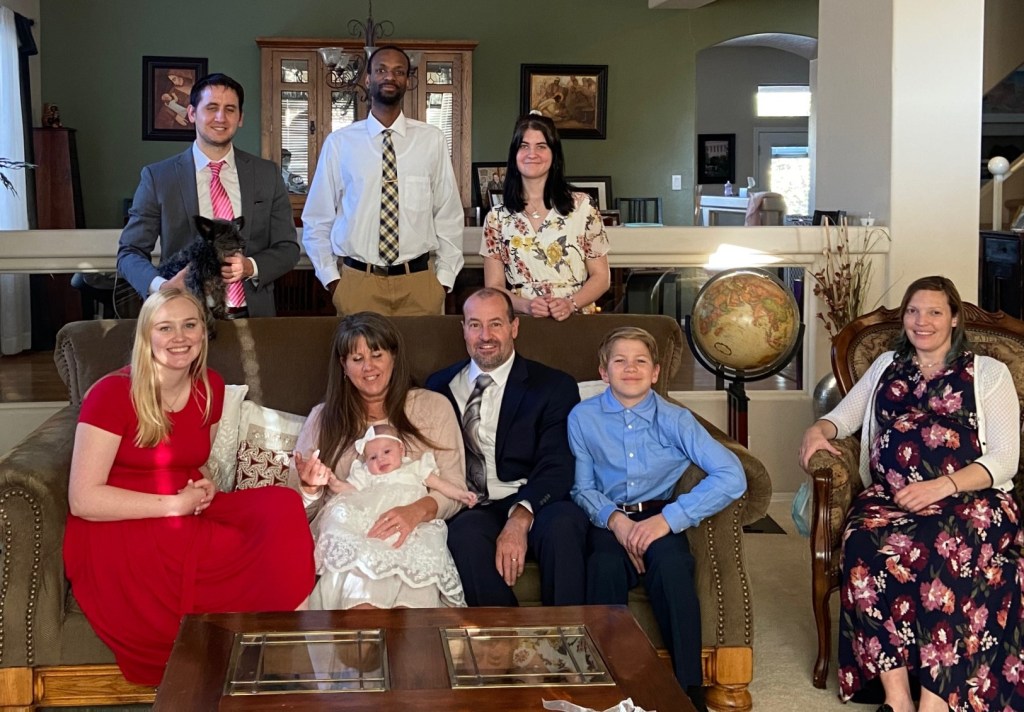
I recently had the special opportunity to bless Ivy. Leading up to the blessing, I did some research on the history of blessing children in the Church of Jesus Christ and its significance. For Ivy’s blessing, Beth put together an event and a description of what a baby blessing is. Here is that description:
What is a baby blessing?
In summary, the naming and blessing of children is a commandment of God. It is proper for a worthy father to name and bless his children. Blessing of children was done during the time of Christ, and it occurred in the early years of the restored Church. The ordinance has become a regular practice followed by Church members ever since.
Who has the authority to bless a baby?
A worthy priesthood holder under the direction of the local bishop. It is usually the father or a close family member.
What is the priesthood?
The word priesthood has two meanings. First, priesthood is the power and authority of God. It has always existed and will continue to exist without end. Through the priesthood, God created and governs the heavens and the earth. Through this power, He exalts His obedient children, bringing to pass “the immortality and eternal life of man.”
Second, in mortality, priesthood is the power and authority that God gives to man to act in all things necessary for the salvation of God’s children. The blessings of the priesthood are available to all who receive the gospel.
What is the format of a baby blessing?
When blessing a baby, priesthood holders gather in a circle and place their hands under the baby. When blessing an older child, brethren place their hands lightly on the child’s head. The person who gives the blessing:
1. Addresses Heavenly Father.
2. States that the blessing is performed by the authority of the Melchizedek Priesthood.
3. Gives the child a name.
4. Gives words of blessing as the Spirit directs.
5. Closes in the name of Jesus Christ.
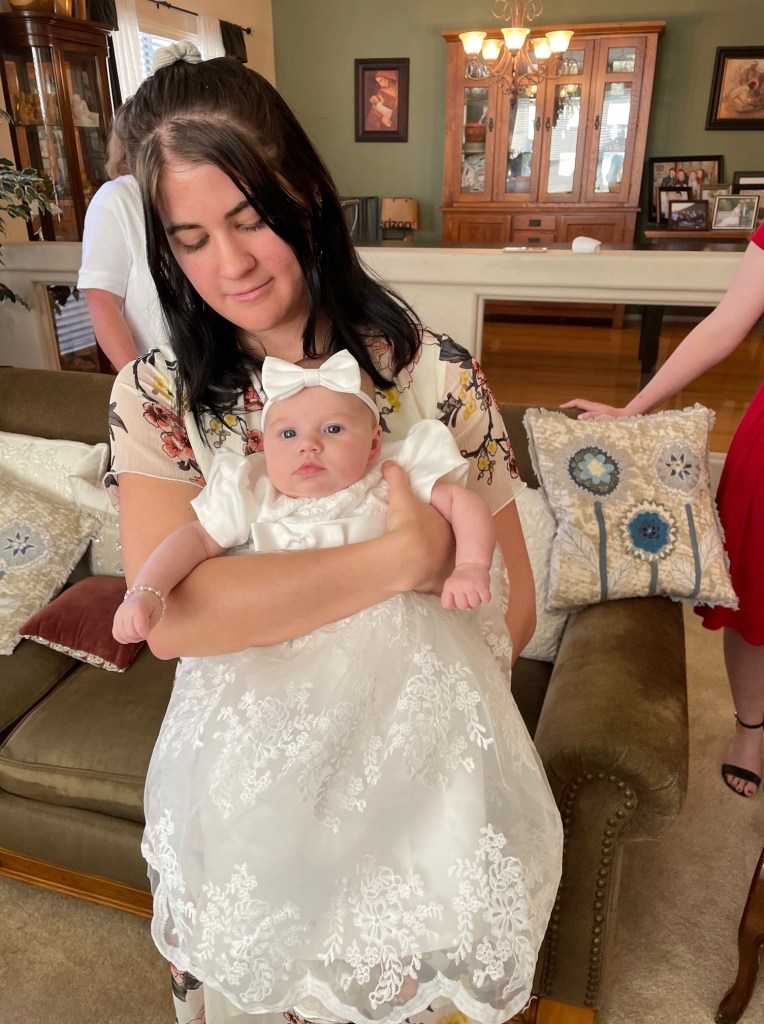
Ivy and Aunt Cambria
Reading up on the baby blessing beforehand taught me some interesting things about this sacred practice that I would like to share.
Unique to giving a blessing to an older child or adult, the naming and blessing of a child is directed to Heavenly Father like prayers are.
This could be because the baby is too young to understand the words directed to him or her.
It appears that Melchizedek Priesthood holders are authorized to more than ask for a blessing but are able to pronounce a blessing upon the child directly, as the spirit directs.
Sometimes inspiration (or confidence) to pronounce/give a blessing does not come. In this case it is of course acceptable to ask Heavenly Father for these blessings. I believe this is how I felt in giving Ivy her blessing. It was enough to ask Heavenly Father to bless her with my requests.
It is important to remember the naming and blessing of children is not a saving ordinance. It is still an important and sacred moment seen in heaven.
“It is an awesome responsibility to be a priesthood agent of the Lord, to act in his behalf, and to approximate in one’s words and doings what the Lord would do if he were here. A father, especially, who is to bless his child, has the delight and responsibility to prepare himself beforehand by pondering and by fasting and prayer, that he may be sensitive to the suggestions of the Spirit when giving the blessing.”
“How blessed we are to be able to present our little ones before the Lord, our families and the Church, and then consecrate them to the Lord. How blessed we are to be able to name them, plead over, pray for, and, yes, to bless them directly and personally in harmony with our finest desires for them, by the authorization and wisdom of heaven.”
An interesting account from Joseph Smith on March 13, 1843 says, “Twenty-seven children were blessed, nineteen of whom I blessed myself, with great fervency. Virtue went out of me, and my strength left me…”
“[The next day] Elder Jedediah M. Grant enquired of me the cause of my turning pale and losing strength last night while blessing children. I told him that I saw that Lucifer would exert his influence to destroy the children that I was blessing, and I strove with all the faith and spirit that I had to seal upon them a blessing that would secure their lives upon the earth; and so much virtue went out of me into the children, that I became weak, from which I have not yet recovered; and I referred to the case of the woman touching the hem of the garment of Jesus. (Luke 8).” (History of the Church, 5:303.)
Elder John Taylor said the Savior’s example of blessing children “should be studiously complied with without hesitancy or objection” (by priesthood holders).
We see that Joseph Smith followed the example of the Savior who blessed children in both Israel and the American continent. (Mark 10:14-16 and 3 Nephi 17). What an amazing and marvelous thought: our virtue can be passed to our children. Our blessings are a force Satan must reckon with. It makes me want to bless my daughter daily. It also adds insight to a scripture that has always been a bit puzzling in Luke 8:46. Virtue can literally leave us to help others.
The new name:
A new name is often involved when a covenant relationship is formed.
When Adam and Eve were given dominion over the earth, Adam named all the animals (Genesis 2:19-20).
When we get baptized we follow a similar pattern, taking upon us a new name, the name of Christ.
Temple covenants also involve the giving and receiving of names.
The responsibility of blessing a child is bestowed, ideally, on he who helped create that child’s body, and who Heavenly Father entrusted His child with in mortality.
Joseph F. Smith – “The patriarchal order is of divine origin and will continue throughout time and eternity. There is, then, a particular reason why men, women, and children should understand this order and authority in the households of the people of God and seek to make it what God intended it to be, a qualification and preparation for the highest exaltation of his children. In the home, the presiding authority is always vested in the father, and in all home affairs and family matters there is no other authority paramount…This authority carries with it a responsibility, and a grave one, as well as its rights and privileges, and men cannot be too exemplary in their lives, nor fit themselves too carefully to live in harmony with this important and God-ordained rule of conduct in the family organization.”
It is my experience that giving blessings is often the closest I ever feel to Heavenly Father. I can feel him speaking through me and it is always a powerful, emotional, and memorable experience. The opportunity to bless my daughter will be one of the greatest moments of my life. I have immense gratitude to my Heavenly Father for entrusting Ivy into my care, allowing me to name her, and trusting me to watch over and protect her in this life and through eternity.
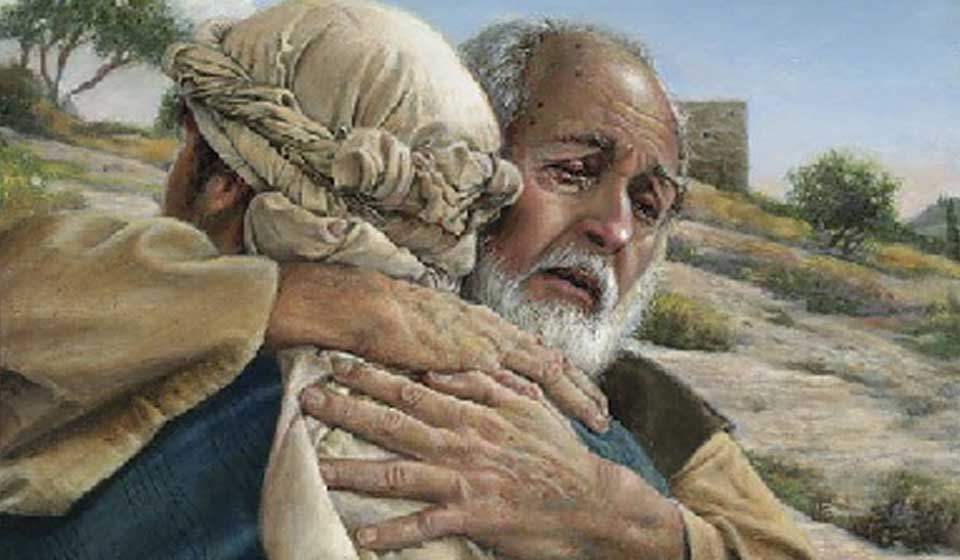
The story of the Prodigal Son is well known. For those who have not read it before or haven’t read it recently it can be found in Luke 15:11-32.
The story of the Prodigal Son has always hit close to home for me. Obviously, it’s easy for me to relate to the younger son. You should read Luke chapter 15 above but a quick summary: there were two sons. They will be referred to as the elder/older son and the younger son as I write. The two sons were given their inheritances. The younger son left his home and went to a faraway city. There he squandered his inheritance on “riotous living.” When he hit the lowest of lows, the younger son returned home to beg his father to allow him to be a servant. The father, instead of showing anger, welcomed his son home, killed the fatted calf, put a robe on his son, gave him a ring, put shoes on his feet, and threw a huge party in celebration of his return.
The older son, upon hearing of his brother’s return and the subsequent party, was angry.
This story is often told in such a way that the primary lesson is about the Prodigal Son and his father’s reaction to his return. The story is called “the prodigal son” after all. That lesson being that no matter how we stray, how far gone are, and how many mistakes we make our Heavenly Father (the father in the story) will always welcome us back. In fact, Heavenly Father rejoices at our repentance:
“I say unto you, that likewise joy shall be in heaven over one sinner that repenteth, more than over ninety and nine just persons, which need no repentance.”
All Prodigal Sons like myself rejoice at this story.
I once heard a different perspective on this story, and I’d like to share it. There is a great lesson to be learned in the story of the Prodigal Son by looking at a secondary character: the older brother.
A great question to ask yourself before reading any of Christ’s parables is “who was He speaking to?” Another good question is “What was He trying to teach?” If you look at the parable from the perspective of the Prodigal Son, you can say Christ was teaching those who have sinned that they can always repent and return to the light of their Heavenly Father’s love.
Who was Christ speaking to when he gave this parable? He was speaking to those looking for the message of God. He was speaking to the listeners. These were the ones looking for the message of God. When giving this parable Christ was speaking to the saints.
Consider what can be learned from the older brother. The older brother never left. The older brother never sinned. The older brother respected and worked for his father. Many say, and I always thought, he was justified in his reaction. His exact words in verses 29 and 30:
“And he answering said to his father, Lo, these many years do I serve thee, neither transgressed I at any time thy commandment: and yet thou never gavest me a kid (fatted calf), that I might make merry with my friends:
But as soon as this thy son was come, which hath devoured thy living with harlots, thou hast killed for him the fatted calf.”
This appears to be a natural reaction. He had always been there. He had always done right. Only for his corrupt brother to return and receive honor.
Why did the older son stay and work hard for his father? Why did he keep his commandments? Was he simply looking forward to the inheritance he was to receive?
Why do you serve God and keep his commandments? Are you looking forward to your mansion? Do you serve God so you can inherit His glory? Are you serving Him for YOUR benefit?
We should serve God because we love God. We should serve God because we love those around us. Our service to God shouldn’t be for the blessings and honors He can give us. Our hearts should serve for love and not for our inheritances.
Jesus didn’t tell this story only to get sinners to repent. He also told this story to get the saints to repent. The Prodigal Son went out to experience life and disregarded his father’s possessions. The older son on the other hand stuck around, but he was working to please his father. He looked at himself as moral and worthy. He was after his father’s possessions. That’s what he concerned himself with. The elder son was keeping score. He was trying to earn his father’s love and inheritance.
Sometimes we are like the Prodigal Son: sinning and needing to return home. Sometimes we are like the older brother: serving for the glory of the world.
Often we are like the older son in our envy and jealousy. When someone returns to the fold do we judge them for their past? Or, like the father in the parable and our Heavenly Father, do we rejoice at someone’s return?
Elder Holland in his talk, The Other Prodigal, said:
“I testify that no one of us is less treasured or cherished of God than another. I testify that He loves each of us-insecurities, anxieties, self-image, and all. He doesn’t measure our talents or our looks; He doesn’t measure our profession or our possessions. He cheers on every runner, calling out that the race is against sin, not against each other. I know that if we will be faithful, there is a perfectly tailored robe of righteousness ready and waiting for everyone, “robes…made…white in the blood of the Lamb.” May we encourage each other in our effort to win that prize is my earnest prayer.”
Let us not compare our blessings to the blessings of others, what we have to the possessions of others. Let us support and help each other to all return to our Heavenly Father. Jealousy is of Satan. We should never look down on somebody who made mistakes and is trying to return to God, because then we are the sinner. We can learn from every character in Christ’s great parable. Be like the Prodigal Son and repent, humble ourselves, and return home. Be like the elder son and don’t envy but welcome our wayward brothers and sisters back home with joy and love. And be like the father, loving all those around us, embracing the sinner and the saint alike. I believe this is God’s hope for us and what Christ was teaching us through this story.
__________________________
Here is a link to Jeffery R. Holland’s talk, The Other Prodigal:
What do you think the point of organized religion is?
I had an obvious realization recently, only recently. The point of organized religion is to bring you closer to Heavenly Father and Jesus Christ. If organized religion doesn’t bring you closer to God, then why do it? I think it’s why we see so many people disenfranchised with organized religion. In their hearts and souls, they know and hope what organized religion will bring – closeness with God. When it doesn’t do that (and in fact sometimes does the opposite) they move away from it.
The second point of organized religion: to bring us peace.
This second part isn’t as simple as “I belong to a church so I am happy and peaceful.” We know that Christianity is not always comfortable. This peace is bigger than worldly comfort. This peace is the knowledge that you are right with God. This peace is more eternal than this life.
Why don’t organized religions do these two things? Some do, and I’m not discounting those who come closer to God and find peace in any faith. My point stands, that a lot of people have moved away from organized religion. Why? Why don’t most organized churches bring us closer to God or bring us peace? They don’t have the proper authority from heaven to do so.
God, through revelation has told us exactly what we need to do to come closer to Him and to have peace:
Faith in Jesus Christ
Start by simply believing in Jesus Christ. Believe He was born, believe He lived, believe He is the son of God, believe He died for you and your sins.
Repentance
Once you believe, be better. Don’t take for granted the suffering Christ went through for you. Pray to God and ask forgiveness for the mistakes you have made and continue to make.
Baptism
Religion has corrupted this simple principle. All God asks is you make a symbolic gesture to show that you have faith in Him, faith in Jesus Christ, and will remember them. Then use that show of faith to change and be better. God has asked us to be baptized. Follow His commandments and be baptized.
Gift of the Holy Ghost
The world is ever distracting and evil. God has given us someone to provide strength. The Holy Ghost is one with God and Jesus Christ and can be with us always.
I have the perfect example to help illustrate the important role the Holy Ghost plays. I received a text from a friend one afternoon while I was working telling me his dad had passed away. My friend didn’t want me to find out over social media, so he texted me. When I read it I initially thought selfishly. I was at work. There wasn’t anything I could do. I wanted to kneel and pray and cry. But as I was sitting there something happened. As clear as if a person whispered in my ear, I heard and felt a message. Clear as day I knew important things. This was my friend. He was hurting. Clear as day, “go to your friend.” I’m not affectionate, it’s hard for me, ask my wife. Beth knows that better than anyone. It’s not in my nature to want to go comfort and cry with a friend. That seems hard and vulnerable. But in that very important moment I know the Holy Ghost came to me and directed me. I know it was important for me, and I believe it was important for my friend. The Holy Ghost did that. I know that because I’ve worked so hard to be able to hear when the Holy Ghost speaks to me. I have so many examples of that. I could go on for days about the important moments that the Holy Ghost guided me.
After the Holy Ghost, the final step: endure to the end. Take the sacrament each week to renew your covenants from baptism. Repent every day. Remember Jesus Christ every day. That’s it. That brings you closer to God. I know because it has for me.
People don’t change overnight. I know to many it seemed like I changed overnight. I didn’t. It was years of slowly changing habits, changing thoughts. Many saw first-hand who I used to be but didn’t see the slow, gradual change to who I am now. I always told myself I was “good.” What good was me telling myself I was good if my actions and my selfishness said otherwise? Four years ago, if I received the text I mentioned above I would have said “I’m sorry” and “let me know if you need anything.” Today, I’m different. I’m different because of Jesus Christ.
What’s important? I know why I’m here. I know where I come from. I know where I’m going. This brings peace.




 No Coincidences