Category: Uncategorized

  • Discipline, Sharks, and Freedom

    Discipline, Sharks, and Freedom

    I watched a video recently. You can watch it here:

    In the video, some surfers are complaining about a barrier in the ocean. They’d travelled for a once in a lifetime surf trip and a barrier was keeping them from being able to surf the big waves.

    As they were complaining, an older surfer walked up and let them use his binoculars. Through the binoculars, just beyond the barrier, the young surfers could see a feeding frenzy. Sharks were just beyond the barrier.

    What seemed like the worst thing in the world quickly turned into a great protection and a great blessing.

    How often do we look at life as though through a murky glass? If we only had binoculars, or could see and understand the bigger picture, the way God sees things, how differently this world would look.

    1 Corinthians 13:11-13

    11 When I was a child, I spake as a child, I understood as a child, I thought as a child: but when I became a man, I put away childish things.

    12 For now we see through a glass, darkly; but then face to face: now I know in part; but then shall I know even as also I am known.

    13 And now abideth faith, hope, charity, these three; but the greatest of these is charity.

    I think back on my teenage years. I wasn’t the most rebellious teenager. I was far from the most obedient. I pushed boundaries. I experimented with what I thought would bring me joy.

    As I’m now in my 30s, I realize just how stubborn and rebellious I am. This life is an opportunity for my spirit to prove whether or not I will choose God. I try my best. I realize that I am still just a child. Thinking I know best while God watches and lets me stumble around, making all the mistakes I need to so I eventually develop the humility, faith, and trust He knows I need.

    As I consider teenagers today, my heart fears for them. I remember when I thought I needed to drink, try drugs, do all the worldly things or else I would miss out. Or just to feel like I belonged.

    I think back on how lucky I was to try these things and escape with my free-will intact. Many are not so lucky.

    We look at so many destructive habits and activities from the perspective that they are fun and exciting. They are the big wave. But beneath the big wave are dangers we don’t perceive. Beer commercials always show the party. There is always a picture of abject excitement, freedom, liberation, and joy. What is never shown is what is lurking underneath: addiction, sadness, loneliness, emptiness, fear, doubt, dependance, despair, danger, suffering.

    The products of a worldly life are these things. I’ve seen it. We all have. And yet we think we want to be a part of these things, a part of this world.

    Thrilling and tantalizing waves.

    A feeding frenzy underneath. 

    Some quotes from that video –

    “The Lord’s commands do not constitute some grueling underwater barriers that we must learn to grudgingly endure in this life so that we might be exalted in the next.”

    “The Lord’s commandments are given out of love and caring. They are intended for our joy in this life just as much as they are intended for our joy and exaltation in the next.”

    There is this worldly perspective that restrictions and the commandments of God take away our freedom. Let me be free! Let me party! Let me eat, drink, and be merry!

    “Seek freedom and become captive of your desires. Seek discipline and find your liberty.”

    -Frank Herbert, Chapterhouse: Dune

    We think real freedom is drinking what we want to drink, not realizing we become a slave to that drink.

    Real freedom is eating what we want to eat, not realizing we become a slave to our appetites.

    Real freedom is going to the party, not realizing we are a slave to the fear of missing out.

    We are commanded to avoid things because those things take away our freedom, they do not liberate us.

    Real freedom is not being dependent on any substance, food, drug, or activity. Real freedom is discipline.

    Why does God give us commandments? Not to restrict us but to protect us. Not to hold us back but to let us fly to our highest potential.

  • Text to a Friend

    Text to a Friend

    I want to share an exchange with one of my oldest theological friends. I invited this friend to hear me speak in church. My topic was Ephesians 1:10 which reads:

    “That in the dispensation of the fulness of times he might gather together in one all things in Christ, both which are in heaven, and which are on earth; even in him”

    I may share that talk sometime in the future.

    My friend was invited to the talk and like the consistent and reliable friend he has been now for years whether across state lines or in the state of Arizona, showed up. I went about ten different directions before I settled on where I would go with my talk. The direction I finally settled on was one in which I knew this friend would disagree. I knew because it was a topic we had regularly disagreed on.

    Afterwards, this friend gave me expected thoughts regarding his side of things and how they relate to my talk. He was pointing out where he disagreed. This is why we have such good conversations! I already knew his points as we’d had the discussion before.

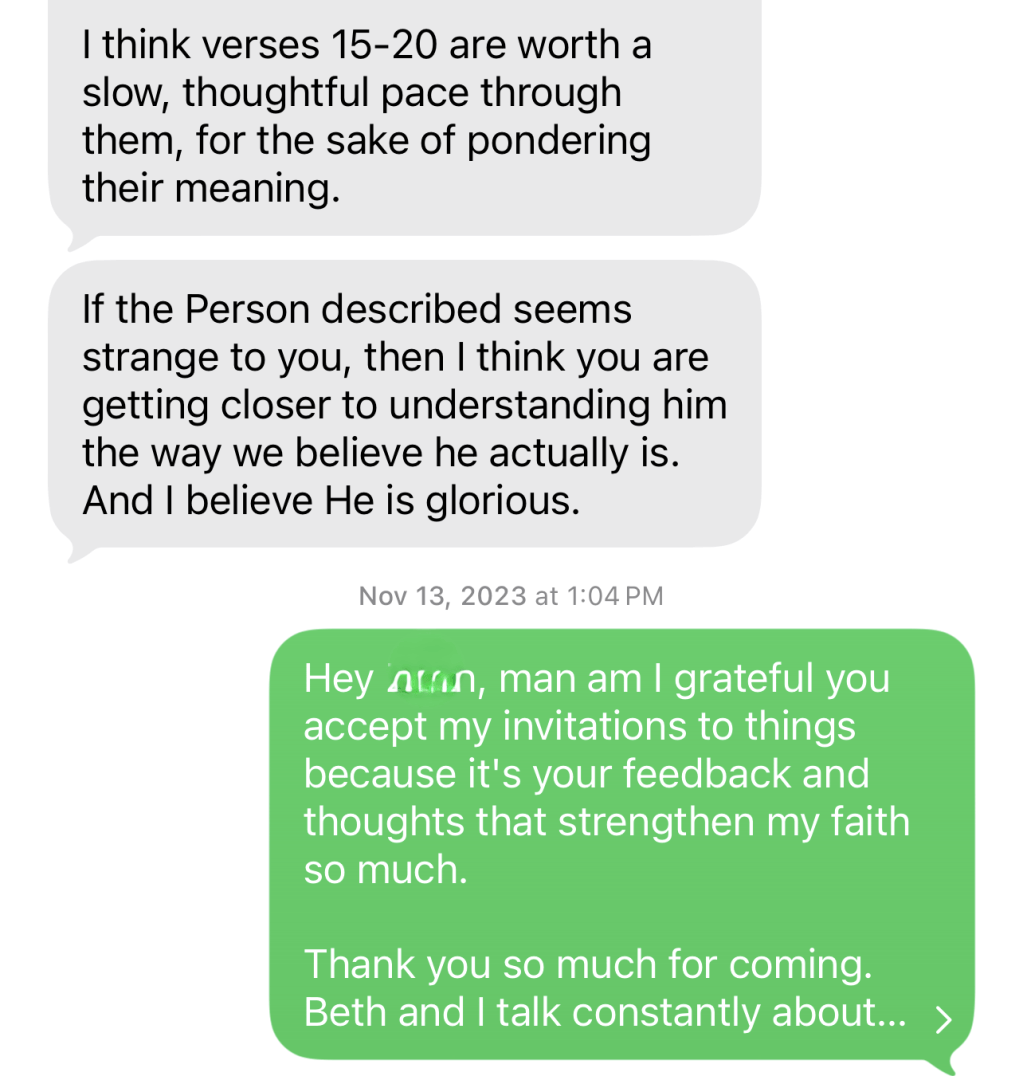
    It resulted in a text I got to send to him that I would like to share (yes, this was one text):

    “Hey, man am I grateful you accept my invitations to things because it’s your feedback and thoughts that strengthen my faith so much.

    Thank you so much for coming. Beth and I talk constantly about how we can’t trust people to keep commitments and do things they say they’ll do. You and [your wife] are one of two couples in our life (outside of family) that when you say you’re going to do something or be somewhere we know you will be. Thank you for that.

    I knew exactly what thoughts you’d have on my talk and I welcome them. I knew it would be somewhat, maybe inflammatory, to you, as I know it touched on things we’ve disagreed on from the beginning. I am glad that you appear to have not been offended by my words. Our disagreement really comes down to one thing, I think. And that’s if the Book of Mormon is true.

    I appreciated the exercise you gave me. As I did it, I came out more convinced that Jesus Christ is the literal Son of God, as the scriptures say. That’s the thing. You read the Bible and see God and Jesus Christ in one way. I see it, without a doubt in my mind, another way. Nothing will change that.

    But why do I see it another way? How can something so clear to you, and something so clear to me, be the opposite?

    As I said in my testimony, it comes down to a prophet. How can I know Jesus Christ is who He is? Because a prophet told me. How do I know he’s a prophet? He would have had to do something miraculous.

    I’ve concluded the Book of Mormon is the miracle God provided so I could know Joseph Smith was who he said he was. And if he was who he said he was, then Jesus Christ is who Joseph Smith said He is: the Son of God, on God’s right hand, as the scriptures say.

    It’s here that I finally thank you for giving me this great gift. It was years ago that you said you couldn’t accept the Book of Mormon because there was no proof the way there was with the Bible – archaeological and otherwise. I have spent the past years seeking “proof” that the Book of Mormon is what Joseph Smith claimed it to be. My list now is well over 400 items (*that was true in 2023 when this was written, now well over 800 individual items) and I am excited to share it with you one day.

    I have you to thank for that. You have built my testimony in a miraculous way and I thank our Heavenly Father, and you for that.

    Of course, “proof” is an interesting word. Despite all the records, eye witnesses, evidences, and testimonies, many still deny Jesus Christ existed, the Bible is the Word of God, etc. My “proof” may not do it for you. But when I review my list, there is not a shred of doubt in my mind that the power of God provided us the Book of Mormon. My faith has become knowledge.

    Until this life ends and we get to review everything, you will never understand how fruitful you have been to building my faith and testimony. Thank you, friend.

    Jesus Christ is the center of everything. He is my King, my Savior, my Redeemer. He is my advocate with the Father. Without Him I have nothing. Without Him I am nothing. I know we see Him differently. That doesn’t change who He is and what He’s done for us. Maybe one of us will change our minds one day. But ultimately, as long as we believe Jesus Christ is our Savior and King, one day we’ll both stand before Him and we’ll know. And it won’t matter who was right or who was wrong. Only He will matter. What a day that will be! Man, I look forward to it!”

    I share this because I think it’s important. The point of Christ is to bring us together. Though we disagree on many, many doctrinal points, this friend and I have fostered a relationship of discussion, debate, and disagreement, always founded on love and respect.

    I am truly grateful for how this person has strengthened me in Christ. That’s what this life is about. There can be good reason there is disagreement in the world – it can be for us to learn how to coexist with those we disagree with. We all have unique experiences in this life. Every moment shapes us and every experience we have changes the way we view the world. It’s through these experiences and listening to the viewpoints of others, someone who has had a vastly different life than we have had, that we can grow and become better.

    The world needs a little more of this.

  • Who Will You Become?

    Who Will You Become?

    “You wasted it,” he said.

    I looked back, confused by what I was seeing. I considered a response. All that came was, “Who are you?” 

    “I’m all that you could have been,” he replied.   

    He looked just like me. I guess I couldn’t have been a bodybuilder. “What do you mean I wasted it?” I asked. 

    “You were given so much. So much opportunity. So much of a head start. You were raised to know God. You were raised to know Jesus Christ. You were raised to know why you were here and where you were going. And look what you did with it.” 

    I stared back dumbly. Ok, that was unfair. I got married late. Had one kid. Got divorced. Held down a decent job for most of my life. Maybe I drank a bit too much and I had a propensity to gamble. But my son loved me, despite my faults. My life wasn’t perfect by any means but a waste? This seemed over the top.  

    “I didn’t waste it. My life? It wasn’t wasted,” I finally said. I had no other defense than to repeatedly say it wasn’t a waste.

    “I’ve come to tell you that you did. I’m sorry,” the other me seemed to say with real compassion. Would I have been equally compassionate in his shoes? 

    “What did you do differently?” I asked. 

    A vision opened up to me. This must have been what so many near-death-experiencers describe as a life review, but this wasn’t my life. It was me I was seeing, but it wasn’t my life. It was my life for stretches. But then something changed. In a miraculous way I saw it all. The thoughts, the struggle, the fear, the doubt, and the triumph. I saw the grappling with faith.

    In my life, I’d never come back to God. It was too painful to feel like I’d let Him down. The focus of this vision was one critical moment.  A prayer to God begging Him to take this alternate version of me back. I’d never done that. 

    The vision flew through other minor and major events. The major events: Marriage, but not at the venue I got married at, this was performed at a beautiful white building. A temple. A wife he (the alternate version) was faithful to. Children that didn’t just “love” him but admired and adored him. Children that had their own faith that strengthened and guided them in a fallen world. A wife that appreciated him and stuck with him through it all. 

    Then seemingly minor but apparently important events: Service, church callings, prayers, books read, time spent studying, time spent writing, small discussions, small moments shared, smiles, gratitude, forgiveness, sharing, giving. I had to admit it was a much different life than the one I had lived. It sure had a lot less football on Sundays.

    Did I waste it?

    In 2021 when I wrote the above, I had heard the question, “If on the last day of your life you met the person you could have been, what would you say to each other?” 

    That inspired me to write the brief dialogue above. It’s what I thought that interaction could look like if I never turned back to God and reminded myself what is truly important about this life.

  • Satan is Jesus’s Older Brother

    Satan is Jesus’s Older Brother

    Stay with me.

    Before I go down this path let me acknowledge some things:

    1. We don’t understand how time works in eternity. It’s likely everything I’m about to say is nonsense from the eternal perspective. Still, have some fun with me. I know I got your attention with that title.
      • It’s very possible that God “adopted” billions of intelligences at the same time. Meaning, It didn’t go Satan, then Jesus, then Moses, then you, then me, etc. It’s probably not that simple. Anyways…

    Now that’s out of the way, I think there is a fun thought experiment/argument to be had that despite Jesus Christ having the title of “Firstborn”, Satan might be “older” than Jesus.

    Everything in this world symbolizes Jesus Christ. Everything points to Him (Moses 6:63, 2 Nephi 11:4). 

    There are some individuals from history that are clear types and shadows of Jesus Christ.

    Examples:

    1. Joseph of Egypt
      • Savior of his people and all of Egypt
    2. Moses
      • Liberator of Israel
    3. Nephi
      • Led his people to the Promised Land
    4. David
      • King of Israel
    5. Isaac
      • Inheritor of all that Abraham had and father of Israel (Jacob)
    6. Jacob (Israel)
      • Father of the covenant people of Earth
    7. Joseph Smith
      • Restorer of the Gospel on Earth (through Jesus Christ, of course)
    8. Peter
      • Leader of Christ’s church after Christ’s ascension
    9. Abel
      • In the likeness of his father, hearkened to the voice of the Lord
    10. Ephraim
      • Received the birthright, descendents are responsible for the gathering of Israel

    All of these men represent Jesus Christ in different but very clear and obvious ways. 

    What do all these men have in common? None of them are the oldest in their family. None of them are the firstborn.

    Interesting, right?

    “Well, but, the scriptures say Jesus Christ is the firstborn of God. Clear as day,” said a hypothetical someone arguing against my point.

    What if “firstborn” has meaning closer to heir, covenant son, preeminent one?

    Psalm 89:27 speaking of David, King of Israel, reads:

    “I will make him my firstborn, higher than the kings of the earth.”

    David was the youngest son in his family.

    In Genesis 22:2 God says to Abraham:

    “Take now thy son, thine only son Isaac, whom thou lovest…”  

    But Isaac wasn’t Abraham’s only son. He also had Ishmael. Maybe Isaac was his covenant son. 

    Jeremiah 31:9 reads:

    “For I am a father to Israel, and Ephraim is my firstborn.”

    None of Ephraim, David, or Isaac were the firstborn. Yet they were each described as such in varying ways.

    Now Jesus’s words about Himself:

    “I was in the beginning with the Father, and am the Firstborn” (D&C 93).

    This is a captivating feature of scripture. There is a repeated theme of an older brother rejecting His younger brother who receives stewardship over him. 

    Cain opposed Abel.

    Ishmael yielded to Isaac.

    Esau opposeed Jacob.

    Joseph of Egypt was rejected by his older brothers.

    David was initially overlooked by his older brothers.

    Are these older brothers representative of Satan, the way the younger brother is representative of Jesus?

    Sound familiar? (Satan’s Story and Satan’s Story Continued)

    Maybe all these examples are meant to teach us something. It’s hard to be an older brother and yield leadership to your younger brother. What if Satan had taken another route and humbly accepted Jesus Christ? What if he accepted Jesus Christ’s position as “firstborn of the Father”, the chosen one, God’s beloved? What if Cain didn’t oppose Abel? Where would Cain be now?

    Also, what if Joseph of Egypt’s brothers accepted his position of power over them from the beginning? Joseph wouldn’t have been able to complete his earthly mission of saving all of Egypt. Sometimes, maybe, we need opposition (2 Nephi 11).

    But what happens when older brothers do humbly yield to their younger brother? Joseph Smith’s older brothers were legendarily supportive of his calling as God’s prophet. Esau famously humbled himself and reconciled with Jacob. Moses’s older brother Aaron appears to have accepted Moses’s role as prophet most of the time. Amazing things happen when older brothers can humble themselves.

    What if Laman and Lemuel could have humbled themselves before Nephi? Think of the love, peace, and prosperity that could have existed among the Nephites in the Americas. But then we wouldn’t have had all the lessons the Book of Mormon teaches us about opposition.

    God’s plan is perfect.

    It’s fascinating to look at scripture from a broader perspective, look for patterns, and try to grasp all that God wants us to learn and understand.

    While I prefaced this post saying it could be somewhat silly of an exercise, I stand by it. I think it’s a good exercise to review the scriptures in out-of-the-box ways and try to see the patterns God may be trying to teach us.

    Wherever in the birth order Jesus Christ and Satan landed, we know they were “older.” We know that God chose Jesus Christ to be His Son, the Redeemer of the world, the Savior of mankind. We know God doesn’t make mistakes. I’m grateful for what the scriptures teach me about Jesus Christ and that they can constantly strengthen my testimony of Him and all that He did for me.

  • Repentance

    Repentance

    3 Nephi 11:32 reads: 

    “And this is my doctrine, and it is the doctrine which the Father hath given unto me; and I bear record of the Father, and the Father beareth record of me, and the Holy Ghost beareth record of the Father and me; and I bear record that the Father commandeth all men everywhere to repent and believe in me.” 

    3 Nephi 11:37-38 reads:

    “And again I say unto you, ye must repent, and become as a little child, and be baptized in my name, or ye can in nowise receive these things. 

    And again I say unto you, ye must repent, and be baptized in my name, and become as a little child, or ye can in nowise inherit the kingdom of God.” 

    These were some of the first recorded words Jesus Christ spoke to His other flock in the Americas (John 10:16).

    Hugh Nibley says, 

    “Who is righteous in the Book of Mormon? There’s a very simple definition of righteousness in the Book of Mormon, as in the book of Ezekiel. One is righteous because he is repentant, and a person who is not repenting is a person who is not righteous. That’s all there is to it, because we’re all wicked and we all need to repent all the time. “Say nothing but repentance to this generation” (D&C 6:9). The first word of the Lord to the Nephites was, “This is my doctrine…and I bear record that the Father commandeth all men, everywhere to repent…” (3 Nephi 11:32). You have to do that. And as Ezekiel tells us, if a person has been righteous all his life but he’s not repenting any more, he’s wicked (see Ezekiel 18:20-32). Of course, he may have been wicked all of his life, and if he’s repenting now, he’s righteous. It makes no difference. So, always repent, always keep repenting. “But behold, all nations, kindreds, tongues, and people shall dwell safely in the Holy One of Israel if it so be that they will repent” (1 Nephi 22:28).

    I’ve thought a lot about that Hugh Nibley quote since I read it. 

    Can it be that simple? Is it that black and white? 

    Good person = someone repenting 

    Bad person = someone not repenting 

    Does this mean deathbed confessions are adequate? Does this mean if you confess your sins and repent the day before you die that you are righteous? 

    Yes and no. 

    I believe Hugh Nibley’s point is powerful. Repentance=righteousness. Unrepentance=unrighteousness.  

    There’s another part of this equation. Repentance=change. 

    I think back on the eight years I was inactive from church. One of the most distinct aspects of that time period was not praying. I never prayed. Praying made me feel guilty. Since I was not praying, naturally I was also not repenting. At the time I couldn’t repent. Not only due to the fact that I wasn’t praying, but also because I wasn’t ready. I wasn’t going to stop doing the things I was doing. I couldn’t repent and then go continue to do what I was doing. I hope I’ve never taken for granted the Atonement of Jesus Christ. I know I do. But I try so hard not to. 

    As I’ve been back at church these last 10 years, I haven’t missed a day of repentance. I repent at least once and sometimes two or three or four times a day. My nightly prayers have a consistent feature, no matter what – asking for forgiveness for the mistakes I’ve made. I often try to think back through my day and think of the mistakes I made and the things I could have done better. 

    Repentance causes change. If I repented during the years of my inappropriate behavior, it would have been insincere, or it would have led to change. I wouldn’t have been trying to change. My repentance started when I was ready to change. That isn’t to say I should have waited as long as I did. But I do believe Heavenly Father has an unimaginable amount of patience with us. I think we’ll one day marvel at how much love and patience He possesses.  

    Repentance has a negative connotation. It shouldn’t. Repentance makes us better. As Ivy put it one day when I asked her, “Why do we want to be like Jesus?” 

    “Because He is nice.” Repentance makes us nicer. Repentance makes us better. It isn’t a negative thing at all.  

    Are there nice people that don’t “repent.” Of course. But repentance is bigger than that. It’s a humility. It’s recognizing our faults. It’s recognizing we have nothing without all that God has given us. It is a desire to change and be even better than we were the day before. 

    So are deathbed confessions valid? That’s not for me to decide. I know repentance results in change. Ultimately God will decide. It’s not for us to judge. And that’s the most important point to make. When someone shows up to church for the first time, someone who has made a million mistakes and a million bad life choices; when that person shows up to church, you love them. You love and accept and forgive. Leave the rest for God to decide. A person coming to church and trying to change should be shown as much love as a church congregation can muster.

    The miracle of the Atonement is that it is eternal – backwards and forwards. Forever. Christ is always there waiting for us when we’re ready. When we’re ready to start repenting, then we are ready to start changing, and then we can start to be ready to go see Him again. Hopefully, through so much repentance, we can become like Him. That’s the ultimate goal.