Category: Uncategorized

  • Lehi’s Dream

    Lehi’s Dream

    Some thoughts I had while reading about Lehi’s dream. I will not relate every detail of the dream so for those who are unfamiliar, it can be read in 1 Nephi chapter 8.

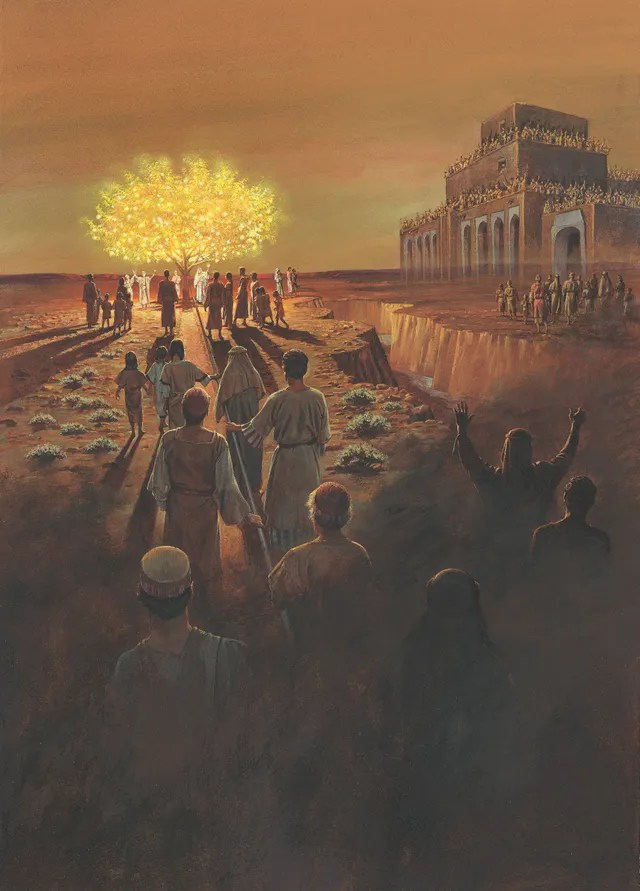
    The first thing I noticed is the location where Lehi starts in his dream. The people he sees later all start at the head of a fountain of water. It could be this is where they started or this is where Lehi first sees them. What seems significant to me is this: Lehi is wandering blindly through the dark and dreary wilderness (verse 4). It is then that Lehi encounters a man dressed in a white robe who bade Lehi to follow (verses 5, 6).

    What I find significant is that later in the dream Lehi beckons Sam, Sariah, and Nephi, along with others, to come to the tree. Where is their man in a white robe? I think what we’re learning here is the significance of prophets in God’s plan. Lehi was led to the Tree of Life, the fruit, the gospel of Jesus Christ by a man in a white robe. Let’s assume the being in the white robe is Jesus Christ Himself (Sidenote: Let’s be clear, in Lehi’s dream I don’t know that the man in the white robe is necessarily Jesus Christ. It could be someone Christ sent like Gabriel or Adam to lead Lehi. But the principle stands and for simplicity, I’ll refer to the white-robed being as Christ). So, Christ leads Lehi to the gospel. It’s then that Lehi guides others there. Not to say that others don’t have a personal relationship with Jesus Christ, just that if we follow the guidance of and heed the prophet, he will guide us to the Gospel of Christ and keep us connected to the iron rod.

    The significance of a prophet is further illustrated by verse 8. Lehi doesn’t encounter Christ and immediately show up at the Tree. He “traveled for the space of many hours in darkness.” I think this represents the trials and tribulations Lehi had to go through. He was scorned, threatened death, and ultimately had to leave his home for his testimony of Christ. Prophets don’t become prophets overnight. They’re often the most persecuted among us. Then Lehi “began to pray unto the Lord that he would have mercy on me, according to the multitude of his tender mercies” (verse 8). It was when Lehi humbly cried out that he beheld “a tree, whose fruit was desirable to make one happy” (verse 10).

    Lehi is led to the gospel. In a way I think he is ordained a prophet in that moment. From there he beckons and leads others to the fruit.

    Another way this can be looked at is that anyone who leads others to the tree of life, like Lehi led his family, can be a type and shadow of Christ. If you are an example to someone of Christ-like love and lead someone to come closer to Jesus Christ, you are acting in the role of the white-robed person, or Jesus Christ. You become a Savior on Mount Zion.

    Another significant feature of Lehi’s dream is the river of water. It can become confusing what exactly the river of water represents if you read Lehi’s dream, then Nephi’s interpretation of it. In chapters 12 and 15 Nephi is clear, the water was filthy and represents the depths of hell (12:16). If you read 11:25 it reads, “the rod of iron…led to the fountain of living waters, or to the tree of life.” I think the significance here is the water is “living water” as it approaches the tree of life. As the water distances from the Tree of Life it becomes filthy. Therefore, at the head of the river, away from the Tree of Life, it was filthy and represented hell.

    Those in the great and spacious building mocked those who sought the Tree of Life. I think one interpretation could be that those in the building were products of ignorance. They knew no better. They were deceived by the “wisdom thereof, the pride of the world.” Laman and Lemuel can not plead ignorance. They had seen an angel (1 Nephi 3). Their father was a prophet. They started from a different point than someone who ended up in the great and spacious building. When Laman and Lemuel denied what they knew and denied all the light they’d been given, they were swept away. To whom much is given, much is required (Luke 12:48). “He who sins against the greater light shall receive the greater condemnation” (D&C 82:3).

    1 Nephi 12:18 “the large and spacious building…is the vain imaginations and the pride of the children of men. And a great and a terrible gulf divideth them; yea, even the word of the justice of the Eternal God, and the Messiah who is the Lamb of God.”

    The gulf that separates the people in the great and spacious building from the Tree of Life is their ignorance, not always of their own fault. Their upbringing might have brought them to the building. They may have been more easily deceived by Satan because of their upbringing and experiences. They may have started with an unfair disadvantage that made them unable to accept the gospel, “a terrible gulf” that made it too difficult to understand “the word of the justice of the Eternal God.” If they only understood how kind and loving their Father in Heaven is, or even that He is their Father, they likely wouldn’t laugh and scoff at those who embrace this great truth and find comfort from this truth.

    That’s why it’s so important that this message is shared with the world.

    This, I believe, is also why we must never judge others. We don’t know the experiences of others. It may be that if we were raised in a certain house, with a certain culture, with a certain understanding, with a certain life, with certain experiences, we would be just like the individual who scoffs at the Gospel. We don’t know the circumstances of someone else. We don’t know why they are the way they are. In their shoes, we may be no different. This is why it is to our greater condemnation to judge others. Don’t judge someone. You can’t comprehend all there is to know about them. Only one person can do that. He will rightfully and righteously judge them.

    Back to Laman and Lemuel and the filthy water that sweeps them away – as said, they are worse off. This is also why those who partake of the fruit and are brought to be ashamed by the scorn of the world “fell away into forbidden paths and were lost.” They didn’t make it to the spacious building. They were lost to wander forbidden paths. Once you’ve tasted the sweet truth of the Gospel of Jesus Christ there is no going back. You can try to go back to the world, but most find they are more lost than ever. There are so many examples of individuals who leave the church but can’t ever really leave it. They become lost, always seeking to find something to fill the void the Church of Jesus Christ left. They can’t fill the void so they end up attacking it.

    11:35 reads, “The multitude of the earth was gathered together; and I beheld that they were in a large and spacious building, like unto the building which my father saw. And the angel of the Lord spake unto me again, saying: Behold the world and the wisdom thereof; yea behold the house of Israel hath gathered together to fight against the twelve apostles of the Lamb.”

    Many of these people are deceived, and therefore they fight against God, unknowingly sometimes. The wisdom and pride of the world can be churches that look at the poor and needy and manipulate them. Or it can be individuals who look at any other church and scoff and mock. Oftentimes, these actions are done in the guise of defending God. More evil has been perpetuated under the guise of doing what’s right than just about anything. God needs us to defend Him by our kind actions and good examples, not by slandering, judging, or hating others. Many today of other faiths openly mock what they don’t realize is Christ’s true and living church. They have been deceived by the wisdom of the world. And in mocking “they never knew Him” (JST Matt. 7:33).

    These are just a few of my thoughts from Lehi’s dream of the Tree of Life. I feel there is so much to learn from this simple story. As with all things in the Book of Mormon, this points to Jesus Christ and helps point me in the direction of trying to be more like Him.

  • Why Polygamy?

    Why Polygamy?

    The question is often asked: Why did God command Joseph Smith to enact the practice of polygamy, or multiple wives.

    The answer is sometimes given that it was for God to raise up righteous seed. to increase the number of children born in the gospel covenant in order to “raise up seed unto [the Lord]” (Jacob 2:30). I will come back to this.

    Another reason that isn’t often spoken of. Joseph Smith’s calling as a prophet was to restore all things. Not some things. Not most things.  All things.

    If a Priesthood power was had or executed in this earth, it was Joseph Smith’s duty to restore it in this, the dispensation of the fullness of times.

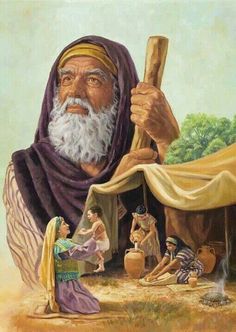
    To many people distraught at the idea of polygamy I would ask, “Do you believe in the Bible? Do you believe in Abraham, the great Patriarch?” How can a practice so wholeheartedly be condemned in the 19th century but be acceptable to you in the past? God is eternal. He doesn’t care about 2000 BC or the 1830s. To Him it is all one eternal round.

    It’s amazing that the staunchest denouncers of plural marriage never speak of Abraham, Isaac, and Jacob. The same Abraham, Isaac, and Jacob whom they pronounce with vigor, “I believe in the God of Abraham, Isaac, and Jacob.” Israel, whom the 12 tribes of Israel come from, exist because of this practice so condemned by modern critics.

    I want to touch back on the “righteous seed” theory. Some I think at least slightly scoff at the idea. It’s such a broad concept that most simple human minds can’t see such a big picture. Couldn’t God raise children to Him in a different way? He’s God, right?

    Maybe.

    But God has always worked through us, here on earth, to do, build, create, and work. He doesn’t magically insert tens of thousands of people because He needs them here. He commands and we either react with faith or with stubbornness.

    I’d like to give a real-life example of this principle of raising seed unto Him.

    I am a descendant of polygamy. Me. Someone you know is here because of this practice. Where would I be if not for this practice? I would have either been born to another family, outside of the covenant, outside of this Church, or I’d still be in line waiting to come to earth.

    I’m grateful for the practice of polygamy. I know it was difficult. I know it was a great test of faith. It was an incredible trial for those who had to live it. Those who endured it faithfully, like my great-great-great grandfather, Benjamin F. Johnson, have blessed me and the life of countless others. I’m grateful to him.

    It is pretty well documented how much Joseph Smith struggled with the principle. He all but avoided it for many years. Do you think Joseph Smith who was already persecuted and hated, driven from state to state, wanted to institute something that would make his enemies more hateful? Do you think he wanted to institute something that gave his enemies more anger and vitriol towards him and the Church? It was hard enough. It was not easy for Joseph Smith to institute polygamy.  Ultimately, he had to learn obedience to all of God’s commands. Even the hard ones. Even the ones he didn’t understand.

    We don’t know exactly why God instituted the practice of polygamy, anciently or modernly. We can guess, we can hypothesize. But like many other principles or workings of God, it comes down to faith. I wouldn’t be here without the faith of someone else who accepted something difficult. It’s a small act of faith on my part to accept and show gratitude for their great faith in times past.

  • Fences or Guardrails?

    Fences or Guardrails?

    I read a book I probably wouldn’t admit willingly reading, except that a cool experience and message came out of it, so here we are.

    That book was called Are Your Standards Fences or Guardrails by John Bytheway. There’s nothing wrong with this book. It’s just… a book I would be embarrassed to read as a kid as much as I was embarrassed to be reading it as an adult. I mean, just look at the cover, I think that says it all. It’s a super uplifting and positive book to help teenagers live morally and with high standards in an increasingly low standard world. If I start a book I’m going to finish it. As with any book, something will be learned from it. This book had a particularly cool experience come from it.

    The cool experience that came from reading this book developed out of a realization that Beth brought to my attention.

    I’ve gotten many of the books I’m currently reading from my grandparents. Many still have the sticker on the inside cover that reads, “Mr. & Mrs. Leach.”  As I was reading this book and wondering, ‘Why am I reading this?’ I noticed, like I often do, where the touch of my grandma was. This book was full of ear-marked pages.

    I mentioned it to Beth. “Here’s evidence of Grandma.”

    Beth asked what year the book was published and I told her.

    Beth wondered out loud, “2003…. So, who would she have had in mind while reading this?”

    My first thought was nobody. Her kids were already grown up with kids of their own by 2003. Then I slowly connected the dots. 2003….I would have been 13…. Oh… Grandma was likely thinking about me (along with others) while she read this. 

    It added some reverence to this book. Here I was approaching 20 years after my grandma read this book with me in mind and I was reading it with my daughter (only Ivy was born when I was reading this) and younger siblings in mind. It’s amazing how life changes. It’s amazing how we change. Every page my grandma ear-marked was for good reason. She had reason to worry about me at that time. At that time, I was on my way to breaking every guideline from that book.

    Here I am 20 years later having the same worries about the younger generation.

    It’s partly why I write all these silly posts. Maybe one day my daughter will read them and have an idea of who I was in 2020, and 2022, and 2025. Because by the time she’s reading this in 2033 I’ll be well on my way to grumpy, old, so-out-of-touch father.

    ***TANGENT*** I already feel that way this weekend playing catchphrase with my 19 year-old cousin and her friend. Did you know a 19-year-old doesn’t remember 9-11? That hit me like a slap to the face, woah! The most impactful and memorable day of my life was not experienced by a generation that is now approaching or already in their 20s! That’s crazy. That same cousin has never seen an episode of Boy Meets World. It’s a crazy thing getting older.

    Anyways, this was less about the book and more about what it made me realize. Life is so fluid. I remember being 15 and being convinced I knew everything. Now I’m in my 30s and realize I know almost nothing.

    Life moves and changes so quickly. It’s an amazing thing. I don’t know what closing or profound thought I have to finish this post. I guess I’ll close with this:  to my 12 year-old daughter in 2033, know I once thought I knew everything and it took many years of stupidity to realize how little I know. It took me a long time to realize the adults around me that I thought were hypocritical, or judgemental, or out of touch, or just trying to keep me from having fun really only ever had my best interests in mind.

    To my two girls: I love you and the adults around you love you. All we’ll ever want is the best for you and to protect you. I promise you that.

  • Chosen by God

    Chosen by God

    I had a thought that never occurred to me before while reading Doctrine and Covenants 138, as obvious as this thought is.

    I believe it’s correct that some of the ancient prophets, Adam down to Joseph Smith and beyond, have resurrected bodies and are in heaven teaching. For some reason I’d only ever thought about them teaching those who had already been on earth and died. For the first time it occurred to me that they might also be teaching those who haven’t come to earth yet.

    This seems to be affirmed by the words of modern prophets, from Doctrine and Covenants Student Manuals:

    “President Joseph F. Smith was shown that many choice servants of this dispensation were also among those noble spirits. The Lord held them in the spirit world where they were taught and prepared to come forth and lay the foundations of His latter-day work. The Prophet Joseph Smith once said that “every man who has a calling to minister to the inhabitants of the world was ordained to that very purpose in the Grand Council of heaven before this world was” (Teachings, p 365).

    “President (Joseph F.) Smith also observed that, in addition to these leaders, there were “many others” who “received their first lessons in the world of spirits and were prepared to come forth in the due time of the Lord to labor in his vineyard for the salvation of the souls of men” (D&C 138:56). This refers to the doctrine of foreordination, which teaches that “in the premortal spirit world, God appointed certain spirits to fulfill specific missions during their mortal lives. … Foreordination does not guarantee that individuals will receive certain callings or responsibilities. Such opportunities come in this life as a result of the righteous exercise of agency, just as foreordination came as a result of righteousness in the premortal existence.”

    “President Russell M. Nelson taught: “Your spirit is an eternal entity. … Your Heavenly Father has known you for a very long time. You, as His son or daughter, were chosen by Him to come to earth at this precise time, to be a leader in His great work on earth. You were chosen not for your bodily characteristics but for your spiritual attributes, such as bravery, courage, integrity of heart, a thirst for truth, a hunger for wisdom, and a desire to serve others. You developed some of these attributes premortally. Others you can develop on earth as you persistently seek them.”

    These are things I’ve known, and thought about, but an encouraging and empowering reminder when the world fights back so aggressively against spiritual things.

    We were chosen before we came. We were potentially tutored by the very greatest prophets and teachers the world has ever seen. The tutoring from great prophets pales in comparison to the reminder that we were chosen by God, the eternal Father. God of Heaven and Earth. Creator of all things. When we remember He chose us for a purpose, and we’re on the Earth now for that purpose, the oppositions of the world should seem silly.

    If I was lucky enough to receive training from a great prophet and was chosen by God before coming here, anything is possible.

  • Meaning in Religious Art

    Meaning in Religious Art

    This was an essay I wrote for a meaning of life through art class I took, thus the official format. I feel it was worth sharing.

    Meaning in Religious Art

                It was with difficulty I prepared to hypothesize about the meaning of life when I believe I know the meaning of life. It occurred to me that if I truly believe I know the meaning of life, and I do believe that, that it would be dishonest to write this essay in any other way than to state what I know in my heart to be true. It’s for that reason that I’ve decided to pick three pieces of artwork; a hymn, a mural, and a piece of literature to give a brief explanation on how those pieces portray what I know to be true about the meaning of life. Given my powerful belief of these principles, and the desire I have to share them in my life, it’s with excitement that I write this essay and explore the meaning of life through art.

    Religion

    It’s important to note that a religious individual cannot begin to explore the topic of “the meaning of life” without their ideologies, beliefs, and understandings that come from their religious upbringing having a huge impact on their exploration. I fully acknowledge that many may disagree with my conclusions and interpretations of these pieces of art. That is what makes art beautiful. Art is completely subjective. My viewpoint on the world will color how I view this art. I look to explore how my viewpoint shapes my perspective on these pieces of art and helps me consider the meaning of life.

    Hymn

                I’d like to start by discussing my favorite hymn which is titled “A Child’s Prayer” (MormonTabChoir, 2014). A main focus throughout this essay will be the emotion elicited through this artwork. I believe that art that makes one ponder the meaning of life is likely evoking strong emotions. I cannot listen to this song without strong emotions welling inside me. I feel a change come over me as I listen to the lyrics, likely because it’s this song I focus on when I most question about the meaning of life.

                “A Child’s Prayer” asks a poignant question: “God, are you there?” That’s the portion I ask myself in difficult times. The song unfailingly leads to the important statement: “Pray, he is there, speak, he is listening” (A Child’s Prayer, 1992). This is an important reminder about life and its meaning. The most important line in this song, and the one that most defines the meaning of life on earth is, “You are his child” (A Child’s Prayer, 1992). The meaning of life is to grow and learn and come closer to our Heavenly Father. This hymn is a powerful piece of art that speaks to the soul and reminds one of things often forgotten, but that will forever be true.

    Mural

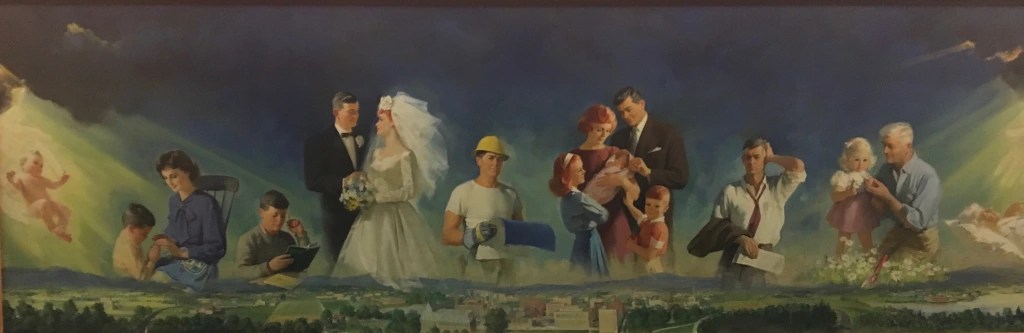
    The second piece of art I’d like to discuss is a mural aptly called, Purpose of Life (Skemp, 1964). Purpose of Life is a simple but compelling representation of the cycles of life and what life is about. Like the hymn, “A Child’s Prayer,” this mural evokes strong feelings within me, and I believe would for anyone who strongly considers its message. 

                The painting starts by showing a child entering the world. There are subtle hands shown coming from the sunlight, appearing to gently lead the child into this life. The depiction follows a young man growing. First, he is at his mother’s side, then reading, and then getting married. These three quick jumps create a feeling inside. As a result, a question develops: is life really that short? The painting continues, showing the boy, now a man, working. The man is shown with his wife and children. The man is shown with graying hair. The man is shown with his grandchild.

                The climax of the painting is the man lying on his deathbed. There is light above him, and the same hands that brought him to earth beckon him home. What could better illustrate the purpose and meaning of life than this painting? The purpose of life is to live, love, grow, learn, and then to come home. As my eyes scroll across the painting, powerful emotions arise. I consider growing up with my family. I consider the family I’ve started. I consider that like everyone before me, my life is heading to the same place, a return trip home. This mural does a fantastic job of illustrating the true meaning of this life.

    Book

    I couldn’t write a paper about the meaning of life without crediting a piece of literature that has given meaning to my life. The Book of Mormon is an entire book that focuses on the question, what is the meaning of life? The Book of Mormon is a piece of literature that literally details the purpose of life (Book of Mormon, 1830). Through my study of it, I have learned many important principles. One of these most important principles that give meaning to my life is that God loves and cares about all people, and that includes me. Others include that God is aware of us and is watching our progress, this life is important and there’s a reason I’m here, and that God keeps His promises. These are the principles that give my life meaning. 

    In a world of chaos and confusion, these basic principles give me hope. They provide light to my world. I simply couldn’t write about the meaning of life without discussing the book that has changed my life, brought me so much comfort, and put me on a path that gives my life meaning and purpose. The Book of Mormon is eloquent in its message and is a powerful work of art that I believe to be from Heaven. I can’t read it without feeling that God is there and being reminded why I’m here. 

    Conclusion

    I am grateful for these pieces of art and the feelings they create inside me. It’s these feelings that tell me there is more to this world than meets the eye and that I’m never alone. Great art provokes thought and emotion. Great art can make one stop and ponder. Great art can make one appreciate beauty and see the world in a different light. As Cooper (2003) says, “art, like philosophy, is the act of bringing truth into being” (p. 109). These three pieces of art, the hymn “A Child’s Prayer, the mural Purpose of Life, and the Book of Mormon, are each art pieces that provide this purpose for me, enlighten my life, and remind me the purpose of being here. I am grateful for art that makes us look beyond ourselves, consider purpose, and even see eternity.