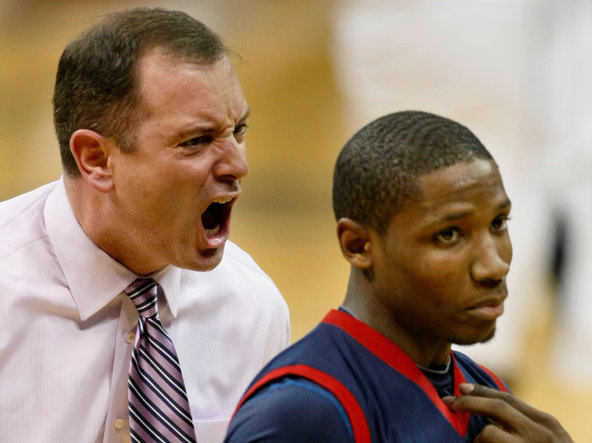
I grew up with a lot of yelling coaches. There’s one in particular I still have nightmares about. He was a coach who communicated in only one way: yelling as loudly as possible. I always had the feeling he hated me. As an adult, looking back, I haven’t gained a new perspective on this. It hasn’t become one of those, “He yelled at me to make me stronger, and he really did care about me.” No. I still think he hated me.
I didn’t respond well to yelling.
One of my concerns when I started coaching basketball 5 seasons ago was how I would handle yelling. As I mentioned in How do we speak to others, I have an inherent aversion to yelling. I didn’t want to yell period, let alone at my girls. I was worried how the girls I coached would respond to me if I wasn’t willing to yell at them. Would they respect me? Could I discipline them?
What I’ve found, and I’m grateful to report, is that in my experience you don’t need to yell at anyone to get them to respect you. A quiet, private chastisement or loving criticism is 1000 times more effective than yelling or publicly embarrassing a player.
There was one game I’ll never forget. We were beating the team badly in the second half, but it hadn’t always been that way. It was a close game through the first half. But as the second half got going, their coach started to get flustered. The coach was yelling at the refs and their players constantly. It was a classic case of a coach losing their cool as the game stayed close. This was obvious from my seat. As the coach yelled at the refs more, their players lost focus and started complaining about the officiating as well. Then the coach started turning their frustration on the players, yelling at them after turnovers or mistakes. I saw their team quickly devolve. Players were throwing their hands up in frustration. After every play, they were looking to their coach to make sure they weren’t about to be yelled at. It reminded me so much of my time playing for my yelling coach.
That was the reason our lead extended in the second half until we were blowing them out. I always wonder how a coach can expect their players to stay calm and composed if the coach themselves is unable to do so.
At one point in that game, when the opposing coach was yelling at one of their players, a player on my team who was sitting next to me on the bench looked up at me and said, “Thank you.” I replied, “What?” and she said, “Thank you for not being like that coach and yelling at us.” That was about the best coaching compliment I’ve ever received.
I explained to that player my coaching philosophy. Yelling doesn’t help. All yelling does is put everyone on edge.
That same player, at the end of the season, gave me a card with a note that read, “Thank you so much for this season. I loved playing with you as a coach, thank you so much for being the coach. I hope you have a great time with your wife and Ivy” (this was before Sage).
If you’re wondering why and how coaching is rewarding, there it is.
So, do I yell? The season from this example (3 seasons ago now), I actually had to apologize to my team on a couple occasions. There were a couple games where I wasn’t proud of how I acted on the bench. I lost my cool, exhibited frustration on the bench, and sometimes yelled. One time I snapped at a player in the heat of a game. I felt really bad about that. I pulled that player aside afterward and apologized. At practice after a game where I got frustrated and started yelling, I explained to the team my philosophy: how can you stay composed if I don’t? I told them I was disappointed in my behavior and planned to be better.
I hope that taught those kids something about accountability. If I don’t hold myself accountable, how should I expect to hold them accountable? I doubt they’d ever had a coach admit to being wrong. I wonder, how can we expect these athletes to respect someone who doesn’t admit when they’re wrong?
One more story from this last season, our first at Notre Dame Prep. We had a really good team this year. We were 15-0 with two games to go. I knew this second to last game would be our toughest test. At halftime, my worries were justified as we were down two points. Throughout the first half I had to constantly reign myself in to keep myself from losing it on my players. They weren’t playing like themselves and I was disappointed. It was only after that I realized they were doing their best, but the lure of that undefeated season had really gotten into their heads. As I was walking from our bench to our locker room, I was prepared go crazy on my team under the guise of lighting a fire under them. If you’ve played serious sports, all these coaching tropes probably sound familiar.
As I walked from our bench, I received wise words from Cameron. He said, “Before you go in there, remember that these girls have never been down at halftime.” He clearly saw in my face what was about to happen in that locker room. I’m glad he did. He saved me from what would have been a mistake. He was right. These girls didn’t need to get more flustered by not only being down at halftime but then getting yelled at in the locker room. How could I expect them to be composed if I wasn’t? Instead, I put a smile on my face, walked in, and told the girls how awesome it was to be in a close game for once. I then got into the things we needed to do better.
Now, our team had some stern halftimes throughout the season. As a coach, you’re perpetually trying to lift your team higher, no matter how much you’re winning by. But, what would I have taught those girls if, in the one game they were losing, I walked in and blew a gasket? I would have taught them the worst possible thing – that habits, and effort, and sportsmanship, and accountability were not as important as winning and losing. That is not a lesson I want to instill in any young person.
As for yelling productively, another fear I had, that didn’t end up being a problem. I used to wonder if I could coach when I don’t like to raise my voice at all. I quickly learned, that in the intensity of a game, I can’t help but raise my voice – to the players on the court, so the ref can hear a question I have, in the huddle over a crowd. This is what I consider productive yelling. My fear of not being able to yell during a game is lost. If anything, I need to tone it down. Those games can get exciting and intense and sometimes I’m tempted to run to half-court in the middle of a play to call a timeout because the ref won’t look at me (that happened).
Productive yelling is good. Yelling to try to demean a player or to get their respect is not. Especially when that yelling is insulting or embarrassing, which it often is. I didn’t respond well to yelling when I played and it’s my experience that a lot of kids don’t.
Winning is fun, but it’s not our primary goal as a coaching staff. These girls will all go on to have jobs, be professionals, get married, have kids, and do all the things that make this life rewarding and challenging. Our primary goal as a coaching staff is to prepare our student-athletes to be prepared for life. Basketball will pass. But learning to keep your cool under pressure, have confidence, do your best, and treat and speak to people with respect will better them for life.



 No Coincidences