Tag: Adam and Eve

  • Pondering on Death, Eternity, Growth, and Mortality

    Pondering on Death, Eternity, Growth, and Mortality

    Emma Smith, the wife of the prophet, was once given a promise that is worth pondering.

    Emma had a 14-month-old child die.

    As a father of three, the thought is unimaginable. Reading through the list of Smith children that died in infanthood is heartbreaking.

    According to Alexander Smith, Emma’s son who made it to adulthood, shortly before her death in 1879 she had a vision where Joseph Smith visited her and promised her she would raise all her children who had not lived to adulthood after her mortality ended.

    What are the implications of this?

    I believe what can be gleaned from this is powerful, comforting, and gives a look into the truly magnificent love and power of a Father in Heaven. I believe the truths restored by Joseph Smith to be awe-inspiring. I believe the truths revealed by Joseph Smith should be awe-inspiring if he truly was a prophet of God. I believe that to be truth.

    I’ve read near-death experiences that describe young children playing in heaven. I still wonder about, and don’t comprehend, age, mortality, “childhood and adulthood”, maturity, time, and the importance of our bodies.

    Those categories: age, mortality, childhood and adulthood, maturity, time, and our bodies seem like a wide-ranging and somewhat unrelated group of topics.

    But what was shared with Emma Smith makes those topics intertwined.

    What is age? In mortality, I am 30 years older than my children. But in the eternities their spirits are eternal, they never had a beginning. Who I am to say that I am any more “mature” than my two sweet daughters? My two young girls teach me and inspire me daily. I believe I came to earth before them to guide them, lead them, watch over them – a great and marvelous calling and responsibility – but they’re also here to guide, lead, and watch over me. It’s the great circular of life (not to be confused with, though very similar to, the Circle of Life in the Lion King).

    In this sense, what is childhood and adulthood?

    It is one eternal round.

    But that experience – of me raising my children and the humility that brings – and my children being raised – and the humility that takes – clearly has significance and importance to our eternal progression. This explains why Emma was given this promise that she would one day raise the children she lost. She missed that opportunity, but in God’s Plan, nothing is truly missed. It’s all one eternal round. It all comes back. This should be a great comfort to anyone who has lost any loved ones, to anyone who’s felt they missed any mortal opportunity – to raise children, get married, or have any mortal experience – this should be a great comfort to all.

    Another significant message to take from this vision given to Emma is the importance of the family unit. Just because Emma’s children died as infants didn’t mean they weren’t her children. They would always be her children. She would always be their mother. The family unit is important. The family unit is eternal.

    I’ve touched on age, mortality, childhood and adulthood, maturity, and time – 5 of the 6 seemingly random topics. What of our bodies?

    Our bodies have eternal significance and their growth has eternal significance. We can not be like our Father in Heaven until we are resurrected and have bodies like His. I’ve been pondering on this a lot lately. The elements are eternal. Element can not be destroyed. When God created Adam and Eve’s bodies from the dust of the earth, He was taking eternal element and making a tabernacle for them. Our eternal spirits are housed in eternal element. There is something extraordinary and significant about our bodies. We cannot be properly resurrected beings, we cannot be like our Heavenly Father, without attaining our bodies.

    After our resurrection we will attain our bodies for the rest of eternity and therefore be more like our Father.

    Finally, the biggest thing to take away from Emma’s experience is how ignorant we are of the complete workings of God. We can rest assured that a perfect and all-loving Father in heaven will make ALL things right. Every last item that is a concern to us – death, raising children, marriage, relationships, family – all of it will be understood and made right in a perfect way.

    I have no doubt that my Heavenly Father, and your Heavenly Father, loves all of us in such a deep and incomprehensible way. I have faith in His love and His character. I have faith in His Plan. I know all our concerns are but the concerns of a child wanting a chocolate bar at a store. The child can’t see the grand scheme and can’t see how the world can be right while leaving the store without a chocolate bar. One day our eyes will be opened and we will see that the chocolate bar wasn’t as important as we thought, for our Father had created a plan to give us all the chocolate our heart could desire.

    If we follow Him and trust Him, it all will be made right.

  • Adam-God Theory

    Adam-God Theory

    I’ve heard of the “Adam-God Theory” but never looked into it. Until recently, I really didn’t know what exactly it referred to. Here is my research into the Adam-God theory for those interested and especially for those who may have concerns about this theory and its history in the restored Church of Jesus Christ.

    Before I begin, almost all my thoughts come from this link:

    https://www.fairlatterdaysaints.org/answers/Mormonism_and_doctrine/Repudiated_concepts/Adam-God_theory#Question:_What_is_the_Adam-God_Theory.3F

    It was a great resource on this topic and I recommend it if you want to learn more.

    If you want a quick, short video that sums up the whole history of the Adam-God theory, watch this video:

    Now, my thoughts.

    The Adam-God theory is the theory that Adam and God the Father are the same person. This theory was mentioned by Brigham Young.

    First – Adam is not God the Father. Adam is not who we pray to. This does not fit the teachings of the scriptures, does not fit modern revelation, is not a doctrine of the restored gospel. So why are we talking about it, you ask?

    Second – Yes, Brigham Young did make some bold statements about Adam being God. He also made countless statements contradicting that statement. Brigham Young was a convert and a prophet. Try to imagine the dichotomy of those positions. Try to imagine someone a few years into the faith trying to lead the entire church. Is it so shocking that there were erroneous statements made, especially when we consider and understand the personality and boldness of the prophet who led the saints across the rugged wilderness of the West?

    Third – Because Brigham Young made incorrect statements does not mean he was a false prophet. It means he was learning line upon line, and he made false statements. He has made statements to try to help us, the people of the church, reconcile some of his more questionable comments. For example, when speaking generally about who Adam was and proposing some thoughts about Adam, Brigham started by saying, “I propose to speak upon a subject that does not immediately concern yours or my welfare….I do not pretend to say that the items of doctrine and ideas I shall advance are necessary for the people to know, or that they should give themselves any trouble about them whatever.. (Brigham Young, Oct 8, 1851). If it does not concern our welfare, don’t get too hung up on it. The church was young and growing when Brigham was prophet. God has always worked through us, mortals, to fulfill His works. This has always resulted in fallibility. Brigham Young was a prophet, even if he made mistakes in the thousands of public discourses he gave during his learning period as a prophet/convert.

    Fourth – Because prophets are fallible does not mean we cannot trust and follow them. As The Church has grown out of its infancy, it has strengthened itself in countless ways. One of those strengths has become the checks and balances of the church organization. The First Presidency and Quorum of the Twelve Apostles must be unanimous in any declaration of doctrine. President Nelson speaks hundreds of times a year. Not every word from his mouth (in my opinion) is scripture. It is guidance and direction from God’s anointed prophet, yes, but not scripture. But when President Nelson, the First Presidency, and the Quorum of the Twelve sign their names to a declaration, it becomes binding guidance on doctrine, church policy, etc. Such was the case with “The Family: A Proclamation to the World” for example.

    Now, the statement made by Brigham that when Adam and Eve came to the Garden of Eden they already had celestial, resurrected bodies is interesting. I more think they came with perfect bodies as they came directly from the Father and hadn’t yet been corrupted by the fall, not that they were necessarily resurrected bodies yet. Celestial, maybe, resurrected, I don’t think so. That’s all I will say on this matter, though, to support my point earlier that things that distract from our salvation should be discussed with caution. I haven’t done enough research, pondering, or praying to comment on this with much confidence and would hate for my children 150 years from now to claim I believed Adam was already resurrected when put in the Garden of Eden. See how these small comments can be blown out of proportion? Grateful I’m not a prophet.

    Another thought – the eternal nature of the plan of happiness is not something we can begin to comprehend. If it ultimately distracts us from our current efforts towards salvation, we should tread with ultimate caution. Such is the thinking about if Adam lived on another planet before he came here and countless other thought experiments that might distract from what is important, which is, Jesus Christ performed the ultimate atoning sacrifice for my sins. He died so that I can live. He suffered so I can be forgiven and can live with God, my Father, again. All other questions, while interesting and can expand our minds and thinking, if they distract from the ultimate source of our salvation – the Plan of Salvation and Christ’s personal role in it for us – should be avoided.

    Those are my thoughts on this from my research. Here are some final items to really, I hope, put this theory and any issues involved with it, to rest.

    As mentioned, Brigham contradicted himself many times on the idea that Adam was God. While he mentioned the idea a couple times in public, there are many other instances of Brigham Young speaking where he clearly separated Adam and God the Father as two separate individuals.

    BYU professor Stephen E. Robinson sums it up well:

    “Yet another way in which anti-Mormon critics often misrepresent LDS doctrine is in the presentation of anomalies as though they were the doctrine of the Church. Anomalies occur in every field of human endeavor, even in science. An anomaly is something unexpected that cannot be explained by the existing laws or theories, but which does not constitute evidence for changing the laws and theories. An anomaly is a glitch…. A classic example of an anomaly in the LDS tradition is the so-called “Adam-God theory.” During the latter half of the nineteenth century Brigham Young made some remarks about the relationship between Adam and God that the Latter-day Saints have never been able to understand. The reported statements conflict with LDS teachings before and after Brigham Young, as well as with statements of President Young himself during the same period of time. So how do Latter-day Saints deal with the phenomenon? We don’t; we simply set it aside. It is an anomaly. On occasion my colleagues and I at Brigham Young University have tried to figure out what Brigham Young might have actually said and what it might have meant, but the attempts have always failed. The reported statements simply do not compute—we cannot make sense out of them. This is not a matter of believing it or disbelieving it; we simply don’t know what “it” is. If Brigham Young were here we could ask him what he actually said and what he meant by it, but he is not here…. For the Latter-day Saints, however, the point is moot, since whatever Brigham Young said, true or false, was never presented to the Church for a sustaining vote. It was not then and is not now a doctrine of the Church, and…the Church has merely set the phenomenon aside as an anomaly.”

    From the link above previously mentioned:

    “As far as can be determined, none of Brigham Young’s successors in the presidency of the Church continued this teaching in public, and by the presidency of Joseph F. Smith (1901–18) there were active moves to censure small groups that taught Adam-God.

    One of the earliest statements from the Church rejecting Adam-God teachings was made by Charles W. Penrose in 1902:

    The Church of Jesus Christ of Latter-day Saints has never formulated or adopted any theory concerning the subject treated upon by President Young as to Adam.

    In October 1976 general conference, Spencer W. Kimball declared the Church’s official position on Adam-God:

    We warn you against the dissemination of doctrines which are not according to the Scriptures and which are alleged to have been taught by some of the General Authorities of past generations. Such, for instance, is the Adam-God theory. We denounce that theory and hope that everyone will be cautioned against this and other kinds of false doctrine.‘”

    Other statements by future general authorities refuting Brigham Young’s opinions:

    Bruce R. McConkie – “What I am saying is that Brigham Young, contradicted Brigham Young, and the issue becomes one of which Brigham Young we will believe. The answer is we will believe the expressions that accord with the teachings of the Standard Works.”

    And Brigham Young himself – “I am more afraid that this people have so much confidence in their leaders that they will not inquire for themselves of God whether they are led by Him. … Let every man and woman know, by the whisperings of the Spirit of God to themselves, whether their leaders are walking in the path the Lord dictates, or not.”

    Finally, while some might consider everything said here to be a sign that the church changes and is “wrong,” I would completely refute that. The church is changing. The church is growing. The church is living.

    Doctrine and Covenants 1:30 is Christ speaking and reads “And also those to whom these commandments were given, might have power to lay the foundation of this church, and to bring it forth out of obscurity and out of darkness, the only true and living church upon the face of the whole earth, with which I, the Lord, am well pleased, speaking unto the church collectively and not individually.”

    While so many would criticize the Church of Jesus Christ of Latter-day Saints for changing, the Lord describes it as living. The only living church on the face of the earth. This is a power of Christ’s church- not a weakness.

  • Black and White and Adam and Eve

    Black and White and Adam and Eve

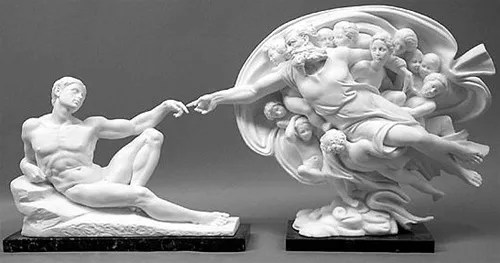
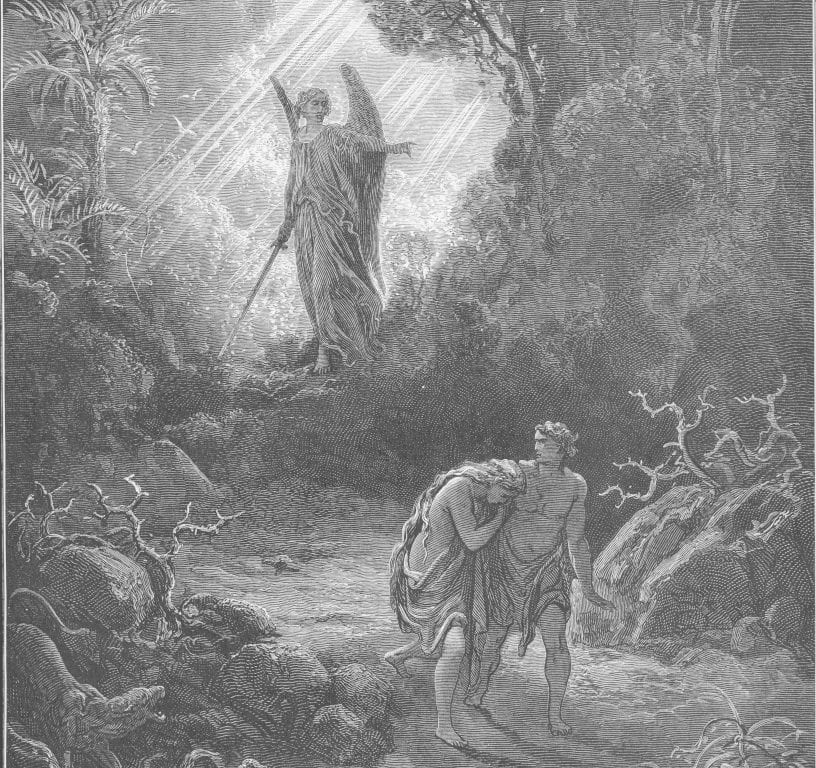
    In the Garden of Eden Adam and Eve were given two commandments.

    1. Multiply and replenish the earth.
    2. Do not eat of the Tree of the Knowledge of Good and Evil.

    In the church we are familiar with this dichotomy. Commandment one could not be completed without disobeying commandment two. What were Adam and Eve to do?

    I recently read a classic short story called The Invisible Collection from Out of the Best Books Volume 1 (p. 329). This short story was in a section titled “Good Versus Evil.”

    In this short story, an art shop owner/dealer learns of a patron of his art shop, which his father and grandfather ran before him, that had been a client for nearly 60 years. He decides to go visit this client to see his collection and see if he might be able to purchase some of it back from him. The client had been collecting for 6 decades and the pieces he bought for cents were now worth a fortune. This story was set in Germany after the war. Inflation was ravaging the country.

    The art dealer visited the modest home of this art collector, only to learn that the art collector that had purchased hundreds of paintings, drawings, and art pieces from his shop was blind. This art collector hadn’t always been blind, he had become blind after the war. Our main character, the art shop owner, learned that this now very old man still daily pulled out the many portfolios he had collected and went through each piece one by one. He used his memory to see every detail he had spent countless hours admiring when he still had his vision. His art collection, even blind, was his greatest treasure.

    When our shop owner arrived at the home, he was immediately pulled aside by the wife and daughter of this old man. They told him the truth before he could cry out in astonishment in front of the old man. In order to survie they had been selling the art pieces for years. The husband of a second daughter of the old art collector had been killed in the war and she was left with 4 young children to feed. The family was barely getting by, barely surviving. They sold these priceless art items to survive. They replaced the real art with papers to fool the old man. They never told the old man because, understandably, they didn’t want to break his heart.

    This story really made me think.

    Lying is bad, right? And yet, in this story, the family of the old man had to lie, didn’t they? Or did they?

    Multiply and replenish the earth, but don’t eat from that tree. Many things in this life are not black and white. There isn’t a “right” or “wrong” answer to every question. There’s a lot of gray area in this life. That’s the point, though. God wants us to learn in this life to be wise stewards. He wants us to learn to make decisions for ourselves, to learn and grow from our choices.

    “nevertheless, thou mayest choose for thyself, for it is given unto thee”

    Moses 3:17

    God is teaching us to be rulers in this life. God wants us to learn good from evil. He wants us to learn to follow the promptings of the Spirit (truth) and learn to follow that guidance. He wants us to take many options and make the best choice. He wants us to learn how to evaluate what is best to do, then do it.

    Being worthy is receiving something, putting it into your life, and acting upon it. As we prove ourselves worthy God gives us bit by bit more, and we grow step by step. That is what God is teaching us in this life. Worthiness, righteousness, freedom of choice, and stewardship.

    So, in this light, that we’re daily being tutored by God for greater purposes, how are our daily choices?

  • Beth’s Talk on Mosiah 3:19 (January)

    Beth’s Talk on Mosiah 3:19 (January)

    This is a talk, exactly as written, by Beth, that she gave in church in January. She rehearsed the talk verbally to me multiple times before I heard it in church. Of course, through hearing it I knew it was a great talk, but it wasn’t until proofreading and preparing to post this that I was struck by how phenomenal a talk this really was. Hope you enjoy reading it as much as much as I did. And now, Beth –

    Mosiah 3:19 Talk
    January 9, 2022
    Good morning brothers and sisters.
    I wanted to start by introducing my family as we are one of the families that were blended into this ward with the recent changes in the stake. My name is Elisabeth Quackenbush. My husband is Brayden Quackenbush. We met in the Scottsdale Young Single Adult Ward in 2017 and have been married for over 2 years. We have a one year old daughter named Ivy. You’ll see her running around Sunday School for another 5 months but she is very excited to start nursery after that.

    The topic I was given to speak on this morning is the scripture Mosiah 3:19. When I was informed this was my assignment I wasn’t really surprised. This scripture comes into my mind a lot and is brought up in conversations about life all the time when I’m chatting with my husband. I think it sticks in my mind because it stands in such contrast to a lot of the attitudes of the world these days.

    For those of you that memorized scripture mastery back in the day you may remember this scripture, but as a reminder, this scripture is King Benjamin speaking to his people in the Book of Mormon. It reads,

    “For the natural man is an enemy to God, and has been from the fall of Adam, and will be, forever and ever, unless he yields to the enticings of the Holy Spirit, and putteth off the natural man and becometh a saint through the atonement of Christ the Lord, and becometh as a child, submissive, meek, humble, patient, full of love, willing to submit to all things which the Lord seeth fit to inflict upon him, even as a child doth submit to his father.”

    When we break down this verse, we can derive meaning in a variety of ways. The first that I noted is that the natural man is inherently selfish. The second is the importance of change to the Eternal Plan of Happiness.

    Boyd K Packer stated in his 1990 talk, “Put Off the Natural Man, and Come Off
    Conqueror”:
    “Unchecked selfishness [of the natural man] stubbornly blocks the way for developing all of the divine qualities: love, mercy, patience, long-suffering, kindness, graciousness, goodness, and gentleness. Any tender sprouts from these virtues are sheared off by sharp selfishness. Contrariwise, I cannot think of a single gospel covenant the keeping of which does not shear off selfishness from us.”

    Through the influence of the Holy Ghost, and the atonement of Jesus Christ, we can and should change from the narrow focus of the natural man and become, “submissive, meek, humble, patient, full of love, and willing to submit to the will of God.”

    This idea of our ability and strength to change stands in stark contrast to the pervasive attitude of our society. This attitude states that we are born a certain way. We can’t change, and even shouldn’t want to change. If we do change, we are inauthentic. On the surface, this has a false sense of empowerment, I think. However, this idea that change is bad and that we must only be one way for the rest of our life is truly limiting, almost an eternal purgatory of mediocrity. Compare this to the freedom and growth permitted to us through Jesus Christ’s suffering, that we may improve and become like our Heavenly Father and Savior, Jesus Christ.

    My husband and I have had the opportunity to have many deep, religious
    conversations with friends of a variety of backgrounds. We often come across
    criticism of our faith’s belief that we can take steps, including repentance, baptism, and participating in temple ordinances, to change and become like God. We are accused of valuing works and forgetting the grace provided through Jesus Christ. On the contrary… His grace is the key element that permits us TO become new beings.

    In 2 Corinthians 5:17 we read, “Therefore if any man be in Christ, he is a new
    creature: old things are passed away; behold, all things are become new.”

    Brad Wilcox does a beautiful job in his BYU talk, “His Grace is Sufficient” at outlining how the Atonement of Jesus Christ, through His death and resurrection, provides us the need to change… (forgive me for this lengthy quote but as many of you know, this talk is incredible…)

    “[Yes, we are saved by Grace but] Have you been changed by grace? [We] are so excited about being saved that we are not thinking enough about what comes next. We are so happy the debt is paid that we may not have considered why the debt existed in the first place. Latter-day Saints know not only what Jesus has saved us from but also what He has saved us for.

    “A life impacted by grace eventually begins to look like Christ’s life. While many Christians view Christ’s suffering as only a huge favor He did for us,
    Latter-day Saints also recognize it as a huge investment He made in us.

    “As Moroni puts it, grace isn’t just about being saved. It is also about becoming like the Savior. The miracle of the Atonement is not just that we can live after we die but that we can live more abundantly. The miracle of the Atonement is not just that we can be cleansed and consoled but that we can be transformed.“

    Again, just think for a minute… how does that compare to what we are being taught by the world? I can’t change, I shouldn’t change…

    HOW DO WE PUT OFF THE NATURAL MAN AND BECOME LIKE CHRIST?

    We can actively seek this positive change…

    In her 1998 BYU Speech, Wendy Watson, now well known as Wendy Nelson, lists some ways. One is reflection. She notes how Alma directs this type of reflection:

    “Just how does Alma invite these change-inducing reflections? One way is through his use of questions. In Alma 5 alone, more than 40 questions are offered—questions like:
    Have ye received his image in your countenances? Have ye experienced this mighty change in your hearts? . . .
    . . . If ye have experienced a change of heart, and if ye have felt to sing the song of redeeming love, I would ask, can ye feel so now?‘ [Alma 5:14, 26]. Through the process of persistent questioning, Alma invites us to reflect over and over again: on our status with the Lord, on our spiritual growth and development, on things that need to change or have changed—and before we know it our desire for more change increases.”

    Another idea is to listen to the uplifting voices of authority in your life remembering, “As helpful as human voices of authority are, none can or should replace the ultimate voice of authority—the Word himself: the Savior Jesus Christ. What are you doing to hear his voice in your life? What are you doing to establish his voice as the voice of authority for you?”

    Other ways we can develop this change to become more like Him… Consistently and earnestly repent, seek out holy places, take steps of faith, pray to Him daily.”

    Sometimes change finds us…whether it be through loss, grief, depression, or trials in life, change is often thrust upon us in this mortal life. Again, the world finds few answers as to why there is such suffering and grief in the world. His eternal plan of growth and development is sometimes the only answer that makes sense. If we are to become like Christ, our innocent brother that felt all the sufferings of the world, how can we expect to be truly changed without some suffering of our own?

    Peter in speaking of [trials], said: “Beloved, think it not strange concerning the fiery trial which is to try you, as though some strange thing happened unto you: But rejoice, inasmuch as ye are partakers of Christ’s sufferings; that, when his glory shall be revealed, ye may be glad also with exceeding joy.”

    When we endure this life, put off the natural man, and develop into more Christ-like beings, we set ourselves up to feel an even greater degree of joy in this life and in eternity.

    This topic makes me think of a time when I came back to church after living a life that was not in line with what I knew to be right. I made many positive changes when I started coming back and attending the Scottsdale Young Single Adult ward. I starting observing the sabbath day, stopped a lifestyle of college partying, broke off a serious relationship, and made several other difficult but important decisions.

    However, with all this positive change and shunning of the enticings of the natural man, I still felt like I wasn’t receiving the blessings I thought I would. I wallowed in self pity over my own suffering for a while because of this and even wondered if all of my change was for nothing.

    However, I eventually decided I would stop focusing on what I needed and instead turned outward. I made it my mission to seek anyone in my ward that seemed lonely as I was. I sought opportunities to serve those that were also going through a variety of trials. And a miracle happened! The less I focused on my pain, my loneliness, my loss, and focused on loving those around me as Christ did, I really came to find true joy.

    I couldn’t believe how sincerely I loved everyone around me. I didn’t feel lonely. I developed new, Christ-like attributes. And ultimately, I shunned the ultimate trait of the natural man – selfishness. What a blessing that lesson was for my life.

    I know how hard it can be to put off the feelings we have as humans in a difficult mortal journey. It is something we will actively have to work for as long as we live. However, I know that when we let ourselves change and take on the characteristics of Christ we will prepare ourselves to find real joy in eternity. We will truly have cause to rejoice in his second coming.

    I say these things in the name of Jesus Christ, amen.

  • Blessing Ivy

    Blessing Ivy

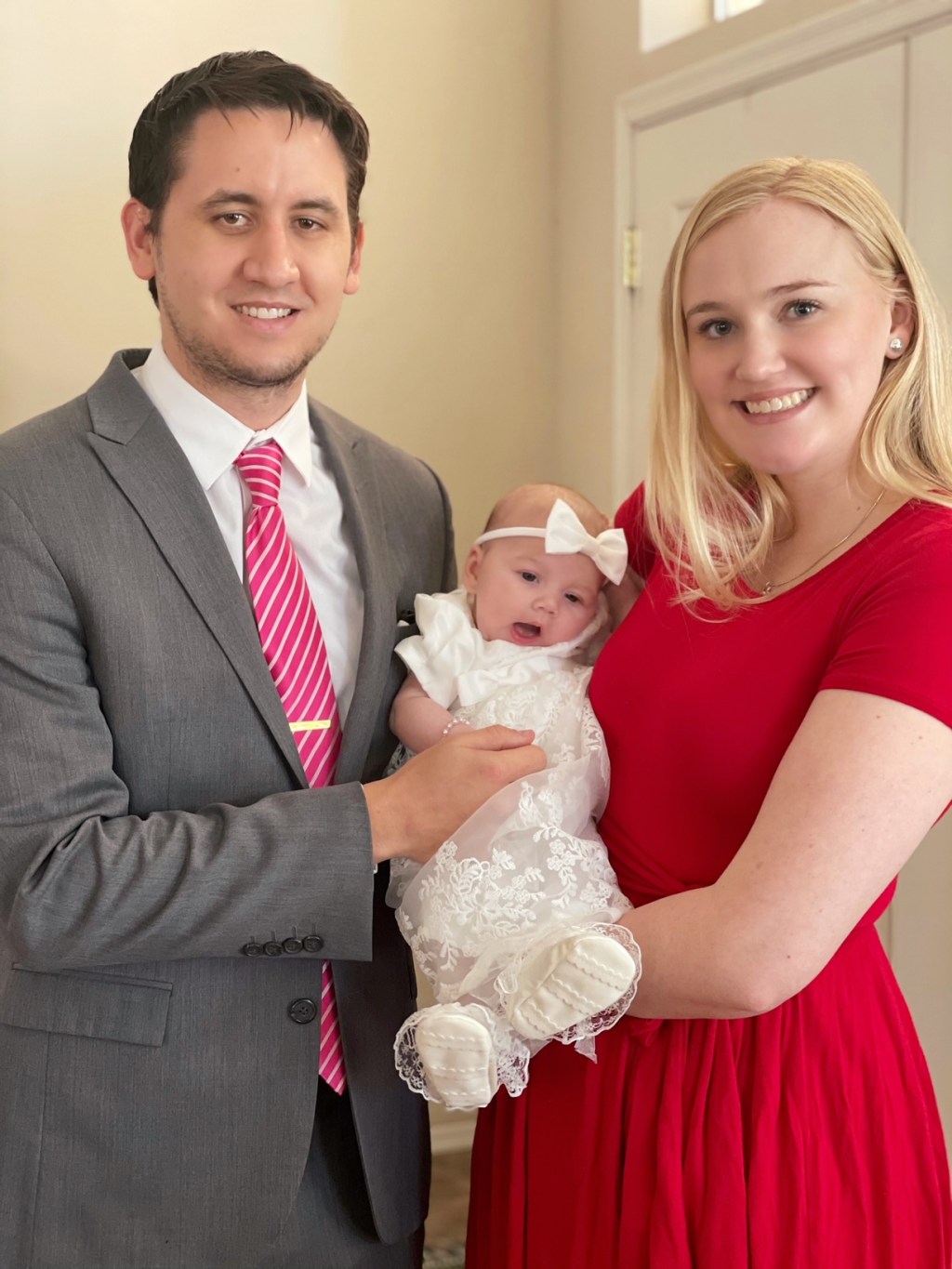
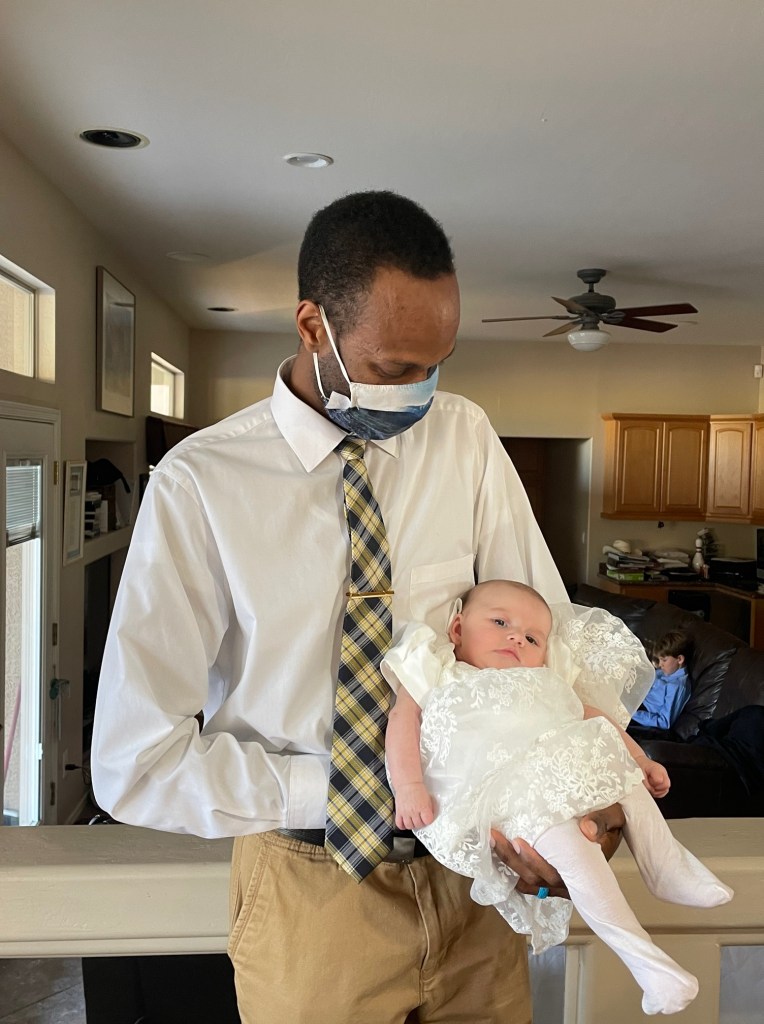
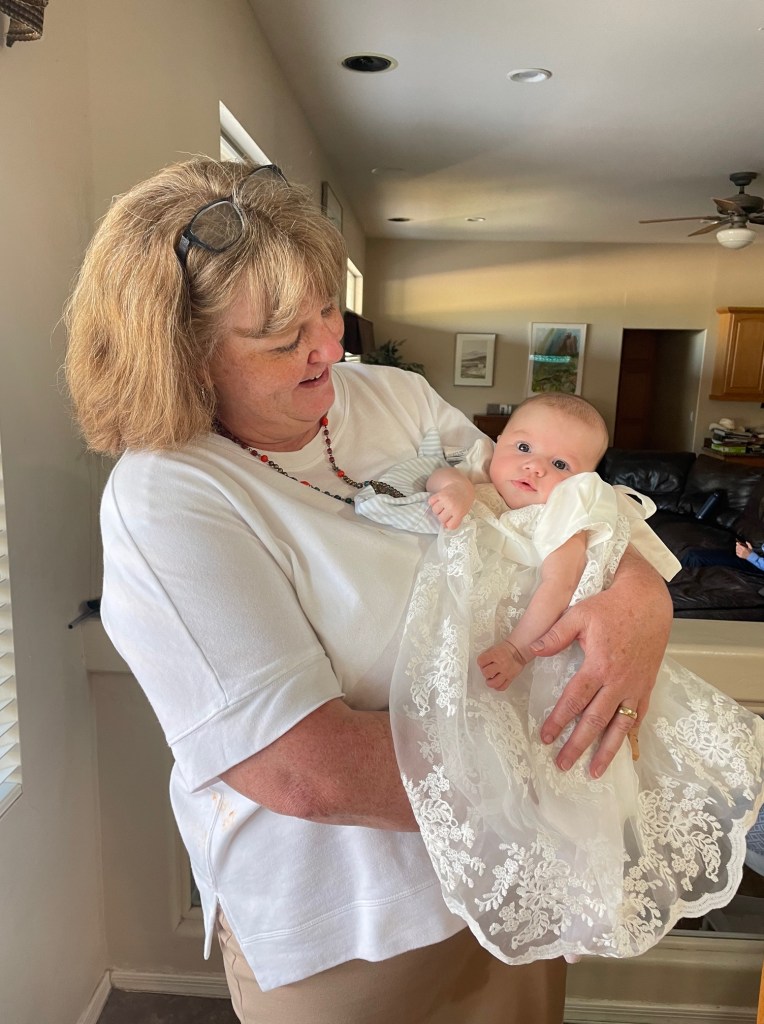
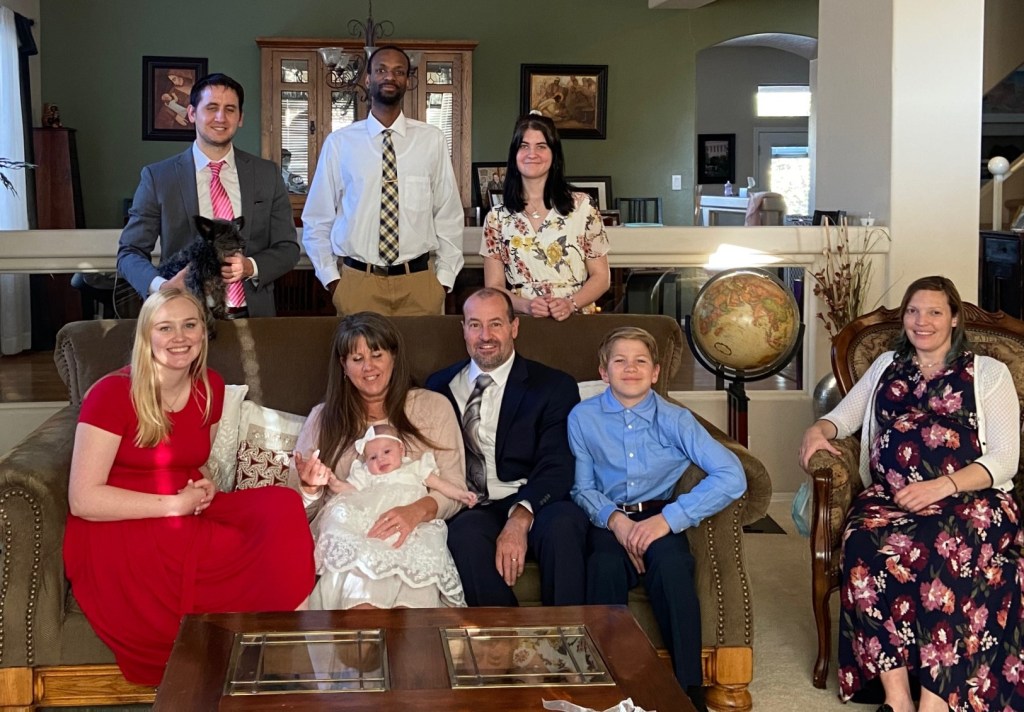
    I recently had the special opportunity to bless Ivy.  Leading up to the blessing, I did some research on the history of blessing children in the Church of Jesus Christ and its significance.  For Ivy’s blessing, Beth put together an event and a description of what a baby blessing is.  Here is that description:

    What is a baby blessing?

    In summary, the naming and blessing of children is a commandment of God. It is proper for a worthy father to name and bless his children. Blessing of children was done during the time of Christ, and it occurred in the early years of the restored Church. The ordinance has become a regular practice followed by Church members ever since.

    Who has the authority to bless a baby?

    A worthy priesthood holder under the direction of the local bishop. It is usually the father or a close family member.

    What is the priesthood?

    The word priesthood has two meanings. First, priesthood is the power and authority of God. It has always existed and will continue to exist without end. Through the priesthood, God created and governs the heavens and the earth. Through this power, He exalts His obedient children, bringing to pass “the immortality and eternal life of man.”

    Second, in mortality, priesthood is the power and authority that God gives to man to act in all things necessary for the salvation of God’s children. The blessings of the priesthood are available to all who receive the gospel.

    What is the format of a baby blessing?

    When blessing a baby, priesthood holders gather in a circle and place their hands under the baby. When blessing an older child, brethren place their hands lightly on the child’s head. The person who gives the blessing:

    1. Addresses Heavenly Father.

    2. States that the blessing is performed by the authority of the Melchizedek Priesthood.

    3. Gives the child a name.

    4. Gives words of blessing as the Spirit directs.

    5. Closes in the name of Jesus Christ.

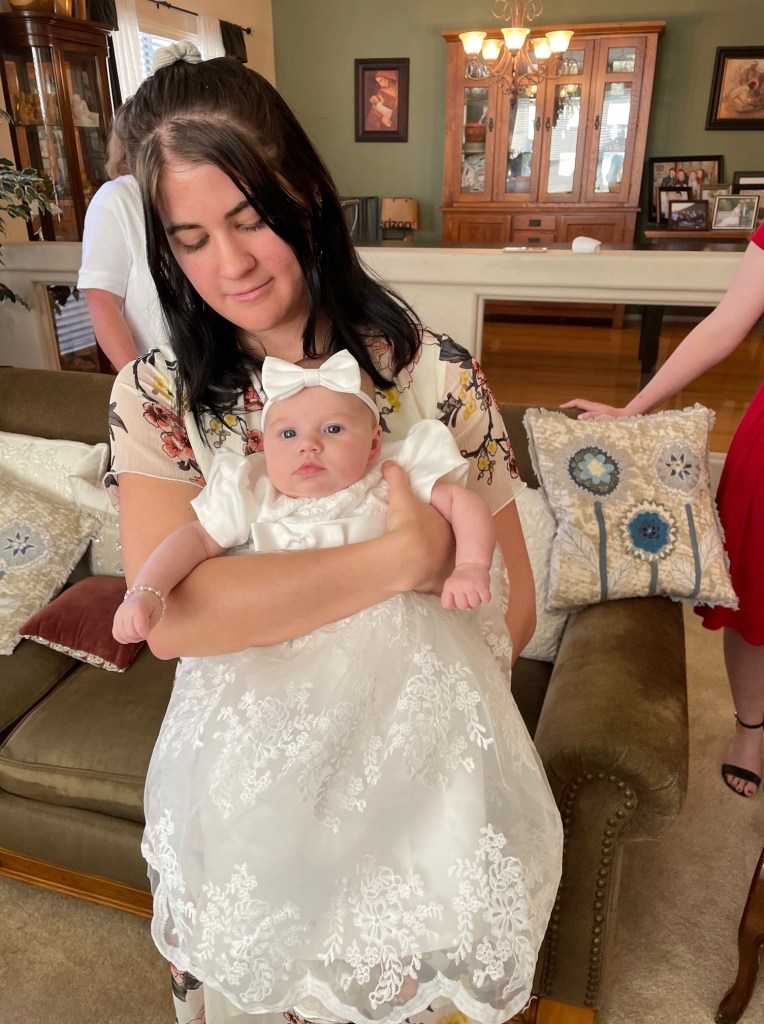
    Ivy and Aunt Cambria

    Reading up on the baby blessing beforehand taught me some interesting things about this sacred practice that I would like to share.

    The below points were taken from this link:

    https://www.churchofjesuschrist.org/study/ensign/1979/12/i-have-a-question/in-blessing-an-infant-should-both-the-naming-and-blessing-be-addressed-to-our-heavenly-father?lang=eng

    1. Unique to giving a blessing to an older child or adult, the naming and blessing of a child is directed to Heavenly Father like prayers are. 
      • This could be because the baby is too young to understand the words directed to him or her. 
    2. It appears that Melchizedek Priesthood holders are authorized to more than ask for a blessing but are able to pronounce a blessing upon the child directly, as the spirit directs.
      • See D&C 20:70
      • Sometimes inspiration (or confidence) to pronounce/give a blessing does not come.  In this case it is of course acceptable to ask Heavenly Father for these blessings.  I believe this is how I felt in giving Ivy her blessing.  It was enough to ask Heavenly Father to bless her with my requests.
    3. It is a commandment to name and bless infants.
      • See again D&C 20:70
      • It is important to remember the naming and blessing of children is not a saving ordinance.  It is still an important and sacred moment seen in heaven.
    4. “It is an awesome responsibility to be a priesthood agent of the Lord, to act in his behalf, and to approximate in one’s words and doings what the Lord would do if he were here.  A father, especially, who is to bless his child, has the delight and responsibility to prepare himself beforehand by pondering and by fasting and prayer, that he may be sensitive to the suggestions of the Spirit when giving the blessing.”
      • “How blessed we are to be able to present our little ones before the Lord, our families and the Church, and then consecrate them to the Lord.  How blessed we are to be able to name them, plead over, pray for, and, yes, to bless them directly and personally in harmony with our finest desires for them, by the authorization and wisdom of heaven.”

    The below points were taken from this link:

    https://www.churchofjesuschrist.org/study/ensign/1988/12/i-have-a-question/why-is-the-naming-and-blessing-of-a-child-important?lang=eng

    1. An interesting account from Joseph Smith on March 13, 1843 says, “Twenty-seven children were blessed, nineteen of whom I blessed myself, with great fervency.  Virtue went out of me, and my strength left me…”
      • “[The next day] Elder Jedediah M. Grant enquired of me the cause of my turning pale and losing strength last night while blessing children.  I told him that I saw that Lucifer would exert his influence to destroy the children that I was blessing, and I strove with all the faith and spirit that I had to seal upon them a blessing that would secure their lives upon the earth; and so much virtue went out of me into the children, that I became weak, from which I have not yet recovered; and I referred to the case of the woman touching the hem of the garment of Jesus. (Luke 8).” (History of the Church, 5:303.)
      • Elder John Taylor said the Savior’s example of blessing children “should be studiously complied with without hesitancy or objection” (by priesthood holders).
      • We see that Joseph Smith followed the example of the Savior who blessed children in both Israel and the American continent.  (Mark 10:14-16 and 3 Nephi 17).  What an amazing and marvelous thought:  our virtue can be passed to our children.  Our blessings are a force Satan must reckon with.  It makes me want to bless my daughter daily.  It also adds insight to a scripture that has always been a bit puzzling in Luke 8:46.  Virtue can literally leave us to help others.
    2. The new name:
      • A new name is often involved when a covenant relationship is formed.
      • When Adam and Eve were given dominion over the earth, Adam named all the animals (Genesis 2:19-20).
      • God blessed them and named Adam after giving him a body (Genesis 5:2).
      • When we get baptized we follow a similar pattern, taking upon us a new name, the name of Christ.
      • Temple covenants also involve the giving and receiving of names.
    3. The responsibility of blessing a child is bestowed, ideally, on he who helped create that child’s body, and who Heavenly Father entrusted His child with in mortality.
      • Joseph F. Smith – “The patriarchal order is of divine origin and will continue throughout time and eternity.  There is, then, a particular reason why men, women, and children should understand this order and authority in the households of the people of God and seek to make it what God intended it to be, a qualification and preparation for the highest exaltation of his children.  In the home, the presiding authority is always vested in the father, and in all home affairs and family matters there is no other authority paramount…This authority carries with it a responsibility, and a grave one, as well as its rights and privileges, and men cannot be too exemplary in their lives, nor fit themselves too carefully to live in harmony with this important and God-ordained rule of conduct in the family organization.”

    It is my experience that giving blessings is often the closest I ever feel to Heavenly Father.  I can feel him speaking through me and it is always a powerful, emotional, and memorable experience.  The opportunity to bless my daughter will be one of the greatest moments of my life.  I have immense gratitude to my Heavenly Father for entrusting Ivy into my care, allowing me to name her, and trusting me to watch over and protect her in this life and through eternity.