Tag: art

  • The Mis-Education of the Negro

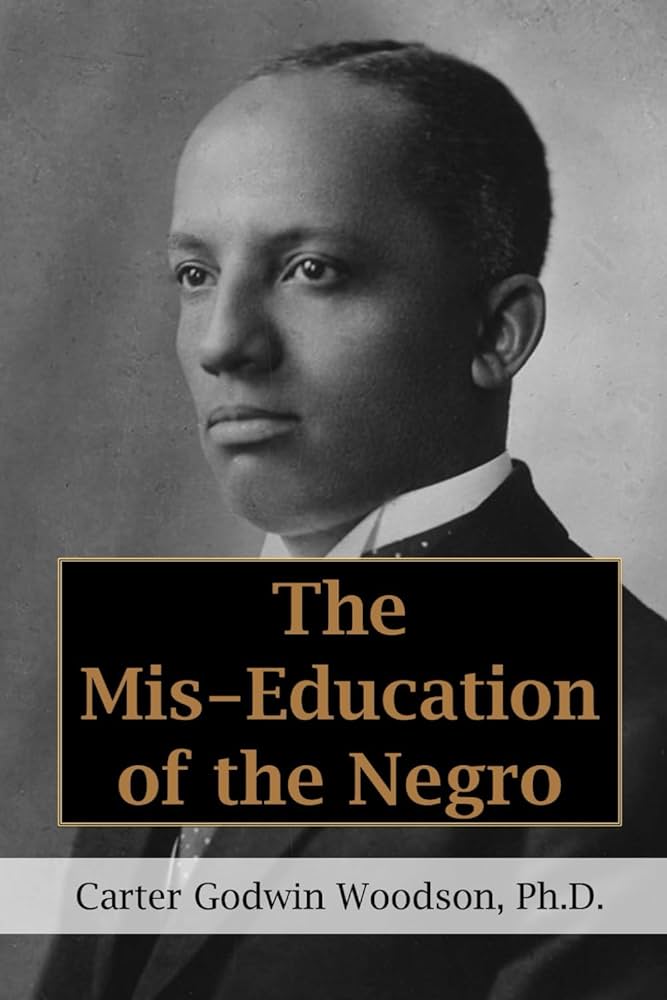
    The Mis-Education of the Negro

    I read a book recommended by CJ (thanks CJ) that I’ve wanted to write something about ever since reading. It was such an interesting and powerful book. It proposed some thoughts I’d never considered and really opened my mind to a different way of thinking about a particular part of American history.

    The book is titled The Mis-Education of the Negro, written in 1933. When I started the book, I immediately texted CJ and said there was too much in the book and that we should start a podcast series exploring the topics. He jokingly agreed to do a podcast. As I continued to read, I noted 40 topics, each I thought would make for a worthwhile discussion.

    CJ and I are at a combined 6 children 4 years old and younger, so a podcast is definitely on hold.

    I read this book a couple years ago.

    Discussing race is difficult. I’ve debated posting this for some time. Not that I’m saying anything controversial or crazy. Just that I don’t like to think too much about race. But our race is important. It makes who we are.

    Sometimes commenting on race as a white person feels like a lose-lose situation. I’m either so positive about other races that it seems like pandering to the point of insincerity or like I’m trying to make up for something, or I’m not positive enough and come across at best not understanding and at worst a racist.

    I think this is why talking about race in America is so difficult. I’ve written about it before and it still is one of the most difficult things I’ve written. 

    And yet, I continue to hear from my black brothers and sisters say that the best place to start is to just be open about discussing it. Which led me to put this post together. Nothing profound. Just my thoughts on a good book.

    I should mention that the book was written in 1933 which led me to continuously ask, is it still that bad? I think many of the disappointing and sad truths the book lays out have improved. Not yet perfect, but improved.

    I want to list some of the topics I noted as interesting from the book. Then I’ll elaborate on one of them.

    1. The “equality” of black and white people. Are black and white people the same? No, we are different in so many ways. From upbringing, culture, background, experience, etc. And that’s ok.
    2. Black people being nominally free but economically enslaved.
    3. Has education for black people gotten better or worse since 1933? I assume it must have improved, but it was a thought this book made me consider.
    4. This is something I feel like people my age have started talking about more- why didn’t we learn how to do taxes instead of the Nina, the Pinta, and the Sante Maria? – The question I asked from reading this book, what is education good for? Why do we care about random historical facts from Europe? To be clear, I appreciate as much as anyone the importance of understanding history and where we came from. But shouldn’t I also know how to file my taxes and apply for a job? Also, on that note of “where we come from.” I remember a lot of history being taught about Europe. I don’t remember a ton being taught about Africa, Asia, or South America.
    5. The opportunities that are afforded whites because more white people own businesses, etc. compared to black people. I think this was much more prevalent in the 1930’s compared to today.
    6. I really struggled with reading this book because I passionately hate the word in the title of the book. Underlining it over and over throughout the book drove me crazy. I almost put the book down many times because I hated how a group of people was being, I felt, unfairly characterized.
    7. Competing churches taking away from impoverished areas.
    8. Why do we study the domineering, warring nations and not the peaceful, productive nations?  The answer is obvious- the winners of wars write history. But philosophically something to consider.
    9. Interesting point mentioned about former slaves avoiding using art to portray their experiences. There were so few books or art pieces made by former slaves depicting that struggle. I think we see that more embraced today with hip hop. Artists like Tupac, Ice Cube, and Kendrick Lemar come to mind as individuals that fully embrace the struggles they have experienced in life and have made great art out of it.

    I heard this not from this book but 3+3 and 2+4 are the same. Different, but still the same.

    The point I’d like to discuss a little more is point one. The author of this book pointed out that we’re so obsessed with making everyone equal that we disregard that people are different. He points out that maybe black people and white people shouldn’t be taught exactly the same. We come from different backgrounds and different life experiences. Something that resonates with me and helps me learn may not resonate or help someone else with a different culture from mine.

    Still, I think this idea is interesting. Generally speaking, a black person has a different life experience from a white person. I’m not talking about just upbringing, I’m talking about the way we see the world, I’m talking about the way we interact with the world, I’m talking about the way the world interacts with us. Black people and white people can be different. That’s not bad though. We’re not different in an inferior / superior way, just different. Good and bad. Different.

    From the book:

    “The differences of races, moreover, is no evidence of superiority or of inferiority. This merely indicates that each race has certain gifts which the others do not possess. It is by the development of these gifts that every race must justify its right to exist.”

    It makes me think about what is happening with gender. Women and men are different, and that’s ok. We all have our own skills and talents that make us who we are. The fact that I’m a man makes me different from my wife. My wife has many skills and talents I’ll never possess. Recently I heard it put this way – 3+3 and 2+4 are the same. Different, but equal.

    That said, the most important thing is that we remember we are all sons and daughters of God. White and black doesn’t mean anything to God. What matters to God is what’s in our hearts. We are all individuals. That’s ok. We should all be treated equally, of course. But we should remember that we are unique. Our uniqueness is great.

    If you want to read a book that makes you consider race and the history of education for black people, this is a great book to read. I encourage all of us to study these ideas so we can better love and understand each other.
  • Meaning in Religious Art

    Meaning in Religious Art

    This was an essay I wrote for a meaning of life through art class I took, thus the official format. I feel it was worth sharing.

    Meaning in Religious Art

                It was with difficulty I prepared to hypothesize about the meaning of life when I believe I know the meaning of life. It occurred to me that if I truly believe I know the meaning of life, and I do believe that, that it would be dishonest to write this essay in any other way than to state what I know in my heart to be true. It’s for that reason that I’ve decided to pick three pieces of artwork; a hymn, a mural, and a piece of literature to give a brief explanation on how those pieces portray what I know to be true about the meaning of life. Given my powerful belief of these principles, and the desire I have to share them in my life, it’s with excitement that I write this essay and explore the meaning of life through art.

    Religion

    It’s important to note that a religious individual cannot begin to explore the topic of “the meaning of life” without their ideologies, beliefs, and understandings that come from their religious upbringing having a huge impact on their exploration. I fully acknowledge that many may disagree with my conclusions and interpretations of these pieces of art. That is what makes art beautiful. Art is completely subjective. My viewpoint on the world will color how I view this art. I look to explore how my viewpoint shapes my perspective on these pieces of art and helps me consider the meaning of life.

    Hymn

                I’d like to start by discussing my favorite hymn which is titled “A Child’s Prayer” (MormonTabChoir, 2014). A main focus throughout this essay will be the emotion elicited through this artwork. I believe that art that makes one ponder the meaning of life is likely evoking strong emotions. I cannot listen to this song without strong emotions welling inside me. I feel a change come over me as I listen to the lyrics, likely because it’s this song I focus on when I most question about the meaning of life.

                “A Child’s Prayer” asks a poignant question: “God, are you there?” That’s the portion I ask myself in difficult times. The song unfailingly leads to the important statement: “Pray, he is there, speak, he is listening” (A Child’s Prayer, 1992). This is an important reminder about life and its meaning. The most important line in this song, and the one that most defines the meaning of life on earth is, “You are his child” (A Child’s Prayer, 1992). The meaning of life is to grow and learn and come closer to our Heavenly Father. This hymn is a powerful piece of art that speaks to the soul and reminds one of things often forgotten, but that will forever be true.

    Mural

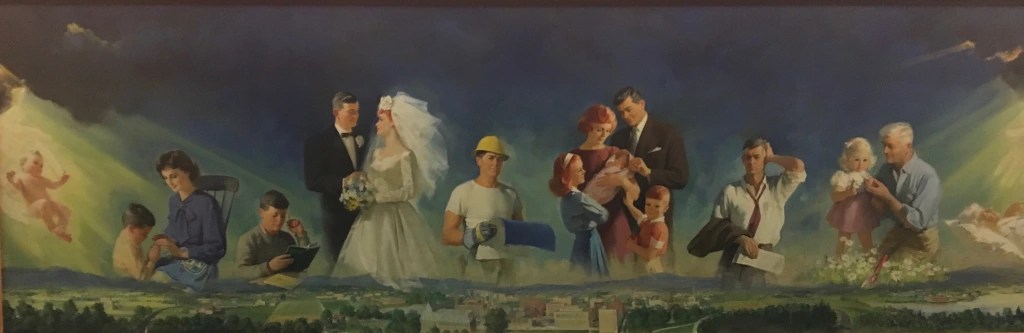
    The second piece of art I’d like to discuss is a mural aptly called, Purpose of Life (Skemp, 1964). Purpose of Life is a simple but compelling representation of the cycles of life and what life is about. Like the hymn, “A Child’s Prayer,” this mural evokes strong feelings within me, and I believe would for anyone who strongly considers its message. 

                The painting starts by showing a child entering the world. There are subtle hands shown coming from the sunlight, appearing to gently lead the child into this life. The depiction follows a young man growing. First, he is at his mother’s side, then reading, and then getting married. These three quick jumps create a feeling inside. As a result, a question develops: is life really that short? The painting continues, showing the boy, now a man, working. The man is shown with his wife and children. The man is shown with graying hair. The man is shown with his grandchild.

                The climax of the painting is the man lying on his deathbed. There is light above him, and the same hands that brought him to earth beckon him home. What could better illustrate the purpose and meaning of life than this painting? The purpose of life is to live, love, grow, learn, and then to come home. As my eyes scroll across the painting, powerful emotions arise. I consider growing up with my family. I consider the family I’ve started. I consider that like everyone before me, my life is heading to the same place, a return trip home. This mural does a fantastic job of illustrating the true meaning of this life.

    Book

    I couldn’t write a paper about the meaning of life without crediting a piece of literature that has given meaning to my life. The Book of Mormon is an entire book that focuses on the question, what is the meaning of life? The Book of Mormon is a piece of literature that literally details the purpose of life (Book of Mormon, 1830). Through my study of it, I have learned many important principles. One of these most important principles that give meaning to my life is that God loves and cares about all people, and that includes me. Others include that God is aware of us and is watching our progress, this life is important and there’s a reason I’m here, and that God keeps His promises. These are the principles that give my life meaning. 

    In a world of chaos and confusion, these basic principles give me hope. They provide light to my world. I simply couldn’t write about the meaning of life without discussing the book that has changed my life, brought me so much comfort, and put me on a path that gives my life meaning and purpose. The Book of Mormon is eloquent in its message and is a powerful work of art that I believe to be from Heaven. I can’t read it without feeling that God is there and being reminded why I’m here. 

    Conclusion

    I am grateful for these pieces of art and the feelings they create inside me. It’s these feelings that tell me there is more to this world than meets the eye and that I’m never alone. Great art provokes thought and emotion. Great art can make one stop and ponder. Great art can make one appreciate beauty and see the world in a different light. As Cooper (2003) says, “art, like philosophy, is the act of bringing truth into being” (p. 109). These three pieces of art, the hymn “A Child’s Prayer, the mural Purpose of Life, and the Book of Mormon, are each art pieces that provide this purpose for me, enlighten my life, and remind me the purpose of being here. I am grateful for art that makes us look beyond ourselves, consider purpose, and even see eternity.

  • Black and White and Adam and Eve

    Black and White and Adam and Eve

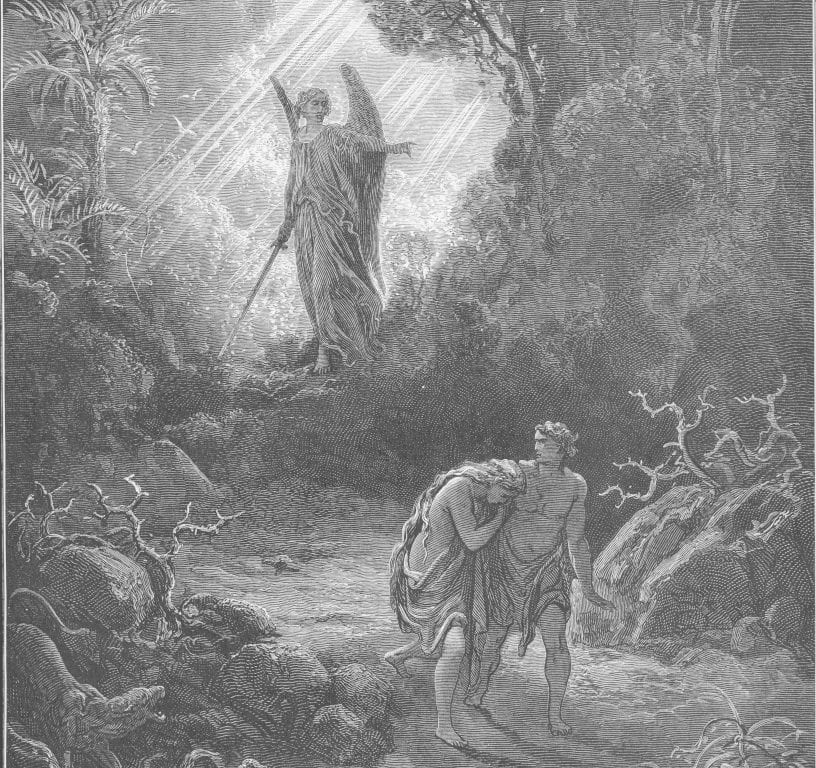
    In the Garden of Eden Adam and Eve were given two commandments.

    1. Multiply and replenish the earth.
    2. Do not eat of the Tree of the Knowledge of Good and Evil.

    In the church we are familiar with this dichotomy. Commandment one could not be completed without disobeying commandment two. What were Adam and Eve to do?

    I recently read a classic short story called The Invisible Collection from Out of the Best Books Volume 1 (p. 329). This short story was in a section titled “Good Versus Evil.”

    In this short story, an art shop owner/dealer learns of a patron of his art shop, which his father and grandfather ran before him, that had been a client for nearly 60 years. He decides to go visit this client to see his collection and see if he might be able to purchase some of it back from him. The client had been collecting for 6 decades and the pieces he bought for cents were now worth a fortune. This story was set in Germany after the war. Inflation was ravaging the country.

    The art dealer visited the modest home of this art collector, only to learn that the art collector that had purchased hundreds of paintings, drawings, and art pieces from his shop was blind. This art collector hadn’t always been blind, he had become blind after the war. Our main character, the art shop owner, learned that this now very old man still daily pulled out the many portfolios he had collected and went through each piece one by one. He used his memory to see every detail he had spent countless hours admiring when he still had his vision. His art collection, even blind, was his greatest treasure.

    When our shop owner arrived at the home, he was immediately pulled aside by the wife and daughter of this old man. They told him the truth before he could cry out in astonishment in front of the old man. In order to survie they had been selling the art pieces for years. The husband of a second daughter of the old art collector had been killed in the war and she was left with 4 young children to feed. The family was barely getting by, barely surviving. They sold these priceless art items to survive. They replaced the real art with papers to fool the old man. They never told the old man because, understandably, they didn’t want to break his heart.

    This story really made me think.

    Lying is bad, right? And yet, in this story, the family of the old man had to lie, didn’t they? Or did they?

    Multiply and replenish the earth, but don’t eat from that tree. Many things in this life are not black and white. There isn’t a “right” or “wrong” answer to every question. There’s a lot of gray area in this life. That’s the point, though. God wants us to learn in this life to be wise stewards. He wants us to learn to make decisions for ourselves, to learn and grow from our choices.

    “nevertheless, thou mayest choose for thyself, for it is given unto thee”

    Moses 3:17

    God is teaching us to be rulers in this life. God wants us to learn good from evil. He wants us to learn to follow the promptings of the Spirit (truth) and learn to follow that guidance. He wants us to take many options and make the best choice. He wants us to learn how to evaluate what is best to do, then do it.

    Being worthy is receiving something, putting it into your life, and acting upon it. As we prove ourselves worthy God gives us bit by bit more, and we grow step by step. That is what God is teaching us in this life. Worthiness, righteousness, freedom of choice, and stewardship.

    So, in this light, that we’re daily being tutored by God for greater purposes, how are our daily choices?