Tag: authority

  • One Eternal Round

    One Eternal Round

    I started making some bad decisions in high school. These decisions nearly derailed my life.

    During that time I was becoming friendly with a girl. She knew about some of my bad decision-making.

    One night when we were hanging out I told her I would never get married anywhere but a temple. This interested her. Why, she wondered, would someone like me, who seemingly cared nothing for this religion that I was raised with, care about a temple marriage?

    I explained to her that I believed my church was true. If my church was true, then it held the authority to marry couples for eternity. That church, therefore, sealed families for eternity. I told her if I married someone I didn’t want it to end after we died. If I were to ever get married, I wanted it to be for eternity.

    When I was in college my decision making had gotten increasingly worse.

    On a night I don’t remember, it was later told to me that I bore my testimony to a girl at a party. I don’t remember any of this. Apparently, religion came up and I told her I knew the Church of Jesus Christ of Latter-day Saints was Jesus Christ’s church on the earth.

    This girl asked the obvious question, “If you know it’s true, why are you doing the things you’re doing?”

    I’m told I said that even though I wasn’t living the standards of the church, I couldn’t deny what I knew to be true.

    That testimony that I don’t remember had a big impact on that girl.

    Years later that first girl from high school sent me a postcard. That girl from high school had gotten baptized. Her postcard was one of a few critical moments that helped me come back to church and changed my life.

    A month after that postcard, in the midst of my difficult journey back to church, I stumbled upon a Facebook message that had gotten blocked and I’d never seen. It was from years prior. It was from the girl at the college party, the girl I bore a drunken testimony to.

    She told me she’d gotten baptized. She told me she had never let me know how big an impact that testimony had on her ultimately getting baptized. I visited her and her budding family. She was sealed in the temple. She had an eternal family. She was happy. It gave me strength to continue on the path of repentance that was so, so hard.

    The girl from high school got married in the temple and now has three kids. She has an eternal family. She is happy.

    A patriarchal blessing is extremely sacred. I share a short line from my blessing with the utmost reverence:

    “Trouble not yourself over lost days, for you are an eternal being”

    I can’t tell you how comforting those words were when I was trying to find strength to stay faithful, and how important those words continue to be to me.

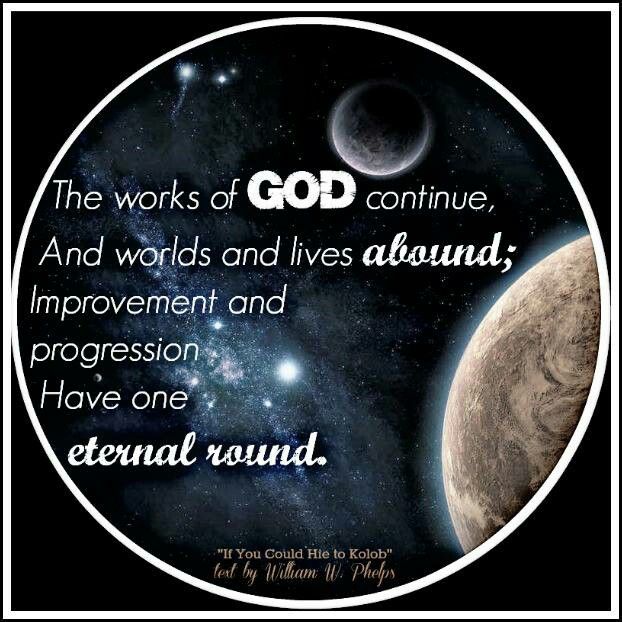
    It is all one eternal round to God (D&C 3:2). He knew I would stumble. What did He do when I stumbled? Put two people in my path that I could somehow, inexplicably, impact at my lowest, during my most degraded behaviors.

    What did He do?

    He put those two people back in my path when they could help me back. He put two people back into my life to help me remember what I always knew, what I was getting dangerously close to forgetting. He put two people in my path to remind me who I was. I am nothing special of myself, but I am a son of God. That is special.

    I marvel at the workings of God. That He loves us so much that He gave us a world so we could leave our Heavenly home, just as children leave their homes here on earth to go out and learn, and grow, and fall. He gave us an earth to fall. But He allowed us a way back.

    I know there is a way back.

    I know that Jesus Christ allows that way back.

    I know that God planned for everything. We are His work and His glory.

    I can never deny what I know.

  • A Kingdom Divided

    A Kingdom Divided

    The first step for Zion is to stop distinguishing ourselves from one another. We are first Children of God.

    President Russell M. Nelson has been clear about the three primary identities we should all focus on for ourselves. Those three identities are:

    First – children of God.

    The first identity is for every person on the face of the earth. Whether they realize it or not, every person is a child or God. The second and third identities are for members of the Church of Jesus Christ of Latter-day Saints. But this does not exclude anyone. The second and third identities are an invitation to the world.

    The second identity is child of the covenant.

    The third identity is disciple of Jesus Christ.

    President Nelson has stressed that anything we give precedence over these three identities distracts from our true potential. As children of God, children of the covenant, and disciples of Jesus Christ, we have a divine inheritance and royal home to return to. Any other worldly designation distracts from our ultimate goal of becoming everything we can be.

    Some of the other designations the world assigns include sexuality, status, race, and political affiliation. There are countless self-defined categories we assign ourselves. None of these things matter, they won’t matter at all when the veil is lifted, and we are reminded of what we always were.

    Zion are the pure in heart (D&C 97:21), Zion are one.

    All who believe in Christ are the children of Christ. But how is Zion established? How can there be unity in Christ given the divisive nature of the world and Christianity?

    A search for all the sects of Christianity brings up THOUSANDS of results. Thousands. How can one know the truth when there are so many claiming to be true? How can Christianity be united under Christ when there are thousands battling for attention, power, and patrons.

    How can God be a God of such confusion and disorder?

    In Luke 11:17 Jesus Christ says:

    Every kingdom divided against itself is brought to desolation; and a house divided against a house falleth.

    How would Jesus Christ feel about the state of the religion that espouses His name?

    I’ve heard it said that Christianity is united, despite its differences, in its faith in Christ. I think this is an admirable way to look at it. In fact, it’s how I try to look at it. It’s my opinion and belief that our faith in Jesus Christ is important and unites us. That said, what really unites us? What enduring principle is it that unites all Christians?

    Is it our belief in what Christ taught? There are a million different interpretations of what Christ taught.  

    Is it our belief in who Christ was? That couldn’t be a more divisive topic. Was He who He claimed to be? Was He the Son of God or wasn’t he?

    Is it our belief in the Atonement of Jesus Christ and what it accomplished? Again, there are different interpretations of Christ’s Atonement, why it was needed, and what it accomplished.

    Surely we can agree on Christ’s resurrection? Was Christ resurrected with His body or wasn’t He? Was there significance to Him eating fish with His disciples after His resurrection? Again, there is contention on this topic.

    What can Christianity be united on? It seems nothing.

    I believe the Church of Jesus Christ of Latter-day Saints provides the only solution to this problem. What Christianity can be united on is a connection to Jesus Christ. A real connection. Not a belief in Him, what He taught, or who He was. The connection must be real and tangible. The connection must be a welding link. The connection must have veracity on earth and in heaven (Matthew 18:18). That connection must be through a covenant.

    A covenant is a two-way promise.

    A covenant binds us to Him.

    When we get baptized, we promise to take upon us the name of Christ, and He becomes our shepherd. From that point on we are inseparably linked with Him.

    Latter-day Saints are a covenant people. The saints of God have always been covenant keepers.

    In the podcast Church History Matters, the hosts were speaking about the early history of temples in the Church of Jesus Christ. Something they said stood out to me as I’ve been working on writing this post.

    “…through the ordinances given to both men and women, living and dead, the human family is being knit or woven or let’s just use the word sealed together into one eternal holy order which we can call the family of God, we can call it the Kingdom of God, we can call it the Church of the Firstborn, we can call it the Celestial Kingdom, or simply the priesthood.”

    In the most recent General Conference of the Church of Jesus Christ of Latter-day Saints, Elder McCune of the Seventy said:

    Joy and eternal perspective come through being bound to the Savior by making and keeping covenants through Christlike discipleship.

    Adam, Abraham, Moses, and Peter; they made covenants with the great Jehovah and became His, and received of His power. Over time, they became more like Him. Over time they became one with Him. Enoch created Zion and was so connected to the Lord that he and his city were taken up to Him. This connection is made through covenants.

    What can unite Christianity? It is a covenant with Jesus Christ.

    Christ’s Church has temples where these covenants can be made.

    We must strive to be one with our brothers and sisters. We can only truly be one as we are united under one banner. The disjointed nature of Christianity is unacceptable. Covenants are needed. It is the banner of covenants with Jesus Christ that will unite Christianity, and nothing else. He died for us. In return, He asked us to believe in Him, follow Him, repent, and be baptized. That was His request of us. There is only one baptism that is acceptable to God the Father and that is the baptism with His authority in the name of His Son. No other baptism is acceptable to Him because it is a baptism not by His authority.

    I wish the Christian world could see that it is covenants that unite us to God. It is covenants that can re-unite us.

    I know as the Millenium approaches that one day all knees will bow and every tongue confess. At some future date the children of God will know and understand the covenants needed to unite the heavenly and eternal family.

    It is here for us now. But the world does not listen. Jesus was sent to this world, but He was not of it. This world struggles with the eternal nature of what God has in store for us. One day the world will have to understand what was always offered to us. What is offered to us is unity under Christ. Eternal families, eternal potential, eternal happiness, eternal inheritance. That is what will come when the world covenants to join with Jesus Christ and be Zion.

  • Inheritance and Lehi’s Blessing

    Inheritance and Lehi’s Blessing

    I have always been confused by the blessings of Lehi to his posterity in the 4th chapter of 2 Nephi in the Book of Mormon.  For one, there is the obvious blessing that is missing: Nephi’s.  For another, there seem to be mixed messages.  Laman and Lemuel have a blessing, but it may be removed?  What does Sam get?  Who is the actual new leader- Nephi or Laman?

    In an article titled Lehi’s Last Will and Testament: A Legal Approach, John Welch goes into great detail on the legality and custom of Lehi’s blessing, and answers all of the above questions. I’d encourage anyone interested to read his whole article. It strengthened my testimony of the authenticity of the Book of Mormon and reminds us of the real world that Nephi was a part of.

    I want to go over some highlights from John Welch’s article that explain Lehi’s blessing in its cultural context. Credit also goes to Alan C. Miner who put together the points I found most relevant to the above questions.

    Inheritance and succession was an important aspect of near eastern culture. It was a way of “preserving and transmitting the family estate from one generation to the next” (John Welch). Typically, the eldest son of the father’s first wife inherited his estate. The leadership of the family was also an important inheritance given. Faulk points out, “a father was free to choose a younger son as his successor, if he found the eldest unworthy of the office.” Sound like this fits Laman and Lemuel much? The father passed this leadership of the family on often through a special blessing (Deuteronomy 21:17), like we see in 2nd Nephi chapter 4.

    There are many examples of this spiritual or ruling leadership being given to a younger son including:

    1. Abel
    2. Seth
    3. Jacob (Israel)
    4. Ephraim
    5. David
    6. Solomon

    In each of these cases older sons were passed over as the spiritual leaders of the family.

    So, we have property inheritance and ruling inheritance. There was a third category sometimes handed down from the father: priestly duties. This is what happened with Lehi giving Jacob the priestly authority in the Book of Mormon. Another example of this was Jacob/Israel’s blessing in the Old Testament. Israel blessed Judah with the ruling authority (Genesis 49:10), Joseph of Egypt receiving a double portion through Ephraim and Manasseh (Genesis 48:22), and Levi inherited some priestly rights to the priesthood.

    As time passed in ancient Jerusalem, it became common custom for the eldest son to automatically receive a double portion of the inheritance. As noted, there were times that younger sons received different portions, or rights to rule, or increased inheritance. This was the exception, not the rule.

    This basic background information brings us to our fascinating story in the Book of Mormon. We have an eldest son, Laman, who was the eldest son of, what appears to be, a relatively well-off citizen of Jerusalem. This family leaves behind their land and property, to venture off to a promised land, a promised land Laman seldom showed faith in attaining. This family spends years in the wilderness, potentially months on a ship, and eventually land in the promised land. This elder brother is now over the moon with joy and enthusiasm. He will inherit all that his father has and be the leader and now king of a new nation.

    But what about Nephi? It was Nephi from the start that helped the family in the wilderness. It was Nephi that went back and got the plates so they could remember God and how to read and write. It was Nephi who built a ship to get them to the promised land. Nephi led the family, physically and spiritually to the promised land. He was the natural leader of the family and deserved to inherit the leadership, and kingship, of this great new nation.

    Lehi has a bit of a conundrum. How was Lehi going to handle Laman’s expectation to receive a double portion from his father? How was Lehi to handle the expectation from Laman that, as the oldest son, it was his RIGHT to inherit everything, despite his lack of leadership throughout the journey. Especially when Nephi had been declared a “ruler and a teacher” (1 Nephi 2:22, 3:29) by God Himself.

    This brings us to our blessing, and to the answer to the questions I always had.

    Lehi needed to appease Laman while attaching appropriate contingencies to his blessing. The main contingency was that Laman’s blessing would be applicable as long as he hearkened unto Nephi. This same admonition was given to Lemuel, Sam, and the sons of Ishmael. If they refused to follow Nephi, their blessings would be null and void.

    So Lehi employed three ways to diminish Laman’s blessing and role as the firstborn son. In diminishing Laman’s role Lehi enhanced Nephi’s. This leads us to the questions:

    First, why was Sam’s portion linked with Nephi’s? Why were there no Samites?

    Combining Sam’s inheritance with Nephi’s was similar to Joseph of Egypt’s blessing being doubled through his sons, Ephraim and Manasseh. Sam’s share of the land was linked to Nephi’s and therefore Nephi’s portion was doubled through Sam’s faithfulness, loyalty, and devotion he would show to Nephi as he always had.

    Welch discusses a second way Lehi diminished Laman’s blessing as found in 2 Nephi 4:5-9, “He [Lehi] blessed his firstborn’s children to the effect that their sins and cursings would be answered upon the heads of their parents. This could not have been flattering to Laman.”

    The third way Laman’s authority and blessing was reduced, Lehi referred to Jacob three times as his “firstborn…in the wilderness” and applied the priestly duties to him. By naming Jacob as another version of the “firstborn,” Lehi subtly took away from Laman’s claims as the firstborn son. As we remember, the custom in ancient Jerusalem was for Laman to receive the inheritance by default because he was the firstborn son. But, with Jacob also receiving a form of the title, “first born son,” Laman lost some claim on this exclusive title.

    Laman was warned that if he was disobedient, to God and to Nephi, that his blessing would be revoked. Lehi was, in a way, willing to give Laman the cursory “honor” of the blessing while putting many safeguards in place to keep Laman from actually ruling.

    This background context gives us additional insight into how the Nephites (followers of Nephi) and Lamanites (followers of Laman) could so quickly devolve into war and contention. The peace was kept as long as Lehi, the official patriarch, was around. Custom in Jerusalem was to love and respect the father (Exodus 20:12). But as soon as Lehi died, it was chaos. Laman was never one to heed faith or blessings, so the warnings from his now passed father were of no concern to him. He wanted to rule.

    To conclude, Alan C. Miner states, “Thus, John Welch has provided a plausible cultural background and answer as to why there were no “Samites.”  His words also give testimony to the fact that the ancient world of which Lehi and Nephi were proposed to be a part of in the pages of the Book of Mormon was a very real world.” The confusing nature of the blessing adds to the authenticity of the Book of Mormon.  Lehi’s blessing is consistent with the pattern an ancient Israelite may use in blessing his children. 

    I bear testimony that the Book of Mormon is a true historical account of families that originated in Jerusalem and eventually settled in the Americas. The more I read and study the book the more obvious it becomes. God has given us a second witness of the divinity of Jesus Christ, and I’m grateful for it. I’m grateful for a book that has been tested for 200 years and still holds up. I’m grateful to know God is still invested in us and our lives. I’m grateful for the Book of Mormon, Joseph Smith, and the Church of Jesus Christ of Latter-day Saints.

  • Authority in God’s Kingdom

    Authority in God’s Kingdom

    In 1830 the church was brand new and something extremely difficult happened.  An issue occurred which would forever shape church government.  This issue would establish a pattern, God’s pattern, of order.

    An extremely faithful member of the Church, in fact one of the 8 witnesses of the Book of Mormon, started to receive revelations on the gathering of Zion.  This member was Hiram Page.  He was faithful to the church and would never deny the Book of Mormon’s authenticity.  It was not surprising that many church members believed the revelations Hiram Page received.  Why wouldn’t they?  He was a faithful member.  He was one of the 8 witnesses, a blessed individual that saw and beheld the gold plates.

    The issue was, if Hiram Page could receive revelation for the entire church, then who couldn’t receive revelation for the entire church?  You’re seeing where this is going.  The Church of Jesus Christ of Latter-day Saints would go the way of all other sects of Christianity:  chaos.

    There must be order in God’s system.  God could not have every person claiming revelation for His Church.  It’s important to note, personal revelation is an important part of our mortal journey.  Personal revelation is also critical in God’s church.  Revelation cannot be received by an individual pertaining to the entire church or to guide those in a higher position of authority.  Without this rule, there would be complete confusion, as there started to be when Hiram Page reported his revelations.

    When this problem arose, Joseph Smith was in the most difficult of positions.  How did he correct this issue without seeming authoritarian and dictatorial?  He needed Hiram Page, Oliver Cowdery (who supported Hiram’s revelations), and all church members to understand the significance of this issue. 

    Joseph Smith met with the congregation and explained revelations received prior to Hiram’s revelations.  Joseph Smith had documented the Lord’s commandments in Doctrine and Covenants sections 20 and 21.  He now learned that many members of the new church didn’t understand these doctrines and principles of church government. 

    The history states that Joseph Smith joined with the people and explained the revelations in Doctrine and Covenants 20 and 21 in detail.  He used simple language and explained what it actually meant.  In what could have been a contentious and ugly situation, church members, Oliver Cowdery, and Hiram Page himself left understanding the error of their ways.  This was a prophet of God explaining God’s order.  All present accepted.

    This is the way it should be.

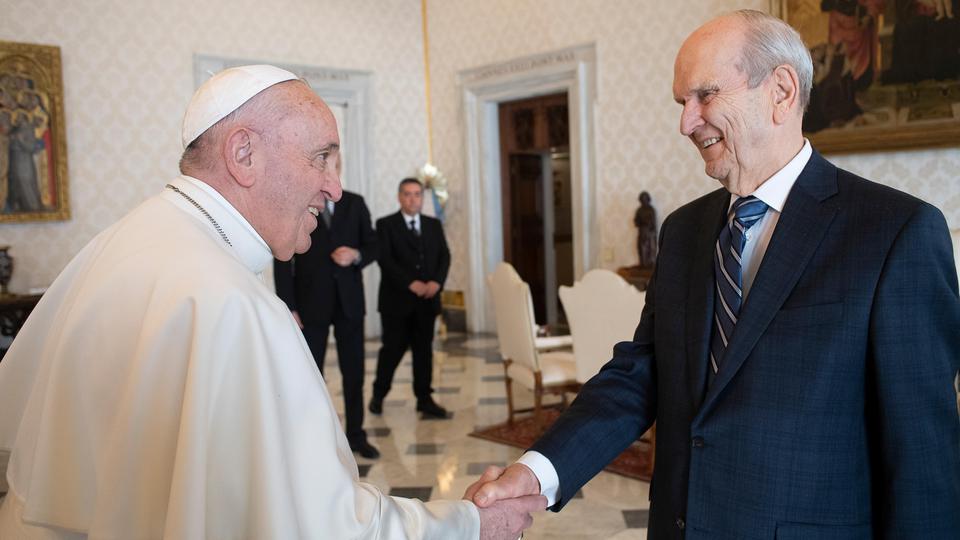
    I would like to compare this to something I learned when reading about how “retired” Pope Benedict XVI… retired.  I didn’t understand how this could be and wanted to research to see what happened.

    Instead of commenting on what I learned about Pope Benedict’s retirement, I want to comment on something else I came across.  An article I read talked about how the current Pope Francis has considered relaxing priestly celibacy rules and how “retired” Pope Benedict came out publicly against this.

    Does this not present a problem?  What if the current Pope did make a decree and the “retired” Pope publicly voiced his disagreement with it?  Would there be another branch of Catholicism?  One following current Pope and one following retired Pope?

    I can’t understand it.  There can’t be confusion in God’s kingdom.  While men are imperfect, God can’t have questions of authority in His church.  Otherwise, there is complete chaos.

    These stories of how two issues were handled strengthened my testimony of the importance of authority.  I believe the Church of Jesus Christ of Latter-day Saints is Christ’s Church restored to the earth, and as such, it must have order.  As I study Priesthood authority and how the church functions with millions of members across the entire globe, I’m blown away at how seamlessly it all works.

    Joseph Smith foresaw General Authority Seventies when the church was a couple dozen members.  Now as the Church grows and there are 12 quorums of the Seventy, anyone who doesn’t believe this church to be divinely guided must marvel at Joseph Smith’s foresight.

    The truth is it wasn’t Joseph Smith’s foresight, it was God’s foresight.  This church is divinely guided, divinely structured, and divinely governed.  My testimony of this grows daily as I understand the structure of the church better and see how the Lord guides His Kingdom. 

  • Sidney Rigdon Miracle

    Sidney Rigdon Miracle

    21 August, 1842. 

    Apparently, it had been thought that Sidney Rigdon meant “to renounce his faith in Mormonism” when he took the stand on 21 August 1842.  Instead, he “appeared to bear his testimony of its truth, and add another to the many miraculous evidences of the power of God.”

    I stumbled upon this story while reading a commentary on Doctrine and Covenants section 124 verses 103-110.  In these verses Sidney Rigdon is admonished to continue to stand by the Prophet Joseph Smith, along with other commandments, and “if he will hearken unto my voice, it shall be well with him” (verse 110).

    Smith and Sjodahl remark that, “Sidney Rigdon, according to a generally prevailing impression, was more or less under the influence of a spirit of apostasy.  It is related that, in Liberty jail, he declared to his fellow-prisoners that the sufferings of the Lord were nothing compared with his, and while the faithful Saints were straining every nerve to complete the Nauvoo Temple, he had no word of encouragement to them.  As a consequence of his disposition, he did not have good health.  Like the Corinthians who partook unworthily of the Sacrament (1 Cor. 11:30), he was ‘weak and sickly.’  The Lord, therefore, points out to him the cause of his ailments and promises to heal him, if he will do his duty and stand by the Prophet as a true counselor.”

    The admonition from the Lord in section 124 was given on January 19, 1841 so it was 19 months later that he took the stand to detail the miracle he had experienced to those gathered.

    As mentioned, given Sidney’s recent state of apostasy, I’m sure the gathered congregation was expecting to see some potential fireworks.  They got fireworks, but not the apostasy-themed ones they were expecting. 

    Sidney told the congregation that his daughter Eliza died.  She was pronounced dead by a physician.  I will quote the story from the Joseph Smith Papers.  “after a considerable length of time she rose up in the bed and spoke in a very powerful tone to the following effect in a supernatural manner: she said to the family that she was going to leave them (being impressed with the idea herself that she had only come back to deliver her message and then depart again,) saying the Lord had said to her the very words she should relate; and so particular was she in her relation, that she would not suffer any person to leave out a word or add one.  She called the family around her and bade them all farewell with a composure and calmness that defies all description, still impressed with the idea that she was to go back.  Up to the time of her death she expressed a great unwillingness to die, but after her return she expressed equally as strong a desire to go back.  She said to her elder Sister, Nancy, ‘it is in your heart to deny this work, and if you do, the Lord says it will be the damnation of your soul.’  In speaking to her sister Sarah she said, ‘Sarah, we have but once to die, and I would rather die now than wait for another time.’  She said to her Sisters that the Lord had great blessings in store for them if they continued in the faith, and after delivering her message she swooned, but recovered again.”

    It goes on to say that she continued in a near death fashion for 36 hours before she called her father, Sidney to her.  Continuing from the Joseph Smith Papers: “the Lord had said to her, if he (Sidney) would cease weeping for his sick daughter, and dry up his tears that he should have all the desires of his heart; and that if he would go to bed and rest, he should be comforted over his sick daughter, for in the morning she should be getting better and should get well.”  Sidney had wept and prayed for his daughter’s life.  His daughter told him the Lord had commanded her to stay for Sidney’s prayers.

    The account continues, (Sidney speaking), “It has also been rumored that I believe that Joseph Smith is a fallen prophet.  In regard to this, I unequivocally state that I never thought so, but declare that I know he is a prophet of the Lord, called and chosen in this last dispensation, to roll on the kingdom of God for the last time.  He closed by saying as it regards his religion he had no controversy with the world, having incontrovertible evidence, that through obedience to the ordinances of the religion he now believes, the Lord had actually given back his daughter from the dead.”

    There is so much to unpack here.  A few things that caught my attention –

    Sydney being weak due to taking the sacrament unworthily. 

    The statement potentially made by Sidney Rigdon to the effect that the Lord’s sufferings were nothing in comparison to his, blasphemous indeed. 

    Interesting that Eliza was commanded to give the precise words of the Lord.  Shows the importance of the Lord’s words, when He speaks, we listen and when we relay His message it must be precise.

    Also, interesting that Eliza at first didn’t want to die, but once she had met the Lord, she didn’t want to come back to life.  Why did she ultimately come back?  Because the Lord commanded her.  I believe this not to be out of duty to Him (though of course it was) but out of love.  The Lord doesn’t force. 

    My concluding thought is on the cunningness of the devil.  I haven’t studied the life of Sidney Rigdon much after he officially left the church.  After reading this story I looked a little more into Sidney Rigdon.  Apparently, after Joseph Smith’s martyrdom Sidney went on missions to the East to preach and gather followers to his new church.  Sidney called it, “the most successful mission he had ever undertaken.”  Where is this church today?

    What I thought about the cunningness of Satan is this: Sidney Rigdon appears to never have denied the faith. Maybe that source exists and I haven’t seen it.  What Sidney did instead was claim the authority as his own.  He was misguided and pride took over.  He believed the authority rested with him and so, instead of denouncing the faith, he tried to promote it in his own way.  God had chosen his prophet.  Sidney Rigdon couldn’t upheave that.

    I believe there is a lot to be learned from this story from Church history. I noted just a couple of the interesting points that could result in their own post. Ultimately I settled on this important point –

    I’m not sure where Sidney Rigdon’s church is today.  I know where the Church of Jesus Christ is today.