Tag: belief

  • Where Can Faith Take You?

    Where Can Faith Take You?

    I recently read a passage from a book titled The Sinbad Voyage. This book details a 6000-mile voyage from Oman to China in a replica of an ancient Arab ship.

    The passage that sparked this thought was:

    The Arabs took to the sea with that same philosophy of devotion which helped them cross the great deserts. They set out trusting in the destiny which Allah would provide them, and both camel caravaneer and Arab shipmaster used the same stars to guide them on their courses, believing that God had placed the stars there for that very purpose. [In a previous voyage across the sea], I had only to glance upwards to appreciate the heritage of Arabe seafaring: of the major navigation stars used by sailors, most bore Arabic names because it was Arab savants who had developed the art of astronavigation (p. 16).

    “The sea road was the great achievement of early Arab navigation. It was nothing less than the 6000-mile voyage by way of Ceylon and South-east Asia to the fabled ports of China (p18).” (emphasis added)

    So these Arab shipmasters navigated the oceans of their world. Exploring, adventuring, expanding the horizons of what they and the people around them thought were possible. Both in the deserts and the oceans. This image can help visualize this ocean exploration:
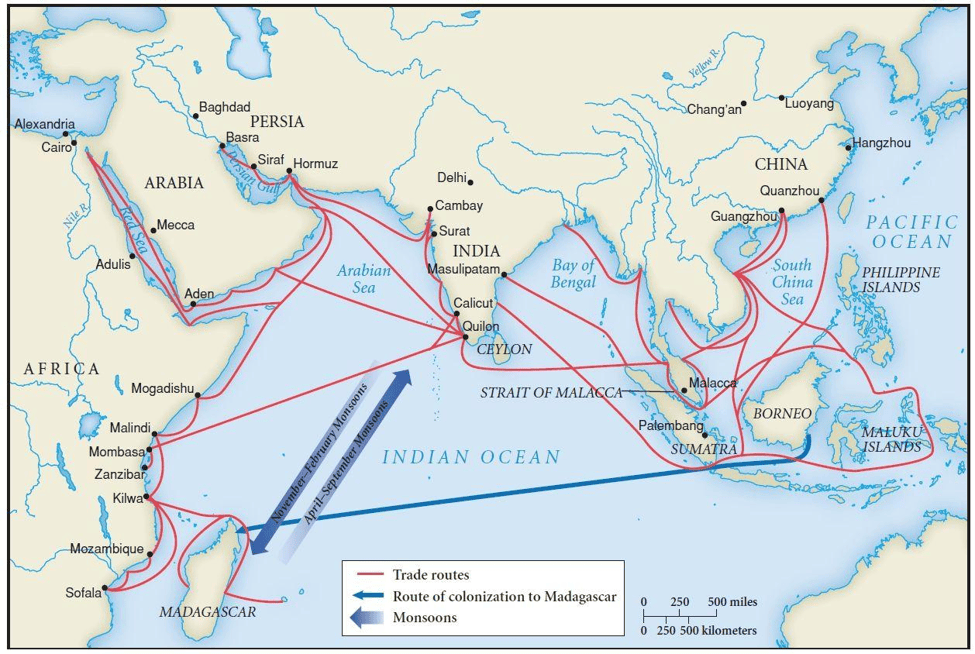
    From other passages I read that even at its most consistent and well-established, roughly 1 in 10 trips to China never returned.

    Can you imagine setting out into the ocean knowing there was a good chance you would never return?

    Why did they do this?

    Some people just have an adventurous death wish, hop on a raft, and push off into the ocean. This is true.

    Others have a view of what is possible and go for it. But there is still an immense amount of belief, trust, and faith in boarding a large ship and setting off on what is known to be an amazingly treacherous and dangerous journey. Why do it?

    The thought that occurred to me as I read that passage about the ancient Arab explorers was this: it was faith that allowed these Arab shipmasters to do amazing things. Many truly believed that Allah was watching over them and would safely guide them, by destiny, or by whatever else you want to call it, to their destination.

    Why did they believe it?

    Faith.

    Did some die? Yes. Was their faith misguided? Who knows. But that doesn’t take away the fantastic thing they did because they had faith.

    People with faith accomplish amazing things.

    What role has faith played in the discovery of the world? Without faith in something greater, people wouldn’t do fantastic things. Or they would do them less often.

    What does the role of faith play in our everyday lives?

    Why did your body move when you told it to get out of bed this morning? Do you even realize you told your body to get out of bed this morning? Why did you believe your body would move when you told it to this morning?

    The answer is faith.

    You can give all sorts of other answers if you’d like. But ultimately you had faith that if you told your legs to swing over the side of your bed and to walk, they would do it. You had to have faith that it was possible. Every living act is done with faith.

    The next time you venture out to do something difficult or scary ask yourself: do I have faith that I can accomplish this thing? If you have faith, you can do anything. And if you have faith and fail, you learn something.

    When you think about it this way, you can’t lose.
  • Abraham’s Faith

    Abraham’s Faith

    I had a thought (shocker).

    I shared last week about Abraham’s shared experience of almost being sacrificed by his father.

    Here’s another way to look at it.

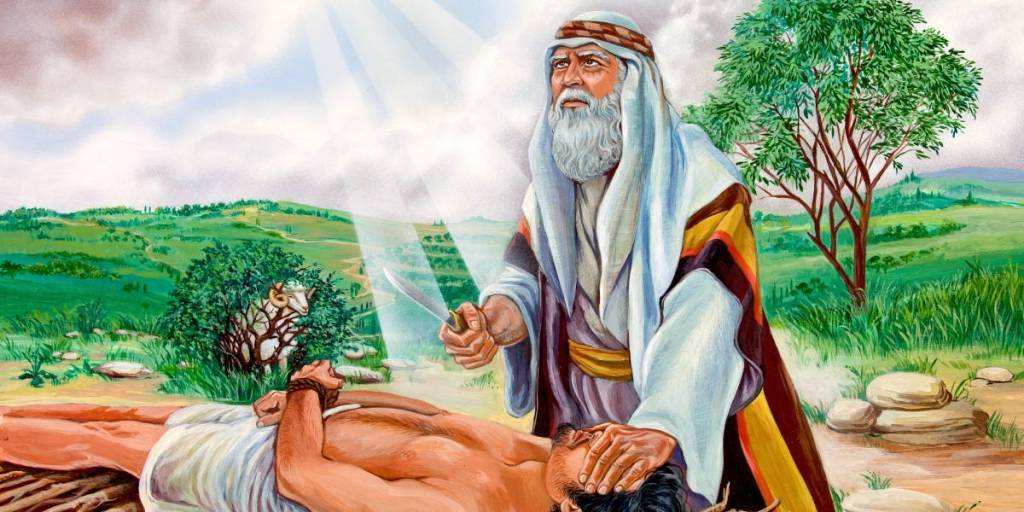
    We marvel at the faith of Abraham to sacrifice his son. He didn’t know that God would stop him moments before he went through with it. For all Abraham knew, his son would be dead, gone. And yet, he was still willing to do what God asked him to do.

    We marvel at this faith to do the impossible.

    What about God, when it came to sacrificing His only Son? Well, we would say, God knew the end. He knew His Son would conquer death and be resurrected. He knew His Son’s death would only be temporary. He’s God. He has nothing to worry about. Abraham was just a man. Abraham had no such knowledge.

    Or did he? 

    Faith is the “assurance of things hoped for, the evidence of things not seen” (Hebrews 11:1). Faith, by its nature, is to not have a perfect knowledge of things. Was Abraham’s faith so perfect that he did know, just like God knew with Jesus Christ, that everything would be ok?

    Abraham had a promise from God. God promised Abraham that his seed would be as numerous as the stars in the heavens and the sands of the sea. Abraham had some understanding of the eternities. It didn’t matter to him when the promises of God would be fulfilled. He trusted God. He had a perfect knowledge that God would keep his promises. 

    Now. The gut-wrenching, heart-tearing, indescribable and impossible act of losing your son. The pain. What about that? Abraham had faith that God would even make that right. Abraham had faith that God would only allow him to do what ultimately he needed to do to become who he could become. Abraham trusted God enough to do anything. Why? I think because he knew God loved him. Abraham didn’t have faith that God loved him, didn’t hope that God loved him, didn’t believe that God loved him. He knew. 

    Maybe faith proceeds knowledge.

    If we truly understand God’s love for us, His children, we can do anything, and endure anything.

    Abraham didn’t know the exact result of the sacrifice of his son. But he did know that God kept His promises. And hew knew that God loved him. And whatever the result, it would all work out for their benefit, glory, and growth in the long run. 

    That is faith.

  • Incommensurable

    Incommensurable

    I was listening to a podcast about the incommensurability of Joseph Smith being able to describe what the translation process for the Book of Mormon was like.  

    Incommensurable is like indescribable, without relation to anything, unquantifiable.  

    Joseph Smith had many experiences, including the First Vision, that were incommensurable and therefore difficult for him to describe.

    I’ve written 330+ posts at this point. In many of them, I’m trying to describe incommensurable things. I’m trying to describe my testimony. I’m trying to describe my experiences. I’m trying to describe a change that has happened inside me. I’m trying to describe things I know to be true. These things, without the reader feeling my emotions, my heart, my chest, my mind, without being in my skin, words can’t describe many of the things I try to write and share. 

    I wish I could hand the testimony I have of the Book of Mormon and of Jesus Christ’s sacrifice for me into the heart of every person I ever meet, if only for a moment (I want it back!). But I can’t. I wish I could give to someone how I know the Book of Mormon is true. I’ve tried before. I can’t. 

    I wish I could describe so that you, the reader, could understand what I felt when I left the Bishop’s office and knew, just knew with all my heart, that Christ was going to forgive me for everything I had done. I wish I could describe the feeling that washed over me. I wish you could feel my tears. I wish you could feel that experience. 

    Many of you have in your own way. Some of you haven’t.

    Tears come to my eyes just thinking back on some of these moments in my life.

    Incommensurable.  

    I want to state something clearly, since I can’t use words to properly describe my testimony and knowledge of my Savior. Here are facts to review. 

    I have changed. 

    I am a father. 

    I am a different person than I was 5, 10, or 15 years ago. I am far, far, far from perfect. Embarassingly far from perfect. Shamefully far from perfect. I recognize that. But –

    If you see anything good in me, it’s because of Jesus Christ.

    If you think I have any admirable qualities, it’s because of Jesus Christ. 

    If you think I’m any sort of decent father, it’s because of Jesus Christ. 

    If you think I’m any sort of decent person, it’s because of Jesus Christ.

    Everything good I am and everything good I can be is because of Him. 

    I am not a father without Him. I am not a son without Him. I am not a friend without Him. 

    Everything good I am, is because of Him. 

    For those that haven’t had revelatory experience of knowing that Christ is your Savior, and feeling what He has done for you, I invite you to sit and ponder all your mistakes. Ponder the pain you’ve caused others. Ponder all the bad. Realize He forgives you because He loves you. Then ponder all the good you’ve ever done. All the help you’ve ever provided. All the smiles you’ve caused. Consider all that is good about you, and thank Him. Whether you realize it or not, it’s because of Him.  

  • San Junipero

    San Junipero

    I really enjoy the show Black Mirror on Netflix.

    For those who don’t know the show, each season includes independent episodes that usually (but not always) have a futuristic, technological theme.

    One of my favorite episodes is called San Junipero.

    I don’t love this episode for its ending. I love it for how it makes me think. Funny enough, I watched the episode a second time, 7 years after the first viewing. Usually when something really makes me think, I pull out my phone and start writing down my thoughts.

    In 2025 when I rewatched San Junipero, I pulled out my phone to take notes. I found notes I took 7 years prior. I didn’t remember taking those notes. But they fit exactly what I thought 7 years later watching the episode a second time. Good to see I’m consistent. Typing those thoughts out led to this blog post.

    In the show, San Junipero is a virtual reality where people can upload their consciousness to live and experience life much like in the real world. In San Junipero, people can eat, drink, laugh, dance, and do seemingly all of the things that you can do in real life.  

    The main character is named Yorki. Yorki meets a character named Kelly (I hope it goes without saying that there are about to be spoilers for the episode).

    Yorki and Kelly start a romance in San Junipero. In San Junipero, everyone is young and vibrant. We learn that in the real world Yorki is an old woman who was paralyzed at the age of 20 and has spent her entire life in a coma-like state. Kelly is an old woman who was given 3 months to live 6 months ago.

    We learn that Kelly was married for many years to a man named Richard. Kelly and Richard… well, I’ll let Kelly tell the story.

    The episode comes to a climax when Yorki is trying to convince Kelly to stay with her in San Junipero.

    This leads to one of the most powerful monologues I’ve ever seen on television. In exasperation and frustration at Yorki’s request, Kelly exploded (you can watch the exact clip on YouTube HERE):

    “49 years. I was with him for 49 years. You can’t begin to imagine. You can’t know. The bond, the commitment, the boredom, the yearning, the laughter, the love of it. The *expletive love. You just cannot know. Everything we sacrificed. The years I gave him. The years he gave me. Did you think to ask? Did it occur to you to ask?

    “We had a daughter, Allison. Always difficult, always beautiful. Died at 39 years old, bless her heart. And Richard and I, we felt that heartbreak as one.

    “You know when he was dying, Rich said to me, when they offered him this, to pass over, pass through, spend eternity in this *expletive graveyard you’re so in love with, he said, ‘How can I? When she missed out, how can I?’ And so he went. And I wish I could believe he’s with her now, that they’re together, but I don’t. I believe they’re nowhere. Just like you said. Gone…

    “And now you give me some sales pitch about how *expletive peachy forever could be. You want to spend forever somewhere nothing matters? End up like Wes. All those lost *expletives at the Quagmire trying anything to feel something, go ahead. But I’m out. I’m gone.”

    The episode goes on. You see a coffin being lowered into a grave next to Richard’s tombstone. You think that’s the end.

    Black Mirror is known for its twists. I love it for its twists. I hated this twist.

    Kelly is back in San Junipero with Yorki. She decided not to “pass on.” She stayed in San Junipero. The show plays background music of Belinda Carlisle’s Heaven is a Place on Earth.

    While this may seem like a happy ending, the broader implications broke my heart.

    Obviously, I’m going to take this from a perspective of faith.

    There’s a lot to unpack here and a lot to consider. It’s why, despite my dislike for the ending, it’ s still one of my favorite episodes.

    Kelly could have “moved on” and spent an eternity with her husband and daughter. Instead she decided to stay in an artificial world.

    What is the lesson here?

    Her husband Rich had a particle of faith. Just a mustard seed of faith, you might say. Kelly couldn’t exhibit even that. She said herself, “I wish I could believe he’s with her now.” Wish. She Wishes. She hopes, probably. But she couldn’t believe it. She couldn’t even give real honest effort. She could only wish and hope but she couldn’t believe. According to Kelly Richard didn’t believe, but clearly he tried to. From a faithful perspective, what did Richard get? An eternity with his beloved daughter. What did Kelly get? An eternity in a fake and counterfeit world.

    Kelly took the guarantee in front of her. She took what she knew. She chose earth. She chose an existence of “trying to feel alive” over eternal life.

    Kelly’s monologue makes mention of a place called the Quagmire. The definition of quagmire is: “a soft boggy area of land that gives way underfoot.” A land that gives way underfoot = unsteady, uncertain, unsure. A sandy foundation.

    The Quagmire was a disgusting, sad, pathetic place where people in San Junipero went to party. It was all grotesque acts, cage fighting, drugs – all the worst of the world. Why did so many people in San Junipero go to the Quagmire? A hell-hole of debauchery? Kelly in her monologue pointed out the reason the living souls of the dead in San Junipero went there. Why would they go to somewhere so horrible? Just to try to feel alive.

    This is another eternal point to consider. The Quagmire clearly represented hell. Hell is a lack of progression. Hell is a lack of purpose.

    What is life without purpose? What is your purpose?

    Kelly chose a fake world. Will her life there be happy? Maybe. It might even be amazing, from an earthly perspective.

    We know that people really will make this choice. When some die, they can’t enjoy an otherworldly experience because they are too attached to this world. It’s the reason Jesus said to leave all earthly things behind and seek after eternal things. There is so much in store for us if we can just seek it out. Some will choose this world and this life because they can’t garner the faith to hope for something so much more.

    For those that want a greater blessing, there will be an eternity of love and joy, and things we can’t even begin to wrap our minds around – amazing, spectacular, fantastic things. But if we get too stuck in this world, we’ll miss the opportunity for that so much more.

    The fictional Richard hoped for so much more. He wished for so much more. He believed it just enough that he received it. A blessed existence for eternity with his daughter.

    I so wished the show would have taken an “eternal perspective” for once. But alas, it is a show of the world.

  • A Lesson on Prayer from Ivy

    A Lesson on Prayer from Ivy

    “Become as little children” (Matthew 18:3).

    I think about this a lot.

    Ivy and I pray together often. Most nights at dinner. Most nights before bed.

    I used to say the prayer almost every time. Then most nights we both would say a prayer. Then we started splitting it 50/50, sometimes I would say it, sometimes Ivy would say it. Now she says it almost every time.

    It’s really neat to see her try to replicate what I say. When we were both saying a prayer each night, she would usually ask me to go first. When it was her turn, it was clear she was trying to repeat as much of what I said as she could remember.

    When she started asking to go first then demanding I repeat things she said, I knew she was close to taking over this important responsibility. I was very happy.

    It’s fun watching her prayers evolve.

    Recently she’s started saying something profound and powerful every night.

    “Heavenly Father, thank you for everything we have, and thank you for everything we don’t have.”

    When is the last time you thanked God for everything you don’t have?

    The faith of a little child. What a thing.

    Now Ivy is teaching me how to pray.

    I couldn’t be happier.