Tag: bible

  • The Chance of Faith

    The Chance of Faith

    One Sunday I was in my car with a friend, CJ Matthews.  We were driving after church to go do something.  I can’t remember what it was.  Visit someone or give a blessing or something that like.

    A few minutes into the drive I realized I was out of gas. I remembered I’d been out of gas since I left my home that morning to drive to church.  It was 20 minutes to our location. It would be 20 minutes there, 20 minutes back to CJ’s car. Then the drive home. No way I could make it without getting gas.

    Which Gasoline Should You Buy?
    Not me on a Sunday unless CJ is in the car.

    I informed CJ of our dilemma.  I let him know I wouldn’t be getting gas on a Sunday.  God would get us there and get us back.  If you could see the look on CJ’s face!  It was great.  His response, “Is God going to turn air into gasoline for you to return?  Pull over and get gas.  I’m not walking to a gas station.”

    I eventually complied with his request, though begrudgingly.  I had the faith that God would help us accomplish what we needed to accomplish without having to stop for gas.

    This is a topic my wife and I playfully debate often.  I try to say that I have no concern about my life or well-being.  If I’m meant to die, I will die when God needs me back and not a second sooner.  I joke often that the best way to die would be by lightning at the top of a mountain.  That would clearly indicate an urgent need God had for me to return and start serving Him on the other side.

    My wife is in the other school of thought.  She agrees with CJ.  Don’t put yourself in harm’s way.  Don’t put yourself at risk.  Don’t be stupid. Boring!  I’m inclined to be stupid. Sometimes I consider it my way of showing God I have faith. I know, my wife has already told me I’m stupid.

    Anyways.

    I’ve made this a joking introduction but it’s something I truly struggle with. 

    Where does faith end and wise action start?

    The principle is told in a story that I love and think about often.  The story goes like this, I’ll tell my version.
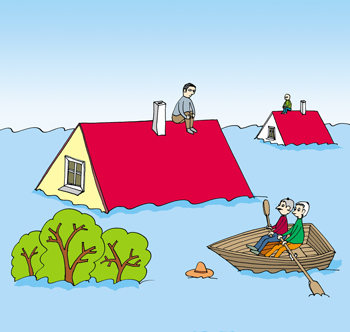
    Flood. Man on the roof of his house

    A great flood comes, and a man gets on top of the roof of his house.  A man comes by in a canoe.  “Hop in!”  he yells.  The man on the roof calmly tells him no thanks.  The water gets higher.  A couple in a boat comes by.  “Get in!  The water is rising!”  The man on the roof calmly denies the gesture and stays on his roof.  The water gets higher.  The man on the roof is close to being overtaken by the water.  A helicopter comes by and throws a rope down.  The man on the roof waves it away.

    The man on the roof is finally overtaken by the water and drowns.

    When in heaven he looks to God and asks, “I prayed the whole time I was on the roof.  Why didn’t you help me?”

    God replies, “I sent you a canoe, a boat, and a helicopter!  What else did you want from me?”

    I know what the scriptures tell us.  I know God wants wise servants.  I know he wants us to be prepared.  I know He wants us to work problems out in our minds and learn to problem solve.  I know we’re here to learn to make good choices. 

    But I also know we’re here to learn faith.  We’re here to learn obedience.  We’re here to learn to trust God.

    I hope I live my life with a firm belief that God will guide me wherever He needs me as long as I do my part.  I often joke about how God holds my hand and guides me to places, decisions, people.  I often joke how God has been there with me every step of the way.  He has blessed me in so many profound ways I can’t deny His loving guidance in every moment of my life.

    I know that God still wants me to do my part.

    So, I put my faith forward.  God will get me there!  Or does God put a gas station directly on my journey so I can get gas?  How often is God up there, exasperated, “I put the gas station right along the way!”  Or even better, “I put CJ and Beth around you to balance out your silly refusal to take care of yourself!”

    I wonder how often I’m turning away the canoe, boat, and helicopter.  I only hope I’m ultimately doing what God wants me to do.  I think that’s the best any of us can do.

  • Faith and Signs

    Faith and Signs

    3 Nephi chapter 2 is a fascinating and important part of the Book of Mormon.  It’s especially important to our day.  There’s a chance our moment in history could be parallel to this time in the Book of Mormon record.

    The start of chapter 2 tells us that despite many signs, wonders, and prophesied events coming about, the people continued to harden their hearts and scoff at the idea of a being like Jesus Christ, the Son of God, ever visiting them.   

    Verse 8 reads:

    “Now the Nephites began to reckon their time from this period when the sign was given, or from the coming of Christ; therefore, nine years had passed away.”

    There are two important points I want to make here.

    First, many miraculous signs happened.  This resulted in an extremely short-lived conversion. 

    3 Nephi 1:22 in part reads:

    “the more part of the people did believe, and were converted unto the Lord.”

    A mere 3 years (3 years!) and we have 3 Nephi 2:1:

    “the people began to forget those signs and wonders which they had heard, and began to be less and less astonished at a sign or a wonder from heaven, insomuch that they began to be hard in their hearts, and blind in their minds..”

    We see here how an outward sign can have a bolstering effect on faith, but ultimately signs create temporary faith.  The people didn’t do the necessary work to grow, strengthen, and develop their faith.  Within 3 years those signs were a distant memory.  Their day to day deeds and thoughts were what shaped them.  Those who continued to pray, look for Christ, and study the words of the prophets looked forward to a miraculous day.  Those who saw a sign and only momentarily changed their thinking or habits soon fell back into their disbelieving and hard-hearted ways.

    Terrance Szink says, “the conversion was the result of an outward sign and required no work on the part of the people.  They had seen the sign but, for the most part, they did not sustain their faith.”

    Faith must be practiced daily. If not, it will die like a flower without water.  We are entering a time just like this time in the Book of Mormon.  We are entering a time when signs will become common.  Miraculous events will happen around us.  How many around us will harden their hearts and not see what is right in front of them? 

    There will come a time when Biblical prophesies will start to be more obvious.  There are already signs around us that have been prophesied for centuries.  These signs will become more obvious.  This will only temporarily make people look to God, if it does at all.  Soon people will scoff at believers. People will speak of science and coincidence.  Many will say Christ is not coming because He doesn’t come in their expected timing.  Christ will come exactly when He intends to.

    The second point I want to make is more just an interesting thought.

    How funny is it that a vast majority of the people in the Book of Mormon quickly forgot the signs they’d seen? Yet, as a whole, the people changed how they kept track of time.  They started to speak of years in terms of the time since the sign appeared.  How ironic is that?  These people that didn’t believe the sign still acknowledged it was important enough that they changed how they tracked time.

    It’s reminiscent of today.  As a society we use the year 2020 as the time since Christ’s birth.  Yet, how many people among us today don’t even believe in Jesus Christ?  How many don’t believe He was the Son of God? He was important enough for us to mark our calendar by Him but not important enough to actually believe in Him.

    I believe many will have to answer for this hypocrisy one day.  The signs of Christ are obvious.  The impact He had on the world are so profound, and yet many still deny.  One day we will all have to stand before God and either accept Jesus Christ as our Savior, or reject Him.  I hope on that day our hearts are not hardened and we don’t deny the grace and love that will be right before us.

  • The Rock Christ would Build His Church Upon

    The Rock Christ would Build His Church Upon

    In a book called The Forerunners by Mark E. Petersen, I was introduced to an interpretation of a scripture that I’d read and heard quoted a thousand times.  The truth of the interpretation was so clear I couldn’t believe I’d lived so long with such a clear misunderstanding of the meaning of that important scripture.

    The verse is Matthew 16:18 which reads:

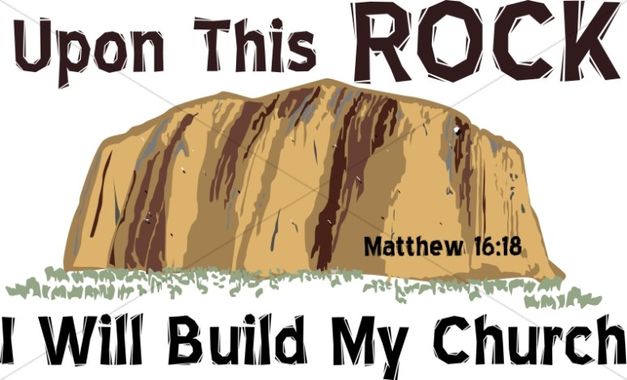
    18 And I say also unto thee, That thou art Peter, and upon this rock I will build my church; and the gates of hell shall not prevail against it.

    Let’s give some context to this important passage.

    Jesus was with His apostles and He asked a simple question:  Who do the people say I am? (verse 13)

    They responded with some of the rumors out there – Some thought Jesus was the returned John the Baptist, some thought Elias, others thought Jeremias or another of the prophets.  (verse 14)

    Jesus asked, who do you say I am? (verse 15)

    Peter, Jesus’s first apostle responded, “Thou art the Christ, the Son of the living God.” (verse 16)

    Christ responds, “Blessed art thou, Simon Barjona (Peter): for flesh and blood hath not revealed it unto thee, but my Father which is in heaven.”

    Which leads us to our important verse and the part I always misunderstood.

    Christ says to Peter, “thou art Peter, and upon this rock I will build my church.”

    One more quick review to make the point clear:

    1. Christ says who am I?
    2. Peter answers – you are the Christ, the Son of the living God.
    3. Christ responds – blessed are you, for flesh and blood (man) has not revealed this but my Father who is in heaven has revealed this to you.
    4. Christ, in responding to Peter stating properly that He is the Christ, says “thou art Peter.”
    5. Then, adding to what Jesus said about the truth being revealed to Peter by God, Jesus says, “and upon this rock I will build my church.”

    Christ wasn’t saying the church would be built on Peter.  Christ’s Church couldn’t be built on anyone’s shoulders but His own.  Additionally, Christ is adding that the testimony of Him could only be received by man from Heavenly Father, more specifically the Holy Spirit.  The rock of Christ’s Church would be Christ Himself, and the testimony of Christ only comes by revelation from the Holy Spirit.  Not by flesh or blood, but by Heavenly Father and personal revelation.  Thus, the rock of Christ’s Church would be personal revelation that Jesus is the Christ.

    I was always so confused by this scripture.  Why would the rock, the sure foundation of Christ’s Church be on anyone but Christ?  How could Peter be the foundation?  He is not.  There is only one foundation.  There is only one name by which we can receive salvation, there is only one person who can save us.  That is Jesus Christ.  The Son of the living God.  Our Savior and King.

    My foundation - $Christ ministries$

    This scripture, when properly read, emphasizes the importance of coming to a personal testimony that Jesus is the Christ.  We’re reminded that the testimony of Christ does not come from man.  It comes from personal revelation.  It is unfortunate that personal revelation has been removed from much of modern Christianity.  Modern Christian churches say the heavens are closed and God speaks to us no longer.  He only speaks to us through His ancient word.  But what of today?  How do we come to a testimony of Jesus Christ but through revelation from heaven and the Holy Spirit?

    If God no longer speaks to man then man can no longer receive testimony of Jesus Christ.  But men receive testimony of Jesus Christ daily.  Every day millions worship Jesus Christ.  Every day thousands come to the realization that only through Christ can they be saved.

    Revelation is alive.  The Holy Spirit talks to us daily.  He reveals the testimony of Christ to the hearts of man.  God speaks to us;  through scripture, through prophets, and most importantly through the Holy Ghost.

    A quote from William Barclay of the Church of Scotland:

    “The rock is the truth that Jesus Christ is the Son of the living God.  To Peter that great truth had been divinely revealed.  It was God Himself who had opened Peter’s eyes to that great discovery.  The fact that Jesus Christ is the Son of God is indeed the foundation stone of the Church’s faith and belief.  On that great truth the Church is founded for ever and ever.  This explanation holds that the divinely revealed truth that Jesus is the Son of God is the only foundation on which the Church is founded.”

    The Church of Jesus Christ of latter-day Saints.

    It was restored to point men to Christ.  His name is in the name of His Church.

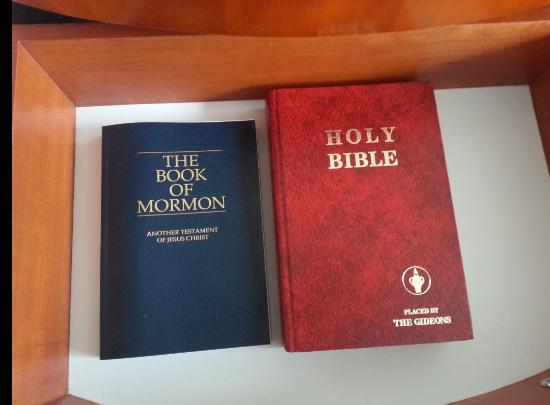
    Jesus Christ still is actively interested and engaged in the affairs of man.  Under the direction of His Father, our Father, He sent an angel named Moroni to reveal an ancient record to his modern-day prophet.  He, through the Holy Spirit, directed and guided Joseph Smith through the translation of a record that would make clear His doctrine and the saving ordinances of His gospel. Not to replace the Bible, but to add a second testimony to it.

    The testimony of the Bible, the Book of Mormon, and my testimony is this: Jesus Christ lives.  He directs His church.  He loves all and wants us all to return to Him.

    This is the foundation of His Church.

    “Build firmly upon the rock of your Redeemer. Treasure His life and teachings. Follow His example and commandments. Embrace the powerful gifts of His Atonement. As you do, I promise you that you will see the [challenges of life] for what they are, [and] the spiritual rock under your feet will be solid and secure.” From #ElderAndersen’s pinterest.com/pin/24066179229002852 inspiring #LDSconf facebook.com/223271487682878 message lds.org/general-conference/2014/04/spiritual-whirlwinds #ShareGoodness
  • Truths Removed from the Bible:  What does the Book of Mormon tell us about Baptism?

    Truths Removed from the Bible: What does the Book of Mormon tell us about Baptism?

    I like to think about what critics would say as proof against the Book of Mormon.  I think it helps to have responses to honest concerns about its validity.  I always hope something I read, know, or especially my testimony can one day help someone to see what I see, the truth of this ancient record. 

    The Book of Mormon makes a very important claim.  The claim is that many plain and precious truths have been removed from the Bible over time.  When Joseph Smith first translated the Book of Mormon this was an outlandish and inflammatory statement.  Even more so than today. Christianity in the early to mid-1800s had a firm belief that the Bible was infallible. 

    From a website (https://stepbystep.alancminer.com/) I’ve loved using to study alongside the Book of Mormon, I read this:

    “Richardson, Richardson and Bentley write that while the Book of Mormon testifies to the authenticity of the Bible, it does not claim that the Bible is without error. It specifically states that there were many “plain and precious things” that were deleted from its pages through the evil works of men. (See 1 Nephi 13:20-32; 19:10-12; 20:1-3; 2 Nephi 3:5-22; Alma 33:3, 13, 15; 34:7; 46:23-27; Helaman 8:19-20; 15:11; 3 Nephi 10:14-17; 12:13, 17-19, 22, 29-30; 14:1.)

    Scholars of the Bible have found indisputable evidence that the Bible has indeed suffered many deletions. Non Mormon scholarship has concluded that the gospels found in the New Testament have also been manipulated.”

    Critics may ask for specific examples of any “plain and precious truths” found in the Book of Mormon that are not also found in the Bible.

    The website I mentioned above goes on to list 24 plain and precious truths removed from the Bible and where they are laid forth in the Book of Mormon.  I’d like to go over an extremely important one.

    Baptism is only for those who are accountable (Moroni 8:5-23).

    I know of nowhere in the Bible that lays forth the age of accountability. Should children be baptized?  We know baptism is of the utmost importance:

    John 3:5 “Jesus answered, Verily, verily, I say unto thee, Except a man be born of water and of the Spirit, he cannot enter into the kingdom of God.”

    What does the Book of Mormon teach us on the subject of baptism? Moroni chapter 8 is full of profound truths found nowhere in the Bible. I will quote portions of the chapter here but encourage everyone to read the chapter and ponder its truthfulness.

    8 “the whole need no physician, but they that are sick; wherefore, little children are whole, for they are not capable of committing sin; wherefore the curse of Adam is taken from them in me (Jesus Christ), that it hath no power over them”

    9 “I know that it is solemn mockery before God, that ye should baptize little children.”

    10 “repentance and baptism unto those who are accountable and capable of committing sin; yea, teach parents that they must repent and be baptized, and humble themselves as their little children, and they shall all be saved with their little children.”

    11 “And their little children need no repentance, neither baptism.”

    12 “But little children are alive in Christ…if not so, God is a partial God, and also a changeable God, and a respector of persons; for how many little children have died without baptism!”

    15 “For awful is the wickedness to suppose that God saveth one child because of baptism, and the other must perish because he hath no baptism.”

    19 “Little children cannot repent; wherefore, it is awful wickedness to deny the pure mercies of God unto them, for they are all alive in him because of mercy.”

    20 “And he that saith that little children need baptism denieth the mercies of Christ, and setteth at naught the atonement of him and the power of his redemption.”

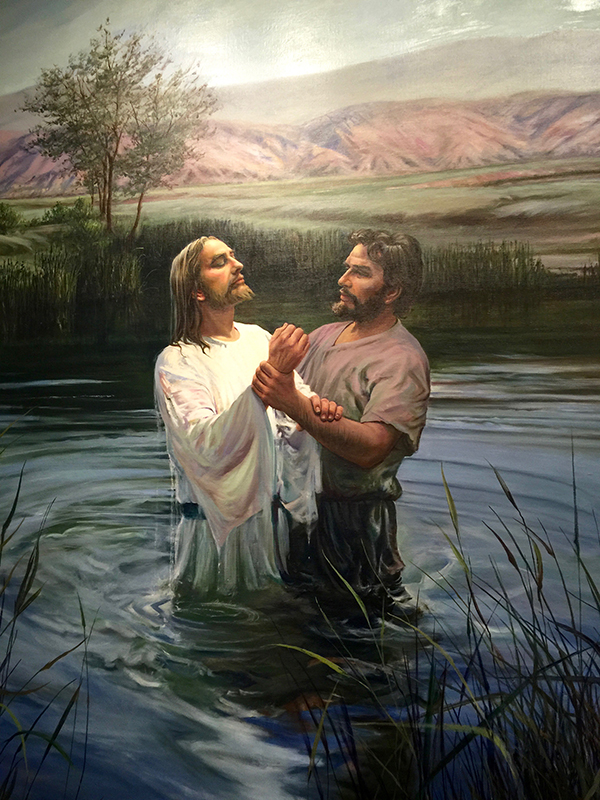
    Girl Being Baptized

    Who can read this and deny the truth that speaks to your heart and soul?  It is so clearly laid out. So perfectly explained. 

    What about how to baptize?  There is so much confusion in the world on not only when but how.  Does the Book of Mormon provide an answer?  Of course!  3 Nephi 11:24-28.

    24 And now behold, these are the words which ye shall say, calling them by name, saying:

    25 Having authority given me of Jesus Christ, I baptize you in the name of the Father, and of the Son, and of the Holy Ghost. Amen.

    26 And then shall ye immerse them in the water, and come forth again out of the water.

    27 And after this manner shall ye baptize in my name; for behold, verily I say unto you, that the Father, and the Son, and the Holy Ghost are one; and I am in the Father, and the Father in me, and the Father and I are one.

    28 And according as I have commanded you thus shall ye baptize. And there shall be no disputations among you, as there have hitherto been; neither shall there be disputations among you concerning the points of my doctrine, as there have hitherto been.

    How lucky we are to live in the dispensation of the fullness of times. I’m grateful for the Book of Mormon. I’m grateful that it clarifies what has been a point of contention within Christianity for centuries.

    Christ was our ultimate example.

    2 Nephi 31:5 And now, if the Lamb of God, he being holy should have need to be baptized by water, to fulfil all righteousness, O then, how much more need have we, being unholy, to be baptized yea, even by water!

    Click below to learn more about baptism as it has been perfectly restored through the Gospel of Jesus Christ by the Church of Jesus Christ of Latter-day Saints.

    https://www.churchofjesuschrist.org/study/manual/true-to-the-faith/baptism?lang=eng

  • Pride of the Gentiles

    Pride of the Gentiles

    I write this as a complement to my testimony of the Book of Mormon as the Word of God.

    For the purposes of what I’m writing I will focus on the Old Testament.  I would gladly speak on the New Testament, but for simplicity I will focus on the Old.

    Let’s look historically at the creation of the Bible.  The text of the Old Testament was preserved and handed down by the hands of the Jews.  It was protected by the Jews.  If not for the Jews, there would be no Old Testament today.

    By definition, a gentile is a person who is not Jewish.  The Gentiles received the Bible from the Jews.  Most of us are gentiles.  If you come from Europe, have Catholic, Protestant, or pretty much any other Christian ties in your ancestry, you are most likely considered a gentile.  Again, none of us would have the Bible today if it weren’t for the Jews.

    It’s those same Gentiles who today say, A Bible, a Bible, we have a Bible! (2 Nephi 29:3).  But how do you have the Bible?  You have it from the Israelites, from the Jews.  You didn’t do anything to gain it.

    When Christ was crucified and resurrected the Jews of old who believed in Christ had a difficult time moving past their traditions.  If you read about Paul and his missionary efforts, you will see that a major portion of his time was spent fighting Judaizers.  Judaizers were “Christians in the primitive church who taught it was necessary to adopt Jewish customs and practices, especially those found in the Law of Moses.”

    From History of the Christian Church, 1, 338 regarding Judaizers:

    These men were Christians in name, but narrow-minded and narrow-hearted Jews in fact.  They were scrupulous, pedantic, slavish formalists, ritualists, and traditionalists of the malignant type.  Circumcision of the flesh was to them more important than circumcision of the heart, or at all events an indispensable condition of salvation.  Such men could, of course, not understand and appreciate Paul, but hated and feared him as a dangerous radical and rebel.  Envy and jealousy mixed with their religious prejudice.  They got alarmed at the rapid progress of the gospel among the unclean Gentiles who threatened to soil the purity of the church…”

    For just a couple of examples of Paul’s contention with Judaizers see Acts 15:23-29, Galatians chapters 3 and 4, Acts 21: 20-25.  That last example in Acts 21 would be roughly the year AD 58.  At this point, 25 years after Christ’s death, there were still thousands of Jewish Christians following the Law of Moses.

    I give this historical background to make a comparison to the Christian gentiles of today. 

    Christians who cannot accept any scripture outside of the Bible are the Jews of old.  Holding firm to their traditions, fighting to preserve what they’ve always known, refusing to see the greater blessing of the Gospel right before them.

    The Gentiles of today say, “I have a Bible.”  By what source have you gotten your Bible?

    2 Nephi 29 4-5:

    4 But thus saith the Lord God: O fools, they shall have a Bible; and it shall proceed forth from the Jews, mine ancient covenant people. And what thank they the Jews for the Bible which they receive from them? Yea, what do the Gentiles mean? Do they remember the travails, and the labors, and the pains of the Jews, and their diligence unto me, in bringing forth salvation unto the Gentiles?

    5 O ye Gentiles, have ye remembered the Jews, mine ancient covenant people? Nay; but ye have cursed them, and have hated them, and have not sought to recover them. But behold, I will return all these things upon your own heads; for I the Lord have not forgotten my people.

    The Jews couldn’t accept further revelation – that Jesus was the Christ and in Him the law was fulfilled.  Gentiles today  – who have only been shown the mercy of God by being adopted into Christ’s fold – do the same thing.  They have a Bible, they need no “other” Bible.

    What does this speak of?  It speaks of pride.  This attitude says – “God has given us all He’s going to give us and now it’s up to ME, MAN to interpret what God is saying.”  This pride removes God from the equation.  You think God has disowned us?  You think He’s given us all He can or will give us?  WHY?!?!?  God loves His children.  Has He abandoned us?

    The hard-hearted, prideful, and stubborn attitude of holding onto traditions has kept people from Christ since the start of mankind and it continues today.  Let go of pride and accept that God still speaks to man.  Pride makes us interpret the Bible how it suits us.  Let go of pride and let God guide us.

    The denial of modern revelation is the removal of God.  It is the denial of either God’s love for us or His power in redeeming His children.  How can people who can only accept the Bible not see that?  They’ve removed a living God for God’s word.  The Bible is God’s word to us, but what good is it if you don’t understand it?  What good is it if you kick against the pricks?  Let the spirit work within you and accept all truth God will give you.  He will enlighten your mind and expand your spirit, but you must let Him, and stop removing Him by saying you have the Bible and that’s all you need.

    The great apostle Paul spent his entire missionary career fighting against the Judaizers.

    Today modern-day missionaries of the Church of Jesus Christ of Latter-day Saints spend so much time fighting modern day Judaizers, traditionalists.  We must Bible bash, meanwhile we have a far greater message: GOD STILL LIVES, GOD STILL SPEAKS, REVELATION IS ALIVE.  He has provided a new Book of Promise – the Book of Mormon – to help and guide us. Not to replace the Bible but to supplement it.  READ IT.  And see for yourself if it speaks to your spirit. See for yourself if God still loves His children. See for yourself if Jesus is the Christ and if HE IS STILL redeeming his people.  Set aside your pride!

    2 Nephi 29: 6-9

    Thou fool, that shall say: A Bible, we have got a Bible, and we need no more Bible. Have ye obtained a Bible save it were by the Jews?

    Know ye not that there are more nations than one? Know ye not that I, the Lord your God, have created all men, and that I remember those who are upon the isles of the sea; and that I rule in the heavens above and in the earth beneath; and I bring forth my word unto the children of men, yea, even upon all the nations of the earth?

    Wherefore murmur ye, because that ye shall receive more of my word? Know ye not that the testimony of two nations is a witness unto you that I am God, that I remember one nation like unto another? Wherefore, I speak the same words unto one nation like unto another. And when the two nations shall run together the testimony of the two nations shall run together also.

    And I do this that I may prove unto many that I am the same yesterday, today, and forever; and that I speak forth my words according to mine own pleasure. And because that I have spoken one word ye need not suppose that I cannot speak another; for my work is not yet finished; neither shall it be until the end of man, neither from that time henceforth and forever.

    How accurate are those words written nearly 2600 years ago?  Inspired writing.  It is my testimony that the Book of Mormon can only bring a person closer to the Savior of the world, Jesus Christ.  I wish we could all remove our pride and stop being like the Judaizers of the primitive Church.  Accept that Christ is as interested in us today as He was when He walked the earth 2000 years ago.  Read His word.  Hear His word.  Feel his word.  Accept his words. All of them.

    Jesus Teaching in the Western Hemisphere (Jesus Christ Visits the Americas)