Tag: church talk

  • Text to a Friend

    Text to a Friend

    I want to share an exchange with one of my oldest theological friends. I invited this friend to hear me speak in church. My topic was Ephesians 1:10 which reads:

    “That in the dispensation of the fulness of times he might gather together in one all things in Christ, both which are in heaven, and which are on earth; even in him”

    I may share that talk sometime in the future.

    My friend was invited to the talk and like the consistent and reliable friend he has been now for years whether across state lines or in the state of Arizona, showed up. I went about ten different directions before I settled on where I would go with my talk. The direction I finally settled on was one in which I knew this friend would disagree. I knew because it was a topic we had regularly disagreed on.

    Afterwards, this friend gave me expected thoughts regarding his side of things and how they relate to my talk. He was pointing out where he disagreed. This is why we have such good conversations! I already knew his points as we’d had the discussion before.

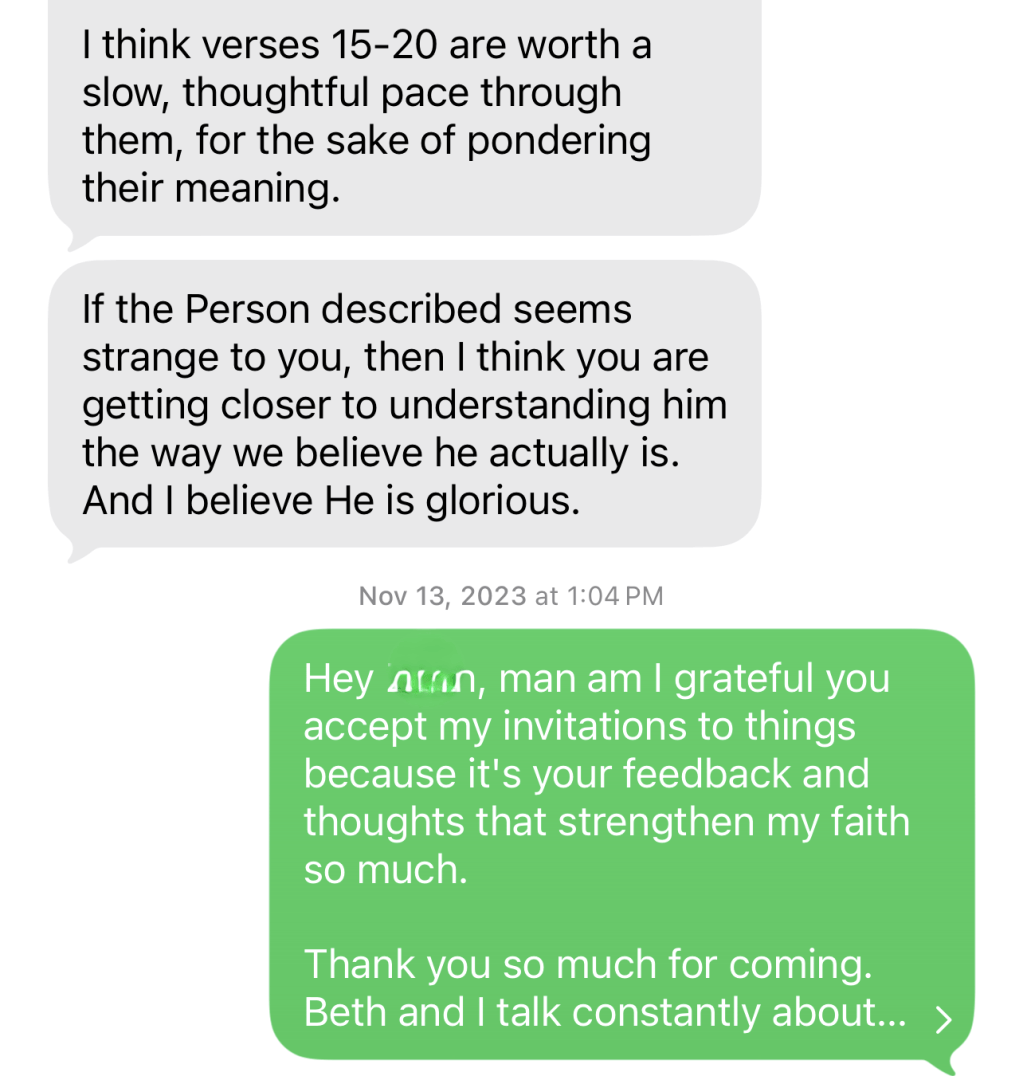
    It resulted in a text I got to send to him that I would like to share (yes, this was one text):

    “Hey, man am I grateful you accept my invitations to things because it’s your feedback and thoughts that strengthen my faith so much.

    Thank you so much for coming. Beth and I talk constantly about how we can’t trust people to keep commitments and do things they say they’ll do. You and [your wife] are one of two couples in our life (outside of family) that when you say you’re going to do something or be somewhere we know you will be. Thank you for that.

    I knew exactly what thoughts you’d have on my talk and I welcome them. I knew it would be somewhat, maybe inflammatory, to you, as I know it touched on things we’ve disagreed on from the beginning. I am glad that you appear to have not been offended by my words. Our disagreement really comes down to one thing, I think. And that’s if the Book of Mormon is true.

    I appreciated the exercise you gave me. As I did it, I came out more convinced that Jesus Christ is the literal Son of God, as the scriptures say. That’s the thing. You read the Bible and see God and Jesus Christ in one way. I see it, without a doubt in my mind, another way. Nothing will change that.

    But why do I see it another way? How can something so clear to you, and something so clear to me, be the opposite?

    As I said in my testimony, it comes down to a prophet. How can I know Jesus Christ is who He is? Because a prophet told me. How do I know he’s a prophet? He would have had to do something miraculous.

    I’ve concluded the Book of Mormon is the miracle God provided so I could know Joseph Smith was who he said he was. And if he was who he said he was, then Jesus Christ is who Joseph Smith said He is: the Son of God, on God’s right hand, as the scriptures say.

    It’s here that I finally thank you for giving me this great gift. It was years ago that you said you couldn’t accept the Book of Mormon because there was no proof the way there was with the Bible – archaeological and otherwise. I have spent the past years seeking “proof” that the Book of Mormon is what Joseph Smith claimed it to be. My list now is well over 400 items (*that was true in 2023 when this was written, now well over 800 individual items) and I am excited to share it with you one day.

    I have you to thank for that. You have built my testimony in a miraculous way and I thank our Heavenly Father, and you for that.

    Of course, “proof” is an interesting word. Despite all the records, eye witnesses, evidences, and testimonies, many still deny Jesus Christ existed, the Bible is the Word of God, etc. My “proof” may not do it for you. But when I review my list, there is not a shred of doubt in my mind that the power of God provided us the Book of Mormon. My faith has become knowledge.

    Until this life ends and we get to review everything, you will never understand how fruitful you have been to building my faith and testimony. Thank you, friend.

    Jesus Christ is the center of everything. He is my King, my Savior, my Redeemer. He is my advocate with the Father. Without Him I have nothing. Without Him I am nothing. I know we see Him differently. That doesn’t change who He is and what He’s done for us. Maybe one of us will change our minds one day. But ultimately, as long as we believe Jesus Christ is our Savior and King, one day we’ll both stand before Him and we’ll know. And it won’t matter who was right or who was wrong. Only He will matter. What a day that will be! Man, I look forward to it!”

    I share this because I think it’s important. The point of Christ is to bring us together. Though we disagree on many, many doctrinal points, this friend and I have fostered a relationship of discussion, debate, and disagreement, always founded on love and respect.

    I am truly grateful for how this person has strengthened me in Christ. That’s what this life is about. There can be good reason there is disagreement in the world – it can be for us to learn how to coexist with those we disagree with. We all have unique experiences in this life. Every moment shapes us and every experience we have changes the way we view the world. It’s through these experiences and listening to the viewpoints of others, someone who has had a vastly different life than we have had, that we can grow and become better.

    The world needs a little more of this.

  • Beth’s Talk on Mosiah 3:19 (January)

    Beth’s Talk on Mosiah 3:19 (January)

    This is a talk, exactly as written, by Beth, that she gave in church in January. She rehearsed the talk verbally to me multiple times before I heard it in church. Of course, through hearing it I knew it was a great talk, but it wasn’t until proofreading and preparing to post this that I was struck by how phenomenal a talk this really was. Hope you enjoy reading it as much as much as I did. And now, Beth –

    Mosiah 3:19 Talk
    January 9, 2022
    Good morning brothers and sisters.
    I wanted to start by introducing my family as we are one of the families that were blended into this ward with the recent changes in the stake. My name is Elisabeth Quackenbush. My husband is Brayden Quackenbush. We met in the Scottsdale Young Single Adult Ward in 2017 and have been married for over 2 years. We have a one year old daughter named Ivy. You’ll see her running around Sunday School for another 5 months but she is very excited to start nursery after that.

    The topic I was given to speak on this morning is the scripture Mosiah 3:19. When I was informed this was my assignment I wasn’t really surprised. This scripture comes into my mind a lot and is brought up in conversations about life all the time when I’m chatting with my husband. I think it sticks in my mind because it stands in such contrast to a lot of the attitudes of the world these days.

    For those of you that memorized scripture mastery back in the day you may remember this scripture, but as a reminder, this scripture is King Benjamin speaking to his people in the Book of Mormon. It reads,

    “For the natural man is an enemy to God, and has been from the fall of Adam, and will be, forever and ever, unless he yields to the enticings of the Holy Spirit, and putteth off the natural man and becometh a saint through the atonement of Christ the Lord, and becometh as a child, submissive, meek, humble, patient, full of love, willing to submit to all things which the Lord seeth fit to inflict upon him, even as a child doth submit to his father.”

    When we break down this verse, we can derive meaning in a variety of ways. The first that I noted is that the natural man is inherently selfish. The second is the importance of change to the Eternal Plan of Happiness.

    Boyd K Packer stated in his 1990 talk, “Put Off the Natural Man, and Come Off
    Conqueror”:
    “Unchecked selfishness [of the natural man] stubbornly blocks the way for developing all of the divine qualities: love, mercy, patience, long-suffering, kindness, graciousness, goodness, and gentleness. Any tender sprouts from these virtues are sheared off by sharp selfishness. Contrariwise, I cannot think of a single gospel covenant the keeping of which does not shear off selfishness from us.”

    Through the influence of the Holy Ghost, and the atonement of Jesus Christ, we can and should change from the narrow focus of the natural man and become, “submissive, meek, humble, patient, full of love, and willing to submit to the will of God.”

    This idea of our ability and strength to change stands in stark contrast to the pervasive attitude of our society. This attitude states that we are born a certain way. We can’t change, and even shouldn’t want to change. If we do change, we are inauthentic. On the surface, this has a false sense of empowerment, I think. However, this idea that change is bad and that we must only be one way for the rest of our life is truly limiting, almost an eternal purgatory of mediocrity. Compare this to the freedom and growth permitted to us through Jesus Christ’s suffering, that we may improve and become like our Heavenly Father and Savior, Jesus Christ.

    My husband and I have had the opportunity to have many deep, religious
    conversations with friends of a variety of backgrounds. We often come across
    criticism of our faith’s belief that we can take steps, including repentance, baptism, and participating in temple ordinances, to change and become like God. We are accused of valuing works and forgetting the grace provided through Jesus Christ. On the contrary… His grace is the key element that permits us TO become new beings.

    In 2 Corinthians 5:17 we read, “Therefore if any man be in Christ, he is a new
    creature: old things are passed away; behold, all things are become new.”

    Brad Wilcox does a beautiful job in his BYU talk, “His Grace is Sufficient” at outlining how the Atonement of Jesus Christ, through His death and resurrection, provides us the need to change… (forgive me for this lengthy quote but as many of you know, this talk is incredible…)

    “[Yes, we are saved by Grace but] Have you been changed by grace? [We] are so excited about being saved that we are not thinking enough about what comes next. We are so happy the debt is paid that we may not have considered why the debt existed in the first place. Latter-day Saints know not only what Jesus has saved us from but also what He has saved us for.

    “A life impacted by grace eventually begins to look like Christ’s life. While many Christians view Christ’s suffering as only a huge favor He did for us,
    Latter-day Saints also recognize it as a huge investment He made in us.

    “As Moroni puts it, grace isn’t just about being saved. It is also about becoming like the Savior. The miracle of the Atonement is not just that we can live after we die but that we can live more abundantly. The miracle of the Atonement is not just that we can be cleansed and consoled but that we can be transformed.“

    Again, just think for a minute… how does that compare to what we are being taught by the world? I can’t change, I shouldn’t change…

    HOW DO WE PUT OFF THE NATURAL MAN AND BECOME LIKE CHRIST?

    We can actively seek this positive change…

    In her 1998 BYU Speech, Wendy Watson, now well known as Wendy Nelson, lists some ways. One is reflection. She notes how Alma directs this type of reflection:

    “Just how does Alma invite these change-inducing reflections? One way is through his use of questions. In Alma 5 alone, more than 40 questions are offered—questions like:
    Have ye received his image in your countenances? Have ye experienced this mighty change in your hearts? . . .
    . . . If ye have experienced a change of heart, and if ye have felt to sing the song of redeeming love, I would ask, can ye feel so now?‘ [Alma 5:14, 26]. Through the process of persistent questioning, Alma invites us to reflect over and over again: on our status with the Lord, on our spiritual growth and development, on things that need to change or have changed—and before we know it our desire for more change increases.”

    Another idea is to listen to the uplifting voices of authority in your life remembering, “As helpful as human voices of authority are, none can or should replace the ultimate voice of authority—the Word himself: the Savior Jesus Christ. What are you doing to hear his voice in your life? What are you doing to establish his voice as the voice of authority for you?”

    Other ways we can develop this change to become more like Him… Consistently and earnestly repent, seek out holy places, take steps of faith, pray to Him daily.”

    Sometimes change finds us…whether it be through loss, grief, depression, or trials in life, change is often thrust upon us in this mortal life. Again, the world finds few answers as to why there is such suffering and grief in the world. His eternal plan of growth and development is sometimes the only answer that makes sense. If we are to become like Christ, our innocent brother that felt all the sufferings of the world, how can we expect to be truly changed without some suffering of our own?

    Peter in speaking of [trials], said: “Beloved, think it not strange concerning the fiery trial which is to try you, as though some strange thing happened unto you: But rejoice, inasmuch as ye are partakers of Christ’s sufferings; that, when his glory shall be revealed, ye may be glad also with exceeding joy.”

    When we endure this life, put off the natural man, and develop into more Christ-like beings, we set ourselves up to feel an even greater degree of joy in this life and in eternity.

    This topic makes me think of a time when I came back to church after living a life that was not in line with what I knew to be right. I made many positive changes when I started coming back and attending the Scottsdale Young Single Adult ward. I starting observing the sabbath day, stopped a lifestyle of college partying, broke off a serious relationship, and made several other difficult but important decisions.

    However, with all this positive change and shunning of the enticings of the natural man, I still felt like I wasn’t receiving the blessings I thought I would. I wallowed in self pity over my own suffering for a while because of this and even wondered if all of my change was for nothing.

    However, I eventually decided I would stop focusing on what I needed and instead turned outward. I made it my mission to seek anyone in my ward that seemed lonely as I was. I sought opportunities to serve those that were also going through a variety of trials. And a miracle happened! The less I focused on my pain, my loneliness, my loss, and focused on loving those around me as Christ did, I really came to find true joy.

    I couldn’t believe how sincerely I loved everyone around me. I didn’t feel lonely. I developed new, Christ-like attributes. And ultimately, I shunned the ultimate trait of the natural man – selfishness. What a blessing that lesson was for my life.

    I know how hard it can be to put off the feelings we have as humans in a difficult mortal journey. It is something we will actively have to work for as long as we live. However, I know that when we let ourselves change and take on the characteristics of Christ we will prepare ourselves to find real joy in eternity. We will truly have cause to rejoice in his second coming.

    I say these things in the name of Jesus Christ, amen.