This is a version of an essay I wrote for a science and religion course. That’s why it has such an “official” tone, and the headlines. I don’t share this because I think it’s an extraordinary essay. But I do think I made some decent points about the “God issue” in science. When you spend this much time writing an essay that fits the theme of your blog, it’s just gotta be shared. So here’s my essay on intelligent design, evolution, and God.
Intelligent Design and Evolution
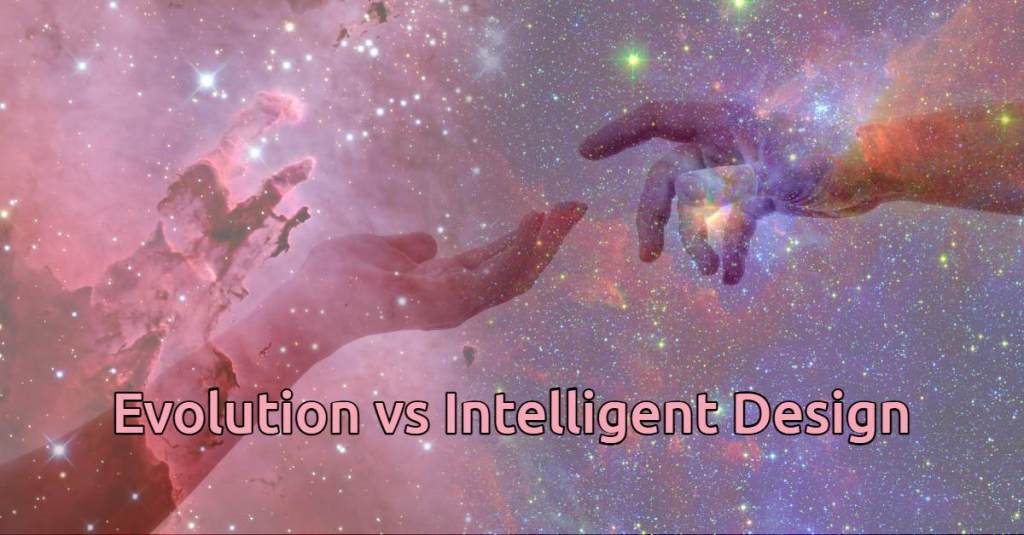
God is the center of the debate between science and religion, and in particular the debate between the theories of evolution and intelligent design. To claim any other conflict ahead of the question of whether God exists is to distract from the root cause that separates these theories. If the question of God’s existence could be solved one way or another, then evolution and intelligent design could coexist and potentially benefit one another. Unfortunately, the existential question of God will never be solved by science. Therefore, with God being the center of the issue, exploring the “God issue” between evolution and intelligent design is the best way to help the two theories reconcile with one another, even if the true question, “does God exist?” is never answered.
The God Question
Believers of evolution and believers of intelligent design have more to agree upon than is often realized. However, there is one topic or question that creates a gulf between the two fields. That question is: Does God exist? When evolutionists and intelligent design proponents come to understand this as the main question that separates them, it may be possible to relate and coexist, and therefore grow as fields of knowledge alongside one another. It is the loud voices of ardent atheist evolutionists such as Richard Dawkins, Sam Harris, and Daniel Dennett who pronounce aggressive disbelief in God, and it is the loud and passionate voices of creationists who oppose belief in the undeniable evidence of evolution that create this void (Wolf, 2006). The milder, middle-of-the-road voices get drowned out by the louder minority. The believer in intelligent design who accepts the facts of evolution and the believer in evolution who can see the merits in intelligent design theory are the voices that bring these two fields to an agreement that benefits both. Intelligent design need not deny many aspects of the theory of evolution. Evolution need not devalue the merits of the theory of intelligent design. At the root of the conflict is the belief in God. Coming to understand God as the major issue and question can bring both sides into more agreement, or at the very least, a middle-ground of mutual understanding.
Historical Belief in God
The thinking of the world has transitioned aggressively from a belief in God. While there has been a movement away from God, especially in scientific communities, as can be illustrated in countless scholarly writings such as The God Delusion (Dawkins, 2006) and Why Intelligent Design Fails (Young & Edis, 2014), a large portion of the world still believes in some higher power, some creator that put humans on this earth. It is nearly impossible for a firm believer in God to remove that innate belief from their consciousness.
In the book The 5000 Year Leap, Cleon Skousen (2011) discusses John Locke’s famous Essay Concerning Human Understanding. “In it Locke pointed out that it defies the most elementary aspects of reason and experience to presuppose that everything in existence developed as a result of fortuitous circumstance. The mind, for example, will not accept the proposition that the forces of nature, churning about among themselves, would ever produce a watch, or even a lead pencil, let alone the marvelous intricacies of the human eye, the ear, or even the simplest of the organisms found in nature. All of these are the product of intelligent design and high-precision engineering” (Skousen, 2011, pp. 95-96). Locke’s thinking agrees with the teleological argument of intelligent design put forth by William Paley in the 1700s (Crashcourse, 2016). Locke continues to expound on this topic by pointing out how a man can come to know God exists. Skousen concludes with Locke’s thinking, “And because any thoughtful person can gain an appreciation and conviction of these many attributes of the Creator, Locke felt that an atheist has failed to apply his divine capacity for reason and observation” (Skousen, 2011, p. 97).
These examples from Locke are used to illustrate a point. It was not long ago that disbelief in God was deemed a ludicrous proposition. It wasn’t long ago that these theists were the louder voices. Historically, those with no belief in God have been discriminated against and ridiculed similarly to how science ridicules belief in God today. Ridicule of the belief of God is as counterproductive today as the ridicule of not believing in God has been throughout history.
Attack on God
An outspoken opponent of theism in the scientific community is Richard Dawkins. One of the basic attacks Dawkins uses against God is comparing belief in God to belief in any number of mythical creatures. Dawkins often refers to belief in God as being similar to believing in a Flying Spaghetti Monster (Dawkins, 2006). Dawkins says that because people believe in something ridiculous like the Flying Spaghetti Monster, doesn’t mean he has to accept it. This analogy is not close to comparable. There aren’t books handed down for centuries about belief in the Flying Spaghetti Monster. There isn’t a majority of the world population believing in Flying Spaghetti Monsters. We don’t have any support for the existence of Flying Spaghetti Monsters. This is just one example of an unfair attack from the “militant atheism” that Dawkins proposes (Dawkins, 2008).
Scientists like Dawkins ignore the evidence that does exist out there because it doesn’t suit their needs or beliefs. This is the opposite of scientific progress and something Dawkins is “militantly” opposed to. There are many unexplained phenomena with adequate scientific evidence behind that scientists like Dawkins disregard simply because it’s phenomenal and they can’t understand it. Take, for example, near-death experiences. The catalogs and books being put together of people of different cultures, ages, demographics, and backgrounds all detailing a similar experience is dismissed out of hand. Science is based on observation. If any other phenomena like gravity or momentum had as much documented support as near death experiences that have been cataloged, scientists would explore further, not dismiss automatically.
Another main critique of intelligent design is that the theory mentions design without defining who the designer would be. The reason intelligent design refuses to mention the designer is obvious. The mere mention of God is liable to get extreme backlash from the scientific community. Furthermore, it leaves the concept open to the many interpretations of the nature of God and who the creator may be across varying religions. This is an example of why the attack on God is counterproductive. It creates the dynamic where intelligent design theory talks about an ambiguous “designer” without simply stating that the designer is a theorized divine creator. God is the answer to the question of who the intelligent designer would be, and yet because of the aforementioned loud minority, God is not specifically mentioned. The issue is that while so many believe in this designer, in and out of the scientific community, no one can say the name for fear of being criticized.
Intelligent Design within Evolution
There is plausible proof of many elements of evolution. However, this does not remove the possibility of the influence of intelligent design. That is to say, it is conceivable that the world can evolve while also having the influence of an intelligent designer that planned for this evolution and progression. The two theories need not be at odds with one another. Intelligent design and evolution both have holes and flaws in their theories as Darwin himself admitted (Leddra, 2010). Neither theory is perfect. If either theory were perfect, there would be a definitive answer. That’s why they are still classified as theories. The conflict really comes down to one question: is there a God? This is where the entire conflict between intelligent design and evolution lies. That question will not be answered decisively by either science or religion.
Science will not answer whether God exists. That will always be a matter of faith. If that question is answered it will mean that God has revealed Himself and His purpose, as science will never disprove God. This is obvious, for you cannot prove that something does not exist. If there is a God and He reveals Himself and His purposes, designs, and methods to humanity, then the conflict between intelligent design and evolution will instantly become a moot point. Humanity will know for a fact how living things came to be. The question of if they evolved, how they evolved, and God’s role in it, and these debates between intelligent design and evolution will become null and void.
Conclusion
These examples showing the change in how God is perceived in both society and science, and how science has changed in the attack on God, go to show the underlying cause of all the controversy. It is ultimately about the existence of God. We can conclude, then, that it is extremely important for religion and science, and their respective theories, to consider how they can coexist with one another. By rejecting even the possibility of a God, science limits itself and its ability to explore the universe. By rejecting evolution, the theory of intelligent design limits its ability to coexist with science. Science will benefit by cooperation between the theories of intelligent design and evolution. This cooperation ultimately hinges on finding a way to reconcile the question of God, for the ability of all theories to progress to their fullest potential, and the furthering of knowledge for humanity.

 No Coincidences