Tag: example

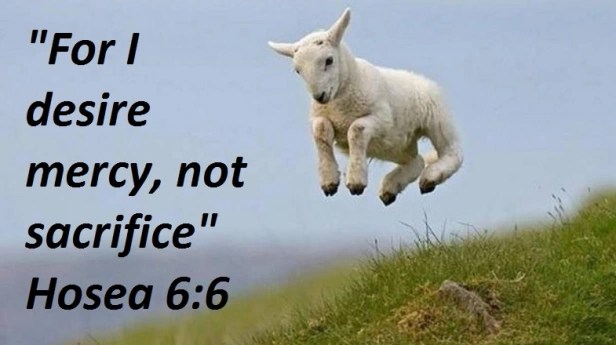
  • The Higher Law and the End of Blood Sacrifice

    The Higher Law and the End of Blood Sacrifice

    Christ fulfilled the law. This was why blood sacrifices were done with after His last and great sacrifice. But what does this mean, practically?

    The Israelites practiced God’s law which was a law of reparations. You take out the eye of an enemy maliciously, you take out his eye. Someone kills your brother, you kill him. The problem with this is obvious. Blood begets blood and when does it end?

    This is why the Israelites practiced the law of sacrifice. They took an animal, that had nothing to do with bloodshed, or theft, or lying, and instead of continuing the constant cycle of reparations, they sacrificed the blood of the animal. This is obviously what Christ represented when He died on the cross. He paid the price for all our sins, because we are incapable of paying such a price.

    This is why Christ preached a higher law. No longer was it an eye for an eye but it was turn the other cheek. No longer was it sue for damages but give your second coat. Christ’s point was that after He died for our sins, animal sacrifices would be done away with, there was no more putting your sins off on a goat. Christ was teaching the end of strife. Someone wrongs you, forgive them and move on. This put an end to the vicious cycle of payback and recompense.

    Who was the greatest example ever of this? Jesus Christ never asked us to do something He didn’t do first, when He was up on the cross, and forgave those who had scourged, beaten, and crucified Him.

    But of course, justice still had to be paid for a wrong done. That’s where Christ came in, paying the ultimate and last sacrifice with His blood. So, we flawed human beings, who sometimes commit wrong without even meaning to, can be forgiven. This is the miracle of what Christ did for us, the miracle of His atonement, the miracle of His forgiveness, and the miracle of the higher law.

  • Maybe (The Story of the Chinese Farmer)

    Maybe (The Story of the Chinese Farmer)

    “There once was a farmer whose horse ran away. Upon hearing the news, his neighbors came to visit. ‘Such bad fortune,’ they said, full of sympathy.

    “‘Maybe,’ the farmer replied.

    “The next morning the horse returned, bringing with it three other wild horses. ‘What great fortune!’ The neighbors exclaimed.

    “‘Maybe,’ replied the old man.

    “The following day, the farmer’s son tried to ride one of the untamed horses. He was thrown off and broke his leg. The son would forever limp. ‘What terrible fortune!’ The neighbors cried.

    “‘Maybe,’ answered the farmer.

    “The next morning the army came through the farmer’s village to draft young able-bodied men for the war. Seeing his son’s limp, they passed him by. The neighbors congratulated the farmer. ‘What wonderful fortune!’ They said.

    “‘Maybe,’ said the farmer.”

    So, it’s hard to know which experiences will turn out to be fortuitous and which will be unfortunate.

    Another story to consider.

    A dog is at the vet. It is there with its wonderful owner. The dog knows his owner loves him very much. The dog’s owner provides food and shelter to him every day. His owner takes him for walks every day and loves him so much. His owner would never do anything to harm him.

    At the vet, the dog is due to get shots.

    The owner knows the importance of these shots. The owner knows the dog needs the shots to keep him healthy. The owner knows the shots are for her dog’s ultimate benefit.

    While the dog is getting shots, all he can think is, “why oh why is my owner letting them do this to me? It hurts so bad! Why is she letting this happen?” The dog looks at his owner and cries and cries. He’s in so much pain. “Why is she standing there ignoring my pain? Why isn’t she doing anything? Doesn’t she love me?”

    The gap between the dog’s understanding and his owner’s understanding is vast. If the owner tried to explain to her dog germ theory and why he needed his shots, he wouldn’t understand any of it.

    The gap between God and us must be infinitely more expansive than the gap between our understanding and that of our pets.

    We don’t know completely why bad things happen to good people. We don’t know why some live while some die.

    The restored gospel of Jesus Christ tells us some key information. This information doesn’t completely answer the question of why bad things happen to good people, but it does add important information.

    We all chose to come here.

    We all knew it would be hard.

    Some knew they would experience unimaginable pain.

    We all chose to come here.

    The good news of the Gospel of Jesus Christ is that no pain, no hardship, no difficulty, no tragedy, is without meaning or purpose. It’s all for one great design: to make us better and stronger. Even as I say that, “to make us better and stronger” those words fall flat. Someone experiencing immense pain doesn’t care that they’ll be stronger in the end. Saying “to make us better and stronger” is akin to telling the dog, it’s going to be ok. Our understanding is limited. That doesn’t take away from the fact that everything that happens here is meant for our ultimate good. Everything here is to help us to reach our full potential.

    Do you think that dog understands those shots will help him live longer? Could we possibly understand if God tried to explain to us the mysteries of the universe and how that unimaginable pain can be for our benefit?

    Does this make unimaginable pain easier to endure? I think it does. I’m not in the throes of pain at the moment, though.

    When I thought I might die, and I thought how desperately I would miss my wife and my one month old daughter, when I thought about how I wouldn’t get to teach her to talk, shoot a basketball, or ride a bike, my heart hurt. But then I knew something amazing. I knew that, even if I had to leave my daughter and my wife, I’d see them again. Life is one eternal round with God and nothing would be lost. I knew that if I had to leave, it was for my ultimate benefit, and the benefit of my family. I had to trust God in that moment. That brought me peace.

    Could the farmer’s son have realized that breaking his leg and being limp for the rest of his life would actually save his life? He couldn’t know it. But someone did.

    When bad things happen, take comfort. Trust Him.

    How do we know what is a blessing and what isn’t? We don’t. Someone does. Trust Him.
  • Do I Learn from Ivy?

    Do I Learn from Ivy?

    Sometimes I find myself praying for God to change Ivy.  Not big changes, stuff like, “help her to not be grumpy,” “make her sleep well,” “help her to be happy.”

    Then something hit me that I of course knew but needed to come face to face with. Ivy is just going through her motions.  It’s more important for me to learn to control mine. 

    Ivy can be grumpy, mean, crying, not sleeping, screaming, and causing all other sorts of havoc.  That’s not what matters.  What matters is my patience, my learning, my growth.

    I’ll say it again, Ivy’s going through her motions, and I’m learning to control mine.

    There will come a point when she will be responsible for her actions and will be accountable for her behavior.  How can I expect her to be great at controlling her behavior as she gets older if I haven’t mastered my own behavior yet?  She will learn from my (and Beth’s) example.  It makes me think of the Macklemore song called Growing Up where he says,

    “I’ll be patient, one more month

    You’ll wrap your fingers round my thumb

    Times are changing, I know

    But who am I if I’m the person you become

    If I’m still growing up”

    (Side note, as writing this I almostttt lost my patience as I pulled a piece of paper out of Ivy’s mouth and kept her from deleting everything I just typed.  The joys of fatherhood 😊)

    Back to my point, Ivy does what she does and is what she is, innocent and perfect.  I’m the one that needs to change.

    So, when I find myself mistakenly saying, “Heavenly Father, please comfort Ivy and make her know she is safe and watched over so she can sleep tonight,” instead I say, “Heavenly Father, give me the strength, energy, and patience, that even if Ivy doesn’t sleep a wink tonight, I can help her know she is watched over, I can make her feel comforted, and I can have complete patience with her as she helps me to grow.”

    I am eternally grateful for fatherhood and all it is teaching me.

  • Blessing Ivy

    Blessing Ivy

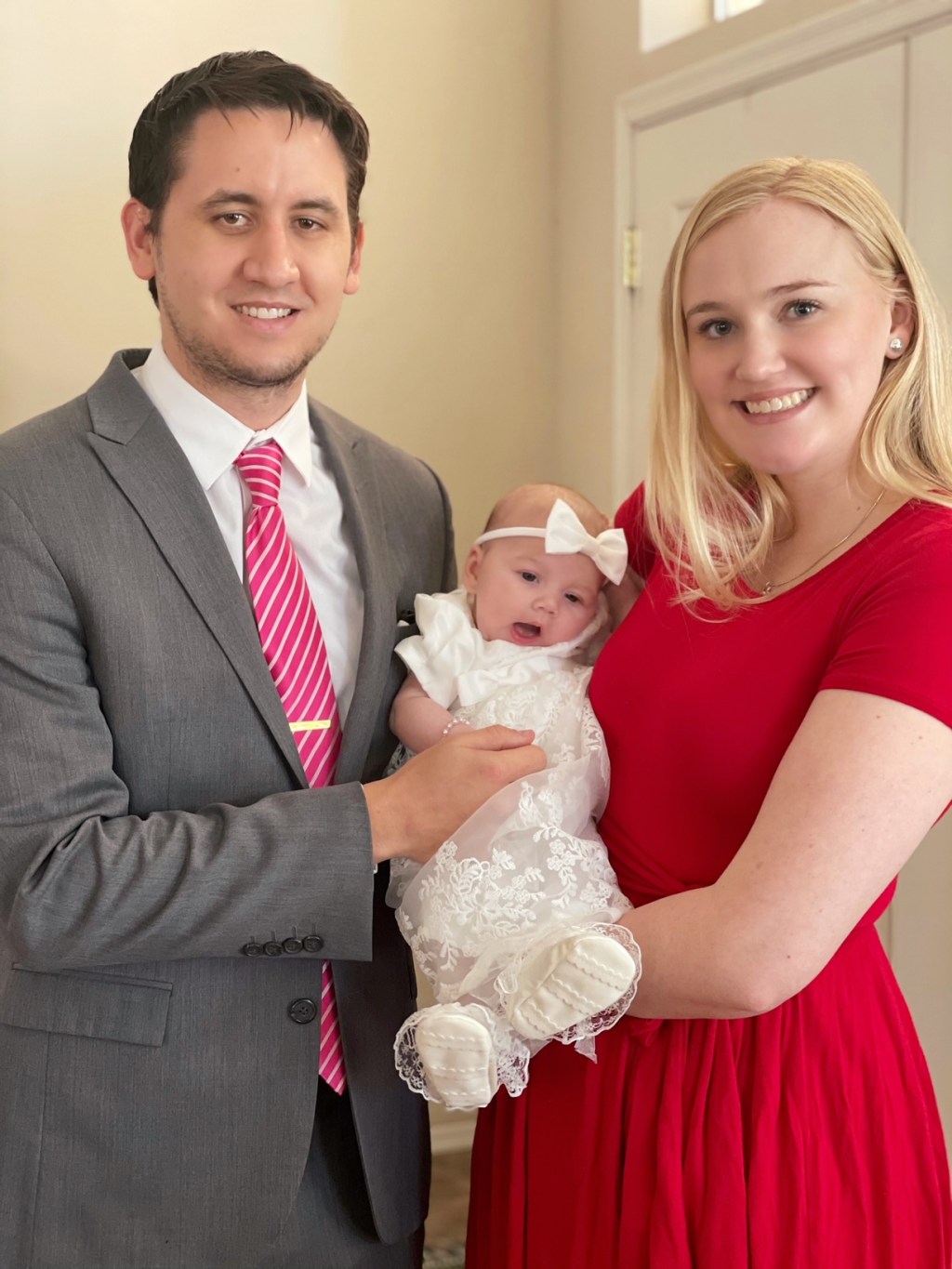
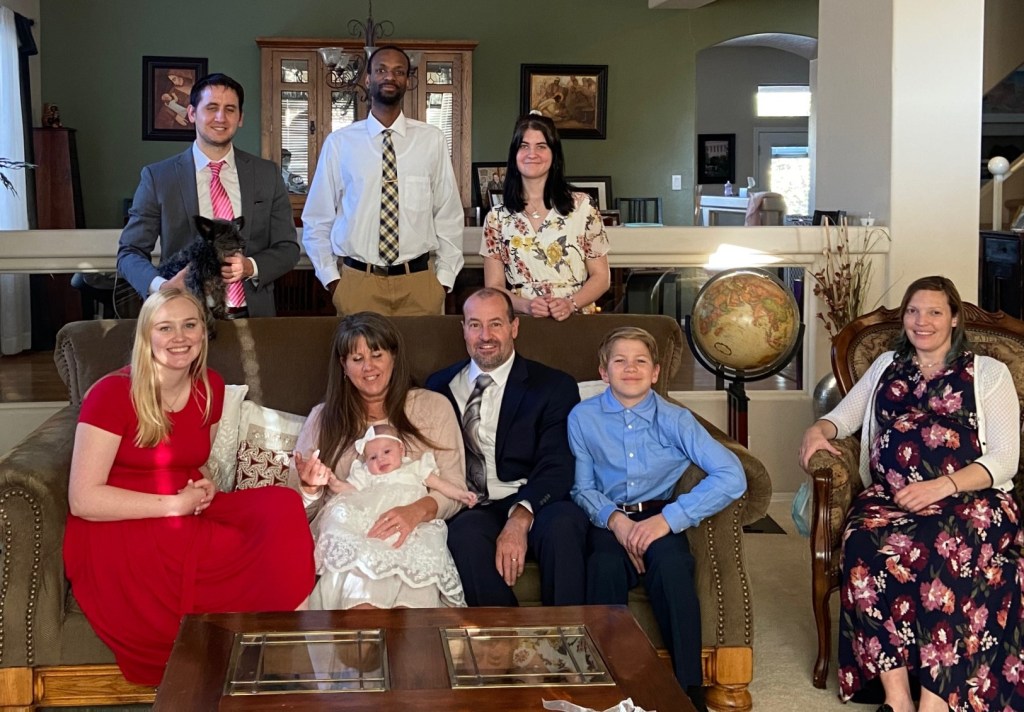
    I recently had the special opportunity to bless Ivy.  Leading up to the blessing, I did some research on the history of blessing children in the Church of Jesus Christ and its significance.  For Ivy’s blessing, Beth put together an event and a description of what a baby blessing is.  Here is that description:

    What is a baby blessing?

    In summary, the naming and blessing of children is a commandment of God. It is proper for a worthy father to name and bless his children. Blessing of children was done during the time of Christ, and it occurred in the early years of the restored Church. The ordinance has become a regular practice followed by Church members ever since.

    Who has the authority to bless a baby?

    A worthy priesthood holder under the direction of the local bishop. It is usually the father or a close family member.

    What is the priesthood?

    The word priesthood has two meanings. First, priesthood is the power and authority of God. It has always existed and will continue to exist without end. Through the priesthood, God created and governs the heavens and the earth. Through this power, He exalts His obedient children, bringing to pass “the immortality and eternal life of man.”

    Second, in mortality, priesthood is the power and authority that God gives to man to act in all things necessary for the salvation of God’s children. The blessings of the priesthood are available to all who receive the gospel.

    What is the format of a baby blessing?

    When blessing a baby, priesthood holders gather in a circle and place their hands under the baby. When blessing an older child, brethren place their hands lightly on the child’s head. The person who gives the blessing:

    1. Addresses Heavenly Father.

    2. States that the blessing is performed by the authority of the Melchizedek Priesthood.

    3. Gives the child a name.

    4. Gives words of blessing as the Spirit directs.

    5. Closes in the name of Jesus Christ.

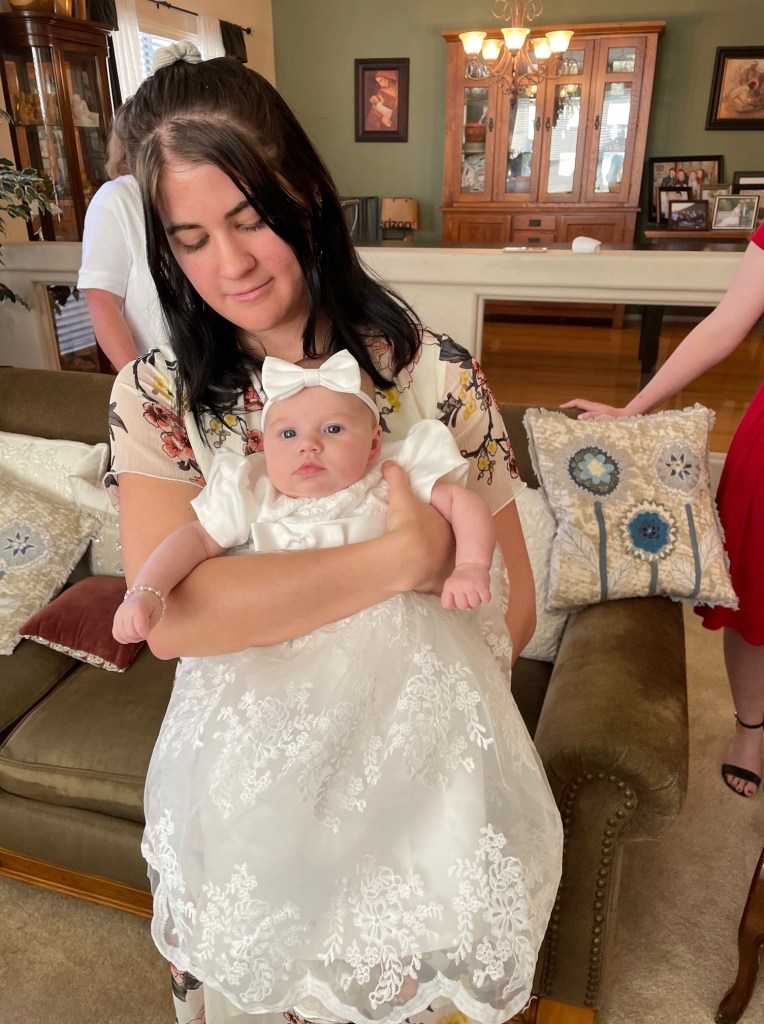
    Ivy and Aunt Cambria

    Reading up on the baby blessing beforehand taught me some interesting things about this sacred practice that I would like to share.

    The below points were taken from this link:

    https://www.churchofjesuschrist.org/study/ensign/1979/12/i-have-a-question/in-blessing-an-infant-should-both-the-naming-and-blessing-be-addressed-to-our-heavenly-father?lang=eng

    1. Unique to giving a blessing to an older child or adult, the naming and blessing of a child is directed to Heavenly Father like prayers are. 
      • This could be because the baby is too young to understand the words directed to him or her. 
    2. It appears that Melchizedek Priesthood holders are authorized to more than ask for a blessing but are able to pronounce a blessing upon the child directly, as the spirit directs.
      • See D&C 20:70
      • Sometimes inspiration (or confidence) to pronounce/give a blessing does not come.  In this case it is of course acceptable to ask Heavenly Father for these blessings.  I believe this is how I felt in giving Ivy her blessing.  It was enough to ask Heavenly Father to bless her with my requests.
    3. It is a commandment to name and bless infants.
      • See again D&C 20:70
      • It is important to remember the naming and blessing of children is not a saving ordinance.  It is still an important and sacred moment seen in heaven.
    4. “It is an awesome responsibility to be a priesthood agent of the Lord, to act in his behalf, and to approximate in one’s words and doings what the Lord would do if he were here.  A father, especially, who is to bless his child, has the delight and responsibility to prepare himself beforehand by pondering and by fasting and prayer, that he may be sensitive to the suggestions of the Spirit when giving the blessing.”
      • “How blessed we are to be able to present our little ones before the Lord, our families and the Church, and then consecrate them to the Lord.  How blessed we are to be able to name them, plead over, pray for, and, yes, to bless them directly and personally in harmony with our finest desires for them, by the authorization and wisdom of heaven.”

    The below points were taken from this link:

    https://www.churchofjesuschrist.org/study/ensign/1988/12/i-have-a-question/why-is-the-naming-and-blessing-of-a-child-important?lang=eng

    1. An interesting account from Joseph Smith on March 13, 1843 says, “Twenty-seven children were blessed, nineteen of whom I blessed myself, with great fervency.  Virtue went out of me, and my strength left me…”
      • “[The next day] Elder Jedediah M. Grant enquired of me the cause of my turning pale and losing strength last night while blessing children.  I told him that I saw that Lucifer would exert his influence to destroy the children that I was blessing, and I strove with all the faith and spirit that I had to seal upon them a blessing that would secure their lives upon the earth; and so much virtue went out of me into the children, that I became weak, from which I have not yet recovered; and I referred to the case of the woman touching the hem of the garment of Jesus. (Luke 8).” (History of the Church, 5:303.)
      • Elder John Taylor said the Savior’s example of blessing children “should be studiously complied with without hesitancy or objection” (by priesthood holders).
      • We see that Joseph Smith followed the example of the Savior who blessed children in both Israel and the American continent.  (Mark 10:14-16 and 3 Nephi 17).  What an amazing and marvelous thought:  our virtue can be passed to our children.  Our blessings are a force Satan must reckon with.  It makes me want to bless my daughter daily.  It also adds insight to a scripture that has always been a bit puzzling in Luke 8:46.  Virtue can literally leave us to help others.
    2. The new name:
      • A new name is often involved when a covenant relationship is formed.
      • When Adam and Eve were given dominion over the earth, Adam named all the animals (Genesis 2:19-20).
      • God blessed them and named Adam after giving him a body (Genesis 5:2).
      • When we get baptized we follow a similar pattern, taking upon us a new name, the name of Christ.
      • Temple covenants also involve the giving and receiving of names.
    3. The responsibility of blessing a child is bestowed, ideally, on he who helped create that child’s body, and who Heavenly Father entrusted His child with in mortality.
      • Joseph F. Smith – “The patriarchal order is of divine origin and will continue throughout time and eternity.  There is, then, a particular reason why men, women, and children should understand this order and authority in the households of the people of God and seek to make it what God intended it to be, a qualification and preparation for the highest exaltation of his children.  In the home, the presiding authority is always vested in the father, and in all home affairs and family matters there is no other authority paramount…This authority carries with it a responsibility, and a grave one, as well as its rights and privileges, and men cannot be too exemplary in their lives, nor fit themselves too carefully to live in harmony with this important and God-ordained rule of conduct in the family organization.”

    It is my experience that giving blessings is often the closest I ever feel to Heavenly Father.  I can feel him speaking through me and it is always a powerful, emotional, and memorable experience.  The opportunity to bless my daughter will be one of the greatest moments of my life.  I have immense gratitude to my Heavenly Father for entrusting Ivy into my care, allowing me to name her, and trusting me to watch over and protect her in this life and through eternity.