Tag: Frank Herbert

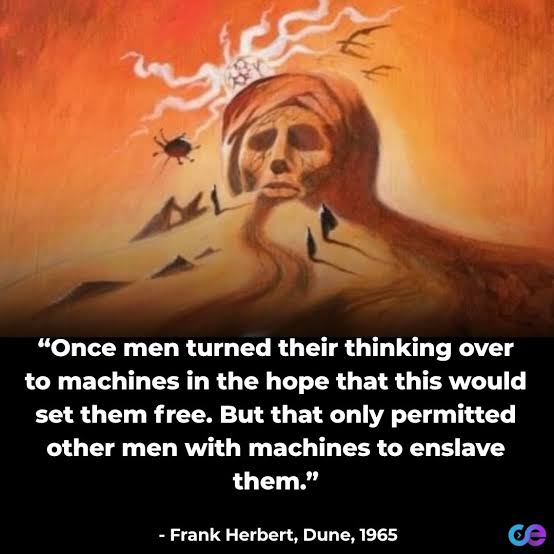
  • “Man may not be replaced”

    “Man may not be replaced”

    ** Spoiler Alert for Dune books 7 and 8

    The books Brave New World by Aldous Huxley and 1984 by George Orwell rightly deserve their flowers for eerily predicting aspects of society in 2026.

    There is another book that I think deserves more attention for what it foresaw that are just now coming to fruition.

    Frank Herbert wrote Dune in 1965. He went on to write and publish the original 6 Dune novels through 1985 until his death in 1986. Seemingly ending his magnificent Dune series before it could be concluded.

    That is until his son Brian found Frank’s transcripts, notes, and outlines for the conclusion of one of the greatest science fiction series in history. The story is actually fascinating. Ten years after his father died, Brian received a call from his father’s estate attorney stating they found two forgotten safety deposit boxes. These boxes contained information about the conclusion of Dune. Motivated by this, Brian started searching his property and found another box of Dune notes.

    There were 6 original Dune books written by Frank. It was 2 decades before fans would receive the grand conclusion to the series, written by Frank’s son using his original notes.

    This timing makes the finale to Dune, found in those outlines and notes, all the more fascinating. Frank Herbert formed the thoughts behind Dune’s conclusion no later than 1985 and likely much earlier.

    This is where the spoiler part comes in. If you intend to read the final 2 books in the Dune series, books 7 (Hunters of Dune) and 8 (Sandworms of Dune), this is a major spoiler.

    Last chance.

    The revelation really comes at the end of book 7.

    The grand, unknown, unstoppable enemy of the universe, coming to destroy all humans – is artificial intelligence.

    It was right in front of the reader the whole series. There are illusions to a prequel-esq war between humans and machines. It is constantly alluded to. But we never get much information about it. We know a woman named Serena Butler was integral to the war against machines. That’s about all we know.

    I found this fascinating, given what’s happening now. In an age when computers were just becoming a thing, well before the movie Terminator ever hit theatres, Frank Herbert imagined a battle between man and machine. Right at the dawn of real-world computing, Frank alluded to the Butlerian Jihad, a battle against “thinking machines” that shaped the Dune universe.

    Artificial intelligence hadn’t been a factor really at all throughout 7 books. So when it was revealed AI was the great enemy of the universe, I got goosebumps reading that in 2025.

    An interesting part about the artificial intelligence in the Dune books is that before the reveal in book 7, the biggest threat of artificial intelligence hadn’t been the machines themselves. The biggest threat to humanity had been their self-reliance on machines. Humans had started to lose their problem solving and independent abilities because they handed everything over to machines. Humans were heading towards losing their agency to machines.

    Sound familiar?

    This is what we see happening to humans today. High schoolers can’t write – essays, letters, or coherent messages. Humans don’t read books anymore. They watch short form videos that melt their brains. I’ve experienced this a little with my work. Why think through a problem when I can plug it into AI and ask the computer – how do I fix this?

    I feel myself losing problem-solving skills as I rely more and more on artificial intelligence.

    There are many scary parts to what is happening with technology at this moment in history. The scariest thing might be the lethargy falling upon us all.

    In the Dune universe they evolved because they intentionally removed machines as crutches and made themselves smarter, more advanced, better. What are we losing as a people when we turn over thinking to machines?

    This is where the adage “man shall not be replaced” comes from.

    In the Dune universe they made a conscious decision note to be replaced. What decision will we make? What decision are we making every day with our actions? Was Frank Herbert warning us?

    Ultimately, in the books humanity had to learn to live alongside technology. Humanity didn’t need to destroy technology. Technology didn’t need to destroy humanity. Humans needed to use their humanity to make sure they progressed alongside technology. Humans can’t stop improving. Humans need to always be improving, just as technology will always be improving. Humans shouldn’t be replaced.

    The ultimate safeguard for humanity’s future isn’t a total ban on thinking machines, but rather ensuring that our human ethics, consciousness, and spirit remain deeply embedded at the core of the digital networks we create. This was Frank Herbert’s prophetic message to us. This should be our goal with technology.
  • Books in 2023

    Books in 2023

    My books read have an inverse correlation to how many children I have. 58 in 2020, 45 in 2021, 26 in 2022, 21 in 2023, and in 2024 I’m on pace to finish 15. I miss reading 50 books in a year, but I have the best distractions.

    This is the third year I’ve made a list of all the books I read. Click to see lists for 2021 and 2022.

    2023’s book list comes with even more of a disclaimer than usual. You may have noticed I’m posting 2023’s list at the end of 2024. It’s been at least a year since I’ve read most of these books. This made it difficult to remember the finer details of the individual books. Add the fact that I packed all these books away so I can’t review my highlights, and I struggled a bit remembering each individual book.

    Still, it might mean the list even better represents what books I liked because the list will partially indicate the most memorable books from last year.

    So, here is the order of my most enjoyable reads from 2023.

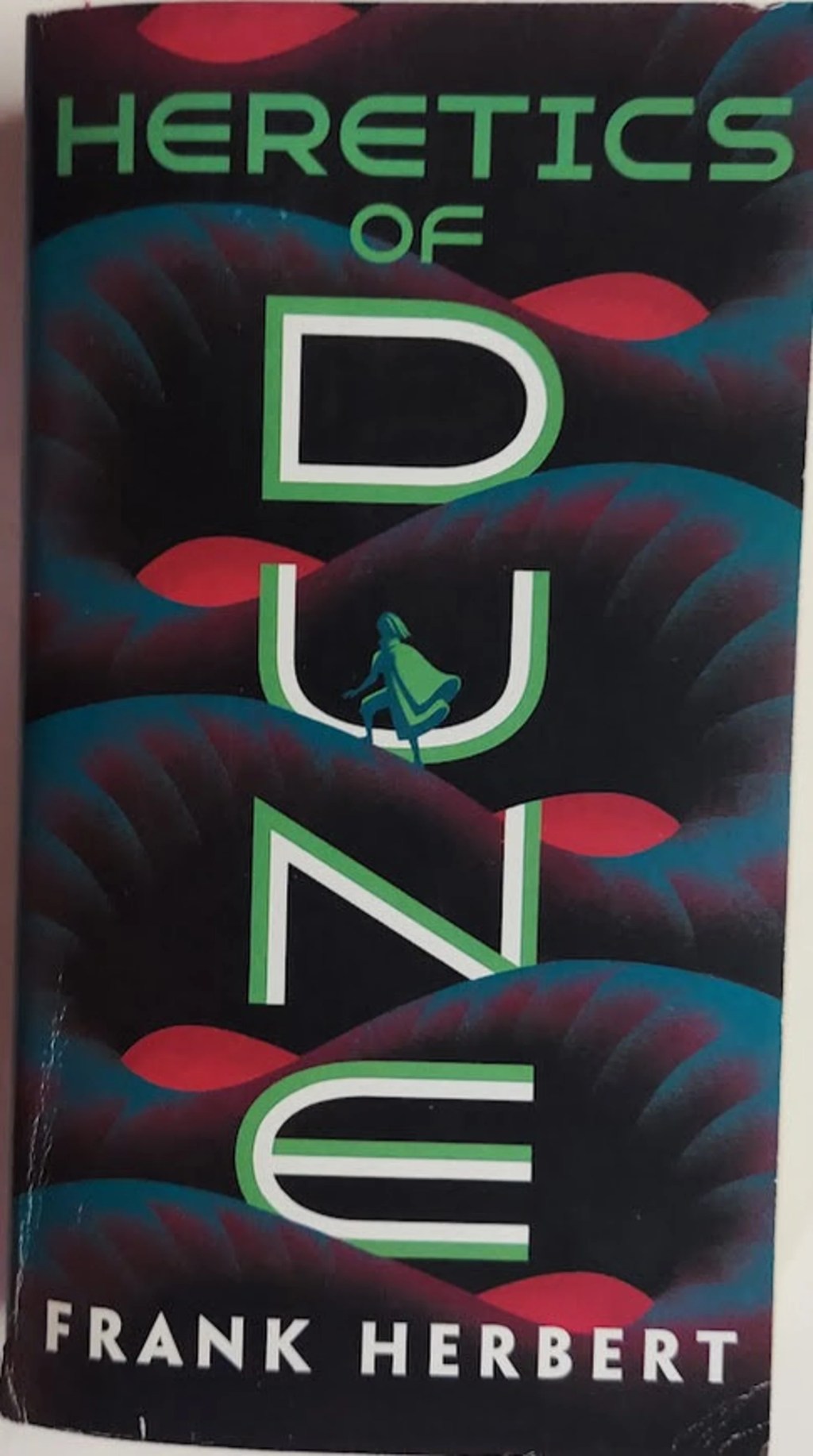
    1. Heretics of Dune by Frank Herbert
      • The fifth book in the Dune series, I must show respect for what Frank Herbert created in the Dune universe by ranking this book this high. I love this series. I loved this book. I love his universe. I love his writing. Best series I’ve read since Harry Potter, hands down.
    2. The Silkworm by Robert Galbraith (aka J.K. Rowling)
      • I loved this book, the second book in the Strike detective novel series. JK Rowling is the greatest author of our generation. This list doesn’t even have a Harry Potter book on it and yet Harry Potter was mentioned in the top two books. Anyways…
    3. Mandy’s Promise by Frank Leach
      • This book has a special place in my heart as it was written by my grandpa. Re-reading the synopsis of the book gave me chills because it really was a great story. I loved this book.
    4. The Man Who Broke into Auschwitz by Denis Avey
      • This was a phenomenal book. I just read the Wikipedia page on it and learned some of the story might have been embellished. Well, yeah, welcome to story-telling. It’s an extraordinary tale of a man who tried to get into Auschwitz and eventually survived being an Allied prisoner of the Second World War.
    5. Ancient America and the Book of Mormon by Thomas Stuart Ferguson and Milton R Hunter
    6. Outliers by Malcom Gladwell
      • This book was great, really made me think about how our situations and often some luck impact our potential growth and abilities. Must read for someone wanting to understand the outliers or overperformers in our society.
    7. Hugh Nibley’s semester one on the Book of Mormon
      • This is a transcription of all lectures from a Book of Mormon class Hugh Nibley taught from 1988-1990 at BYU. Don’t ask me how I found it, but I did, and I immediately downloaded and saved all of them. These are insightful, his understanding of history is off the charts, so many extraordinary insights that grew my testimony in the Book of Mormon and God’s hand in the history of all things. If you want a copy, let me know and I’ll send it to you. Invaluable.
    8. Career of Evil by Robert Galbraith
      • Book three of the Strike detective series. This book is ranked a little lower than Silkworm because it dragged a little more with a lot more developing characters and drawn-out suspicion. The end was well-worth the wait though.
    9. Songs of the Morning Stars by Sarah Hinze
      • This is a collection of stories about children visiting their families before they were born. Legend has it my dad dreamt of all of us before we came. He knew all our genders. So this one hits close to home.
    10. Thinking, Fast and Slow by Daniel Kahneman
      • This book was about how our minds work and about our fast or slow reactions or decisions. It explores thinking and ways to improve our decision-making.
    11. Go Forward with Faith by Sheri L. Dew
    12. Room by Emma Donoghue
      • I actually started this book once years ago and never finished it. That was back when I sometimes didn’t finish books. I enjoyed it this time. This is the story of a young boy born in captivity. Fascinating thought experiment about life, freedom, and experience. Also became a movie.
    13. Doctrine and Covenants Commentary by Hyrum M Smith and Janne M Sjodahl
      • This book was a 1200-page church history grind, but extremely rewarding to finish.
    14. Malachi and the Great and Dreadful Day by Mark E. Petersen
      • Malachi is a lesser-known prophet which means there is less content for the author to provide but also more I didn’t know about Malachi to be learned. I enjoyed this book. Other books I’ve read in the series included Moses (#24 from 2021) and Joshua (#22 from 2022).
    15. Book of Lost Tales Vol 3 Lays of Beleriand by J.R.R. Tolkien
      • By book three it felt like I was reading the same legends over again, with extra commentary about where words came from that didn’t super interest me. I still love reading Tolkien’s tales but didn’t love these as much.
    16. Liberty and Tyranny: A Conservative Manifesto by Mark. R. Levin
      • Without revealing too much about my political beliefs, I enjoyed this book.
    17. The Shaping of Middle-Earth (Vol 4) by Christopher Tolkien
      • See above commentary on Vol 3, lots of repetition, still fun to read Tolkien’s legend.
    18. Way to Be by Gordon B. Hinckley
      • Gordon B. Hinckley had a way of speaking and it comes out in this book. It was full of witty and funny stories amidst spiritual guidance and advice from a prophet of God.
    19. Gospel Symbolism by Joseph Fielding McConkie
      • I don’t remember this book super well, but it was all about the significance of symbolism in the scriptures and in the temple.
    20. Tao Te Ching by Lao-Tzu
      • “The Way.” This book was like reading Proverbs from the Bible: insightful but dry. Most interesting thought I got from this book was to make me consider the strength of babies.
    21. Mormonism and the Negro by John J. Stewart
      • This book was full of outdated and inaccurate information.