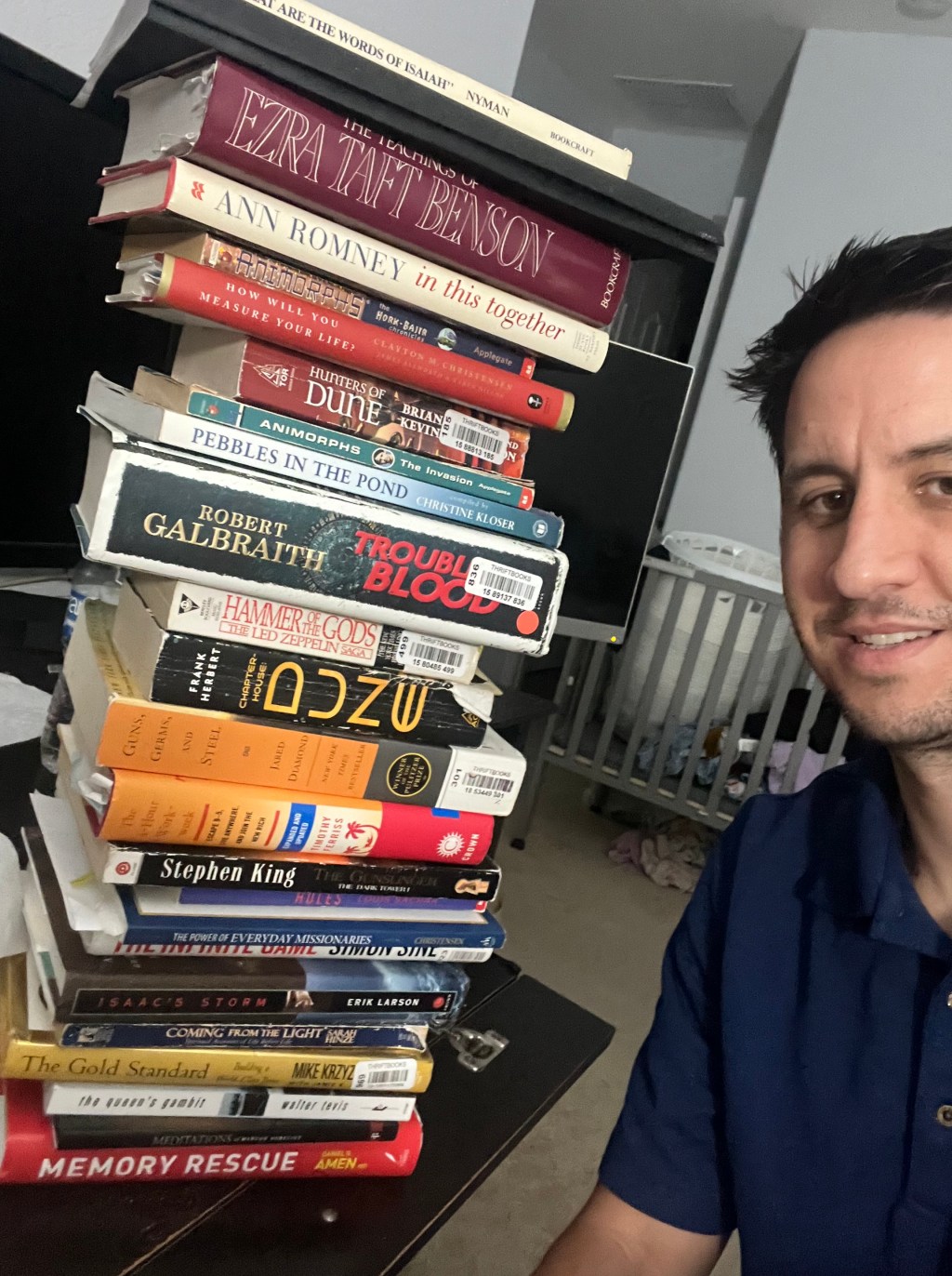
I was disappointed in the number of books I read in 2024. I tried to improve in 2025, despite another new baby and the continued busyness of life. I read 15 books in 2024. Not hard to improve on that. Here are the books I read in 2025 in order of enjoyment.
*As always, my disclaimer, “enjoyment” is so hard to define. I usually go through the list and put the books I most enjoyed reading at the top. But if a book was impactful in other ways, it raises its value. Basically these are my favorite books of the year.
- Harry Potter and the Sorceror’s Stone by J.K. Rowling
- How can this not be first? It’s a foundational book in my life. It’s the book that jump-started my love of reading. I read this book out loud to Ivy and Sage and loved every second of it.
- Power of Everyday Missionaries: The What and How of Sharing the Gospel by Clayton M. Christensen
- One of my favorite books of all time. I think it’s the third time I’ve read it. It’s a powerful and impactful read every time.
- Hunters of Dune by Brian Herbert and Kevin J. Anderson
- I think expectations set how we will enjoy media. I avoid movie trailers for this reason. If I’m told a movie is amazing, I’m likely to end up disappointed. I heard this book was not very good. It being the first book where Frank’s son Brian took over the story, I came in with low expectations. I was blown away. I loved this book.
- Troubled Blood by Robert Galbraith
- J.K. Rowling does it again. Robert Galbraith is a psedynym for J.K. Rowling. I have grown to love these crime novels. It is the fifth book in the series and I think it might be my favorite.
- The Dark Tower 1: The Gunslinger by Stephen King
- I debated putting this ahead of Troubled Blood. This was a page-turner. But then, Stephen King novels usually are. This is the first in what I’ve described as Stephen King’s Mona Lisa, his masterpiece. In this case, the expectations didn’t alter my enjoyment. It was that good.
- Coming from the Light by Sarah Hinze
- This book is a compilation of stories about premortal children. It is an impactful book on me.
- Isaac’s Storm: A Man, a Time, and the Deadliest Hurricane in History by Erik Larson
- This was one of my grandma’s old books that I took off the shelf wondering why in the world I would ever read about a storm from the year 1900. This is a book I would never go out of my way to read. Those are often the books that will most surprise you. In a great underdog story, this book became one of my favorites of the year. It had me in tears thinking about life, death, destruction, and family at the end. Despite being #7, this might be the number one book I’d recommend from this year.
- How will you Measure your Life by Clayton M. Christensen
- Second Christensen book of the year. This book came recommended and I loved it. The message in it paired perfectly with The Infinite Game which I read earlier in the year but is right behind this on the list.
- The Infinite Game by Simon Sinek
- This book came highly recommended by my brother. It started off slow, to the point that I wondered why he recommended it. Then it picked up. A book that shaped and altered my preexisting opinion so impactfully can’t be too far down this list.
- Chapterhouse: Dune by Frank Herbert
- This list is making me take a look at the evolution of my reading. The Harry Potter books are my favorite books of all time. I almost put Hunters of Dune above Harry Potter. But Harry Potter is still the GOAT. This wasn’t my favorite of the Dune books. Still great. I liked Hunters of Dune more.
- Animorphs: The Hork-Bajir Chronicles by K.A. Applegate
- These lists are really hard to make when you love most every book you read each year. Where do you rank a book you loved as a child? Can’t be ahead of the Dune books, surely.
- Animorphs: The Invasion by K.A. Applegate
- The first book in the Animorphs series. I read these as a kid and loved them. Adds some fun to my reading to revisit what sparked a love of reading in the first place. You’ll see a pattern from this year with Harry Potter, Holes, and Animorphs. I’m thinking a lot more about why I grew to love reading as my girls start growing into their young reading years.
- Yesterday’s Sunshine by Lyle Hollis Rodabough
- Put this up there with Isaac’s Storm as a book I was super pleasantly surpised to thoroughly enjoy. It was the autobiography of a man I had never met and didn’t know anything about. He was the father of someone I worked with. I loved this book. He was a police officer for many years and the stories were incredible.
- Queen’s Gambit by Walter Tevis
- This came recommended. I’m not a big chess guy but I loved the show on Netflix and I love games. Really enjoyed this book. Again, can’t believe it’s this low, but I read some good books this year.
- Guns Germs and Steel: The Fates of Human Societies by Jared Diamond
- This was an impactful book for me. It opened my eyes to some macro concepts in the history of societies. It also opened my eyes and made me think more about why the world is the way it is.
- Hugh Nibley Semester 4 on the Book of Mormon
- The transcript of Semester 2 was #2 last year and Semester 3 was #9. Whereas I loved semester 2 in how it expanded my mind, and semester 3 felt redundant, semester 4 fell in the middle. It felt like it contained more new information that semester 3. As noted in 2024, I just love Hugh Nibley.
- Holes by Louis Sachar
- As a kid, this was my favorite non Harry Potter book. I loved this book. It’s just as good for a second reading nearly 3 decades later.
- In this Together by Ann Romney
- Another book I question why I ended up reading, but enjoyed. Ann is a survivor of MS. It was interesting reading her story.
- Gold Standard by Coach Krzyzewski
- Fun fact, I bought this book used and found that it was signed by Coach K. Pretty cool. I remember this being a fine book. I just don’t remember much about it. Making it lower on this list.
- The Castaways by Sarah Hinze
- The first book in the series is higher on the list. This one felt less powerful. Still great, but didn’t pack the power of the first.
- 40-Hour Work Week by Tim Ferris
- I read this in 2024 as well where it was #3 for that year. I think this ranking is mostly due to fatigue with reading this book multiple times in a short period of time.
- Hammer of the Gods by Stephen Davis
- I don’t know how this book got on my list. It’s the story of Led Zeppelin. I had never listened to a Led Zeppelin song. Glad I read this though, taught me about something I knew nothing about.
- Great are the Words of Isaiah
- Isaiah is tough. This was a book trying to make the words of Isaiah less tough.
- Pebbles in the Pond
- I started off with a lot of momentum in this book but it got to be a grind near the middle. Similar to Teachings of Ezra Taft Benson. Impactful, and I liked the book, just near the bottom in enjoyment for the year.
- Teachings of Ezra Taft Benson
- This was a compilation of basically everything President Benson ever said before becoming the prophet of the Church of Jesus Christ of Latter-day Saints in 1985. I don’t mean to disparage this book by its ranking. It was an immensely important book for me to read. But it was ~700 pages and kind of a grind at times.
- Memory Rescue: Supercharge Your Brain, Reverse Memory Loss, and Remember What Matters Most by Daniel G. Amen
- Another one of my grandma’s old books I wouldn’t normally go out of my way to read this. I haven’t been able to enjoy microwave popcorn and sugar guilt-free ever since. Which I guess is good and bad. I’m not a huge fan of medical books where a portion of the content goes over my head. But it was impactful and I recommended it to others.
- Meditations of Marcus Aurelius
- This little book came recommended from a friend. It was short and quick. I enjoyed it, but don’t remember a ton about it.
 No Coincidences