Tag: health

  • Is Roseto, Pennsylvania Zion?

    Is Roseto, Pennsylvania Zion?

    There was an extraordinary thing happening in Roseto, Pennsylvania in the 1950s. I read about it in an awesome book called Outliers by Malcom Gladwell.

    Roseto, Pennsylvania was an outlier when it came to heart disease. For some reason, instances of heart attacks and heart trouble in Roseto were shockingly different than anywhere else.

    In the 1950s, heart attacks were the leading cause of death in men under the age of 65 (Outliers, p. 6).

    In Roseto, nobody under 55 had heart attacks. Roseto had half as many people with heart trouble over 65 compared to any other area studied. This included next-door cities and towns.

    What’s fascinating about this is that this phenomenon apparently had nothing to do with genetics, diet, or any other seemingly obvious reason. There was no obvoius indicator of why a whole community would be free of heart trouble.

    Heart trouble wasn’t the only thing missing from this community. A sociologist was brought in to study the community. His name was John Bruhn and he said, “There was no suicide, no alcoholism, no drug addiction, and very little crime. They didn’t have anyone on welfare. Then we looked at peptic ulcers. They didn’t have any of those either. These people were dying of old age. That’s it” (Outliers, p. 7).

    What made Roseto unique, then?

    Finding no pattern, those doing the study had to look at anything different about Roseto to try to explain this phenomenon.

    This led to a primary theory. That primary theory behind why Roseto, Pennsylvania residents didn’t suffer heart trouble or many other common diseases had to do with their community.

    Roseto had an old-fashioned way about it in the 1950s, even compared to the standards of its day. The residents of Roseto were primarily Italian-American immigrants. The standard in Roseto was to live at home as long as possible, take care of one another, and generally live a more laid-back and communal way of life. A young man would stay at home and take care of family. If he lost a job, it was okay. The community would often try to keep shortcomings like a lost job secret so as not to create any embarrassment. Kids would take care of parents. Parents would take care of kids. The community took care of each other. It was a family-focused, close-knit community.

    “(Researchers) learned about the extended family clans that underlay the town’s social structure. They saw how many homes had three generations living under one roof, and how much respect grandparents commanded. They went to mass at Our Lady of Mount Carmel and saw the unifying and calming effect of the church. They counted twenty-two separate civic organizations in a town of just under two thousand people. They picked up on the egalitarian ethos of the community, which discouraged the wealthy from flaunting their success and helped the unsuccessful obscure their failures” (Outliers p. 9, emphasis added).

    The fact that Roseto residents had such low instances of heart trouble revealed a potential connection between community relationships and social support to reduced stress and heart disease. The community of Roseto appeared to buffer its inhabitants from the stresses of life.

    This got me to thinking.

    What is Zion? What is the perfect society? What will it look like? What will it be like, practically speaking?

    “…the Rosetans had created a powerful, protective social structure…” (Outliers p. 9).

    Will Zion be a community that goes to church together? A community that stops to talk to each other? A community that continues to live under one roof with their direct family as long as possible? A community where equality reigns? A community where spontaneous cookouts in front yards are common?

    This sounds like Zion to me.

    It’s fascinating that a community basically shielded itself from the stresses of a fallen world by living by these principles. I believe these are God-given principles: fairness, love, community, support, unity – that’s what makes Zion.

    “When presenting (the researchers’) findings at many medical conferences where their peers were presenting long rows of data arrayed in complex charts and referring to this kind of gene or that kind of physiological process, and they themselves were talking instead about the mysterious and magical benefits of people stopping to talk to one another on the street and of having three generations under one roof….No one was used to thinking about health in terms of community” (Outliers p. 10).

    This Christmas season, as I’m inevitably considering the state of our world and where we’re headed, I can’t help but wonder: is it this simple?

    Community, family, support. People supporting people, people uplifting one another, communities looking out for each other. Neighbors waving hi. People engaging with those in their community. Ministering. Fellowship. Is it that simple? Would that fix our world?

    I think it would. I think this is primarily what is missing from our modern-day societies. Love thy neighbor. How about say hi to thy neighbor?

    This holiday season, aim to light the world. Start by dropping off cookies at a neighbor’s house. It might save you from a heart attack.

  • Reach Out

    Reach Out

    In Mark Chapter 5, Jesus of Nazareth performed a miracle that would foreshadow his great mission. It is in this chapter that the account of Jesus raising Jairus’s daughter from the dead occurs. It’s what happens in between Jairus coming to the Savior and Jesus performing that miracle that caught my attention.

    On the way to raise a girl from the dead, Jesus was surrounded by people. A woman, who we’re told “had an issue of blood” (verse 25) reached out and touched Christ’s garment.

    Verse 30 reads:

    “And Jesus, immediately knowing in himself that virtue had gone out of him, turned him about in the press, and said, Who touched my clothes?”

    The thought occurred to me, is it a coincidence that this healing happened in this way at this moment? Christ performed many miracles. Here is a miracle, seemingly performed by someone else through Him. In verse 28 the woman said, “If I may touch but his clothes, I shall be whole.” Christ goes on to tell her that she is made whole by her faith.

    On the way to literally raising someone from the dead, why is this story even included? What is an issue of blood when compared to death?

    I wonder, and this is just me thinking, Christ was on His way to conquer death for that girl. At that moment, was there a power, a life giving force emanating from Christ’s very being that allowed this woman to be healed simply by reaching out to Him in faith?

    Now that Christ officially holds the power of the resurrection and has conquered death, is that life giving power emanating from Him constantly?

    Yes, it is.

    What do we learn from this account, then?

    All we need to do is reach out. Christ will heal us. 

  • Why we REALLY don’t Drink Coffee

    Why we REALLY don’t Drink Coffee

    Members of the Church of Jesus Christ of Latter-day Saints abstain from tea and coffee, along with other drinks and substances. We refer to this as the “Word of Wisdom.

    The question often comes up, “Why don’t you drink coffee?” This seems to be the one that really hangs people up. Abstain from cocaine? Makes sense. Alcohol? People can see it. COFFEE?!?!?!!?! People are befuddled.

    This isn’t an easy question to answer, but I wanted to write my thoughts on it. The REAL reason we don’t drink coffee.

    Do we not drink tea and coffee because it makes us healthier? Do we avoid coffee because it’s addictive? Do we avoid coffee for our body’s health?

    Maybe.

    Is that the primary reason we don’t drink coffee?

    NO.

    Why do we pay tithing?

    Why do we partake of the sacrament on Sunday?

    Why do we avoid going to the store or other activities on Sunday?

    Why do we do any number of things the world finds peculiar?

    It’s because we have made covenants with God to obey His commandments. That’s it. That’s why we do what we do. To be obedient to God.

    Maybe it makes us healthier, maybe keeping the sabbath holy renews our spirits, maybe not swearing keeps our minds clean, maybe tithing brings us blessings. But are any of these maybes the real reason we do anything? It shouldn’t be.

    We do these things because we love the Lord and have covenanted to follow Him. End of story. The world might call it restrictive, but from my personal experience, it is the EXACT opposite. It is freedom.

  • Response to Depression

    Response to Depression

    On April 11, 2020 Beth posted a thoughtful and vulnerable post about depression. She really put herself out there talking about something that is sensitive for her. I was proud of her for writing it. It’s still one of the most read posts from my blog.

    It was the 10th post ever put on my blog. It was so early in my blog that I didn’t even put a cover image for it.

    I recently went back to read that post and decided, 4 years later, and after 5 years of marriage, that I would like to write my thoughts on her post and the topic of depression. This will be a difficult post to write because, even after these years, I’m still grappling with my understanding of depression – what it means, how it manifests, my role in it, along with all the other complexities that come with depression.

    I’m going to pull quotes from Beth’s post and give my thoughts.

    In her post, Beth said this:

    “Sometimes in frustration, I just want to sum it up as “if you know, you know” and call it good. But that is not enough. Individuals, family members, institutions, others with depression need to know.”

    I definitely need to know. Because I don’t understand it. And that’s hard for me.

    I am married to Beth. I’ve seen depression. I can kind of understand it. And yet, I don’t. I know I don’t. I don’t get it. And that’s hard for me. It’s hard for me to try to understand something that I don’t know where to begin understanding.

    With me… I may upset some people with depression here until you hear my explanation (or maybe even with my explanation) – depression is being sad and not wanting to get up or do anything. That’s my impression of it because I’ve experienced that. What I haven’t experienced is actually not being able to get out of bed. I don’t understand that. I don’t get it. That’s the reason I don’t understand depression. I just can’t relate to it. That doesn’t mean I don’t think it exists. It’s just something I have a hard time framing because it’s not in my personal experience. We have tons of examples of things we can’t understand because we haven’t seen or experienced them ourselves. I’ll dive into an example later on in this post. It’s hard to understand something you have zero personal frame of reference for.

    I must be clear here. I’m not saying I’m not empathetic or sympathetic to the challenge of physically not being able to get out of bed. I desperately hope I am sympathetic to it. I hope that I’ve showed my wife at least some of the support and understanding she needs through her challenges.

    What I’m saying is that I don’t understand it, I don’t get it.

    I hope if you’re experiencing depression and you’re in a close relationship with someone (parent, sibling, friend, significant other, etc.) who doesn’t understand it, that you can have patience with them as we have patience with you. Not understanding doesn’t always mean not caring or not believing it’s real or that it exists. It can sometimes mean really just not getting it, as much as we want to. I think sometimes it’s as hard for a non-depressed person to understand depression as it is for a person with depression to describe what it’s like to a non-depressed person. This is exactly what Beth is talking about in the above quote.

    Next quote I’d like to comment on from Beth’s post –

    “For me, it is not a weight laying heavily on me. I don’t feel like the people in the commercials that have a dark rain cloud following over their head wherever they go.”

    Beth is referring to what her depression is like to her. This struck me. It may seem silly, but as someone who hasn’t experienced “depression” (I don’t think) I kind of assumed it was all the same. Beth reminded me that just like anxiety and fear and all the other plethora of challenges we face in this life, no two people have the exact same experience. Depression for everyone must be unique to everyone. I’d venture to guess that one person with depression might have as much difficulty understanding another person’s version of depression as I have with understanding it at all.

    I think it’s important to remember that this challenge comes in many shapes and forms and to have patience with everyone and their unique circumstance.

    This is where I bring myself into it to try to understand and sympathize better.

    I struggle with anxiety. It’s not something I talk about a whole lot. I think I treat it like Beth treats depression: with a little bit of embarrassment and avoidance. But now I’m an adult. I’m no longer a scared and confused kid. I’m still sometimes scared and confused, but no longer a kid. I now realize that lots of people struggle with anxiety. It’s not something to be ashamed of.

    Beth and I have talked about depression and anxiety together. She talks about depression which, as I noted, I don’t understand. Then when I try to explain how anxiety manifests in me, I see the confusion descend upon her like the aforementioned cloud of depression. She can’t figure out what I’m talking about. She’ll say outright, “I don’t understand what you’re saying.” Do I take offense to this? Of course not! She hasn’t experienced it. I return to my point earlier – people experiencing depression: don’t blame or get upset with others that don’t understand what you’re going through. Your depression is unique to you. Don’t mistake lack of understanding for lack of caring or believing.

    “Eventually, when you’re in the midst of a depressive episode, you begin to convince yourself that this is the new you. You will never be successful again. You will be a burden and failure for the rest of your life. I was very lucky to never feel like I wanted to end my life but, with feelings like that, it isn’t difficult for me to see how people get there.”

    When I read that, it breaks my heart. When I read that it helps me to remember that this is a real and difficult challenge despite my lack of understanding. I can’t comprehend the idea of taking my own life. I think this is similar to how I don’t comprehend depression. I hope anyone reading this that, like me, struggles with understanding the dynamics and impact of depression on someone’s life, can read that quote and realize how serious this is. In whatever ways depression can feel “unreal” – suicide is not. Suicide is very, very real. We must have sympathy, love, compassion, patience, and as much understanding as we can possibly have to help those in our lives that have depression-like feelings. It can save a life.

    “So why don’t you just get up? Go on a hike, play a game, talk to someone, you’ll feel better.”

    This is my way of thinking.

    “I ask, can you still support me and sympathize with me even if you can’t understand? While that seems like a fair compromise, I still think I can try to help others get a glimpse of my perspective. We can meet in the middle.”

    I reiterate my point made earlier. We can try to understand. Those with depression, we only ask that you try to understand that often we without depression really are trying to understand and sympathize. It’s hard to understand something you can’t comprehend. It’s the catch-22 of sympathy. We sympathize, but ultimately, we can’t understand. If we understood, we’d know. All we can do is our best. Have patience with us as we have patience with you.

    “Sometimes that means lowering expectations for a while. Sometimes that means just learning to listen instead of feeling like you must come up with the solution.”

    This is the part I struggle with the most. I’m the standard guy who wants to fix things. Just listening doesn’t seem productive. I’ve tried over the course of my marriage to be better at this part. Listening. Beth will have to comment on whether or not I have gotten better at this. I’m not sure I want to hear the answer.

    I also struggle with lowering expectations. I’m not sure how to best say this without sounding insensitive but deep down inside I feel like lowering expectations for someone isn’t the answer. I coach basketball and deciding I don’t expect much from my players doesn’t seem like a great answer. In Beth’s whole post, that’s probably the line I most struggled with.

    “While my depression has been well controlled for years now, it’s never truly gone. It can sneak in when I least expect it. I make sure to take my medication daily and be mindful of triggers and warning signs. I try to be vocal with my husband when I feel it creeping in.”

    I’ve been married to Beth for over 5 years now. In that time, I’ve seen the warning signs. I can see when something is coming. I can see when Beth is starting to not be herself. Usually she is short with me, impatient with the girls and I, little things seem to put her on edge, and then there are hours of sleep.

    I guess I have lowered my expectations in the moment. But my way of thinking is so much that aforementioned – “Get up and fight through it”… I can’t help but wonder if lowering expectations is the right thing. Is the best thing to do to let a person with depression lie in bed for hours and days at a time? I’m not sure it is. I’m not sure we’re supposed to lower expectations.

    That said, that’s what I’ve done. In those moments I’ve tried to let Beth know I love her and I’m there for her and I give her the time to “come back.” Usually this is only for a day or two. A day or two where Beth doesn’t leave her room and I take care of the girls, the house, and the responsibilities. If it were more than a day or two, with everything we have going on, I’m not sure I could make it happen.

    This is difficult. It’s made more difficult for my lack of understanding.

    I can usually tell when Beth hasn’t taken her medication. It’s a bit disarming to immediately see the results of this. It’s a palpable and obvious difference. With lack of understanding it’s hard for me to understand how this can so drastically shift behavior so quickly. And yet… when I’m tired, how quickly does my demeanor, patience levels, and personality change?

    I know so little about the body and how it functions. What do I know? I know nothing.

    Ultimately, I have to rely on something bigger for understanding. I’ll close this post in much a similar way to how Beth ended her post 4 years ago. My understanding of God, this life, and His plan makes these things more understandable. We’re here to be tested. We’re here to go through tests that we don’t understand, to test our faith. We’re here to grow. Every challenge in our life is an opportunity to grow. I believe Beth’s depression is an opportunity for her to learn about herself and to become something so much more. I believe her depression is also a part of my mortal experience. It’s meant to teach me something important.

    I hope I’m still learning something important. I hope I’m always patient and understanding and helpful. I hope Beth knows she can always trust me to be there to make up the difference. I also hope Beth knows she’s always good enough.

    The hardest part, I think, about being married to someone with depression is seeing someone smart, and strong, and brave, and kind, and patient, and talented – think she is not those things. There have been many times that I’ve had to remind Beth that just because she doesn’t feel like those things in a particular moment – she is still those things. She will always be those things. They are more innate to her personality and being than depression is.


  • Last Night I let the Party get the best of me (No Sleep)

    Last Night I let the Party get the best of me (No Sleep)

    Remember last week when I wrote about The greatest moment of my life every day? Yeah, well here’s the dark side of that smile.

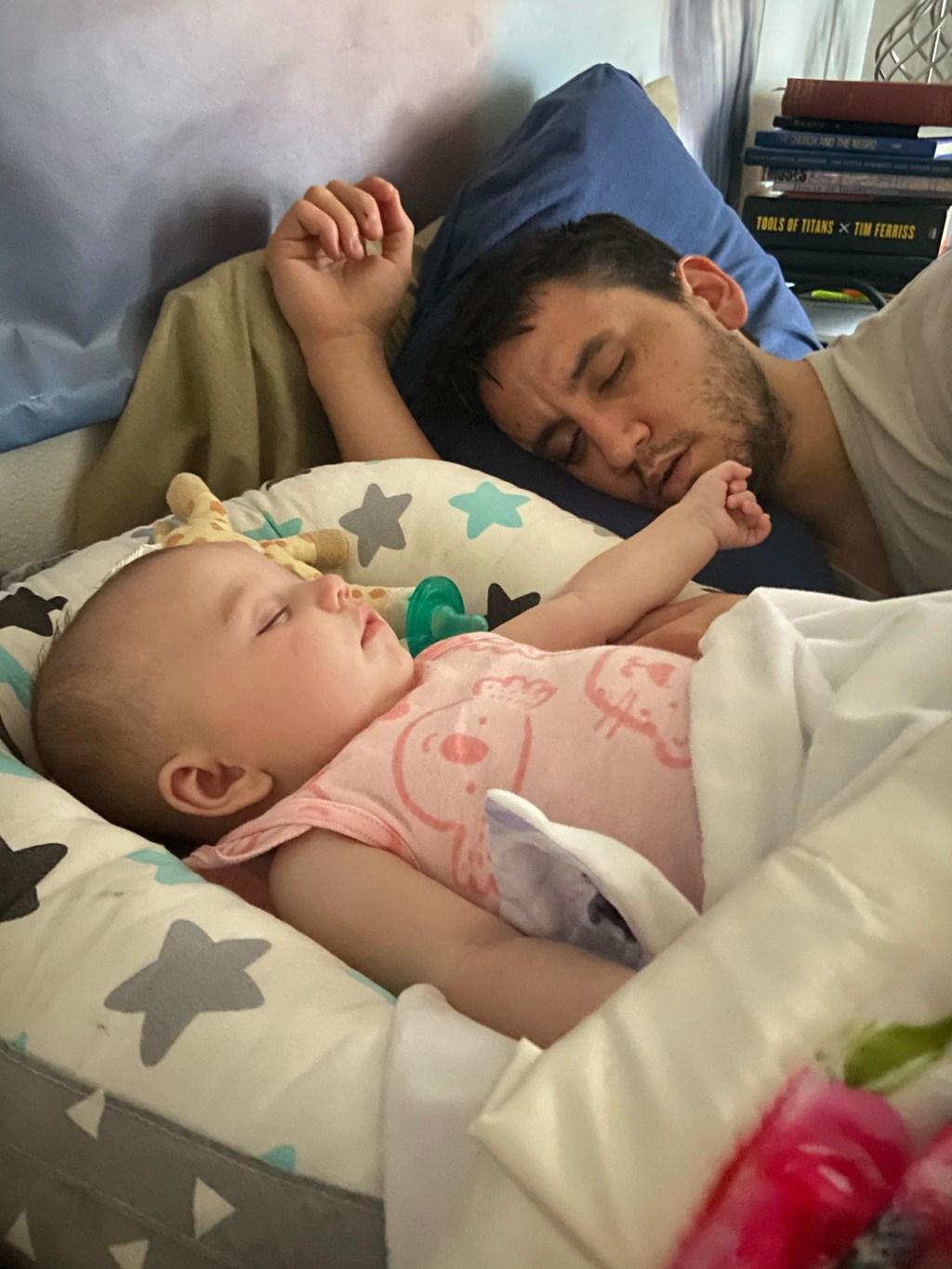
    There’s a serious question/joke every new parent has heard at least 100 times.  Are you getting any sleep?

    Why are we asked this question?

    Because it’s a REAL concern.

    Ivy trying to eat my hand when she should be sleeping

    So, for all those wondering, how has our sleep been?  I wrote about the First 48 Hours.  How have the first five months gone? In a blur would be one way to answer.

    I could go on for a while about sleep training and how much work and effort Beth has put in.  This isn’t a mommy blog so I won’t go into all the detail.  I will say Beth has done an awesome job helping Ivy to sleep.  She usually puts her down between 7pm-8pm.  Ivy will sleep until 6:30am-7:00am with at least one wake-up in the middle of the night.  Some of these wakeups just take putting the pacifier back in her mouth.  Sometimes it’s an hour feeding her a bottle and helping her back to sleep.

    Physically restraining a stubborn baby

    Before I provide my spiritual thought on this, I will stress two points:

    1. Ivy is pretty good overall with her sleeping.  We are blessed.  Beth reminds me of this.  While I have no frame of reference, Beth is in touch with all the mommy’s of the world and knows that babies don’t always sleep the way Ivy does.
    2. Beth does the heavy lifting most nights as I work in the morning.

    As I proceed with my thoughts on getting sleep with a newborn, please refer back to points 1 and 2 often.  Every time you’re thinking, “well Beth is doing all the work, of course you (enter your feelings about my thoughts)…” or “of course it’s not that bad, not all babies sleep like yours has!”  Please refer back to those points.  I am aware of how blessed we’ve been in point one, and I’ve been in point two.

    That said.  My thoughts.

    It hasn’t been that bad.  There.  I said it.

    Don’t get me wrong, it’s HARD.  I’ll say this, I think lack of sleep isn’t as bad as interrupted sleep.  There’s something about having to get up every 2 hours in the middle of the night, even if it’s quick and you can go back to sleep.  That’s what made the first couple months so difficult. 

    I recently heard another father describe the newborn sleeping phase as something like advanced sleep deprivation training for the military.  As he said that, I thought, “huh, I don’t think it was THAT bad” (see point 1!).

    Leading up to Ivy’s birth, I made some big changes to everyday habits of mine.  For one, I’ve cut out sugary drinks completely.  For those who know me, that included Hawaiian Punch or soda with lunch and dinner.  That’s A LOT of sugar.  I cut out the juice and soda about 18 months ago.

    Leading up to Ivy’s birth I read a book that led to two other changes.  I started doing a breathing exercise once or twice a day.  According to this book it’s the single most important thing anyone could do to immediately improve their health.  The other thing this book prompted me to start doing was change my breakfast habits.  I’ve always had breakfast every day no matter what. My breakfast every morning is usually cereal and milk.  My cereal is most often not of the healthy variety.  Berry Colossal Crunch (Cap’n Crunch knockoff) and Cinnamon Toasters (Cinnamon Toast Crunch knockoff) are still in my kitchen from our last order before I changed this habit.  Instead of artificial sugar for breakfast, I’ve transitioned to fruit every morning.  Usually grapefruit and blueberries, apples, oranges, or bananas.

    For those keeping score, I’ve cut out Hawaiin Punch, soda, and cereal in the form of straight sugar.

    For those of you wondering if I still eat candy.  Emphatic YES.  Maybe one day this can be cut down in my life.  We’re not there yet.

    As I pondered on the past 5 months, and the difficulty, something occurred to me.  Like I said above, I don’t think it’s been that bad.  Difficult, not debilitating.  As I thought about this, I thought about a scripture.

    Mosiah 24:14-15 reads:

    And I will also ease the burdens which are put upon your shoulders, that even you cannot feel them upon your backs, even while you are in bondage; and this will I do that ye may stand as witnesses for me hereafter, and that ye may know of a surety that I, the Lord God, do visit my people in their afflictions.

    And now it came to pass that the burdens which were laid upon Alma and his brethren were made light; yea, the Lord did strengthen them that they could bear up their burdens with ease, and they did submit cheerfully and with patience to all the will of the Lord.

    I think this is the most I’ve ever related to this scripture.  I’ve always wondered what it would feel like for burdens to be made light.  The lack of sleep should be killing me.  I have to be on-call every few weeks for work.  A call at 3 in the morning that would take 2 minutes used to infuriate me.  It would ruin my night and the whole next day.  Now a 3am-4am feeding session is a pretty regular occurrence.

    What explains that I haven’t gone into a fit of rage?  For one, I love Ivy passionately. That helps.  But I can’t help but feel like my burdens have been made light.  Heavenly Father knows my prayers have picked up, needing this assistance.

    I’ve wondered how the change in my eating habits has helped my energy.  Does God miraculously give us more energy and uplift us?  He can, of course.  I believe more often He would like to help us by allowing us to help ourselves.  I believe these new habits were inspired and I was guided to them.  I believe it has lightened my burdens, and God continues to lighten my burdens.

    I’m still working on the cheerfully and patient parts.  That I could always improve on.  But I am grateful for God and His help these first few months.  I’ve felt His presence and assistance every day.

    In the end, all the lack of sleep in the world is worth that smile.