Tag: Hebrews

  • Abraham’s Faith

    Abraham’s Faith

    I had a thought (shocker).

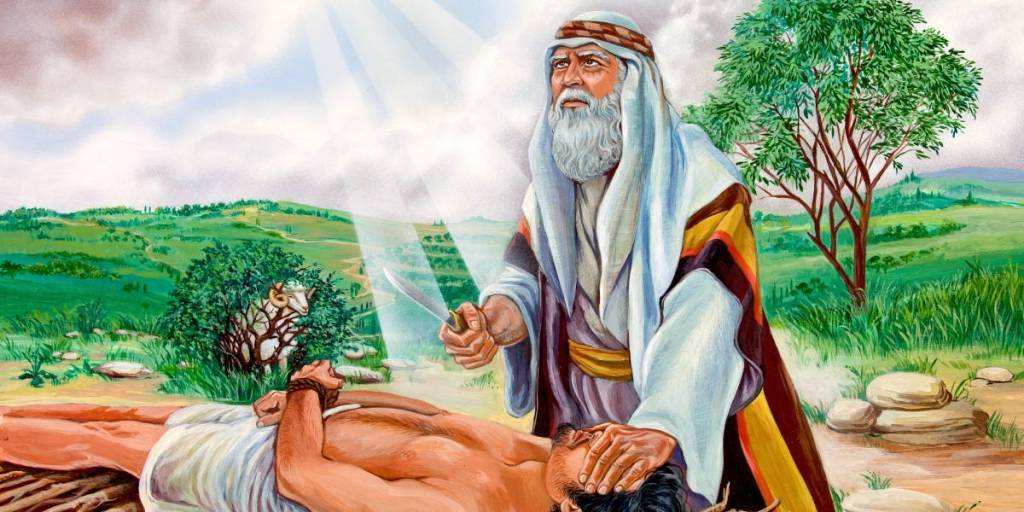
    I shared last week about Abraham’s shared experience of almost being sacrificed by his father.

    Here’s another way to look at it.

    We marvel at the faith of Abraham to sacrifice his son. He didn’t know that God would stop him moments before he went through with it. For all Abraham knew, his son would be dead, gone. And yet, he was still willing to do what God asked him to do.

    We marvel at this faith to do the impossible.

    What about God, when it came to sacrificing His only Son? Well, we would say, God knew the end. He knew His Son would conquer death and be resurrected. He knew His Son’s death would only be temporary. He’s God. He has nothing to worry about. Abraham was just a man. Abraham had no such knowledge.

    Or did he? 

    Faith is the “assurance of things hoped for, the evidence of things not seen” (Hebrews 11:1). Faith, by its nature, is to not have a perfect knowledge of things. Was Abraham’s faith so perfect that he did know, just like God knew with Jesus Christ, that everything would be ok?

    Abraham had a promise from God. God promised Abraham that his seed would be as numerous as the stars in the heavens and the sands of the sea. Abraham had some understanding of the eternities. It didn’t matter to him when the promises of God would be fulfilled. He trusted God. He had a perfect knowledge that God would keep his promises. 

    Now. The gut-wrenching, heart-tearing, indescribable and impossible act of losing your son. The pain. What about that? Abraham had faith that God would even make that right. Abraham had faith that God would only allow him to do what ultimately he needed to do to become who he could become. Abraham trusted God enough to do anything. Why? I think because he knew God loved him. Abraham didn’t have faith that God loved him, didn’t hope that God loved him, didn’t believe that God loved him. He knew. 

    Maybe faith proceeds knowledge.

    If we truly understand God’s love for us, His children, we can do anything, and endure anything.

    Abraham didn’t know the exact result of the sacrifice of his son. But he did know that God kept His promises. And hew knew that God loved him. And whatever the result, it would all work out for their benefit, glory, and growth in the long run. 

    That is faith.

  • Talk – How can I show faith in Jesus Christ more in my daily life?

    Talk – How can I show faith in Jesus Christ more in my daily life?

    I recently shared Beth’s amazing talk given on the natural man being an enemy to God. That can be read by clicking HERE.

    The following week I was asked to give a talk on the topic, “how can I show faith in Jesus Christ more in my daily life?” I thought I’d share that as well. My written talk was more of an outline, but here were my notes.

    Introduction

    Good morning!

    If you were here last week then you saw my wife already introduce us when she spoke.  For those that weren’t here, I am Brayden Quackenbush.  My wife goes by Beth, and we have a 1-year-old daughter named Ivy.

    Brother Patterson commented after Beth spoke last week, quote “Clearly you, like me, have married up.”  So of course, the Bishopric has asked me to speak today, more likely for you to see that principle of marrying up in action for yourself as opposed to any spiritual enlightenment I am meant to impart.  I hope along with demonstrating the marrying up principle, my talk can also provide some uplifting spiritual content for you today.

    Topic – faith

    The topic I was asked to speak on today is, “How can I show faith in Jesus Christ more in my daily life?”

    Let’s start with the what.  What is faith?

    Hebrews 11:1 – Now faith is the substance of things hoped for, the evidence of things not seen.

    Elder Dallin H. Oaks said QUOTE: “‘Faith without works is dead.’ But ‘Works without faith is even deader.’”

    How do we increase our faith?

    Read the scriptures every day.  Pray every day.  Go to church each week.  Serve others.  Go to the temple.

    For those of you that have zoned out – Okay, let’s take a quick pause.  I know I’ve lost most of you.  You’re thinking, great, he started his talk with 5 things I’ve heard 1 MILLION times.  And then you started zoning out.  Come back to me for a second.  I’ll say it again for those who REALLY zoned out.  Come back to me.

    I could go on and on with quotes about what faith is and give ideas you’ve heard over and over and over about how to increase your faith and be exemplary latter-day saints.  In my time back at church, I’ve learned that personal experiences are powerful.  Repetition is good.  There’s a reason we hear the same things over and over.  Read scriptures, pray daily, go to church, attend the temple.  Of course, these things are good and of course these things are important.

    How?

    But HOW do we really show more faith in Jesus Christ in our daily lives.  – This is an interesting question – how?  How is so independent of anyone else’s how. How isn’t a hypothetical.  It’s an action. Faith is a principle of action.  For that reason, I can’t tell YOU how to live with more faith in Jesus Christ.  What I can do is tell you what has helped me.

    It always benefits me to hear of others’ habits, stories, experiences and how they strengthened their faith.  I hope some of my thoughts can help someone here today.

    A little background about me – I spent 7 years of my life, from age 18-25 with zero church activity.  I was about as far from the church as I could be.

    It was wholesome books brought me back. Books that started making me ask the questions – why am I here?  Where am I going?

    The books that most impacted my journey back to church, and influenced my faith in Jesus Christ were Visions of Glory by John Pontius, Jesus the Christ by James E. Talmage, and of course, the Book of Mormon.

    To increase our faith, we must know in whom our faith resides.  That is Jesus Christ.  This is the first how I suggest, that helped me.  President Russell M. Nelson has repeatedly implored us to study the life of Jesus Christ, understand His ministry, understand His life, understand Him.  With more of an understanding of Him, more love for Him will naturally develop, and it will become easier to follow Him and act in faith.

    What other how’s have helped me in my daily life?

    I’ve mentioned I want to focus on faith being a principle of action.  If you have faith in Christ, it should move you towards action.

    For me, after knowing who my faith resides in, it’s helped to be conscious of what I want to accomplish.  Showing more faith in Christ daily needs to be a conscious goal.

    1. Daily affirmations
      • The cartoonist behind Dilbert, his name is Scott Adams, he talks about a habit he developed in his early 20s.  What he did was, every single day, he wrote 15 times a statement over and over.  For example, “I Scott Adams will become a famous cartoonist.”  This was before he’d ever written a comic.  Most of you have heard of Dilbert.  His second affirmation was “I Scott Adams will write a bestselling book.”  He also accomplished this goal.
      • Write what you want to accomplish in your relationship with Jesus Christ, your family, or your greatest desire.  The act of writing it each day will make it a focus in your life.
      • Examples could be:  I will love others.  I will be a loving father/mother.  I will increase my faith in Jesus Christ.  I will bring others unto Jesus Christ.  I will return to live with my Heavenly Father.
      • This makes this a focus every single day.  How did Scott Adams become a famous cartoonist?  Faith.  Now he wouldn’t say it, but that’s what he did.  He put something out there, he focused on it every single day for years and he made it a reality. 
      • Make your faith a focus in your life.
    2. This leads to another how – focus on your thoughts. 
      • A book I read recently stated that rock is sculpted one chip at a time.  Concrete is poured then molded.  People are formed one thought at a time.
      • I hope the daily affirmations example shows the power in our thoughts.
      • Guard every thought.  Any time a judgmental or unkind thought enters your mind, remove it.  Remove impatience.  Remove anger.  It is possible.  Our thoughts are ours to control.  Once you control the negative thoughts, move to loving thoughts.  Keeping your thoughts focused on God and Jesus Christ as much as possible will help.  
      • Matthew 22:37-39 “love the Lord thy God with all thy heart, and with all thy soul, and with all thy mind.  This is the first and great commandment.”
    3. The third thing that has helped me is to study the scriptures with a purpose.
      • I have a close friend who is not a member of this church.  He has read the Book of Mormon multiple times and doesn’t believe it’s divinely inspired.  He believes it was written by a man and not translated by a prophet of God.  I’ve read the Book of Mormon every day for 4 years alongside an online commentary noting every time I find something from Hugh Nibley or some other LDS scholar that can’t be explained by an uneducated farm boy writing the Book of Mormon.  The note in my phone now includes well over 100 notes that can’t be explained by an ignorant farm boy writing the Book of Mormon.  Each day I’m excited to find another unexplainable feature of the Book of Mormon.  That strategy has worked for me.  But I invite you to think about something that can make you interested and excited to read a little scripture each day.  By the way, if you’re interested in seeing my list of “proofs” I would love to share them.  It strengthens my testimony of this work and of the love Jesus Christ has for us in providing these “proofs” of the divine nature of the Book of Mormon to those who seek them.
    4. A fourth, and to me personally, the most important thing that has helped me with my faith is to feel the atonement of Jesus Christ.
      • Can you feel your love and appreciation for Christ and His gospel?  Really feel it, inside of you.  Feel the emotion of it.  For some, your conversion moment may be so long ago that you haven’t thought about it in a long time.  Remember what it was like to realize this was true.  Think about the comfort it brought you.  Remember the feeling of knowing that Christ died for you, and He allowed you all this.  Family, love, peace, eternity: It’s because of Him.  Close your eyes.  Remember that moment.  Feel that moment.  Do that often.
      • The best time to feel this appreciation for Jesus Christ is during the sacrament, it’s why we partake of the sacrament – to remember Him.
      • You need to feel, truly feel, what Christ has done for you.  I’ve had more of a challenge doing this during the sacrament since my daughter Ivy entered my life.  Sometimes I miss the quiet time of closing my eyes and thinking about what Christ did for me that day 2000 years ago.  But then recently I’ve found an amazing substitute.  During the sacrament I’ve found it extremely beneficial to stare at my daughter.  I think about not only what Christ did for me, but I remember that He gave her to me, He saved her, and He allows her to be mine forever.  If you aren’t brought to the verge of tears every so often when you partake of the sacrament or think about what Christ did for you, you NEED to think about it more.  Focus on it and feel it.
      • We’ll be taking the sacrament in a few minutes.  I invite you to focus on Christ.  Think where you’d be without Him.  Think about what He’s done for you eternally.  Eternal glory, forgiveness, love, peace for ALL eternity. Have you thought about the word eternity?  Forever.  That’s what He’s given you.  Feel it in your heart and thank Him with all your might, mind, and strength.
    5. The fifth important part of my faith has been to repent daily.  There is always something to repent for, no matter how good we think we are, we always fall short, and that’s ok.  Because of Him.

    That concludes my how’s of developing and strengthening faith daily, but I hope you can search out your own.

    Why?

    The last thing I’d like to talk about is the why.  Why do we need to develop more faith?  Why does our faith matter?

    When this work truly touches your heart, what do you do?

    In a book called Faith in the Service of about members of the Church of Jesus Christ of Latter-day Saints in the armed forces, a U.S. Air Force Chaplain gave the simple quote: “I am a convert to the gospel, and I am indebted to the missionaries who saved me spiritually.”

    Do you consider your membership of this church being spiritually saved?

    Elder Jeffrey R. Holland when speaking of the Apostle John’s great desire to remain on the earth said:

    “The Apostle John asked the Lord if he, John, might remain on the earth beyond the normal span of life for no other purpose than to bring more souls unto God.  In granting that wish, the Savior said that this was ‘a greater work’ and a nobler ‘desire’ even than that of desiring to come into the presence of the Lord ‘speedily.’”

    From the book Teachings of the Prophet Joseph Smith, “Like all prophets and apostles, the Prophet Joseph Smith understood the deep meaning of John’s request when he said, ‘After all that has been said, [our] greatest and most important duty is to preach the Gospel.’”

    I’ll ask again the question; do you consider your membership to this church as being spiritually and eternally saved?  You have been saved by Christ.  Then save others.  If you saw someone on the roadside bruised and bleeding, would you help them?  And yet we’re surrounded by masses of people missing what we have.  They’re not physically bruised and bleeding. Worse, they’re spiritually bruised and bleeding.  Reach out, share your faith, love, serve, share a Book of Mormon, have a real conversation, invite to church, invite to an activity.  Many people don’t want to be saved because they don’t know they’re drowning.  That’s fine.  You still cast out a life jacket.  The world is lonely, the world is sad, the world is divisive, the world is angry, the world is hurt.  And we have Jesus Christ in our lives.  To whom much is given much is expected.  And we, us, you, here in this room, you have been given as much or more than most individuals in all of human history.  Think about that for a moment.  Billions and billions of God’s children and you live now, in Arizona, in the United States, in a free country, with the saving ordinances of Jesus Christ in your life. You live with a knowledge of God as your father, you live in the dispensation of all times, the fullness, You are peaceful, you are happy. Many of us are prosperous spiritually as well as physically.  And more important than all the physical benefits of our existence – you know where you come from, why you’re here, and where you’re going.  To whom much is given.  Has anyone ever been so blessed as us in this room?

    When we feel how truly blessed we are, when this gospel and the love of Jesus Christ touches your heart, what do you do next?  You share it.

    Don’t be discouraged by the world we live in today.  Even Christ was rejected by many.  Many are called and few are chosen could also apply to the masses that don’t want to come unto Christ.  It is still our sacred duty and loving responsibility to share it.

    I hope that we can strengthen our faith in Christ through righteous habits.  Make it a conscious decision.  Guard our thoughts.  Study with purpose.  Feel the Atonement of Jesus Christ. Repent daily.  These have helped me.  I hope we all can find our own ways to show more faith in Jesus Christ.  And when we do, and our faith is strengthened, strengthen others.

    I say these things in the name of Jesus Christ, amen.

  • TRUTH about Heaven

    TRUTH about Heaven

    On November 19, 1823, a young man named Alvin Smith died.  The Smith family asked a Presbyterian minister to officiate at Alvin’s funeral.  “As Alvin had not been a member of the minister’s congregation, the clergyman asserted in his sermon that Alvin could not be saved.  William Smith…recalled: ‘[The minister]… intimated very strongly that [Alvin] had gone to hell, for Alvin was not a church member, but he was a good boy and my father did not like it.” (Teachings: Joseph Smith, 401, 403).

    On January 21, 1836, while in the temple at Kirtland, Ohio, the heavens were opened up to a still young man named Joseph Smith.  It was recorded:

    1 The heavens were opened upon us, and I beheld the celestial kingdom of God, and the glory thereof, whether in the body or out I cannot tell. 

    5 I saw Father Adam and Abraham and my father and my mother; my brother Alvin, that has long since slept;

    6 And marveled how it was that he had obtained an inheritance in that kingdom, seeing that he had departed this life before the Lord had set his hand to gather Israel the second time, and had not been baptized for the remission of sins.

    7 Thus came the voice of the Lord unto me, saying: All who have died without a knowledge of this gospel, who would have received it if they had been permitted to tarry, shall be heirs of the celestial kingdom of God; 

    8 Also all that shall die henceforth without a knowledge of it, who would have received it with all their hearts, shall be heirs of that kingdom;

    9 For I, the Lord, will judge all men according to their works, according to the desire of their hearts.

    10 And I also beheld that all children who die before they arrive at the years of accountability are saved in the celestial kingdom of heaven. 

    Matthew 7 of the Joseph Smith translation has an important clarification:

    Now these are the words which Jesus taught his disciples that they should say unto the people.

    Judge not unrighteously, that ye be not judged; but judge righteous judgment.

    What is, righteous judgement, then? From the New Testament Student Manual:

    “President Dallin H. Oaks explained these teachings and their application, basing his comments on the principle “that there are two kinds of judging: final judgments, which we are forbidden to make, and intermediate judgments, which we are directed to make, but upon righteous principles:

    First, a righteous judgment must, by definition, be intermediate. It will refrain from declaring that a person has been assured of exaltation or from dismissing a person as being irrevocably bound for hellfire. It will refrain from declaring that a person has forfeited all opportunity for exaltation or even all opportunity for a useful role in the work of the Lord. The gospel is a gospel of hope, and none of us is authorized to deny the power of the Atonement to bring about a cleansing of individual sins, forgiveness, and a reformation of life on appropriate conditions.

    Second, a righteous judgment will be guided by the Spirit of the Lord, not by anger, revenge, jealousy, or SELF-INTEREST(my emphasis added). …

    Third, to be righteous, an intermediate judgment must be within our stewardship. We should not presume to exercise and act upon judgments that are outside our personal responsibilities. …

    Fourth, we should, if possible, refrain from judging until we have adequate knowledge of the facts. …

    “A fifth principle of a righteous intermediate judgment is that whenever possible we will refrain from judging people and only judge situations. … We can set and act upon high standards for ourselves or our homes without condemning those who do otherwise. …

    Sixth, forgiveness is a companion principle to [this] commandment. … In modern revelation the Lord has declared, ‘I, the Lord, will forgive whom I will forgive, but of you it is required to forgive all men’ (D&C 64:10).

    Seventh, a final ingredient or principle of a righteous judgment is that it will apply righteous standards” (“‘Judge Not’ and Judging,” Ensign, Aug. 1999, 7, 9–12).”

    I will refrain from judging that minister at Alvin’s funeral who failed in almost all these points laid out by President Oaks.  I will leave that judgement to God for such behavior.

    What I will say is this:  the hateful, vengeful God that condemns young children and the ignorant to eternal hellfire, is not my God.  My God doesn’t create someone, give them a body, send them to earth, only to condemn them to eternal damnation because they never committed to a God they never heard of.

    Where is the justice, mercy, and LOVE of that God?  There is no love in that God.  That is not my God.

    My God loves all His children.

    1 Peter 4:6 “For for this cause was the gospel preached also to them that are dead, that they might be judged according to men in the flesh, but live according to God in the spirit.” 

    How can it be, then? How can men be judged in the flesh when their flesh has long since been laid in the ground and returned to the dust from which it was formed?

    Salvation for the dead through ministering to the dead.  Baptisms and ordinances for the dead.  Ordinances that the dead cannot, once dead, perform for themselves.  For we, without them, cannot be made perfect, as they, without us, cannot be made perfect (Hebrews 11:40, D&C 128:18).

    Truth.

    Pure.

    Simple.

    If this doesn’t make sense to you, please, re-read it.  Then read it again, then read it again.  New wine is difficult to fit in old bottles.  Then ask me, and maybe I can explain in better.  I know the missionaries can.

    God doesn’t condemn you or your loved ones to hell because you haven’t met or been taught of the true Him.  This is the great evil that Satan has perpetuated throughout Christianity.

    THAT IS NOT GOD.

    God is love.  You, your father, your father’s father.  He loves all of you.  And you will all be able to hear the truth before any judgement is made.  I love that God, and I am grateful for Him.  And I am grateful for Joseph Smith for these pure, simple truths that he restored.  And I am grateful for my Savior, Jesus Christ, who affords me all this: forgiveness, love, peace, eternity with my family.  Because He suffered for me.  Again, and again and again and again I say, thank you.

    To learn more about TRUTH:

    CLICK HERE
  • Lectures on Faith

    Lectures on Faith

    Lectures on Faith – Introduction and Lecture 1: Faith Defined.

    I’ve been watching a series of videos on the Lectures on Faith as supplemental material to my study of the Lectures.

    If you’re not familiar with the lectures on faith, you can read them all here:

    https://lecturesonfaith.com/

    It’s unclear who officially wrote the Lectures on Faith, though they were approved of and taught by Joseph Smith.  At a minimum, the concepts and theology of them comes from revelation given to Joseph Smith.  Yet another example and evidence of his calling as a prophet.

    I write here my notes and thoughts on these videos and the lectures.  There are seven Lectures.  The 10 video series I’ve been watching spans almost 5 hours and reviews each of the Lectures.  In writing this it will help me put together my thoughts and understanding on what Joseph Smith tried to teach us about faith.  Through this process I know my faith will grow by studying these principles.  What Joseph Smith taught about faith is beyond profound, it is revelatory. I will need to study his words and all supplemental material for the rest of my life to get a grasp of the profound and eternal nature of faith.  I look forward to reading over my notes here many times to refresh my mind and expand my knowledge on the subject.

    Video 1 was an introduction to the Lectures.  Video 2 was all about Lecture 1 – Faith Defined. 

    First, what are the Lectures on Faith?  They are principles put together by Joseph Smith to help early elders to share the gospel.

    What do the seven lectures cover? (from Video 1)

    Lecture 1 What is faith?

    Lecture 2 Links the principles of faith and the doctrine of revelation.  The power of human testimony is the medium with which the gospel is passed from generation to generation.

    Lectures 3 and 4 The character and attributes of God.  If we don’t understand the attributes of God, we can’t have confidence to exercise proper faith in Him.

    Lecture 5 The Godhead, nature of the members of the Godhead.

    Lecture 6 The Law of Sacrifice.

    Lecture 7 The fruits of faith.

    What is the plan for the Lectures on Faith?

    1. Teach what faith is.
    2. Teach how to obtain faith.
    3. What happens if you obtain faith?
    Lectures on Faith: The Exalted Nature of the Godhead (Part ...
    Bob Millet

    My favorite part from the first video was this suggestion from Bob Millet, one of the panelists. His suggestion was this: read the Lectures on Faith 20 times then you can start to study them.

    Now that I have an overview on what all 7 lectures will cover and teach, I can get into Lecture 1.

    Lecture 1: Faith Defined

    Obvious question to start, what is faith?

    Faith is the first principle in revealed religion and the foundation of righteousness.  Faith is the substance of things hoped for but not seen (Hebrews 11:1).  The lecture starts broad – faith is the belief that something will come to pass.  Then it gets more religious in tone: “the principle of action in all intelligent beings.”

    Faith is a principle of action.  Faith implies works, it implies activity, both physical and mental.  Just as faith is the moving action in all things temporal, so it is with spiritual (paragraph 12). 

    By faith God formed the earth.  I think this is the most profound point from Lecture 1.  That it is God’s faith that is His power.  Take faith from God and He would cease to exist (paragraph 16).  I know to many this seems like outright blasphemy.  But before rejecting the idea without thought, consider what is being said.  Faith is a principle of power.  It is the power by which God formed the earth.  Take away His faith, take away His power, He ceases to be God.  Luckily for us God’s power cannot be taken away.

    God’s faith and knowledge are equivalent.  It is God’s perfect faith that allows His perfect knowledge.  Consider: faith is believing in something that you haven’t yet seen.  Since God’s faith is perfect what He has faith in will be, it will exist.  We mortals look at faith as weak, unproven, unscientific.  It is God’s trust in the Plan of Salvation that makes Him create worlds. It is God’s perfect faith that created those worlds. It is God’s perfect faith that makes Him the Almighty.

    Again, faith is the power of God.  If faith is that important, it adds a whole new meaning, explanation, and understanding to this life.  Why do we move through life as if through a misty darkness, unsure of everything?  Why the veil that covers our eyes and fogs our minds to so much that we used to know?  Why don’t we know where we come from?  Why don’t we know where we’re going?  Why doesn’t God send angels down to tell us which church is true?  Why doesn’t God allow profound miracles to occur before unbelievers’ eyes so they can KNOW that He exists?  The reason God doesn’t do these things is due to the importance of faith.  We are here to learn faith, develop faith, grow faith; because it is that important.  God does not want to take that opportunity of growth and development away from us.  He won’t.  He knows how critical it is.

    Faith, then, is the first great governing principle which has power, dominion, and authority over all things: by it they exist, by it they are upheld, by it they are changed, or by it they remain, agreeably to the will of God.  Without it, there is no power, and without power there could be no creation, nor existence!” (Paragraph 24).

    Link to Lecture 1: https://lecturesonfaith.com/1/

    Link to Video 1 An Introduction on the Lectures: https://www.youtube.com/watch?v=MiV4dCY9OEA&list=PLc5yYrpPFm2umksQf3jgULxoV4YIXTd2h&index=1

    Link to Video 2 What is faith?: https://www.youtube.com/watch?v=S_EXFQK-KJE&list=PLc5yYrpPFm2umksQf3jgULxoV4YIXTd2h&index=2