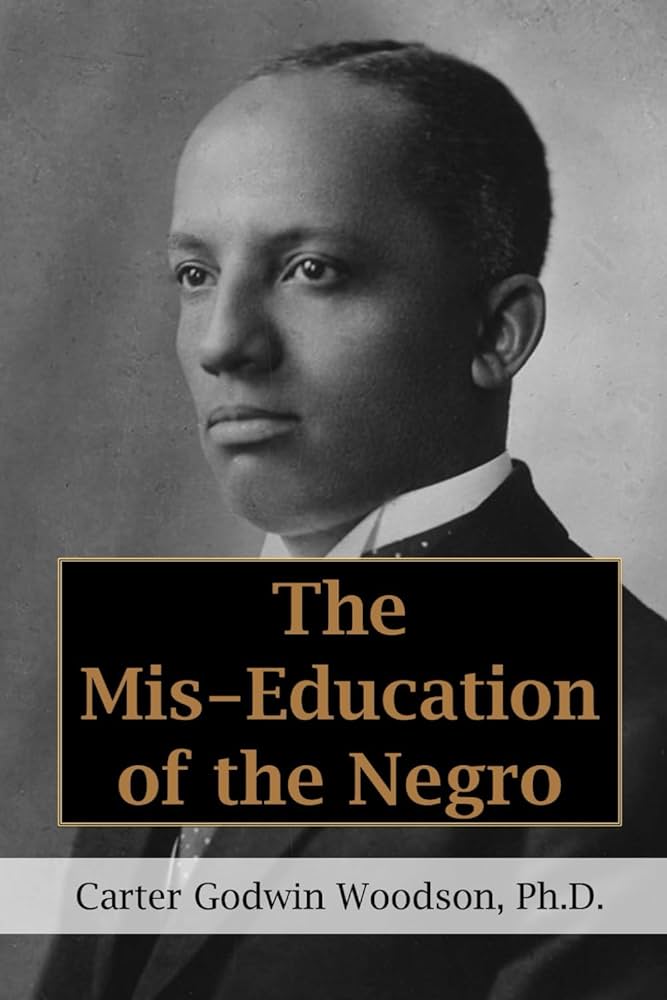
I read a book recommended by CJ (thanks CJ) that I’ve wanted to write something about ever since reading. It was such an interesting and powerful book. It proposed some thoughts I’d never considered and really opened my mind to a different way of thinking about a particular part of American history.
The book is titled The Mis-Education of the Negro, written in 1933. When I started the book, I immediately texted CJ and said there was too much in the book and that we should start a podcast series exploring the topics. He jokingly agreed to do a podcast. As I continued to read, I noted 40 topics, each I thought would make for a worthwhile discussion.
CJ and I are at a combined 6 children 4 years old and younger, so a podcast is definitely on hold.
I read this book a couple years ago.
Discussing race is difficult. I’ve debated posting this for some time. Not that I’m saying anything controversial or crazy. Just that I don’t like to think too much about race. But our race is important. It makes who we are.
Sometimes commenting on race as a white person feels like a lose-lose situation. I’m either so positive about other races that it seems like pandering to the point of insincerity or like I’m trying to make up for something, or I’m not positive enough and come across at best not understanding and at worst a racist.
I think this is why talking about race in America is so difficult. I’ve written about it before and it still is one of the most difficult things I’ve written.
And yet, I continue to hear from my black brothers and sisters say that the best place to start is to just be open about discussing it. Which led me to put this post together. Nothing profound. Just my thoughts on a good book.
I should mention that the book was written in 1933 which led me to continuously ask, is it still that bad? I think many of the disappointing and sad truths the book lays out have improved. Not yet perfect, but improved.
I want to list some of the topics I noted as interesting from the book. Then I’ll elaborate on one of them.
- The “equality” of black and white people. Are black and white people the same? No, we are different in so many ways. From upbringing, culture, background, experience, etc. And that’s ok.
- Black people being nominally free but economically enslaved.
- Has education for black people gotten better or worse since 1933? I assume it must have improved, but it was a thought this book made me consider.
- This is something I feel like people my age have started talking about more- why didn’t we learn how to do taxes instead of the Nina, the Pinta, and the Sante Maria? – The question I asked from reading this book, what is education good for? Why do we care about random historical facts from Europe? To be clear, I appreciate as much as anyone the importance of understanding history and where we came from. But shouldn’t I also know how to file my taxes and apply for a job? Also, on that note of “where we come from.” I remember a lot of history being taught about Europe. I don’t remember a ton being taught about Africa, Asia, or South America.
- The opportunities that are afforded whites because more white people own businesses, etc. compared to black people. I think this was much more prevalent in the 1930’s compared to today.
- I really struggled with reading this book because I passionately hate the word in the title of the book. Underlining it over and over throughout the book drove me crazy. I almost put the book down many times because I hated how a group of people was being, I felt, unfairly characterized.
- Competing churches taking away from impoverished areas.
- Why do we study the domineering, warring nations and not the peaceful, productive nations? The answer is obvious- the winners of wars write history. But philosophically something to consider.
- Interesting point mentioned about former slaves avoiding using art to portray their experiences. There were so few books or art pieces made by former slaves depicting that struggle. I think we see that more embraced today with hip hop. Artists like Tupac, Ice Cube, and Kendrick Lemar come to mind as individuals that fully embrace the struggles they have experienced in life and have made great art out of it.
I heard this not from this book but 3+3 and 2+4 are the same. Different, but still the same.
The point I’d like to discuss a little more is point one. The author of this book pointed out that we’re so obsessed with making everyone equal that we disregard that people are different. He points out that maybe black people and white people shouldn’t be taught exactly the same. We come from different backgrounds and different life experiences. Something that resonates with me and helps me learn may not resonate or help someone else with a different culture from mine.
Still, I think this idea is interesting. Generally speaking, a black person has a different life experience from a white person. I’m not talking about just upbringing, I’m talking about the way we see the world, I’m talking about the way we interact with the world, I’m talking about the way the world interacts with us. Black people and white people can be different. That’s not bad though. We’re not different in an inferior / superior way, just different. Good and bad. Different.
From the book:
“The differences of races, moreover, is no evidence of superiority or of inferiority. This merely indicates that each race has certain gifts which the others do not possess. It is by the development of these gifts that every race must justify its right to exist.”
It makes me think about what is happening with gender. Women and men are different, and that’s ok. We all have our own skills and talents that make us who we are. The fact that I’m a man makes me different from my wife. My wife has many skills and talents I’ll never possess. Recently I heard it put this way – 3+3 and 2+4 are the same. Different, but equal.
That said, the most important thing is that we remember we are all sons and daughters of God. White and black doesn’t mean anything to God. What matters to God is what’s in our hearts. We are all individuals. That’s ok. We should all be treated equally, of course. But we should remember that we are unique. Our uniqueness is great.
If you want to read a book that makes you consider race and the history of education for black people, this is a great book to read. I encourage all of us to study these ideas so we can better love and understand each other.
 No Coincidences