Tag: hope

  • Discipline, Sharks, and Freedom

    Discipline, Sharks, and Freedom

    I watched a video recently. You can watch it here:

    In the video, some surfers are complaining about a barrier in the ocean. They’d travelled for a once in a lifetime surf trip and a barrier was keeping them from being able to surf the big waves.

    As they were complaining, an older surfer walked up and let them use his binoculars. Through the binoculars, just beyond the barrier, the young surfers could see a feeding frenzy. Sharks were just beyond the barrier.

    What seemed like the worst thing in the world quickly turned into a great protection and a great blessing.

    How often do we look at life as though through a murky glass? If we only had binoculars, or could see and understand the bigger picture, the way God sees things, how differently this world would look.

    1 Corinthians 13:11-13

    11 When I was a child, I spake as a child, I understood as a child, I thought as a child: but when I became a man, I put away childish things.

    12 For now we see through a glass, darkly; but then face to face: now I know in part; but then shall I know even as also I am known.

    13 And now abideth faith, hope, charity, these three; but the greatest of these is charity.

    I think back on my teenage years. I wasn’t the most rebellious teenager. I was far from the most obedient. I pushed boundaries. I experimented with what I thought would bring me joy.

    As I’m now in my 30s, I realize just how stubborn and rebellious I am. This life is an opportunity for my spirit to prove whether or not I will choose God. I try my best. I realize that I am still just a child. Thinking I know best while God watches and lets me stumble around, making all the mistakes I need to so I eventually develop the humility, faith, and trust He knows I need.

    As I consider teenagers today, my heart fears for them. I remember when I thought I needed to drink, try drugs, do all the worldly things or else I would miss out. Or just to feel like I belonged.

    I think back on how lucky I was to try these things and escape with my free-will intact. Many are not so lucky.

    We look at so many destructive habits and activities from the perspective that they are fun and exciting. They are the big wave. But beneath the big wave are dangers we don’t perceive. Beer commercials always show the party. There is always a picture of abject excitement, freedom, liberation, and joy. What is never shown is what is lurking underneath: addiction, sadness, loneliness, emptiness, fear, doubt, dependance, despair, danger, suffering.

    The products of a worldly life are these things. I’ve seen it. We all have. And yet we think we want to be a part of these things, a part of this world.

    Thrilling and tantalizing waves.

    A feeding frenzy underneath. 

    Some quotes from that video –

    “The Lord’s commands do not constitute some grueling underwater barriers that we must learn to grudgingly endure in this life so that we might be exalted in the next.”

    “The Lord’s commandments are given out of love and caring. They are intended for our joy in this life just as much as they are intended for our joy and exaltation in the next.”

    There is this worldly perspective that restrictions and the commandments of God take away our freedom. Let me be free! Let me party! Let me eat, drink, and be merry!

    “Seek freedom and become captive of your desires. Seek discipline and find your liberty.”

    -Frank Herbert, Chapterhouse: Dune

    We think real freedom is drinking what we want to drink, not realizing we become a slave to that drink.

    Real freedom is eating what we want to eat, not realizing we become a slave to our appetites.

    Real freedom is going to the party, not realizing we are a slave to the fear of missing out.

    We are commanded to avoid things because those things take away our freedom, they do not liberate us.

    Real freedom is not being dependent on any substance, food, drug, or activity. Real freedom is discipline.

    Why does God give us commandments? Not to restrict us but to protect us. Not to hold us back but to let us fly to our highest potential.

  • Simplified Husbandship

    Simplified Husbandship

    These are the highlights I typed up for myself from a book called Simplified Husbandship | Simplified Fathership by Richard M. Eyre. I typed this up mostly for myself to refer back to.

    This is only on the simplified husbandship portion of the book. These are the quotes, summaries, and most important points I found from the book.

    “To become a better husband –

    change yourself

    not your wife.”

    “The home should be the center of growth, happiness, of excitement. If your home isn’t a happier place now than it was a year ago, you’re not progressing.”

    “A marriage of oneness should have a Venn diagram that is as circular as possible in the middle. When the marriage doesn’t have enough oneness, the middle is like a football.”

    “This type of marriage, like a football, is erratic and hard to predict. There is no telling where it will bounce.”

    “The best way for a husband to pursue this kind of oneness lies not in efforts to change his wife or even in efforts to change the marriage relationship. His best chance lies in changing himself.”

    Partnership-Plan-Pray

    Communication – “Oneness is an impossibility between two who share only part of what they feel.” This one really hits home for me. I’m not a great communicator.

    Inspiration – “The third partner should be the Lord.”

    One strategy for partnership –

    Wife handles the “inside partnership” of inside-the-home things such as home, children, personal kingdom, etc.

    Husband handles the “outside partnership” of outside-the-home things such as money, providing necessities, involvement in outside causes like church and civic, etc.

    In the above example, the wife would be general manager of inside partnership and husband participating partner and vice versa.

    Each night before prayer each gives a brief report on their stewardship, and receives comments, questions, or insight from the participating partner. Both participate, but one is in charge of each.

    During scheduling, attempt is made to find an hour where roles are reversed. Husband spends time with the children on the inside and wife shifts to outside activities, church, civic, or personal. (This seems extremely structured, to the point that it might border on unrealistic, practically speaking. But I still like the premise).

    Partnership – “day planning” – evening prayer.

    Each has a role and the Lord is the supervising partner.

    Partnership meeting is simple and shouldn’t take more than 10 minutes. The results:

    1. Each learns more about the arena where he or she did not spend the day (and becomes more appreciative of what the other is doing).
    2. Each gives input and ideas for the other’s benefit.
    3. Each thinks about what he or she will do the next day in both the general and the limited role.
    4. The prayer becomes far more specific and meaningful (because it is about things just discussed).
    5. Both sleep better when the next day is clear and challenging rather than hazy and uncertain.

    Things I personally could talk about with the outside responsibilities:

    1. Schedule for work / coaching / gym / church calling / projects
      • Go over my daily items
    2. Investments and status
    3. Finances – budget (handled by Beth, could be a part of her report).

    Once a month dinner date, reviewing the month. Review the past month and set goals for the month ahead.

    Once a year “honey-moon” vacation to review the last year and the year ahead.

    Principles:

    1. Total communication and openness
    2. Complementary roles (separate but shared responsibility)
    3. Shared goals and plans
    4. Adding the Lord to your partnership through earnest, regular prayer together

    “If exaltation is the goal, marriage partnerships must fold together in purpose and communication until they become one. We often imagine that temple marriages differ from civil marriages in quantity (they last longer), but, in fact, their quantity will be great only if their quality is great, only if oneness is obtained.”

    “Agreeing to disagree on some things is fine among friends and business partners but not between marriage partners striving for oneness.”

    “Partners are separated when they compete in any context other than fun.”

    “Emerson said, “Marriages do not fail, people fail. All marriages do is show those failures up.””

    Partnership-Plan-Pray Summary:

    • My wife is my partner in all I do.
    • We share everything, including our deepest feelings.
    • We plan our time together and share objectives for our lives inside and outside our home.
    • We pray together regularly, and preceding the prayer is a discussion of our partnership.

    Protect-Pamper-‘Preciate

    “A woman’s ego is no weaker than a man’s, but hers works in a slightly different way. Hers usually is best fed when she is cared for, complimented, appreciated, protected – even pampered a bit – not with the patronizing implication that she is weaker, less able, but with the implication that she is more special, important, and genuinely valued. A wife who receives sincere compliments, who is appreciated, who feels needed and cherished and protected, seems to gain a soft strength, a kind of clear-headed fulfillment that raises her toward her full potential in many areas.”

    “It’s the old notion of “out-giving” that can make marriages even more beautiful. Have you ever watched what happens to a basketball team when one player is so unselfish that he is always looking for a teammate to get the ball to? Other players respond in kind. The ball moves faster; everyone gets better shots. The teamwork of marriage can be similar.”

    Me – This is similar to the advice I received early in my marriage. When I confided in someone about my frustrations with doing household chores, that someone asked me point blank, “Why are you doing chores?” They asked if it was to one-up or get an edge on my wife. They asked how the Savior served. They pointed out that this life is meant for us to become like the Savior. The Savior never asked for anything in return when he served others. If I’m cleaning the house or doing something so that I’m owed something or appreciated by my wife, what’s the point? It’s not service, it’s a way to get an advantage. They said to love and serve my wife for that simple purpose. Because I love her and I want her to be happy, and for no other reason. My life and marriage are better when I realize and remember this.

    “It is not the addition of responsibility and children that destroy romance. It is the subtraction of courtship, of chivalry, of living to make the other person happy.”

    Protect-Pamper-‘Preciate Summary:

    • I love my wife deeply and understand her need to feel cherished and loved. 
    • I feel tenderness toward her and want to find meaningful ways to compliment her, to be chivalrous and protective of her. 
    • I watch her closely and notice the time she needs the “lift” of a tender kiss, a word of sincere appreciation, a helping hand, a date.” 

    Patriarch-Priesthood

    A wife is asked, “What would you do if your husband were to ask you to do something you didn’t agree with, not something unrighteous, but something you didn’t want to do?” 

    She responds, “I would tell him I didn’t want to, and we would discuss it.” 

    “Yes, and most things you would work out and agree on. But let’s say in this instance you still didn’t agree. You thought it was the wrong decision, but he still wanted it. What would you do?  

    She says, “I wouldn’t do it.” 

    “That’s what I want to talk to you about. You would have two options in that situation. One, to refuse. Or two, to say, ‘Yes, you know my feelings, but if you still feel it is right, I will accept your decision.’ If you take the first option you get into a power struggle and minimize his chance to change or repent if he is wrong (his ego, if you defy him, will lock him into his wrong choice). If you take the second option, you show trust and giving, and you maximize his chance to change if his decision is wrong. (The other side of the husband’s ego is the one which feels the responsibility to protect and be fair with his wife who puts her confidence in him.)” 

    The husband is then asked, “Would you ever do that? Demand that your wife do something she did not agree with? If you do, you will sooner or later destroy your relationship. If you force decisions on her, you abuse her trust and become a tyrant. That is what you do if you demand.” 

    If either the husband or wife remembers this, it will work. If the wife respects the priesthood, the husband will use it well. If the husband counsels and communicates rather than demands, the wife will respect the husband and they will be one, with the priesthood belonging to both together. 

    I would add that this example works the other way around as well. If the wife decides on something and doesn’t respect the disagreement of the husband and the husband refuses to compromise, it becomes a problem.

    “In a baseball game the pitcher throws the ball, the catcher catches it. The roles are equal but different. They could rotate, the catcher throwing every other pitch, but they would do less well in the game. In the patriarchal order, the husband holds the priesthood and the wife shares it. The “head of the home” (the husband’s role) and the “heart of the home” (the wife’s role) are equal but different in that both draw on the great, inherent strengths of each.”

    To be a strong priesthood leader in a home:

    1. Take the lead in planning the week together each Sunday. 
    1. Use the priesthood more in the home (for blessings, etc.). 
    1. Have a short personal interview with each child on Sunday evening. 
    1. Hold a good family prayer each morning and a “partnership prayer” with your wife each night.  

    Patriarch-Priesthood Summary:

    • My wife shares the priesthood with me, and we are equal partners. But I hold that authority and I have the righteous strength that helps her feel secure and fulfilled in her support. 
    • I take the lead in planning and goal-setting, in family prayer, and in personal interviews with each of the children. 
    • I realize that there is no intervening link in the priesthood chain between myself and the Lord. As a father I am entitled to direct inspiration for my wife and children. I ask for that inspiration and receive it. 
    • use the priesthood often in my home for personal blessings and to keep the Lord’s Spirit present.  

    Priority 

    “Lack of commitment is Satan’s key tool in destroying relationships. Without commitment, little problems and disagreements can become final ones.” 

    A “planning” husband: “In addition to planning with my wife, I consciously ‘prioritize’ my wife in my personal planning. When I plan my week, I think about her first, and the fist thing I put on my calendar is our Friday night date. Then I ask her about her schedule and try to work out when she might need me. I try to plan at least one little surprise for her each week.” 

    A less planning husband, “I just watch Pattie and try to notice when she needs a little pick up. Also, and I don’t always remember this, I try to make my last thought of the day, just before I got to sleep, be of Patti. I think, ‘What can I do for Pattie tomorrow?…It’s fun to try to think of her for a moment each night just as I doze off.” 

    Priority Summary:  

    • My wife comes first in my plans, my schedule, my priorities. 
    • When I have decisions to make, my first thought is always how they will affect her. 
    • I consciously try to find “little things” to do for her on a regular basis.  

    Becoming these things 

    “Most husbands, busy with jobs, callings, and concerns of all varieties, cannot be constantly thinking of their roles as husbands. Therefore, becoming these four qualities to the point where you live them naturally is the only practical, workable way to improve your husbandship.” 

    “Self-programming” is the idea of making these qualities subconscious, so they don’t have to constantly be thought about. The point is to become these husband qualities.  

    Methods of self-programming 

    1. Running 
    1. Meditation 
    • The same kind of self-programming can be done in meditation. Simply sit comfortably in a quiet place, close your eyes and quiet your mind as best you can. Then begin – “I put my wife first,” etc. 
    1. Shaving 
    1. The last thought of the day. 
    • The quiet night, with no light or distraction, is a good time to say, “I am the patriarch of my home. I lead righteously through the priesthood. Last week I gave a priesthood blessing to little Nell. I watch for opportunities to use the priesthood.” And so on. 

    “Each method of self-programming can be strengthened by prayer. We have great power to change ourselves, but our Heavenly Father is the true changing force.” 

  • Resilience and Will to Win

    Resilience and Will to Win

    Before you read this – I start this post with a brief description of this year’s NBA playoffs. After this introduction I get into personal stories and what basketball this year has taught me. If you don’t care about the NBA, Just get through this brief introduction to get to some life lessons learned.

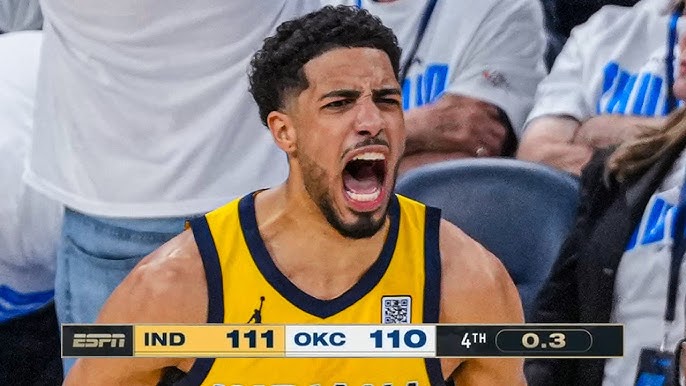
    If you’ve been watching any of the 2025 NBA playoffs then you’ve watched some AWESOME basketball. You’ve also heard about or seen the miraculous Indiana Pacers.

    For the record, I love this team. Tyrese Haliburton has been my second favorite player for some time but he might have taken the top spot.

    I watch all my basketball on a delay (DON’T TEXT ME ABOUT THE SCORE). I put my phone away and don’t look at it to the best of my ability until a game is over.

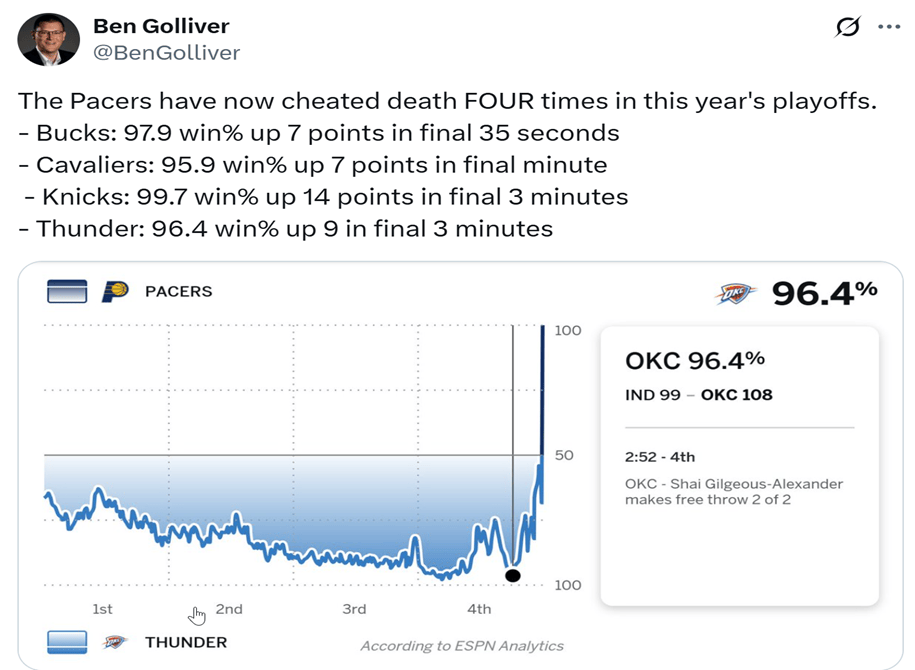
    The Indiana Pacers have had multiple games this playoffs that I’ve fast forwarded to the end, thinking the game was over, only to get to the end and say, “WHAT HAPPENED!?!” loud enough for my wife to get irritated with me. MULTIPLE TIMES. That happens once and it’s an out of this world comeback. The Pacers have had four of those occurences in one postseason.

    Here is something posted by a guy on Twitter about the Pacers comebacks:

    That is four times the Pacers have basically done the impossible. These Pacers have been so extraordinary they’ve made me stop and think more about resilience, will to win, heart, fight, belief, faith, and all the other never-give-up attitudes and character traits.

    I’ve been thinking about momentum. I’ve been thinking about when the energy in a room changes.

    Here’s my personal glory days basketball story I must now share.

    When I was a junior in high school my team was one game behind the fourth seed for the last playoff spot in our division. We played Centennial High School the final game of the season. If we won, we would be exactly tied with them in record. This would mean we would then need to do a one game playoff to determine who got that last playoff spot.

    We beat Centennial handily in the first game on a Friday night. No contest. We were feeling great. We just beat this team easily. Surely we’d do the same the very next morning, right?

    Wrong.

    Centennial switched up their game plan. They actually ran a triangle and 2 to keep the ball out of mine and another player’s hands. Things were not going well. We were down big. Something had to change. I didn’t expect that something being a 3 inch gash to my left eye.

    With things going so badly, our coach called a timeout. He gave us that classic, “You need to fight and be more aggressive” speech. So I went out there and got right on top of the person I was guarding. They swung an elbow down across my face. I went down in a heap. There was blood everywhere. I was taken off the court. I believe we were down 13 when I left the game. I thought everything was over.

    I went into the back and the trainer tried to butterfly stich my face so I could go back out. It was too close to my eye. He couldn’t stop the bleeding. So I was given a white rag to hold over my face and went to watch the rest of the game. To my surprise, as I walked back out to watch the game, I checked the score. We were up! We had gone on a huge run after that hit to my face.

    I was later told that our coach gave another classic speech, something like, “You’re going to let them do that to your teammate? To Quack? That’s your brother! They just busted his head open! What are you going to do about it!?!?!?!” Apparently my team went crazy. Playing with a new force, energy, and purpose.

    My team decided they weren’t going to lose this game while I bled in the back.

    We did win that game.

    Back to the Pacers.

    If you listen to quotes from Pacers players postgame from some of these miraculous comebacks, it’s all, “We never stopped believing”, “We always knew we would win”, “We never give up”. Usually these statements are just cliches, things players have to say as they can think of nothing else to say to a reporter postgame. Things that have to be said after a comeback. But with these Pacers I BELIEVE IT. I believe they never stop believing. I believe they always thought they were going to win. I know they never give up.

    From glory days 17 years ago to more recent, weekend warrior glory days.

    In a recent pickup basketball game my team was up 13-3. We needed to score one more time to win the game. The other team scored. 13-5. No big deal. The other team hit a three. 13-8. Okay. The other team hit another 3. 13-11. Uhm. The other team hit a three. 13-14. It was now next to score wins. At this point all 10 players on the court had watched the Pacers comeback just two days prior. We were all thinking about it. Those on my team felt like the Thunder. It actually crossed my mind, ‘This is how the Thunder felt, oh man, we’re going to lose this game.’ The 5 players on the other team were thinking, ‘This is how the Pacers felt. We’re going to win this game.’

    I took a moment in the middle of that pickup game and looked around at my team. I knew what they were thinking. I looked at the other team. I knew what they were thinking. Before you say, ‘How did you know what people were thinking?’ Well, when the game ended, we discussed it openly. All 10 of us were talking about the Thunder Pacers game and how we felt as a 13-3 lead turned into a deficit.

    I know you’re wondering how that game ended. I don’t want to brag but… you know… I finally decided enough was enough. Used a pick and roll, got a switch, pivoted into the paint, pivoted around a big player, and finished a left hand scoop layup. It was as cool as it sounds.

    But really. There was a moment when I decided, “We’re not going to lose this game.”

    I could have easily stayed in the mindset that hit me for a brief second, “We ARE going to lose this game.” I had to fight that thought. I fought it. And we won. If I stayed in that thought, there’s no chance we win.

    I know I know, pickup basketball at my church building pales in comparison to the NBA Finals.

    So think about the pressure felt by 5 players on a court surrounded by 18,203 watching fans all thinking the same thing: the Pacers are going to do it again. Think about that energy. Think about what that does to your psyche. If I felt it with 10 players on a church basketball court, what did the Oklahoma City Thunder players feel?

    Pressure. Weight.

    What is resilience? What is fight? What is the will to win?

    This is why I love sports. It teaches us about life.

    I tell the girls I coach all the time – “Yes, this is a game. You will win or you will lose. Things will go well or things will go bad. But how do you handle it? This is a game. What happens when life gets hard? What happens when life is easy? How do you handle it? Basketball teaches you about life. It teaches you about who you are. It teaches you how to handle adversity.” Every player I’ve coached has heard some version of this speech.

    So if life has been hitting you in the face lately and you feel like you’re on the other end of an 11-0 run. If you feel like nothing is going your way and you just can’t win. This is my reminder to you that the Indiana Pacers have done the impossible FOUR times in a month.

    Faith. Belief. Hope. Positivity. Fight. Never give up. This is what makes you a winner, in life and in sports.

  • What do we believe in?

    What do we believe in?

    My Aunt Lindsey often asks the question, “What do you know?” I usually respond, “Not much.”

    What do we really know? Anything?

    While reading Mosiah chapter 26, I came across an interesting commentary from Hugh Nibley, one of my favorite scholars. The commentary was on Mosiah 26:15 which reads:

    “Blessed art thou, Alma, and blessed are they who were baptized in the waters of Mormon. Thou art blessed because of thy exceeding faith in the words alone of my servant Abinadi” (emphasis added).

    In considering that phrase, “in the words alone of Abinadi”, Hugh Nibley asks, “Now what about childish faith? What about being gullible, etc.? Alma believed in the “words alone”? Alma saw no evidence, no proof, or anything like that? And it wasn’t the words of God; it was the words of Abinadi alone that he believed in? What’s going on here? Why is there merit in this?”

    He continues, “There is merit because Alma believed in his words alone. I would emphasize his. You are blessed because of the things you choose to believe-not by the act of believing, not just by faith. You weren’t blessed because you believed, but because you chose what to believe. Everybody chooses what to believe. The atheist is a very strong believer. He is the most passionate arguer you can possibly find, and the positivist. Where will you find greater faith and firm conviction than among economists? . . . You must believe in something, and everybody does. But the Lord said, blessed are you [Alma] because of the things you chose to believe; you chose to believe in the things that Abinadi taught.”

    I’ve written before about The Faith of an Atheist.

    What do we believe in?

    This is an interesting statement by Hugh Nibley. The idea that it isn’t our faith that is important. Everyone has faith in something. It is what we have faith in. What do we choose to believe? Do we choose to believe that this is all one dumb coincidence and we’re all here for no real reason? Or do we believe in a Savior who redeems us, a Father who loves us, and an eternity of potential?

    Like a lot of things, it’s really about agency. What do we choose to believe in? Alma chose to believe in something good, hopeful, eternal.

    People who leave the church – are they better for it? This is going to upset some people. But in my opinion, no, people aren’t better for leaving the Church. That’s not absolute, of course. Some who leave the church still donate constantly to good causes, serve others, love others, and use their time in helping others. More often than not, I don’t think that’s the case.

    Many who leave the church, instead of turning their focus to good, hopeful, and helpful things, spend the rest of their lives trying to bash, destroy, and talk negatively about the church. Why is that? If leaving the Church of Jesus Christ is a good thing, why doesn’t more good come from it instead of more negativity? Why is tearing down something, whatever your feelings on it, that brings others hope and joy, a good result?

    Is it easy to be a member of the Church of Jesus Christ? With the number of people my age deciding they don’t care for the Church, or any church, I’d say membership in the Church of Jesus Christ is not super easy. A lot of people say, “The church doesn’t do anything for me.” The Church isn’t about what it can do for you. It’s about what you can do for others. When you leave the Church, what do you do for others?

    Leaving the Church is complicated. I’m not trying to oversimplify it too much. But what I think gets lost sometimes is that leaving the Church is often a selfish choice. At least it was for me. I don’t want to have to get up early for church on Sunday. I don’t want to use my Saturday morning helping an elderly person move their belongings. I want to drink. I don’t have time for a church calling like teaching a class, working with the youth, or organizing group activities. I definitely don’t have time for ministering. Yeah, checking on a couple people every so often to make sure they’re doing OK, and really help them if they say they need something, don’t have time for that. I don’t want to pay 10% of what I earn anymore. The list goes on. Someone leaving the Church NEVER thinks this way (or won’t admit it). It’s about historicity or “what they feel” or feeling lied to or CES letter blah blah. I’m not trying to say that those things can’t be hard for people. They are, and I understand that. But often, it comes back to I, when the Church’s main goal is to help us see outside of ourselves.

    Now let’s be clear. Simply going to church isn’t enough. There are plenty of people who go to church on Sunday, leave, and call themselves stalwart disciples of Christ. You may be worse off than the nonbeliever in that case. It may be worse to believe and turn away the sick and needy than to choose not to believe.

    Does some small historical question, or some big historical question, distract you from a plan called “the Plan of Happiness”? Do you choose to worry about a statement by Brigham Young or some question about Joseph Smith? Do you disregard the miraculous book that was written, the testimony of a Savior of the world, an account of that Savior visiting His children in America? Do you ignore the hopeful and positive miracles because you have doubts?

    What do you choose to believe in?

  • Faith of an Atheist – Bouncing Atoms

    Faith of an Atheist – Bouncing Atoms

    What does an atheist have faith in?

    We all have faith. We have faith that we eat, and the food will sustain our body. We have faith that we drink, and the water sustains our body. We have faith that we breathe, and air sustains our body. We have faith that we will move, and it happens. Every act of our lives is an act of faith.

    As Lectures on Faith Lecture First says: “without [faith], both mind and body would be in a state of inactivity, and all their exertions would cease, both physical and mental.”

    Whether you believe in a Creator or not, this fact remains: all have faith. The only question is: what is your faith in?

    I previously wrote about the faith of an atheist HERE. That post talks about the hope of an atheist. What about the faith?

    If we all live by faith, what does an atheist have faith in?

    The only thing I can think that an atheist has faith in is their self.

    When you remove God from the equation, what else is there? There is you, your mind, your thoughts, your supremacy. Not only that, if there is no God, then this all just happened by chance. You are a product of random chance, with no meaning. You are an object with atoms inside of you bouncing around causing you to do things. If this is all by chance, there is no free will. If there is no God and we are all happenstance, if we are all a great coincidence, then we are Gods, and there are no Gods. There is nothing. There is no point.

    A lack of a belief in God is a lack of belief in anything. If this life is not about a bigger plan then it’s all pointless.