Tag: jesus christ

  • Marriage After 7 Years

    Marriage After 7 Years

    It’s been a long time since I’ve written about marriage. It was in the midst of a worldwide pandemic that I last wrote on this topic.

    Now that I’m a seasoned veteran of the marriage game (7 years), I thought it was time I imparted some more wisdom on the topic.

    First of all, what’s changed in my life now that I’ve been married 7 years? I made a list:

    First, I have way more missing socks.

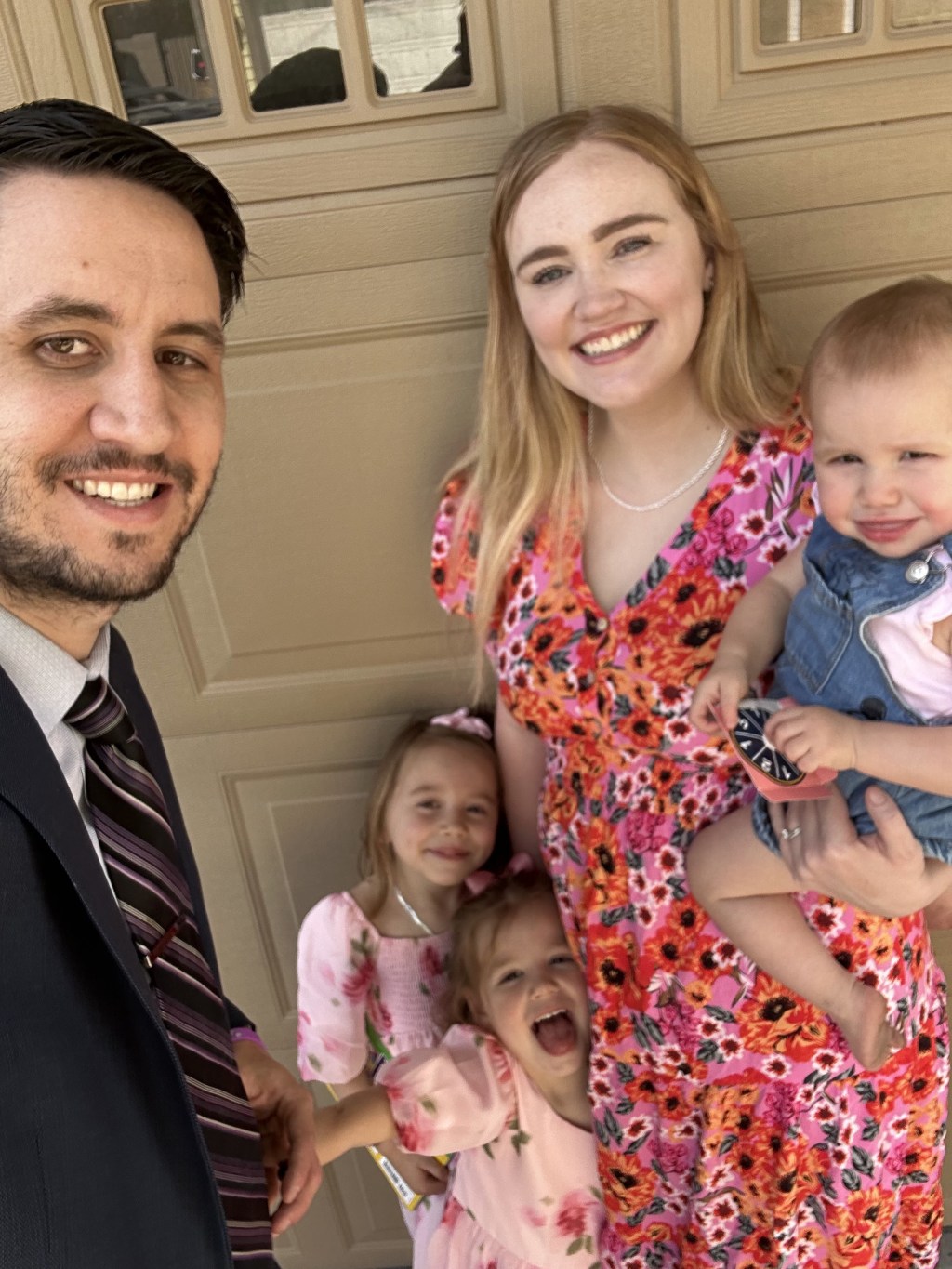
    Second, Hair. Everywhere. This might be a product of 3 daughters as well.

    Third, Clothes. Everywhere.

    That pretty much sums it up. Marriage has caused me to be missing a lot more socks, and encountering a lot more hair and piles of clothes.

    On a more serious note (though I’m deadly serious about the above), I was reading in the Church of Jesus Christ of Latter-day Saints Handbook the other day. I came across the section titled

    Husband and Wife

    A lot stood out to me in this short section of eternal truths about marriage. I wanted to share some of what I read and my thoughts on it. Right from the start:

    “Marriage between a man and a woman is ordained of God.”

    What a simple and profound truth that the world has somehow distorted into a complete mess. I believe this is something that has fallen by the wayside in modern society. In a secular society that considers marriage a tax benefit or something related to governmental laws of the land, the profoundly important nature of marriage is lost. Marriage is ordained of God. When a couple gets married, they’re not just making a vow to each other, they’re making a vow with God. There are reasons for divorce. But do those reasons stand up to separating a union that included God as part of the promise? I think most divorces today would be reconsidered if the participants fully recognized or understood the role God played in the vows made. 

    “A couple makes this covenant [of celestial marriage] when they receive the marriage sealing ordinance in the temple. This covenant is the foundation of an eternal family. When faithfully kept, it allows their marriage to endure forever.”

    The idea of eternal families is near and dear to my heart. A long time ago, when I was very far away from the church, I told a girl I was talking to that I would never get married outside of the temple. This was always something I stood by. My opinion was always, ‘I know this is true, so if I’m going to get married, why would I half do it? If I’m going to get married, it will be forever. If I’m going to have a family, it’s going to be eternal.’

    I believe this is one of the most beautiful truths of the restored gospel, a beautiful truth that God has reminded His children of in this, the dispensation of the fullness of times. We are eternal. Our relationships are important. Our families are the most important.

    That girl that I told I would only ever get married in the temple was not a member of the Church of Jesus Christ of Latter-day Saints. She said she was struck those years ago that I believed something so strongly. At the time I was living completely contrary to the teachings of the Church. Everything I did was in opposition to the laws God had set forth for me. The idea of me ever getting married in the temple was a far-fetched pipe dream. Despite how far away I was from the church, I knew eternal families to be a true principle. I knew my family, with my mom and dad and siblings was eternal. I wouldn’t have my own family, with a wife and children of my own, to be any other way. It had to be eternal. That girl I told those many years ago that I would only get married in a temple – she got baptized years later. She was sealed in Jesus Christ’s temple. Now she is sealed to her boys and to her husband for time and all eternity. She said my firmness on something I was so far from impacted her. I’m glad it did.

    Today my marriage is eternal and will be forever because we made an agreement with God. Marriage is hard. It fluctuates. There are lots of peaks and valleys. I don’t know that it’s getting any easier. But I do know my love for my wife is evolving in a fascinating way. Our relationship is strengthening through bumps and bruises. If not for the belief in an eternal partnership, those bumps and bruises may make me reconsider marriage. But that isn’t an option. In a particularly bad fight years ago Beth texted me while I was at work noting how cold and withdrawn I had been after the fight. She told me if I was considering ending our marriage (this shows how crazy the fight was) that I should just tell her and not keep her in the dark.

    I told her that would never happen. It wasn’t an option. I hope that gave her comfort. I believe it did. No matter how bad our fights get, we have a partnership and that partnership includes God. I’ll have to answer to Him one day if I don’t give every effort in my being to make this union work.

    I’m grateful Beth has the same respect and appreciation for the marriage covenant that I have.

    “God has commanded husbands and wives to cleave to each other. In this context, the word cleave means to be completely devoted and faithful to someone. Married couples cleave together by loving and serving each other.”

    It’s a difficult transition going from only caring about yourself to having to consider someone else for everything. It’s easy to be selfish when it’s just you to worry about. A marriage doesn’t work that way. I had to get over a lot of selfishness when I got married. There’s probably a lot of selfishness still to go.

    “Adam and Eve set an example for husbands and wives… They were united with each other and with God.”

    United. If ye are not one ye are not mine (D&C 38:27). I think marriage is the greatest training ground for learning unity, partnership, and oneness. I already noted the selfishness that must be released when getting married. With selfishness a marriage can’t work. I think this is a primary reason why marriage is so important to God. Adam and Eve were united with each other and with God. If God is an integral part of a relationship, I think it becomes exponentially more difficult for that relationship to end.  

    I am grateful for the marriage covenant. I am grateful for the covenant path that started with baptism and led me to where I am today. The world is ever-changing. The marriage covenant is not. The world is shaky. Eternal families are firm. The world is difficult. My family is my strength. The world attacks me. My eternal companion, my wife, supports me. The Church of Jesus Christ of Latter-day Saints is more than a church. It is Christ’s organization on the Earth today. As such, it is a refuge against the whirlwind. The covenants God has given me in this earth life will benefit me for all of eternity. What a thought. What a blessing. What a gift. I am ever-grateful for that gift.


  • Christ’s Church in the Wilderness

    Christ’s Church in the Wilderness

    I’d like to discuss an interesting pattern. That pattern is that Christ’s Church is always established in the wilderness. Let’s explore: 

    Adam was cast out of Eden into the lone and dreary world. He ventured into a world that was essentially a wilderness. It was here that he received gospel teachings and likely would have established Christ’s Church. 

    Noah established Christ’s Church when the world became so wicked that all the people save Noah’s family were destroyed by the flood. Noah re-established Christ’s Church in a world that had literally become a wilderness.  

    Abraham seemed to steer away from civilization and established his covenant family in the wilderness. 

    Moses removed the Israelites from a life of slavery, in so doing, removing them from Egypt. They ventured into the wilderness. Moses re-established the covenant with Jehovah, and established Christ’s church. 

    Christ was from Nazareth, not Jerusalem. He taught and preached mostly on the outskirts of cities. It could be said that He established His Church from the wilderness.  

    Let’s venture to a different branch of the tree, other children of Israel, to continue to establish this pattern: 

    600 years before Christ came to Earth to re-establish His Church on the outskirts of Jerusalem, Lehi was commanded to leave Jerusalem. Why? To find a promised land. A promised land that was essentially a wilderness. This is where Lehi was to establish Christ’s Church. 

    In ~147-145 B.C. Alma the elder re-established Christ’s Church in the wilderness when he escapes from wicked King Noah and baptizes 204 souls in the waters of Mormon. Read Mosiah 18 for more on this.

    And finally, in 1830 Joseph Smith restored Christ’s Church to the Earth. What happened? Given this pattern, could the Church be established in New York? Boston? Even Ohio or Illinois? Even those cities and states were too “civilized” for God’s Kingdom to be fully established there. So the Church had to move to the wilderness. As God’s pattern always dictated. Fresh ground for His Kingdom, for His Saints. For new wine does not belong in old bottles (Matthew 9:17).

    I love finding patterns that re-affirm the truth of Christ’s restored Church today. God works through patterns. Here is an obvious pattern. God has never been able to establish His church amongst “civilized folks.” It has almost always seemed to take a wilderness. It was in the wilderness of the Salt Lake Valley, among the mountain tops (Isaiah 2:2)  that God allowed the wilderness to blossom as the rose (Isaiah 35:1) for His chosen people. 

    Oh look, more prophesies fulfilled by the Church of Jesus Christ of Latter-day Saints. More patterns continued, more completed. Funny how that works. 

  • Are We Living in the End of Times?

    Are We Living in the End of Times?

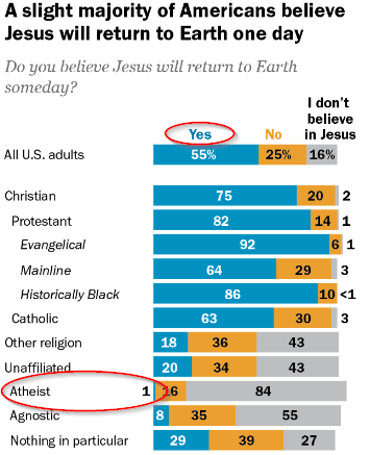
    A simple Google search of “Are we in the end of times?” led to something I found very funny. My attention was caught when my search results returned a headline that started: “In US, 39% of adults believe humanity ‘living in the end…’” That result led to this link: “Do you believe Jesus will return to Earth?”

    Yes, yes, I do. But do others?

    This article was a Pew research article from December 2022 asking U.S. adults that simple, yet complex and extraordinarily important question: Do you believe Jesus will return to Earth? (You know, just the question, is the Creator and God of this Earth gonna, you know, come back, ever? Not a big deal).

    The fact that others believe we’re close to the end, as I do, did not surprise me, or make me laugh.

    What made me laugh, was this:

    Look closely. Do you see it? (I circled it to help out)

    That’s one confused atheist.

    For the record, “Atheist – a person who disbelieves or lacks belief in the existence of God or gods.”

    “Agnostic – a person who believes that nothing is known or can be known of the existence or nature of God or of anything beyond material phenomena; a person who claims neither faith nor disbelief in God.”

    So I guess the agnostic through some mental gymnastics could say they believe Jesus Christ is coming back to earth.

    But man, do I want to meet that atheist! I have a lot of questions. “I don’t believe in Jesus, but I believe the historical figure will come back to earth one day.” Now that I think about it, maybe this atheist has extraordinarily complex and deep thoughts on the matter. Maybe I shouldn’t judge them.

    Anyways, we are living in the end times. If you don’t believe it, read the Bible. It’s pretty clear.

    Elijah has come, this is the last dispensation, pretty obvious if you’re paying attention.

    But Beth tells me I have to tone down my “doomsday” talk so I’ll just leave it at that.

    If you do believe the world is ending, though, please contact me, let’s compare notes and talk shop.

    Until next time!

  • The Gift of Tongues and a Temple in Guatemala

    The Gift of Tongues and a Temple in Guatemala

    I recently learned a little about the Cessationist movement in Christianity. I learned that they believe many things have ceased in modern Christianity. One of the things they think has ceased is the gift of tongues.

    The Church of Jesus Christ is alive and well as is the gift of tongues.

    The most obvious example of the gift of tongues in Christ’s modern church is shown in the millions of 18-24 year-olds learning and speaking foreign languages to spread the gospel.

    I recently read of a true miracle in tongues, and I wanted to share.

    Allen Christenson writes the following:

    “I was privileged to help in the translation of the temple ceremony into K’iche’, a dialect of the Mayan Indians of Guatemala. In 1991, the Church brought up seven choice native Maya members of the Church to record the ceremony for the first time in their own language. Most had never traveled outside their own country. They arrived when we had a bad cold snap and snow storms last January. In a country where it never snows that was quite a shock. They wondered whether the flakes were volcanic ash, and bundled up with layer upon layer of clothing so that the snow would have no chance of touching their skin.

    The Maya today are for the most part illiterate, particularly in their native tongue. It has only been in recent years that some members of the church have begun to learn to read and write in the Maya language, so that they can read the scriptures and other church publications. This is a great tragedy, because until about 500 years ago the Maya were the most literate people in the Americas, preserving their history and culture with a sophisticated hieroglyphic script in hundreds of folded screen books. The Spanish Conquest in the early sixteenth century was a devastating blow to Maya literacy in Mexico and Guatemala. Great numbers of hieroglyphic texts were burned in an attempt to eradicate “idolatrous paganism.” Native scribes were singled out for persecution to such an extent that within one hundred years, the art of writing had nearly disappeared from among the Maya people. When I was a missionary in the Guatemala highlands, no one I knew could read in Maya. Because I opened most of the areas I worked in, the church was in its infancy and there were no members to prepare for the temple. The closest temple in fact was in Mesa, Arizona, and for a people who earned at best a dollar a day, a trip there was a goal which was simply impossible to even think about.

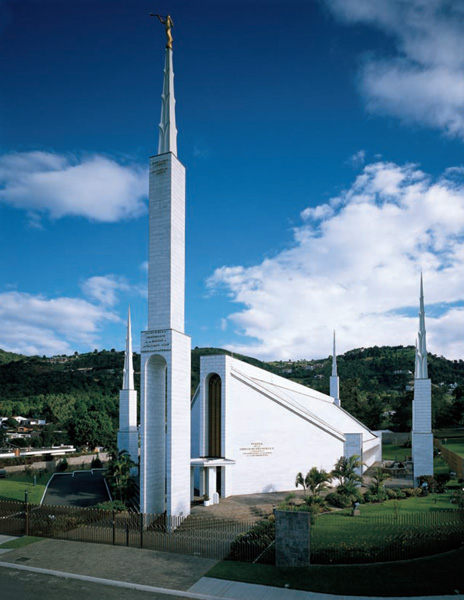
    Today there is a temple in Guatemala City. The Maya who were brought up to record the temple ceremony for their people had all taken out their own endowments and considered it a great privilege to have a part in bringing the blessings of the endowment to their people in a language that they could understand.

    For the first few days, the Maya were given time to read through their parts, review videotapes of the ceremony to practice their timing and voice inflections, and to prepare for the actual recording. It soon became apparent what an impossible thing we were asking them to do. Most of their homes had no electricity, and the rows of machines and blinking lights were frightening and intimidating. None could read any better than at a grade school level, sounding out each word at a time. Just getting out the words was a frustrating and time-consuming task. We frankly didn’t think that it would be possible for them to become proficient enough to read the text rapidly, much less instill in the words the spirit that such a sacred ceremony demands.

    I will never forget the first day we started to record. We put these poor, humble people in a little glass booth, surrounded by technical gadgets, microphones, and earphones and asked them to relax and speak the words with naturalness and the proper spirit. They were so frightened that they could not speak more than a few words at a time, and those were unusable.

    We all went back to our hotel rooms discouraged and felt that we were going to fail. The next day, I noticed a change in the Maya. They were unusually quiet and serious, but somehow they didn’t seem to be as afraid as the day before. When the first brother, who was assigned to read the part of Elohim, was called on to record his part, he stepped into the recording booth without hesitation. The window was set so high in the booth that we could barely see him, being only 5’4″ tall. He put on his earphones, closed his eyes and looked up momentarily, and then said quietly that he was ready. When I gave him his cue he began to speak in the most beautiful, flowing Maya that I had ever heard spoken. He read through three full pages without error before we had to stop him to check the sound level. When I cued him to stop, He asked if he had done something wrong and looked so apologetic that it broke my heart. I assured him that we just had to do some technical things and that he had done beautifully. The spirit was so strong that it was a physical presence that we all could feel. The emotion of it was overwhelming. The brother in charge of the recording instruments turned to me afterward and simply said, “We have just witnessed a miracle, one of the strongest manifestations of the gift of tongues that I have ever witnessed. His voice, inflection, and timing were as good as the best professional actors that we have in English, Spanish, or other of the more established languages.” When I asked this Mayan brother what had happened since the day before, he smiled and said that he knew the enormous importance of the temple endowment for his people and knew that he couldn’t do it on his own. He and the others had tried as hard as they could but that the words just didn’t come. So he had prayed last night to his Father in Heaven and told him that he just couldn’t do it without His help. He didn’t want his people for generations to come to hear his voice and weakness, but the voice of Elohim. He asked if his Father in Heaven would please come to that sound booth with him and speak for himself. He felt assured and that morning he never doubted that God would be there with him. One by one, each of the other Maya read through their parts with similar power and faith. [Allen J. Christenson, “Account of the Recording of the Temple Ceremony into K’iche’ Maya in 1991,” Personal Communication to Alan C. Miner]

    This is one example of a miracle. Miracles are rarely widely spread or publicized. Sometimes they are quiet, personal experiences. Sometimes the world never knows. But if you seek them out, if you look for them, they are there. Miracles happen every day in the world. Miracles happen every day in Christ’s church. Christ’s church is alive in the Church of Jesus Christ of Latter-day Saints. Miracles have not ceased. The gift of tongues is alive and active.

    Mormon 9:20

    “And the reason why he ceaseth to do miracles among the children of men is because that they dwindle in unbelief, and depart from the right way, and know not the God in whom they should trust.”

    Moroni 7:29

    And because he hath done this, my beloved brethren, have miracles ceased? Behold I say unto you, Nay; neither have angels ceased to minister unto the children of men.

    God will never cease to be a God of miracles.

  • Churches for Profit

    Churches for Profit

    This often happens with a blog post.

    I start with a simple anecdotal story.

    I start telling that story and as I start to make a point I realize I don’t know enough about the topic. I start researching. I go down rabbit holes. I end up with thousands of words, quotes, videos, links, and information.

    My simple story gets lost in a lot of information and I never finish my thought.

    This happened with a story about a woman I met.

    This was back when our dog Bengie was still with us. I was walking him when I got into a conversation with an elderly woman sitting on her doorstep. She was very sweet. We discussed her kids, Bengie, and the neighborhood.

    During our conversation she made a simple comment that made me very sad.

    This lady was talking about her church and how it was close enough for her to walk to.

    Internally I was thinking, “Awesome!”

    Then, unprompted, she said, “I don’t give them much money though… just sometimes when I go, I give them a little.”

    Why did this little old lady, a stranger, feel the need to clarify that she didn’t give her church too much money? When talking about her church, the first two things she told me were that it was close and that she didn’t give it too much money. That is sad.

    She didn’t tell me anything about how her church helps her feel closer to God, nothing about how amazing her pastor is, nothing about the community her church brings her life.

    1 – She can walk to it

    2 – She’s not giving it too much money

    When did that become one of the first things you have to say about your church?

    This got me thinking about the progression of churches. Satan has been corrupting religious institutions since the Earth began.

    All institutions, including churches, need money to operate. Where is the line drawn? I think the line may get drawn at extravagance, excess, and greed.

    That’s why this post originally got derailed. I started talking about this woman’s comments about her church, thinking about how sad that she had to mention her donations, and it led to me defending the Church of Jesus Christ of Latter-day Saints and its finances.

    I’m going to set that discussion aside for another day. As I said, there’s a lot to be discussed there.

    Ultimately, it’s sad that profit has to be discussed about any church.

    Churches are for the benefit of man. Not for the profit of man. Churches are for the eternal benefit of man.

    What does the Book of Mormon say on this topic?

    The Book of Mormon takes a strong stance against churches for profit. See Mormon 8:32-37, 4 Nephi 1:26-27, 2 Nephi 26:20-22, 2 Nephi 26:31, and Alma 1:12 for examples.

    I think so many people have been turned away from organized religion due to this corruption for personal gain.

    I think it’s interesting to take a look at the things Satan attacks. Some of the first things to come to mind.

    1. Our true identity – Divine, Children of God
    2. Who God is – our Eternal Father
    3. Truth – what is truth, really?
    4. Churches

    That last one I think is shown in all the things churches have done wrong over the centuries. Judgement, wealth, greed, manipulation, abuse. These are the things Satan has brought into religious institutions and it has resulted in generations of people who then spurn religion, which in turn allows them to spurn the big questions about life.

    I don’t think the major issue with people not going to church is people not being in church, I think it’s them not thinking about who they are, how they got here, who sent them here, and who they’re going to see when the finish here.

    If you’re not asking these questions, you’re not seeing the big picture.

    And that’s what Satan wants. He wants us to miss the bigger picture.

    With technology, the busy-ness of life, and the corruption of churches, Satan is making us forget the real reason we’re here.

    The main benefit of church is thinking about Jesus Christ each week. After that it’s community and support. That’s it, I think. Outside of that, church doesn’t do much. If we all had a strong relationship with Jesus Christ and showed that in a covenantal way as a community by supporting one another and showing our devotion to Jesus Christ regularly in the other ways He’s asked us to, we wouldn’t really need a church. Life would be church.

    That’s the goal.