Tag: jesus

  • Sickness

    Sickness

    I’d like to share a poem by Boyd K Packer.

    In ancient times the cry “Unclean!”
    Would warn of lepers near.
    “Unclean! Unclean!” the words rang out;
    Then all drew back in fear,

    Lest by the touch of lepers’ hands
    They, too, would lepers be.
    There was no cure in ancient times,
    Just hopeless agony.
     · · · · · · · · · · · · · · · · · · ·
     But there was One, the record shows,
    Whose touch could make them pure;
    Could ease their awful suffering,
    Their rotting flesh restore.
     · · · · · · · · · · · · · · · · · · ·
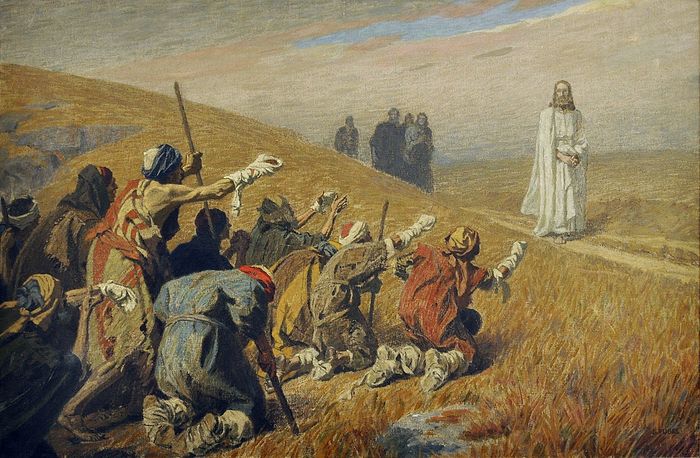
     The day He made ten lepers whole,
    The day He made them clean,
    Well symbolized His ministry
    And what His life would mean.
     However great that miracle,
    This was not why He came.
    He came to rescue every soul
    From death, from sin, from shame.
     · · · · · · · · · · · · · · · · · · ·
     What must be done to make us clean
    We cannot do alone.
    The law, to be a law, requires
    A pure one must atone.
     He taught that justice will be stayed
    Till mercy’s claim be heard
    If we repent and are baptized
    And live by every word.
     · · · · · · · · · · · · · · · · · · ·
     If we could only understand
    All we have heard and seen,
    We’d know there is no greater gift
    Than those two words—“Washed clean!”

    Leprosy was a terrible disease. The skin rotting before the afflicted’s own eyes.

    One day we will stand before Christ and feel how unclean we really are. How grateful will we be for the Atonement in that moment? I’m grateful that we can be washed clean from all our misdeeds, errant thoughts, unkindness, and mistakes. All because He suffered our folly for us.

    While I’m not overexcited to see all my shortcomings, it will be a powerful moment to truly see and understand what Christ did for me. I have an idea now. One day I’ll see and know.

    He died for me.

  • Ivy and Jesus with the Light

    Ivy and Jesus with the Light

    I was working on my laptop and Ivy saw a picture. It was an abstract-looking drawing of a long-haired individual meditating.

    Ivy said, “It’s Jesus.”

    Her and Sage say this if they see pretty much any image of a long-haired individual.

    It makes me happy every time.

    I chuckled.

    Then Ivy said, “Show Jesus with the light.”

    I paused like you often have to do when talking with 4-year-olds to figure out what she meant.

    Jesus with the light…

    Hmm…

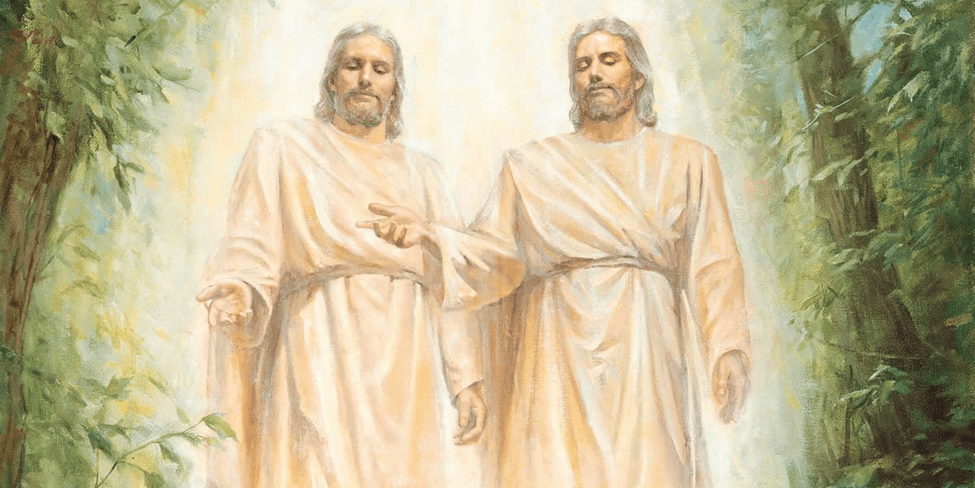
    Then it came to me what she meant. I pulled up this image and showed it to her:

    “Yes! That’s it!” She looked fondly at the picture.

    My happiness turned to joy.

    This picture has a special place in my heart as it was once an answer to prayer that I’ve remembered ever since.

    When I was just returning to church, I attended a fireside one Sunday evening. I dragged Chris along with me. As he and I were walking around the church building halls before the meeting got started, we paused at the above picture, which is present in so many of our church buildings.

    We both looked at it.

    “Why do they look the same?” Chris asked.

    Huh. I’d looked at this picture at least 346,000 times but never really realized or thought about it. They did look the same. I didn’t know the answer.

    Chris shrugged and moved on. I was kind of annoyed I didn’t know the answer to a question I felt I should know. Or at the very least something I should have noticed in my 346,001 viewing of the painting.

    We went into the fireside.

    The speaker was introduced and he stood to speak. He powered on a projector and an image was displayed behind him. 

    Drum roll please.

    You guessed it.

    The image displayed was none other than the painting Chris and I had just been observing in the hall.

    The speaker began, “Does anyone know why the figures in this image look so much alike?”

    My head jerked to look at Chris next to me. Was he hearing this?!

    The speaker went on to explain that the scriptures tell us that Jesus Christ is in the express image of His father. Jesus Christ and our Heavenly Father look alike. Makes sense, He is His Son, after all.

    I can’t remember why the speaker talked about this. It wasn’t a major point. It was something I think he assumed most of us knew (I didn’t!). He proceeded onto his main point that I can’t remember.

    I was shocked.

    Chris asked a question. We received an answer.

    I considered this a miracle.

    I think Chris shrugged and thought, ‘what a coincidence.’

    I have joy today because I came back to church. I have joy today because I consider every day what Jesus Christ did for me yesterday, today, and tomorrow. I have joy today because Ivy and Sage say “Jesus!” every time they see an image of a long-haired man.

    NoCoincidences.

  • What if I saw Jesus in a Fight?

    What if I saw Jesus in a Fight?

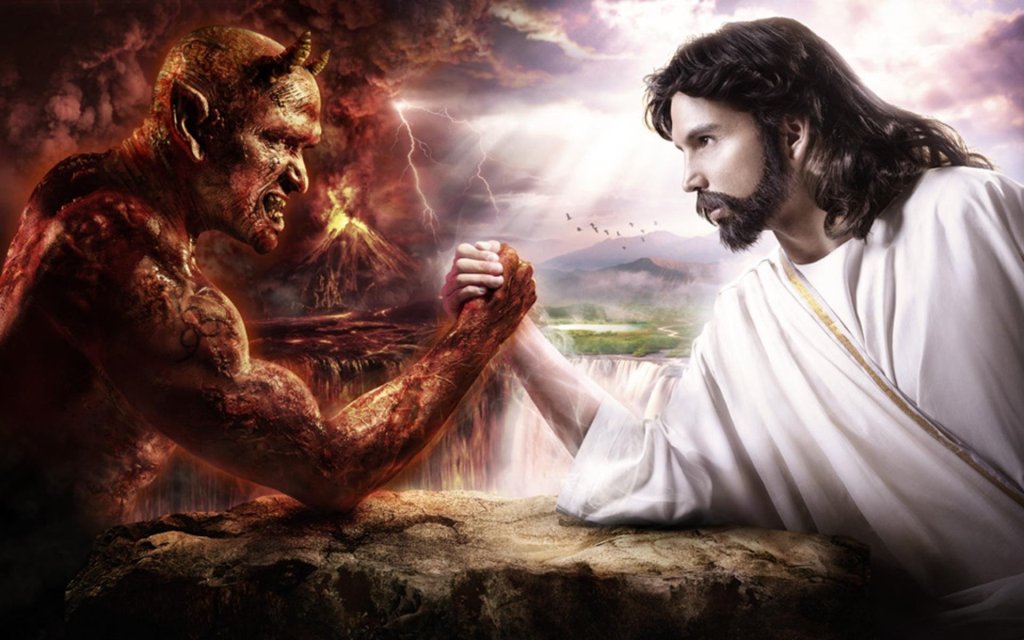
    A friend asked an interesting question: “If you saw Jesus fighting somebody, what would you do?”

    No context, I had many follow-up questions. Has the second coming happened? Why is Jesus here? How do I know he is Jesus?

    But, ok, I can follow along with the exercise.

    My response was, “I would assume he was fighting Satan. I would assume that the person Jesus would be in a fist fight with would have to be Satan taking over a body… but then that doesn’t make sense, because Jesus could simply rebuke Satan, he wouldn’t need to fist fight him…”

    I was interrupted by the friend who reminded me this was a fun what-if and to not go overboard. He then asked again, “But what would you DO?”

    I thought for a moment, then I said, “I guess I’d watch.”

    My friend laughed and then jokingly said, “You’d record it, WORLDSTAR.”

    He made a good point: sitting and watching didn’t seem good enough. So I told the friend, “You’re right, if I saw Jesus fist-fighting someone right now, I would say a prayer to God, asking if this was OK, did Jesus need help, should I do something?”

    It was then asked, “what if Jesus punched Beth?”

    That one made me laugh. I said if that happened, I’d know I was being deceived in some way because Jesus wouldn’t punch Beth in the face.

    This was a fun exercise. I think God will forgive us for any irreverence. I think it’s good if you bring Jesus into a normal conversation, even if in a slightly irreverent way.

    This silly question did lead me to think more deeply about a serious question, though. In this silly context, “What would you do if you saw Jesus in a fistfight?” I realized my first answer was, “I would watch.” I realized that was my first reaction because my first reaction would be that Jesus doesn’t need my help. This is what led me to the more serious thought. How often do I think Jesus doesn’t need my help? How often do we think there’s nothing we can do for Jesus? Now, I’m not trying to get into the faith and works discussion, of course we can do nothing to save ourselves without the atoning sacrifice of Jesus Christ. But, we can still do things for Jesus. 

    We are here on this earth for a reason.  gain, how often do we think, “Jesus doesn’t need my help. I can’t do anything for Jesus. I’m not good enough to do anything for Jesus.” I think sometimes we forget that we are here to do things for Jesus, we’re here to promote Jesus, talk about Jesus, lead others to Jesus, help Jesus in any way we can. We do that by loving others. Jesus does want our help. Whether He needs it is another question. But He has asked us that know of Him to share Him, to be His servants, to be His feet on the ground in a way.

    So, when I think about that question again, “What would you do if you saw Jesus in a fight?” my answer has changed. 

    I would pray. Then I would jump in. At least I hope that’s what I would do.

  • Suzerain and Vassal: The Father and the Son

    Suzerain and Vassal: The Father and the Son

    Mosiah 15:1-2 reads:

    1 And now Abinadi said unto them: I would that ye should understand that God himself shall come down among the children of men, and shall redeem his people.

    2 And because he dwelleth in flesh he shall be called the Son of God, and having subjected the flesh to the will of the Father, being the Father and the Son…

    How can Christ be both the father and the son? It’s a question that has troubled Christianity since before it was called Christianity. How can there be the one true God (Jehovah) and yet Jesus Christ (Jehovah) pray to His father who is in heaven?

    How can Christ be both the father and the son? Well, how are you, reading this a father (or mother) and a son (or daughter)? Sometimes we might overcomplicate the simplest things.

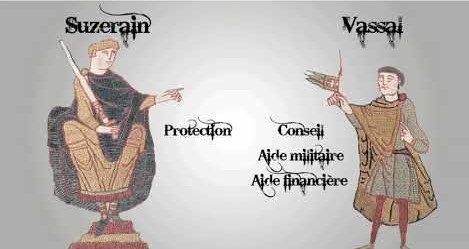
    In the ancient near east there existed a system wherein covenants could be made. That system could be described as a Suzerain Vassal covenant or treaty. In this sort of agreement one of the parties would be greater or more powerful than the other. The suzerain would be the powerful entity. The vassal would be the subservient, or lesser, or learning entity. In this sort of treaty, the vassal would pay tribute or show some form of loyalty to its suzerain. In return, the suzerain would provide protection or some other sort of benefit to its vassal. There could only be one suzerain/vassal connection. Meaning, a vassal couldn’t have two suzerains. This would basically be treason. You can only serve one lord.

    From this article on the suzerain/vassal covenant relationship:

    “The covenant Yahweh established with Israel at Mount Sinai exhibits striking parallels with Hittite suzerain/vassal treaties, which had six basic features: 1) a preamble that identifies the suzerain; 2) a historical prologue that recounts the previous relationship between the parties; 3) covenant stipulations to which the vassal must agree; 4) provisions for periodic reading and safekeeping of the covenant; 5) witnesses to the covenant; and 6) blessings and curses should the vassal either keep or fail to keep the covenant. The Sinaitic covenant contains all six of these characteristics.”

    In his book, The Last Days: Types and Shadows from the Bible and the Book of Mormon, Avraham Gileadi states:

    “the idea of Israel’s suzerain or Lord [Jehovah] assuming vassal or servant status in order to answer to his suzerain [God the Father] for his people’s rebelliousness introduces the concept of a God higher than Israel’s God. That is, Jehovah, the God of Israel, is a “Son” to God the “Father” (3 Nephi 11:7,11,32; compare 15:4-5). That concept does not appear explicitly in the Old Testament. Many Jews, therefore, insist that God is but “one” (Hebrew ehad; Deuteronomy 6:4); other than the Lord, they assume, no God exists (see Isaiah 44:6,8; 45:21-22). However, the idea of “the Father” and “the Son” makes perfect sense in light of ancient Near Eastern suzerain (Lord)–vassal (servant) covenant relationships.

         “Abinadi (and every prophet who teaches God’s redemption of humanity) here enlightens us. Abinadi says that God, who redeems his people, is both “the Father and the Son” (Mosiah 15:1-3; compare Alma 11;38-39; Ether 3:14). That abstruse statement seems at first glance to contradict the careful distinction between the Father and the Son that other scriptures teach. But when viewed from the ancient Near Eastern suzerain (lord)–vassal (servant) covenant relationship, we gain insight on how the Lord can serve as a suzerain or Father to his people Israel, but also can serve as a vassal or Son to his Father or suzerain. To Israel, the Lord is Father, and they become his sons or vassals. To God the Father, the Lord is the Son, subjecting his will to the Father in order to merit Israel’s salvation (Mosiah 15:2,7).

         “Moreover, as the literal and loyal Son of a divine Father–as the Son of a righteous [covenant suzerain “Father”]–the Lord is not subject to death unless he himself consents to die (See the type of Isaac’s consenting to let Abraham sacrifice him–Genesis 22:9) Even if he does die, the Father must come to the aid of his vassal and deliver his Son from death. In ancient Near Eastern literatures there is the concept of the god who dies only to revive and assume the throne of a senior deity. Thus “God breaketh he bands of death . . . giving the Son power to make intercession for the children of men” (Mosiah 15:8). What the Father does for the Son, the Son does for his sons and daughters: when “the Son reigneth, and hath power over the dead . . . he bringeth to pass the resurrection of the dead” (Mosiah 15:20).

         “Moreover, the moment one introduces the idea of the Father and the Son, one also introduces the concept of spiritual progression. That constitutes as much a part of the “good news,” or gospel, as does redemption from death itself (see Mosiah 15:10-19). Inherent in a Father/suzerain–Son/vassal relationship with God is the assuming of divine attributes–becoming God-like…”

    So we see that this Near Eastern tradition of suzerain and vassal treaties and covenants perfectly aligns with how we relate to Jesus Christ. He is our suzerain, making us His children. God is His suzerain. Through our covenant relationship with Christ, we receive protection from both Christ and His Father and our Father, God the Father.

    Another interesting thought from that note is how Christ conquered death. It was by His relationship with the Father that He was able to conquer death. He in turn allows us the same opportunity when we link ourselves to His will and power. Christ received His divine identity from His Father. We can receive our divine identity through Jesus Christ’s Atonement and conquering of death. This is why we only come to the Father through the Son. Christ is our protector, our Suzerain. As we serve Him, we receive that protection as His vassals.

    In addition, another way that Christ is our father is through the resurrection. It is due to Christ’s atonement and resurrection that we are able to be resurrected. This makes Christ the father of our bodies. For we wouldn’t have our bodies without His resurrection and the gift that we can be resurrected into our bodies. God the Father is still the father of our spirits. Whether that be through adoption, some measure of creation, or some other way, we’ll one day know.

    A last note I wanted to make that I liked from this article:

    “The basis of the covenant was Yahweh’s gracious acts toward Israel, not their obedience to him.”

    Our covenant relationship with Christ is a reminder that His grace saves us. It doesn’t matter how obedient we are. We needed His grace to save us. As our Suzerain, His covenant with us is based so much more on how He loves us and all He is willing to do for us than anything we can do for Him. We can never properly repay Christ for all He’s done for us. He is the Suzerain. He has the power to save us.

    This is the good news of the Gospel. Because Christ conquered all, we can become like Him, and in turn, become like our Father in Heaven.

  • 100th Post

    100th Post

    100 posts!  I thought it warranted a special post.  You never know when you start something like a blog if you’ll actually stick to it.  Here I am a year and a half and 100 posts later, with hundreds still to go.

    I figured as part of my first 100 posts I could mention the top 5 most read:

    1. Facing Death
    2. RIP Coach
    3. Ivy James Quackenbush 12/4/20
    4. Don Leedy-Resting in Paradise
    5. An Angel

    It’s interesting what this list shows.  Life and death.

    It was scary starting a blog.  It’s basically a public diary.  I’m excited for Ivy to read it one day.  Thank you to everyone who has read and supported.  The primary motivation in writing and sharing these posts has always been to share my faith story and hopefully help others in some tiny way.  If my story or my thoughts have helped one person think about life or come closer to Jesus Christ, then a million hours (close to how much time I’ve put into this) is worth it.

    I re-read my first post to prepare for writing this.  In reading that, I was kind of surprised by how open and vulnerable I made that.  It inspired me to share another more personal post.

    As I read that very first post I was reminded why I decided to write this.  I had my own very unique journey back to God and I hoped it could help someone, whether that be back to God or to God for the first time.  During those years where I removed God completely from my life, I feared every day I was away from Him that I’d never be able to return.  I know there are so many people out there that feel the same way.  There are also people that have never known God, prayer, repentance, all these things some of us take for granted.  These are abstract concepts to many, I know. 

    I want to share that I believe God is for everyone.  As the world screams at us, “You have your screens, your technology, your books, universities, learning, society with its conveyer belt of packaged food, water always, peace, prosperity.  Watch Netflix!  Relax!  All is well (2 Nephi 28:21).  Set aside thoughts of life, death, and purpose.  You have your purpose, live and let live.”  The world is telling us that despite the chaos around us, everything is fine, and we don’t need God.  I testify that all is well IF we have God.

    I want to tell everyone, there is more than what the world screams at us is important.  There is much, much more.  I want to tell everyone who will listen, God is for you.  If you’ve ever known Him, if you’ve never known Him, if you consider Him a complete foreign concept, if you consider Him a myth, He is for you and He is there for you.  You can come to Him, and when you do, your life changes. 

    That’s what sticks with me most when I think about those years away from God.  I removed Him, but He was never gone.  We can’t remove our Father.  This makes us accountable; it can be a frightening concept if we fear Him.  We don’t need to fear Him.  He is only there out of love.  He will never leave us.

    I bear my testimony of the most important things:  God is our Father, and He does love us.  Jesus Christ did something unimaginable.  Would you die for your child?  Would you suffer the punishment for the sins of your child?  Probably.  Would you die for the person torturing you?  Christ did.  He suffered for all of us, really suffered and felt.  I have been blessed to have the Holy Ghost be a part of my life when I’ve made good choices, since it was conferred upon me when I was 9 years old.  Joseph Smith did see Heavenly Father and Jesus Christ.  He translated the Book of Mormon from ancient records.  The temples that are now dotting the earth are God’s temples. The temples are clean and holy.  I can be with my family forever because of what Christ did for me in Gethsemane and on the cross.

    I know this to be true.  This knowledge brings purpose and understanding to my life.  It doesn’t make trials go away but it makes them understandable. 

    I wish everyone would consider the great plan of salvation, The Plan of Happiness.  But we are distracted. 

    I have been so blessed by God and I ask Him constantly what I’ve done to be afforded so much.  The least I can do is share it with others, and I am glad to do so.

    I leave this testimony for my daughter, and my family, and all those I care about to read- forever.  I leave it in the name of my Redeemer, my Savior, my King, Jesus Christ.

    Amen.

    LDS Church introduces new symbol emphasizing the centrality of the Savior |  KUTV