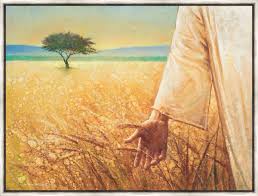
Christ gives the parable of wheat and tares in Matthew 13:24-30:
24 Another parable put he forth unto them, saying, The kingdom of heaven is likened unto a man which sowed good seed in his field:
25 But while men slept, his enemy came and sowed tares among the wheat, and went his way.
26 But when the blade was sprung up, and brought forth fruit, then appeared the tares also.
27 So the servants of the householder came and said unto him, Sir, didst not thou sow good seed in thy field? from whence then hath it tares?
28 He said unto them, An enemy hath done this. The servants said unto him, Wilt thou then that we go and gather them up?
29 But he said, Nay; lest while ye gather up the tares, ye root up also the wheat with them.
30 Let both grow together until the harvest: and in the time of harvest I will say to the reapers, Gather ye together first the tares, and bind them in bundles to burn them: but gather the wheat into my barn.
In Doctrine and Covenants section 86 Christ gave an explanation of this parable. Here are His words:
1 Verily, thus saith the Lord unto you my servants, concerning the parable of the wheat and of the tares:
2 Behold, verily I say, the field was the world, and the apostles were the sowers of the seed;
3 And after they have fallen asleep the great persecutor of the church, the apostate, the whore, even Babylon, that maketh all nations to drink of her cup, in whose hearts the enemy, even Satan, sitteth to reign—behold he soweth the tares; wherefore, the tares choke the wheat and drive the dchurch into the wilderness.
4 But behold, in the last days, even now while the Lord is beginning to bring forth the word, and the blade is springing up and is yet tender—
5 Behold, verily I say unto you, the angels are crying unto the Lord day and night, who are ready and waiting to be sent forth to reap down the fields;
6 But the Lord saith unto them, pluck not up the tares while the blade is yet tender (for verily your faith is weak), lest you destroy the wheat also.
7 Therefore, let the wheat and the tares grow together until the harvest is fully ripe; then ye shall first gather out the wheat from among the tares, and after the gathering of the wheat, behold and lo, the tares are bound in bundles, and the field remaineth to be burned.
Quick rundown:
Verses 1-3 explains the great apostasy that occurred to the church after the apostles “have fallen asleep” (aka were killed).
Verse 4 reminds us that we’re now speaking of our day.
Verse 5 tells us, “the angels are crying unto the Lord… to reap down the fields.” That can be interpreted different ways but basically the angels want to start with the harvest. The harvest can be considered the gathering of souls at the end of times. This leads to
Verse 6 where the Lord tells the angels to hold off on the harvest because He doesn’t want to destroy the wheat. The wheat are the righteous, those followers of the Lord. The tares are those who oppose God.
Verse 7 we learn that wheat will grow alongside tares until the end. Then the wheat will be separated from the tares, and the tares will be burned.
I believe the most telling part of those verses is in verse 6 where it says, “for verily your faith is weak.”
The Lord doesn’t want to pull up the tares because the wheat is still “tender” with weak faith.
I’ve heard this parable many times but for the first time a thought occurred to me. What would it mean for the angels to reap the harvest and pull up the tares while the wheat is still weak? The tares being pulled up signifies the evil people of the world being taken away. The wheat would be too weak to handle this, the wheat is too intertwined with the tares. Wheat and tares, of course, represent people. What does it mean that the wheat is too tender for the tares to be taken? The thought that occurred to me was that the wheat, or faithful people, would have their faith shattered if the tares around them were taken. Could this represent the tares of some friends, family, and people we care about? What if God let loose the angels and took up the tares. How many faithful people would lose loved ones?
Are you a wheat or a tare?
Is our faith weak or strong?
In Matthew 13:38 Christ says
“The good seed are the children of the kingdom; but the tares are the children of the wicked one”.
Christ doesn’t detail the ok seed or the middle ground seed. We are good seeds or we are tares. We are working for Christ or working against Him. We are faithful or we lack faith.
One day the wheat will be separated from the tares and the end will come. When that day comes, which side will we be on? The side of the wheat or the side of the tares? It’s not enough to be lukewarm as the adversary intensifies his attack. Wheat is nourishing, tares are not. There’s no middle ground. You are either a wheat or a tare.
Which are you?

 No Coincidences