
Tag: latter-day saint

  • Listen, Learn, Love

    Listen, Learn, Love

    I recently listened to an episode from a podcast called Listen, Learn Love.  This podcast has opened up my ways of thinking on a few topics.  The episode I listened to recently I basically want to summarize (steal) because the points made are so simple, so well-said, and so true. 

    Here is a link to the website for the podcast if you want to learn more: https://www.listenlearnandlove.org/

    The episode I recently listened to that I’m writing thoughts on here is episode 2 and can be found if you search for podcast “Listen, Learn, and Love.”

    The podcast is hosted by Richard Ostler.  He is a former Young Single Adult Ward Bishop.  He has now done 334 episodes of his podcast which “was created out of the desire to better understand our LGBTQ+ brothers and sisters.  We believe in God and in His decree to love one another.” – from the mission statement on the website. 

    Episode 2 does not focus on the LGBTQ+ topic which I feel is an extremely important topic in the church.  Still, this episode is also important and I learned a lot from it.

    The topic was faith-crisis.  Whether minor or major, any faith crisis is difficult to go through.  When I was returning to church my uncle said something that has stuck with me.  He said he wouldn’t wish the losing of faith on his worst enemy.  You can lose cars, homes, family, money, everything in this world, but losing your faith is the hardest thing that a person can possibly go through.

    As I continue to write I will be presenting many ideas that came directly from Brother Ostler.  Please listen to the episode.  For ease of writing, I won’t reference Brother Ostler in everything I’ll continue to say. Just know most of these thoughts came directly from him, and I hope to re-state them without taking too much away from them.

    In my writing, I often refer to “The Church.” When I say this I am referring to the Church of Jesus Christ of Latter-day Saints.  Something I’d never considered is how important it is to clarify what we mean when we say, “The Church.” The Latter-day Saint Church could mean different things to different people.

    A couple categories for “The Church” are

    1. The Gospel of Jesus Christ.
      • This was described beautifully by Brother Ostler as a pristine, clear-watered pool.  No murkiness.  The Gospel of Jesus Christ is perfect in every way. This hasn’t been completely revealed yet.
    2. The restored Church of Jesus Christ.
      • It has the restored priesthood and priesthood keys. Ideally, this would be perfect.  I think we sometimes confuse this category with the next category I’ll mention.  The restored Church of Jesus Christ should be perfect.  The problem is, as we know, Christ must use fallible men and women to run His church.
    3. The institutional church.
      • This is where we get into a flawed organization. The institutional church has many people, programs, and policies that are meant to implement the Gospel of Jesus Christ.  The institutional church is run by men and women and therefore has flaws.  Christ guides the institutional church, but people make mistakes. Brother Ostler points out in the podcast that as a YSA Bishop he was a part of the institutional church and he knew he made mistakes as a Bishop, a leader in the church.

    Much of the hurt that comes into the souls of God’s children is caused by the institutional church.  It is critical to not confuse “The Church” the institution with the pure and perfect Gospel of Jesus Christ.

    A faith crisis is a serious event that can happen to anybody. You can’t always read and pray a faith crisis away.  We are here to develop faith and while here our faith will be tested.  Sometimes to the very brink.  It’s important to get our roots in the correct place.  Is your faith in a bishop?  It shouldn’t be, it should be in Jesus Christ.  The best bishop in the world can let you down.  Jesus Christ can not.

    The fourth article of faith: “We believe that the first principles and ordinances of the gospel are: FIRST, faith in the Lord Jesus Christ. 

    The Articles of Faith can be read here.  I invite everyone to read and focus on the first four articles of faith in the Restored Church of Jesus Christ.  You’ll notice not only is Jesus Christ’s name in the name of the Church, but that He is referenced three times in the first four articles. 

    Our foundation must be on Christ.

    Brother Ostler talked about the Policy Statement of 2015 and how it created a “mini faith crisis” for him.  These were changes made by the institutional church and have since been reversed.  He talked about how difficult that was for him, personally.  He is not the first person I’ve heard that was impacted in a sad, difficult way by those changes.  He emphasized that the brethren (leaders of the church) were doing their best.  Brother Ostler referred to dominoes, and how the policy statements started to make dominoes fall in his faith.  What saved Brother Ostler’s faith was that all his dominoes didn’t fall.  As he stated so perfectly, some of his dominoes had roots to the center of the earth and couldn’t be shaken.  He referenced Jesus Christ, priesthood blessings, and temples as the foundation of his faith.

    The 2015 Policy Statement is a good example of what separates the institutional church from the Gospel of Jesus Christ. The institutional church can and does make mistakes. Jesus Christ does not reverse. Jesus Christ does not change.

    We must change the way we discuss faith crises.  There are too many people who leave the church because they don’t feel heard.  The idea that you can read or pray away a faith crisis is inaccurate and often leads individuals to feel like the “Church” is avoiding their concerns.  We have to listen, as the Savior did, to those with concerns.  Ask questions.  Having a faith crisis does not mean someone is sinning.  It can mean that, but it doesn’t always.  Brother Ostler is a perfect example.  His self-described “mini faith crisis” came while he was a YSA bishop spending dozens of hours each week in service to others.  He was reading, praying, and serving as much as anyone could at that time.  Imagine telling a bishop he needs to pray more, or read more, or do more to fix your problem.  One could rightfully be turned off by this suggestion.

    We must stop considering a faith crisis as a dirty topic that we must avoid.  Thousands are having one at this moment.  Those with unshaken faith must support and lift those who have a hard time. We must address questions head on and strengthen our faith together. We must strengthen each other. We are family. The Gospel of Jesus Christ is meant for everyone. 

    Now I’d like to share some of my personal story.  I returned to church in 2016.  I narrowly missed being an active member of the church when the policy statements came out.  I know this was a hard time for the church.  I know many people left.  I know many people, like Brother Ostler, were shaken by the announcement. 

    I’ve often thought about my faith.  I feel fortunate and blessed to have never experienced a personal faith crisis.  Even in my time away from the church, I never doubted that Jesus Christ died for me.  I never doubted Joseph Smith was a prophet.  I never doubted the restored Church of Jesus Christ.  I never doubted the Church of Jesus Christ of Latter-day Saints.  While I was living completely opposite to some of the teachings the church, I still knew it was true.  I know I caused many head scratches from those who witnessed my verbal devotion while clearly ignoring all the precepts of the church.

    I said my faith has always been a blessing to me.  I believe it has.  When I was living opposite to the principles of the gospel it felt like a curse.  I’m sure I will need to answer for that one day.  If I knew it so much to be true, I believe I’ll be more accountable for my behavior.  Maybe that’s what gives me so much faith in Jesus Christ.  I know how important His Atonement is to me personally.  I have too many spots on my garments.  Without Him I am a damned soul. 

    Maybe that’s difficult for others who have never grievously sinned.  It’s easy to appreciate a lifeboat when you’re sinking in the ocean.  What if you’re safe on shore, do you still have the same appreciation for the lifeboat?  I’m not implying those who have lived just, kind, good lives start to finish are in anyway unappreciative of the sacrifice Jesus Christ made for them.  I’m truly amazed by those I see that have been faithful and true for all of their mortal journey.  I can only speak for myself.  I was not true for all of my journey and it makes me worship and love my Savior so intensely. 

    I wonder what would have happened if I was in church in 2015.  Would I have struggled?  Would I have left?

    I don’t know the answer to many questions.

    A book I read recently repeated the idea that we (humanity) know so much; space travel, geography, math, science.  Ask someone to give some thoughts about nature or history and everyone can provide some insight.  Ask someone to provide some thoughts about who they are, and they will struggle.  We often know and understand ourselves least of all the things in the world. I take comfort in knowing there are two individuals who know me infinitely better than I currently know myself.

    I want to give advice to anyone currently in a faith crisis.  Fight.  Don’t lose your faith.  Please.  It’s the most valuable thing on this earth.  You can lose your family, money, cars, your home, and you can lose your faith.  I hope we all fight for our faith.  Focus your faith on what is most important.  All your questions – ask them.  Doubt.  Wonder.  Have concern.  Voice your concerns.  But don’t forget where faith should lie.  Jesus Christ is the only name whereby men can be saved (Acts 4:12).

    Sometimes people will hurt, disappoint, or let you down. Sometimes those people may be leaders you trust. We all hurt and disappoint people we love. We must hope that we will receive mercy for the hurt we cause, and therefore should show mercy to those who hurt us. The great giver of all mercy is Jesus Christ. He loves each of us. He wants each of us to do whatever we can to come closer to Him. Stay close to Him and He will never let you down.

    Find those experiences in your memory that remind you that Jesus Christ guides His church.  Read the Book of Mormon and ask yourself if it could be false.  Then ask yourself, if it is false, how can it so perfectly testify of Jesus Christ?

    Find your foundation in sure things.  The pure faith in Christ.  Then fight for that faith.  We hope the Church of Jesus Christ of Latter-day Saints can be a faith building organization for all.  We hope that the covenants we make can strengthen our faith and the faith of those around us.  But at all costs, do not mix the pure, perfect, pristine waters of the Gospel of Jesus Christ with the sometimes-murky institution run by us here on earth.
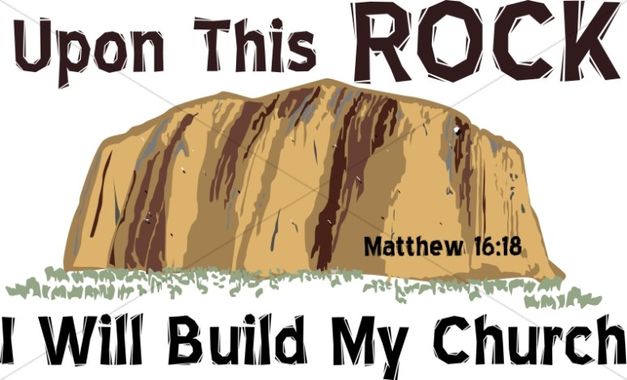
  • The Rock Christ would Build His Church Upon

    The Rock Christ would Build His Church Upon

    In a book called The Forerunners by Mark E. Petersen, I was introduced to an interpretation of a scripture that I’d read and heard quoted a thousand times.  The truth of the interpretation was so clear I couldn’t believe I’d lived so long with such a clear misunderstanding of the meaning of that important scripture.

    The verse is Matthew 16:18 which reads:

    18 And I say also unto thee, That thou art Peter, and upon this rock I will build my church; and the gates of hell shall not prevail against it.

    Let’s give some context to this important passage.

    Jesus was with His apostles and He asked a simple question:  Who do the people say I am? (verse 13)

    They responded with some of the rumors out there – Some thought Jesus was the returned John the Baptist, some thought Elias, others thought Jeremias or another of the prophets.  (verse 14)

    Jesus asked, who do you say I am? (verse 15)

    Peter, Jesus’s first apostle responded, “Thou art the Christ, the Son of the living God.” (verse 16)

    Christ responds, “Blessed art thou, Simon Barjona (Peter): for flesh and blood hath not revealed it unto thee, but my Father which is in heaven.”

    Which leads us to our important verse and the part I always misunderstood.

    Christ says to Peter, “thou art Peter, and upon this rock I will build my church.”

    One more quick review to make the point clear:

    1. Christ says who am I?
    2. Peter answers – you are the Christ, the Son of the living God.
    3. Christ responds – blessed are you, for flesh and blood (man) has not revealed this but my Father who is in heaven has revealed this to you.
    4. Christ, in responding to Peter stating properly that He is the Christ, says “thou art Peter.”
    5. Then, adding to what Jesus said about the truth being revealed to Peter by God, Jesus says, “and upon this rock I will build my church.”

    Christ wasn’t saying the church would be built on Peter.  Christ’s Church couldn’t be built on anyone’s shoulders but His own.  Additionally, Christ is adding that the testimony of Him could only be received by man from Heavenly Father, more specifically the Holy Spirit.  The rock of Christ’s Church would be Christ Himself, and the testimony of Christ only comes by revelation from the Holy Spirit.  Not by flesh or blood, but by Heavenly Father and personal revelation.  Thus, the rock of Christ’s Church would be personal revelation that Jesus is the Christ.

    I was always so confused by this scripture.  Why would the rock, the sure foundation of Christ’s Church be on anyone but Christ?  How could Peter be the foundation?  He is not.  There is only one foundation.  There is only one name by which we can receive salvation, there is only one person who can save us.  That is Jesus Christ.  The Son of the living God.  Our Savior and King.

    My foundation - $Christ ministries$

    This scripture, when properly read, emphasizes the importance of coming to a personal testimony that Jesus is the Christ.  We’re reminded that the testimony of Christ does not come from man.  It comes from personal revelation.  It is unfortunate that personal revelation has been removed from much of modern Christianity.  Modern Christian churches say the heavens are closed and God speaks to us no longer.  He only speaks to us through His ancient word.  But what of today?  How do we come to a testimony of Jesus Christ but through revelation from heaven and the Holy Spirit?

    If God no longer speaks to man then man can no longer receive testimony of Jesus Christ.  But men receive testimony of Jesus Christ daily.  Every day millions worship Jesus Christ.  Every day thousands come to the realization that only through Christ can they be saved.

    Revelation is alive.  The Holy Spirit talks to us daily.  He reveals the testimony of Christ to the hearts of man.  God speaks to us;  through scripture, through prophets, and most importantly through the Holy Ghost.

    A quote from William Barclay of the Church of Scotland:

    “The rock is the truth that Jesus Christ is the Son of the living God.  To Peter that great truth had been divinely revealed.  It was God Himself who had opened Peter’s eyes to that great discovery.  The fact that Jesus Christ is the Son of God is indeed the foundation stone of the Church’s faith and belief.  On that great truth the Church is founded for ever and ever.  This explanation holds that the divinely revealed truth that Jesus is the Son of God is the only foundation on which the Church is founded.”

    The Church of Jesus Christ of latter-day Saints.

    It was restored to point men to Christ.  His name is in the name of His Church.

    Jesus Christ still is actively interested and engaged in the affairs of man.  Under the direction of His Father, our Father, He sent an angel named Moroni to reveal an ancient record to his modern-day prophet.  He, through the Holy Spirit, directed and guided Joseph Smith through the translation of a record that would make clear His doctrine and the saving ordinances of His gospel. Not to replace the Bible, but to add a second testimony to it.

    The testimony of the Bible, the Book of Mormon, and my testimony is this: Jesus Christ lives.  He directs His church.  He loves all and wants us all to return to Him.

    This is the foundation of His Church.

    “Build firmly upon the rock of your Redeemer. Treasure His life and teachings. Follow His example and commandments. Embrace the powerful gifts of His Atonement. As you do, I promise you that you will see the [challenges of life] for what they are, [and] the spiritual rock under your feet will be solid and secure.” From #ElderAndersen’s pinterest.com/pin/24066179229002852 inspiring #LDSconf facebook.com/223271487682878 message lds.org/general-conference/2014/04/spiritual-whirlwinds #ShareGoodness
  • The Social Dilemma (Netflix)

    The Social Dilemma (Netflix)

    What is truth?

    How do we know?

    If you haven’t watched The Social Dilemma on Netflix, watch it as soon as possible.  Could end up being the most important documentary of our generation.  Given that we are the generation of documentaries, that would make it the most important documentary ever.

    Why is this documentary important?  Because it’s real and it’s happening now. 

    What will be the downfall of America?  Have we given Civil War enough consideration?

    Let’s do a quick thought experiment.  What happens if Donald Trump wins the election this November?  There will be 165 million mad people.  Mad enough, maybe, to protest, riot, and maybe fight.

    What happens if Joe Biden wins the election in November?  There will be 165 million mad people.  Mad enough, maybe, to protest, riot, and maybe fight.

    Of course, 165 million people is an exaggeration because not everybody is this passionate, or angry, or inflamed about the upcoming election.

    Let’s call the number 30 million on each side.  Sound much better?

    Why is this happening?  Why are people always so angry?

    There is an increasing gap between what we would deem the “center.”  Center of anything.  Not overly passionate about one side or the other.  I’m not just talking about politics.  I’m talking about anything.  The middle is gone.  The “hear the other side,” “hear them out,” “hear their opinions,” are disappearing.  We’re turning into a world of people who think we know everything while not knowing anything.

    So much from The Social Dilemma gave me an intense feeling of anxiety.  One statistic mentioned was that a study showed lies are spread on the internet/social media 6 times more quickly than truths.  What happens if a lie always has a 6x head start on the truth?  What happens is what we’re seeing happen.  Contention.  Hatred.  Vitriol.  Anger.  Confusion.  Aggression.  Fighting.

    This brings me to the most important point.

    What is truth?

    Can we even know what truth is?

    Truth is a concept society is starting to wonder exists.  How do we find something our society is starting to believe is a myth?

    This is where I turn off all my non-religious friends, but I would ask my non-religious friends:  What is your truth?  What do you turn to when everything around you is chaos, and confusion, and darkness?

    I don’t say this to spread the divide more.  I say this to invite others to find truth and make that truth love-based at all costs. 

    I love God because He loved me first.

    What is truth?

    God is truth. 

    He’s my truth.  Maybe He isn’t yours.  But you must find a truth to hold to dearly.  This truth must be centered on love.  We’ve seen what hate-filled “truth” results in.

    How do we survive in an age of disinformation?

    What do we do to protect ourselves?

    I think first we follow all the suggestions given during the credits of The Social Dilemma documentary.  I will list those here and then add my own suggestions.

    1. Uninstall apps from your phone that waste your time.
      • Hint: most of them.
    2. Turn off notifications.  Especially for anything that vibrates your leg that doesn’t provide an immediate and important alert you need to see at that moment.
    3. Use a search engines besides Google.
    4. Never watch a video recommended to you anywhere:  Facebook, Youtube, etc.  If it’s not something you went there to search for and to watch, just don’t watch it.
      • Wayyyyy easier said than done (but let’s all try!)
    5. Use a Chrome extension to remove recommendations.  Below are some options.
    6. Before you share anything online, fact check, consider the source, do the extra research (make sure it is GOOD).
      • If it looks like it’s designed to push your emotional buttons, it probably is.  Don’t share it.
    7. You vote with your clicks.  If you click on clickbate you’re perpetuating the problem.  Reward GOOD material.
    8. Get different kinds of information.
      • If you are on Twitter, add people who have different opinions from you.
      • Talk to people in the real world about real issues.
      • When you find enough people in the real world to talk to, delete your Twitter.
    9. Delete the social media accounts you really don’t need, that you don’t feel are healthy, that are taking you away from life.  Delete it and embrace the freedom!
    10. Get out of the system.
    11. The World is beautiful.  Live.

    For Families:

    1. Don’t give devices to your children.  Don’t allow them on social media.  Just don’t.
    2. Minimal screen time.
      • Set a limit and stick to it.  It was suggested to ask your child what they think is a good amount of time to spend looking at a screen each day.  Your child will often give a reasonable response.
      • Create that limit and then give rewards for going under it.  Set a 7 hour per week limit for screen time and your child spent 6 hours?  1-hour reward is a bowling trip or mini golf outing.  I used to love incentives like these as a kid.  I hope kids still do.
    3. No devices in the bedroom a set amount of time before bedtime. This will also help with sleep because you’re removing blue light which signals to your brain that it’s time to wind down.
      • Here’s a suggestion – read a book instead of your phone!
    4. Treat Social Media how Latter-day Saints treat dating – not before 16.

    Here are my suggestions.  If you can- delete it all.  Just do it.  I can almost promise you’ll feel better within a couple weeks, after the withdrawals stop.

    Me personally, I have a Facebook.  I use it so I can share my blog.  It’s good to have.  I see the use.  I’m working on limiting my scrolling down my timeline to zero and especially not watching suggested videos in my feed.  Suggested videos inevitably lead me to watching video after video of garbage material.

    Another thing that has helped me a ton has been moving the Facebook app from my main page.  I have it on page two.  That way I’m not constantly slapped in the face by that addictive, dopamine-igniting red alert symbol.  I have my Gospel Library on my home screen and if I find myself instinctively (or robotically) looking at my phone I do my best to open the scriptures and read those instead. 

    I understand all these things are easier said than done.  It’s not easy to delete social media.  It’s not easy, I get it.  I’m right there with you.  Technology is so good.  It can be used for so much good.  Why don’t we start using it for good again? 

    That brings me to my last point.

    My final and most important point.  What can we do to make a difference:  Share GOOD stuff. 

    Emphasis on GOOD MATERIAL.

    By good material I don’t mean you like it, or it tickled your fancy.  I mean it is GOOD.  It is wholesome.  It is kind.  It doesn’t make you explosively emotional but makes you feel gentle in your emotions. I mean good as in the good guided by the spirit.  I mean good as in loving.  I mean good as in spreading positivity. 

    I’m guilty like everyone else.  I see a post from the Church, and I scroll right through.  The AI (artificial intelligence) involved sees that (how scary is that?!).  They know I scrolled quickly past something GOOD.  We each need to make a conscious effort to spend time on the good stuff.  Read the good stuff.  Watch the good stuff.  If you don’t have good stuff on your Facebook timeline, use AI for good!  Go to google and search for Jesus Christ, the scriptures, conference talks, missionary messages.  You know how when you search for that cute new jacket for winter and there are suddenly cute winter jackets on your timeline?  Works the same way for good stuff.  Search for good stuff.  You’ll see more good stuff.  Spend more time with the good stuff. 

    This is how we can combat and fight the echo chamber of hatred.  This is how we remove political polarization.  This is how we remove lies.

    In the steps above I mentioned fact-checking what you share.  How about this? Spiritually check what you share.  Stop.  Say a prayer.  Ask yourself if what you’re sharing is spreading goodness, positivity, or love. If not, it can be deleted.

    I often pray before I write, and I often pray before I share what I write.  I always hope what I write is guided by something bigger and better than me. 

    Spiritually check everything you do online.  Is this making me a better person?  No.  Get it out of here.  Could this make someone’s day, bring a smile, alter someone for the better – SHARE IT. 

    This is what we can do.  This is how we can make a difference.

    I don’t ever say like and share on my blog posts because it’s become such a stupid thing to say.  But we need to say it for the things that deserve it.  Maybe we should change it to “LIKE AND SHARE GOODNESS.”

    So, if you think this was worth reading, did something positive for you, or helped you in any way, please share it.

    We can all do our part by sharing goodness.

    You can join the discussion and learn more about the Social Dilemma documentary at TheSocialDilemma.com

    I think this is important and I think it should be something we all start thinking about.  Let’s start thinking about it.  Let’s start doing our part.

  • Faith

    It’s a topic I will spend my life studying and trying to understand.  This will likely not be the only time I write about faith.  It is something so dear to me, my faith.  I keep coming back to this topic even though I’ve struggled to put together a stimulating thought on the subject.

    Great quotes come to mind, even some just from this last General Conference

    “Faith is the antidote for fear.” 

    Ricardo P. Gimenez

    Faith must be based on truth and eternity. 

    “Faith is the power by which God created the universe.” 

    Hebrews 11:3

    I’ve spent a large part of the last couple years contemplating faith.  What makes it so easy to find for some and so hard for others?  What makes some so sure God is there and others so skeptical?  Is it our nature?  Is it something inside of us?  Is it a simple characteristic difference between persons like blonde, brown, or red hair?  Are we already born with little or a lot of faith?  That doesn’t seem quite right.

    It makes me think of a quote I read recently.  It was in Book 1 of Theophilus of Antioch to Autolycus.  The early writings of a Christian Bishop to a Pagan:

    “Do you not know that faith is the leading principle in all matters? For what husbandman can reap, unless he first trust his seed to the earth? Or who can cross the sea, unless he first entrust himself to the boat and the pilot? And what sick person can be healed, unless first he trust himself to the care of the physician? And what art or knowledge can any one learn, unless he first apply and entrust himself to the teacher? If, then, the husbandman trusts the earth, and the sailor the boat, and the sick the physician, will you not place confidence in God, even when you hold so many pledges at His hand?”

    Theophilus of Antioch
    Mustard Seed

    I once had a discussion with my grandpa about the Book of Mormon.  We discussed the gold plates that Joseph Smith discovered.  Those plates were taken to heaven and were only ever seen by 11 witnesses plus Joseph Smith himself.  Here is a paraphrased version of the conversation with my grandpa:

    “Why do you think the plates weren’t left here for us to see?  Wouldn’t it help so many to physically see them?  Then everyone would believe.”

    His response, “In my experience, even if the plates were right in front of some people, they would still deny.  Why do you think they were taken away?”

    “Well, probably to protect some, for that reason you said.  Some would see them and still deny.  Also, they may have been too sacred to keep on earth.  They may have been mistreated or lost if they stayed here.”

    Then he said something I’ve always remembered. 
    He said,

    “I think there was a much more important reason.  One of the most important things we’re on this earth to develop is faith.  If you saw the plates, there would be no faith involved.  You would know.  And yet, there’s always some measure of faith involved.  As I said, even some looking and touching them may still deny and explain it away as a fanciful story.  But, here’s the important part – because you have never touched them, seen them in anyway, because you had to read the words and feel it in your soul and heart, your testimony is stronger.  Because you never saw them, it involves faith. But could you know with more of a surety they were true if I were holding them in front of you right now?”

    No,” I replied.

    Exactly.  Your testimony of them is not based on physical touch or sight.  You’ve felt the words deep in your soul.  That’s more than your eyes can ever give you.  That’s what we’re here to develop.  Faith.

    Those words have always stuck with me and always will.  I will have so much more to say on this topic as I continue to write.  My message to everyone I love, whether part of my religion or not:  Have faith.  Acknowledge the hand of God in your every day.  To continue off what Theophilus said above, you get a job and then you have faith you will get paid.  You eat food and you have faith it will help your body keep moving.  You wake up and have faith your legs will carry you to where you want to go.  Understand that you live your life by faith and develop it even more.

    Mustard Seed Growing

    One last famous quote by Thomas Aquinas:

    To one who has faith, no explanation is necessary. To one without faith, no explanation is possible.”

    Faith – Tabernacle Choir at Temple Square
  • Content and Media

    Sometimes members of the Church of Jesus Christ of Latter-day Saints are weird.  If you’re a member of the Church and haven’t fully embraced this, it’s time to get on board.  Peter stated,

    “But ye are a chosen generation, a royal priesthood, an holy nation, a peculiar people; that ye should shew forth the praises of him who hath called you out of darkness into his marvelous light.”  

    1 Peter 2:9

    Peculiar, weird. Same thing.  So, take comfort in this if you haven’t already.

    I have many nonmember friends that thought I was weird long before I started going back to church.  That’s mostly because I am weird.  We won’t go into more detail on that.  Since coming back to church though, my nonmember friends have found tons of other reasons to find me weird.

    I will quickly list through some of them:

    1. I don’t do anything on Sunday anymore (not even basketball)!  This comes up all the time.
    2. I stopped listening to a lot of music I used to listen to.
    3. My language changed; the words I use drastically changed.
    4. I started inviting friends to church and dinner with the missionaries almost constantly.
    5. I stopped partaking of some beverages.  Luckily, I never drank coffee.  But when I tell people I don’t drink coffee they almost fall over in shock every time. 
    6. I stopped wanting to go to certain places – like bars.
    7. I slowly stopped gambling.
    8. Finally, and what I’ll talk about here, I recently stopped watching rated-R movies.

    Yeah, this is one I didn’t think we actually followed.  For nonmembers out there, yes, we’re advised to avoid rated-R movies.  I’m going to elaborate on how I came to respect and appreciate this counsel.  It wasn’t until very recently that I started this and I’ve been going strong for a few months.

    My decision to stop watching rated-R movies starts with a particular movie.  It is called Hateful Eight.  I’m not going to go into detail about this movie because that defeats my purpose.  The gist was this. I started the movie and then there was a particular scene that unfolded about midway through.  The end of the scene left me feeling… icky.  I don’t know how else to describe it.  I had to leave my house at that moment and decided I was going to finish the movie later.  It took me some time to get back to the movie.  I started to realize I didn’t know if I wanted to finish the movie.

    For the record, I’m the kind of person who tries to finish something once I start it.  Miserable book?  Gotta get through it.  Boring movie? Maybe the ending is good.  But I started asking myself, do I REALLY want to finish that movie?  I talked to my roommate Chris about it.  He seemed to actually understand where I was coming from, which surprised me.  “Hateful Eight…” he said trailing off, “yeah… there’s a lot in that one.”  I went on to talk about it and learned the part I came to wasn’t even the part he thought I was talking about.  Apparently it got worse after that!

    So, I decided I didn’t want to finish that movie.  Since I was cutting movies off midway through for the first time, I started to think more about that icky feeling I had experienced.  What was it?  I started to realize that particular movie made me feel dark and dirty.  There was an image stuck in my mind I couldn’t get out.  It was unpleasant.  It wasn’t something I wanted in my mind.

    My favorite book, Visions of Glory has a whole section about the entertainment we choose to take in.  What we view and listen to alters us.  It either brings light or darkness to us.  That’s what I felt after that scene. Darkness. 

    I know to many people this may be strange.  I know to some people, cutting some of these things out of our lives seems impossible.  The point I want to make is that it can be done.  I didn’t get rid of all of those 8 things listed above overnight.  In some cases it took years actively going to church to change habits.  The biggest point I want to make is that I’m much happier since making those changes.

    I’m not saying everyone has to cut out rated-R movies. But I am saying that if you did, you might be surprised that first, you’re capable of doing it, and second, how you feel about doing it.  The same goes for Netflix and the endless streams of content we take in.  There are good things and there are bad things.  Sometimes the bad is hard to see. You don’t realize it’s “bad”.  That’s why I appreciate this guidance with rated-R movies.  Why chance it?

    There’s a quote from Visions of Glory about spiritual gifts.  It reads,

    “I observed that there are many people who are governed by the voice of Jesus Christ, who are like lanterns being carried through darkness.  They push darkness away by their approach, and the dark angels must depart.  Evil beings are powerless to penetrate it and are compelled to depart.”

    At some point I decided I wanted to be a lantern.  The idea of being given a chance to provide light to someone’s life and missing that opportunity because my light was dimmed, hurts me.  I don’t want that to happen.  I’m not perfect, but I’m trying.  I’m not judging what anyone else chooses to watch or listen to. However, I am telling you what you watch and listen to is important.

    We in the Church are peculiar.  We must be.  The world needs more lanterns.