I recently learned a little about the Cessationist movement in Christianity. I learned that they believe many things have ceased in modern Christianity. One of the things they think has ceased is the gift of tongues.
The Church of Jesus Christ is alive and well as is the gift of tongues.
The most obvious example of the gift of tongues in Christ’s modern church is shown in the millions of 18-24 year-olds learning and speaking foreign languages to spread the gospel.
I recently read of a true miracle in tongues, and I wanted to share.
Allen Christenson writes the following:
“I was privileged to help in the translation of the temple ceremony into K’iche’, a dialect of the Mayan Indians of Guatemala. In 1991, the Church brought up seven choice native Maya members of the Church to record the ceremony for the first time in their own language. Most had never traveled outside their own country. They arrived when we had a bad cold snap and snow storms last January. In a country where it never snows that was quite a shock. They wondered whether the flakes were volcanic ash, and bundled up with layer upon layer of clothing so that the snow would have no chance of touching their skin.
The Maya today are for the most part illiterate, particularly in their native tongue. It has only been in recent years that some members of the church have begun to learn to read and write in the Maya language, so that they can read the scriptures and other church publications. This is a great tragedy, because until about 500 years ago the Maya were the most literate people in the Americas, preserving their history and culture with a sophisticated hieroglyphic script in hundreds of folded screen books. The Spanish Conquest in the early sixteenth century was a devastating blow to Maya literacy in Mexico and Guatemala. Great numbers of hieroglyphic texts were burned in an attempt to eradicate “idolatrous paganism.” Native scribes were singled out for persecution to such an extent that within one hundred years, the art of writing had nearly disappeared from among the Maya people. When I was a missionary in the Guatemala highlands, no one I knew could read in Maya. Because I opened most of the areas I worked in, the church was in its infancy and there were no members to prepare for the temple. The closest temple in fact was in Mesa, Arizona, and for a people who earned at best a dollar a day, a trip there was a goal which was simply impossible to even think about.
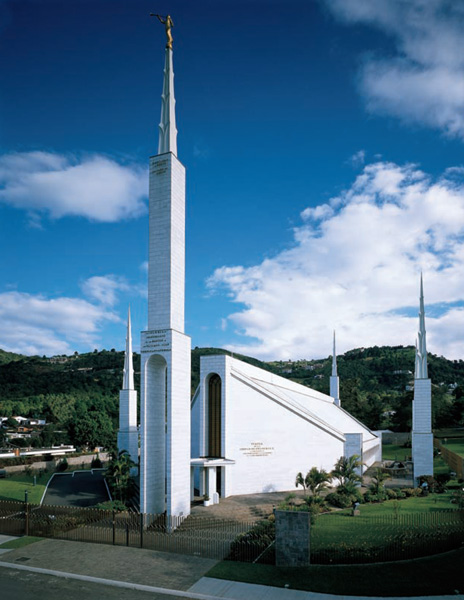
Today there is a temple in Guatemala City. The Maya who were brought up to record the temple ceremony for their people had all taken out their own endowments and considered it a great privilege to have a part in bringing the blessings of the endowment to their people in a language that they could understand.
For the first few days, the Maya were given time to read through their parts, review videotapes of the ceremony to practice their timing and voice inflections, and to prepare for the actual recording. It soon became apparent what an impossible thing we were asking them to do. Most of their homes had no electricity, and the rows of machines and blinking lights were frightening and intimidating. None could read any better than at a grade school level, sounding out each word at a time. Just getting out the words was a frustrating and time-consuming task. We frankly didn’t think that it would be possible for them to become proficient enough to read the text rapidly, much less instill in the words the spirit that such a sacred ceremony demands.
I will never forget the first day we started to record. We put these poor, humble people in a little glass booth, surrounded by technical gadgets, microphones, and earphones and asked them to relax and speak the words with naturalness and the proper spirit. They were so frightened that they could not speak more than a few words at a time, and those were unusable.
We all went back to our hotel rooms discouraged and felt that we were going to fail. The next day, I noticed a change in the Maya. They were unusually quiet and serious, but somehow they didn’t seem to be as afraid as the day before. When the first brother, who was assigned to read the part of Elohim, was called on to record his part, he stepped into the recording booth without hesitation. The window was set so high in the booth that we could barely see him, being only 5’4″ tall. He put on his earphones, closed his eyes and looked up momentarily, and then said quietly that he was ready. When I gave him his cue he began to speak in the most beautiful, flowing Maya that I had ever heard spoken. He read through three full pages without error before we had to stop him to check the sound level. When I cued him to stop, He asked if he had done something wrong and looked so apologetic that it broke my heart. I assured him that we just had to do some technical things and that he had done beautifully. The spirit was so strong that it was a physical presence that we all could feel. The emotion of it was overwhelming. The brother in charge of the recording instruments turned to me afterward and simply said, “We have just witnessed a miracle, one of the strongest manifestations of the gift of tongues that I have ever witnessed. His voice, inflection, and timing were as good as the best professional actors that we have in English, Spanish, or other of the more established languages.” When I asked this Mayan brother what had happened since the day before, he smiled and said that he knew the enormous importance of the temple endowment for his people and knew that he couldn’t do it on his own. He and the others had tried as hard as they could but that the words just didn’t come. So he had prayed last night to his Father in Heaven and told him that he just couldn’t do it without His help. He didn’t want his people for generations to come to hear his voice and weakness, but the voice of Elohim. He asked if his Father in Heaven would please come to that sound booth with him and speak for himself. He felt assured and that morning he never doubted that God would be there with him. One by one, each of the other Maya read through their parts with similar power and faith. [Allen J. Christenson, “Account of the Recording of the Temple Ceremony into K’iche’ Maya in 1991,” Personal Communication to Alan C. Miner]
This is one example of a miracle. Miracles are rarely widely spread or publicized. Sometimes they are quiet, personal experiences. Sometimes the world never knows. But if you seek them out, if you look for them, they are there. Miracles happen every day in the world. Miracles happen every day in Christ’s church. Christ’s church is alive in the Church of Jesus Christ of Latter-day Saints. Miracles have not ceased. The gift of tongues is alive and active.
Mormon 9:20
“And the reason why he ceaseth to do miracles among the children of men is because that they dwindle in unbelief, and depart from the right way, and know not the God in whom they should trust.”
Moroni 7:29
And because he hath done this, my beloved brethren, have miracles ceased? Behold I say unto you, Nay; neither have angels ceased to minister unto the children of men.
God will never cease to be a God of miracles.
 No Coincidences