Tag: Mormon

  • Text to a Friend

    Text to a Friend

    I want to share an exchange with one of my oldest theological friends. I invited this friend to hear me speak in church. My topic was Ephesians 1:10 which reads:

    “That in the dispensation of the fulness of times he might gather together in one all things in Christ, both which are in heaven, and which are on earth; even in him”

    I may share that talk sometime in the future.

    My friend was invited to the talk and like the consistent and reliable friend he has been now for years whether across state lines or in the state of Arizona, showed up. I went about ten different directions before I settled on where I would go with my talk. The direction I finally settled on was one in which I knew this friend would disagree. I knew because it was a topic we had regularly disagreed on.

    Afterwards, this friend gave me expected thoughts regarding his side of things and how they relate to my talk. He was pointing out where he disagreed. This is why we have such good conversations! I already knew his points as we’d had the discussion before.

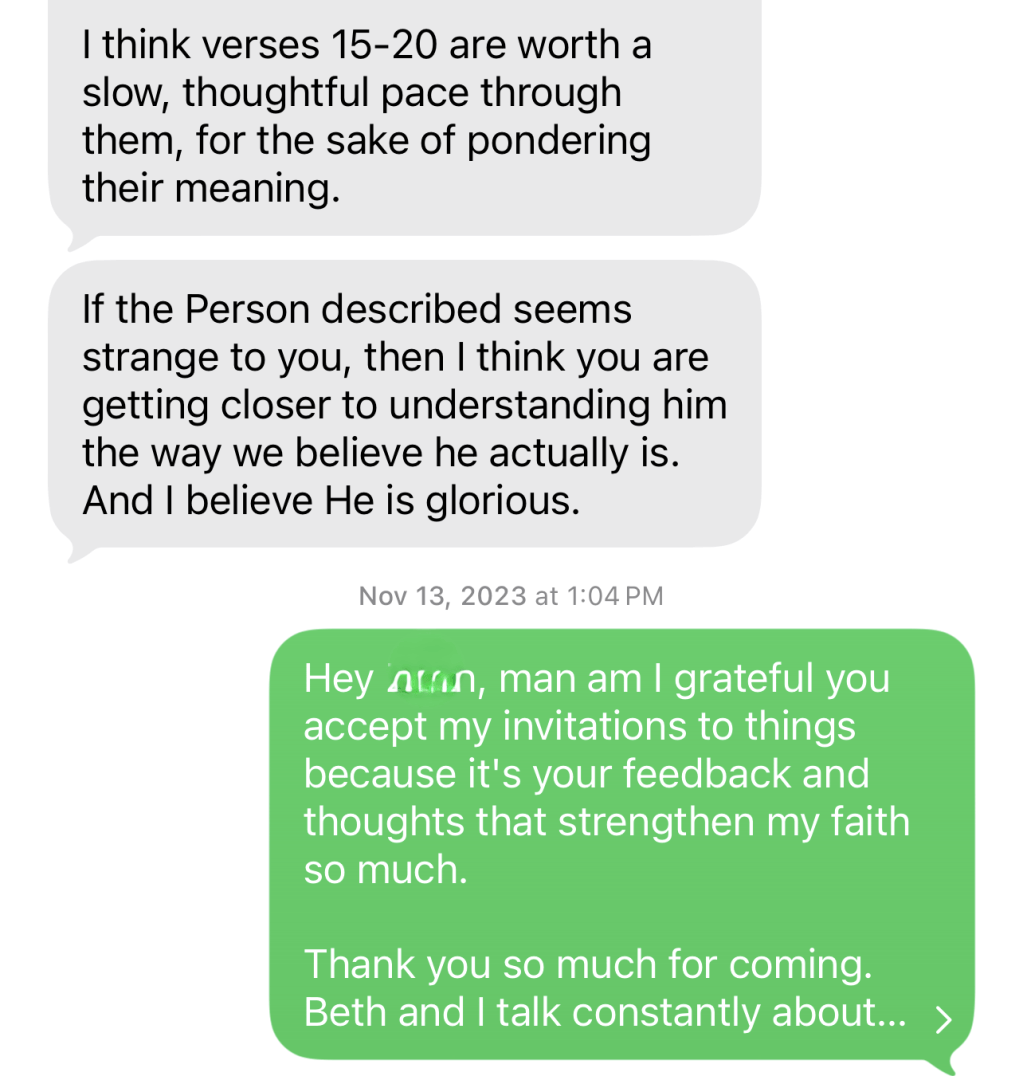
    It resulted in a text I got to send to him that I would like to share (yes, this was one text):

    “Hey, man am I grateful you accept my invitations to things because it’s your feedback and thoughts that strengthen my faith so much.

    Thank you so much for coming. Beth and I talk constantly about how we can’t trust people to keep commitments and do things they say they’ll do. You and [your wife] are one of two couples in our life (outside of family) that when you say you’re going to do something or be somewhere we know you will be. Thank you for that.

    I knew exactly what thoughts you’d have on my talk and I welcome them. I knew it would be somewhat, maybe inflammatory, to you, as I know it touched on things we’ve disagreed on from the beginning. I am glad that you appear to have not been offended by my words. Our disagreement really comes down to one thing, I think. And that’s if the Book of Mormon is true.

    I appreciated the exercise you gave me. As I did it, I came out more convinced that Jesus Christ is the literal Son of God, as the scriptures say. That’s the thing. You read the Bible and see God and Jesus Christ in one way. I see it, without a doubt in my mind, another way. Nothing will change that.

    But why do I see it another way? How can something so clear to you, and something so clear to me, be the opposite?

    As I said in my testimony, it comes down to a prophet. How can I know Jesus Christ is who He is? Because a prophet told me. How do I know he’s a prophet? He would have had to do something miraculous.

    I’ve concluded the Book of Mormon is the miracle God provided so I could know Joseph Smith was who he said he was. And if he was who he said he was, then Jesus Christ is who Joseph Smith said He is: the Son of God, on God’s right hand, as the scriptures say.

    It’s here that I finally thank you for giving me this great gift. It was years ago that you said you couldn’t accept the Book of Mormon because there was no proof the way there was with the Bible – archaeological and otherwise. I have spent the past years seeking “proof” that the Book of Mormon is what Joseph Smith claimed it to be. My list now is well over 400 items (*that was true in 2023 when this was written, now well over 800 individual items) and I am excited to share it with you one day.

    I have you to thank for that. You have built my testimony in a miraculous way and I thank our Heavenly Father, and you for that.

    Of course, “proof” is an interesting word. Despite all the records, eye witnesses, evidences, and testimonies, many still deny Jesus Christ existed, the Bible is the Word of God, etc. My “proof” may not do it for you. But when I review my list, there is not a shred of doubt in my mind that the power of God provided us the Book of Mormon. My faith has become knowledge.

    Until this life ends and we get to review everything, you will never understand how fruitful you have been to building my faith and testimony. Thank you, friend.

    Jesus Christ is the center of everything. He is my King, my Savior, my Redeemer. He is my advocate with the Father. Without Him I have nothing. Without Him I am nothing. I know we see Him differently. That doesn’t change who He is and what He’s done for us. Maybe one of us will change our minds one day. But ultimately, as long as we believe Jesus Christ is our Savior and King, one day we’ll both stand before Him and we’ll know. And it won’t matter who was right or who was wrong. Only He will matter. What a day that will be! Man, I look forward to it!”

    I share this because I think it’s important. The point of Christ is to bring us together. Though we disagree on many, many doctrinal points, this friend and I have fostered a relationship of discussion, debate, and disagreement, always founded on love and respect.

    I am truly grateful for how this person has strengthened me in Christ. That’s what this life is about. There can be good reason there is disagreement in the world – it can be for us to learn how to coexist with those we disagree with. We all have unique experiences in this life. Every moment shapes us and every experience we have changes the way we view the world. It’s through these experiences and listening to the viewpoints of others, someone who has had a vastly different life than we have had, that we can grow and become better.

    The world needs a little more of this.

  • Monumental Moment

    Monumental Moment

    I’ve written about seemingly small moments in my life that made a huge difference on the trajectory of my future. I’ve mentioned a postcard. I’ve also mentioned a seemingly inconsequential invitation to join a basketball team (from that same link). I’d like to elaborate on that basketball invitation story.

    I was so nervous my first time coming back to church that I made my roommate come with me so I didn’t have to go alone. It had been years since I’d been at church.

    I only remember one thing about that first day back at church, and it was after sacrament meeting ended. I’d just sat through my first sacrament meeting in I’m not sure how many years. I was self-conscious, uncomfortable, ready to leave, when the person in front of me turned around in his seat.

    “Hey, do you play basketball?” He asked.

    I remember being blown away. I remember thinking, “Wow! The spirit is powerful here! How did he know???”

    I’ve thought back on that moment. Yes, the spirit was powerful that day. But not in a mystical, this stranger in front of me received a supernatural message that I loved basketball, kind of way. The world would consider that a powerful spiritual experience. What actually happened was equally as powerful, yet more easily “understood” by worldly standards.

    The truth is, as I now suspect, the person who sent that postcard went the extra mile. When I asked about going to church, after telling me where they met and what time, she also reached out to the Bishop of that ward. In hindsignt, I’m pretty sure I was brought up in ward council, a meeting where leaders of a church ward discuss pressing matters.

    I’m sure I was mentioned. I’m sure Kelsie, the postcard giver, told the bishop I liked basketball. That person who turned around in their chair to ask if I liked basketball was in that meeting. I’m sure he was looking for me.

    Is this any less miraculous?

    Is it any less of a miracle that an individual, who had never spoken to me before had heard of me and knew I needed friendship extended in my direction? A complete stranger stepped out of his comfort zone and said hi to a stranger and asked a seemingly random question. A complete stranger didn’t care if I was the worst basketball player in the world, he still asked me to join a city league team with him. 

    As a basketball player, that last part is significant. I would hesitate to ask someone I’d never seen play basketball to join my team. How do I know that person can dribble a basketball? How do I know whether or not that person knows how to play team basketball? How do I know whether or not that person is a nightmare on the basketball court?

    The invitation that day was about more than basketball. That invitation came from an individual who had heard about me, a wayward soul trying to come back, and followed a spiritual prompting to invite me to play on a basketball team- basketball skills be darned.

    That person’s name was David Lake and I owe him a great debt. I have thanked him for that moment. Such a tiny moment. I know he didn’t think about it much after doing it. That was just the kind of person he was. In that moment, a stranger knew me, cared about me, and invited me. 

    That moment made all the difference in my life.

    It’s amazing how a seemingly tiny moment can change the trajectory of a life. Where am I if not for that monumental moment? Did I come to church the next week? Did I meet my wife? Do I have Ivy, Sage, Wren – my own eternal family? 

    There are some moments that carry more weight than others, no matter how seemingly inconsequential.

    My invitation to anyone reading- the next time you’re at the grocery store, or the dog park, or the gym, or at work, and that strange thought comes to your mind while you’re conversing with someone, “Invite them.” Do it. You don’t know the profound blessing that can change a person’s life because you decide to step out of your comfort zone and invite a stranger.

    If you have been blessed by the Gospel of Jesus Christ, share it. Invite others. It’s the least you can do to thank your Heavenly Father for this gift He has given you.

    Beth and I were laughing how roommate Chris is in this picture but I’m not. David Lake prominently placed.
    Beth and I actually met through church basketball. Crazy huh? As you’ll see in this picture, couldn’t be seen too close to her, would be too obvious.
    A future wife, future best friend I still coach with, many lifelong friends, and saving Bishop all in one picture. That’s a miracle.
  • Attack in Michigan

    Attack in Michigan

    For those who didn’t hear, there was a shooting at an LDS church 18 days ago. I’m not sure if this was big news outside of LDS circles. Sad when there is “just another shooting.”

    For these last two weeks I’ve considered writing something about the attack.

    It felt like something I should write about.

    But I didn’t know what to say. Especially with all the conversation that started to come up around it, I didn’t really want to contribute to that.

    But again, I felt like it was something I should write about.

    The first thing I felt when I heard the news was a real, deep sadness. A quick, deep sadness, like a punch of sorrow to my gut.

    The next thing I felt was a little ashamed of myself. There are shootings often. Unfortunately. When this happened, it hit me hard. I found other recent shootings that I hadn’t heard anything about. Every shooting brings me sadness. Why did this one impact me so much more? I guess because this shooting happened against my people, I felt it more.

    I don’t like thinking in terms of “my people.” Polarized, tribal views is one of the major issues in America right now.

    Still, these were my people. I now had images of being with my congregation on Sunday when a nightmare might start. These were followers of Christ. These were my brothers and sisters.

    What happened in Michigan hit me. But it’s not what I want to talk about. What I want to talk about is the response.

    What should separate members of the body of Christ? How should members of the Church of Jesus Christ of Latter-day Saints act? How should true followers of Christ respond to an act of violence against them?

    If we are true studiers of the Book of Mormon, true understanders of the Gospel, and true readers of the Bible, we should know that the response should be love and compassion. No matter how hard that is.

    So when I read that a member of the Church of Jesus Christ of Latter-day Saints, not a member of the attacked congregation, but a member nonetheless, when I heard someone started a fundraiser for the family of the man that did something indescribably wrong, I held back tears.

    I encourage you to read that last link becuase Dave Butler, the man who started the fundraiser, makes some good and important points.

    It’s not easy to forgive your enemies.

    Is this a story of forgiveness or is it a story of empathy, love, and compassion? It is an example of all those things. This was just a way for a community of people to show all those attributes in a difficult circumstance.

    We have a commission to look after the widowed and fatherless. There was now a family that needed that. The human family showed its true character when it stepped up to help the widowed and the fatherless.

    If we could just show more love, compassion, forgiveness, and empathy in this world, how different would it be?

    I am proud of my church.

    I am proud of Jesus Christ’s church.

    I’m proud of our members and what we represent. I know that aggression against the followers of Christ will increase. I wrote about this last week. I hope our faith is ready to withstand the trials that await us.

    I hope that throughout our trials we can always remember that love, compassion, empathy, and forgiveness are always the right choice.

  • What do we believe in?

    What do we believe in?

    My Aunt Lindsey often asks the question, “What do you know?” I usually respond, “Not much.”

    What do we really know? Anything?

    While reading Mosiah chapter 26, I came across an interesting commentary from Hugh Nibley, one of my favorite scholars. The commentary was on Mosiah 26:15 which reads:

    “Blessed art thou, Alma, and blessed are they who were baptized in the waters of Mormon. Thou art blessed because of thy exceeding faith in the words alone of my servant Abinadi” (emphasis added).

    In considering that phrase, “in the words alone of Abinadi”, Hugh Nibley asks, “Now what about childish faith? What about being gullible, etc.? Alma believed in the “words alone”? Alma saw no evidence, no proof, or anything like that? And it wasn’t the words of God; it was the words of Abinadi alone that he believed in? What’s going on here? Why is there merit in this?”

    He continues, “There is merit because Alma believed in his words alone. I would emphasize his. You are blessed because of the things you choose to believe-not by the act of believing, not just by faith. You weren’t blessed because you believed, but because you chose what to believe. Everybody chooses what to believe. The atheist is a very strong believer. He is the most passionate arguer you can possibly find, and the positivist. Where will you find greater faith and firm conviction than among economists? . . . You must believe in something, and everybody does. But the Lord said, blessed are you [Alma] because of the things you chose to believe; you chose to believe in the things that Abinadi taught.”

    I’ve written before about The Faith of an Atheist.

    What do we believe in?

    This is an interesting statement by Hugh Nibley. The idea that it isn’t our faith that is important. Everyone has faith in something. It is what we have faith in. What do we choose to believe? Do we choose to believe that this is all one dumb coincidence and we’re all here for no real reason? Or do we believe in a Savior who redeems us, a Father who loves us, and an eternity of potential?

    Like a lot of things, it’s really about agency. What do we choose to believe in? Alma chose to believe in something good, hopeful, eternal.

    People who leave the church – are they better for it? This is going to upset some people. But in my opinion, no, people aren’t better for leaving the Church. That’s not absolute, of course. Some who leave the church still donate constantly to good causes, serve others, love others, and use their time in helping others. More often than not, I don’t think that’s the case.

    Many who leave the church, instead of turning their focus to good, hopeful, and helpful things, spend the rest of their lives trying to bash, destroy, and talk negatively about the church. Why is that? If leaving the Church of Jesus Christ is a good thing, why doesn’t more good come from it instead of more negativity? Why is tearing down something, whatever your feelings on it, that brings others hope and joy, a good result?

    Is it easy to be a member of the Church of Jesus Christ? With the number of people my age deciding they don’t care for the Church, or any church, I’d say membership in the Church of Jesus Christ is not super easy. A lot of people say, “The church doesn’t do anything for me.” The Church isn’t about what it can do for you. It’s about what you can do for others. When you leave the Church, what do you do for others?

    Leaving the Church is complicated. I’m not trying to oversimplify it too much. But what I think gets lost sometimes is that leaving the Church is often a selfish choice. At least it was for me. I don’t want to have to get up early for church on Sunday. I don’t want to use my Saturday morning helping an elderly person move their belongings. I want to drink. I don’t have time for a church calling like teaching a class, working with the youth, or organizing group activities. I definitely don’t have time for ministering. Yeah, checking on a couple people every so often to make sure they’re doing OK, and really help them if they say they need something, don’t have time for that. I don’t want to pay 10% of what I earn anymore. The list goes on. Someone leaving the Church NEVER thinks this way (or won’t admit it). It’s about historicity or “what they feel” or feeling lied to or CES letter blah blah. I’m not trying to say that those things can’t be hard for people. They are, and I understand that. But often, it comes back to I, when the Church’s main goal is to help us see outside of ourselves.

    Now let’s be clear. Simply going to church isn’t enough. There are plenty of people who go to church on Sunday, leave, and call themselves stalwart disciples of Christ. You may be worse off than the nonbeliever in that case. It may be worse to believe and turn away the sick and needy than to choose not to believe.

    Does some small historical question, or some big historical question, distract you from a plan called “the Plan of Happiness”? Do you choose to worry about a statement by Brigham Young or some question about Joseph Smith? Do you disregard the miraculous book that was written, the testimony of a Savior of the world, an account of that Savior visiting His children in America? Do you ignore the hopeful and positive miracles because you have doubts?

    What do you choose to believe in?

  • Importance of Promises (and Covenants)

    Importance of Promises (and Covenants)

    Since as long as I can remember, promises have been important to me. I’ve always said I would never break a promise for any reason. Period. I’m sure at some points in my life I have broken promises. I have this vague recollection of a broken promise or two that still eat at me. I don’t remember the details, but I remember the feeling of not keeping my word. For whatever reason, promises are something I’ve always considered immensely important, I’m not sure exactly why. Deep down inside, I’ve always thought promises were important to keep. Otherwise, what was the point? Otherwise, words were hollow and how could you be trusted?

    In Alma 23:16-25:2 of the Book of Mormon, there is the story of the Anti-Nephi-Lehis. This is the story of the Lamanites who converted unto the Lord and from then on turned away from their past traditions of murder and bloodshed. They buried their weapons of war and covenanted to shed blood no more. They took their new covenant so seriously that when other Lamanites came to war against them, rather than break their newly made covenant, they knelt before their former brothers and gave up their lives.

    As I read this story recently, a question arose: how seriously do we take our covenants? What does our word mean to us? How about when our word is a promise to God? How important do we deem that pact?

    Covenants are important. Covenants are serious. Keeping covenants is a serious thing.

    The converted Lamanites, or Anti-Nephi-Lehis, made a covenant to shed blood no more. Full stop. No excuses. When their lives were at stake, did they reconsider? Did they say to themselves, “well I promised this, but surely I’m not supposed to lie here and die over a promise”? They thought the exact opposite. Their covenant was worth more than their mortal life. These Anti-Nephi-Lehis understood the significance of covenants. There were no excuses. They had faith. They knew that if they died keeping their word to God, they would inherit a glory and reward that would be well worth the earthly sacrifice.

    Covenants with God are greater than death.

    So, I ask again, how seriously do you take your covenants?

    Have I been perfect in keeping the covenants I’ve made with God? Let’s review the first covenants I made with God when I was baptized at age 9. I covenanted to:

    1. Take upon myself the name of Jesus Christ.
    2. Keep His commandments.
    3. Serve Him to the end.

    Have I been perfect in this? Of course not. None of us are perfect yet. But I’ve tried. I often wonder how much my baptism and the Gift of the Holy Ghost at age 9 strengthened me and helped me to return. I often wonder how my upbringing influences my deep respect for promises. Though I haven’t been perfect, I always took these covenants seriously.

    I now take further covenants I’ve made very seriously. For example, my covenant with my wife, to be faithful to her, to love her, to serve her, to be there for her. That is the most important promise I’ve made in this life and I intend to die before breaking it.

    In a world of promise-breaking and commitment to nothing, I am ever-grateful for the covenants I’ve been privileged to make. I’m grateful for the Church of Jesus Christ that provides the proper authority for me to make promises with God. I’m grateful to be linked to God. I’m grateful for the strength covenants provide in a shaky and uncertain world.

    If you’ve made covenants that you’ve broken, I implore you to reexplore those promsies. Satan leads us to believe that once broken, we can’t mend our word. When our promise is with God, that is true, we can’t mend it. But He can. Jesus Christ suffered the Atonement so that we can come back even to make up for the promises we’ve broken. He knows we aren’t perfect. He will make the difference. I fell into that trap for stretches in my life. Thinking I’d gone too far away from God, I’d broken too many promises, disregarded too many commandments, and I couldn’t come back. The feeling of reuniting with God is the most comforting feeling in the world. Reunite with Him. He will always take us back. He will always reestablish our covenants because He loves us that much.

    Come back to Him and feel His peace.

    I am grateful for covenants and that God allows me, an insignificant little speck, to align and connect myself with Him. What power. What comfort.