
Tag: perspective

  • San Junipero

    San Junipero

    I really enjoy the show Black Mirror on Netflix.

    For those who don’t know the show, each season includes independent episodes that usually (but not always) have a futuristic, technological theme.

    One of my favorite episodes is called San Junipero.

    I don’t love this episode for its ending. I love it for how it makes me think. Funny enough, I watched the episode a second time, 7 years after the first viewing. Usually when something really makes me think, I pull out my phone and start writing down my thoughts.

    In 2025 when I rewatched San Junipero, I pulled out my phone to take notes. I found notes I took 7 years prior. I didn’t remember taking those notes. But they fit exactly what I thought 7 years later watching the episode a second time. Good to see I’m consistent. Typing those thoughts out led to this blog post.

    In the show, San Junipero is a virtual reality where people can upload their consciousness to live and experience life much like in the real world. In San Junipero, people can eat, drink, laugh, dance, and do seemingly all of the things that you can do in real life.  

    The main character is named Yorki. Yorki meets a character named Kelly (I hope it goes without saying that there are about to be spoilers for the episode).

    Yorki and Kelly start a romance in San Junipero. In San Junipero, everyone is young and vibrant. We learn that in the real world Yorki is an old woman who was paralyzed at the age of 20 and has spent her entire life in a coma-like state. Kelly is an old woman who was given 3 months to live 6 months ago.

    We learn that Kelly was married for many years to a man named Richard. Kelly and Richard… well, I’ll let Kelly tell the story.

    The episode comes to a climax when Yorki is trying to convince Kelly to stay with her in San Junipero.

    This leads to one of the most powerful monologues I’ve ever seen on television. In exasperation and frustration at Yorki’s request, Kelly exploded (you can watch the exact clip on YouTube HERE):

    “49 years. I was with him for 49 years. You can’t begin to imagine. You can’t know. The bond, the commitment, the boredom, the yearning, the laughter, the love of it. The *expletive love. You just cannot know. Everything we sacrificed. The years I gave him. The years he gave me. Did you think to ask? Did it occur to you to ask?

    “We had a daughter, Allison. Always difficult, always beautiful. Died at 39 years old, bless her heart. And Richard and I, we felt that heartbreak as one.

    “You know when he was dying, Rich said to me, when they offered him this, to pass over, pass through, spend eternity in this *expletive graveyard you’re so in love with, he said, ‘How can I? When she missed out, how can I?’ And so he went. And I wish I could believe he’s with her now, that they’re together, but I don’t. I believe they’re nowhere. Just like you said. Gone…

    “And now you give me some sales pitch about how *expletive peachy forever could be. You want to spend forever somewhere nothing matters? End up like Wes. All those lost *expletives at the Quagmire trying anything to feel something, go ahead. But I’m out. I’m gone.”

    The episode goes on. You see a coffin being lowered into a grave next to Richard’s tombstone. You think that’s the end.

    Black Mirror is known for its twists. I love it for its twists. I hated this twist.

    Kelly is back in San Junipero with Yorki. She decided not to “pass on.” She stayed in San Junipero. The show plays background music of Belinda Carlisle’s Heaven is a Place on Earth.

    While this may seem like a happy ending, the broader implications broke my heart.

    Obviously, I’m going to take this from a perspective of faith.

    There’s a lot to unpack here and a lot to consider. It’s why, despite my dislike for the ending, it’ s still one of my favorite episodes.

    Kelly could have “moved on” and spent an eternity with her husband and daughter. Instead she decided to stay in an artificial world.

    What is the lesson here?

    Her husband Rich had a particle of faith. Just a mustard seed of faith, you might say. Kelly couldn’t exhibit even that. She said herself, “I wish I could believe he’s with her now.” Wish. She Wishes. She hopes, probably. But she couldn’t believe it. She couldn’t even give real honest effort. She could only wish and hope but she couldn’t believe. According to Kelly Richard didn’t believe, but clearly he tried to. From a faithful perspective, what did Richard get? An eternity with his beloved daughter. What did Kelly get? An eternity in a fake and counterfeit world.

    Kelly took the guarantee in front of her. She took what she knew. She chose earth. She chose an existence of “trying to feel alive” over eternal life.

    Kelly’s monologue makes mention of a place called the Quagmire. The definition of quagmire is: “a soft boggy area of land that gives way underfoot.” A land that gives way underfoot = unsteady, uncertain, unsure. A sandy foundation.

    The Quagmire was a disgusting, sad, pathetic place where people in San Junipero went to party. It was all grotesque acts, cage fighting, drugs – all the worst of the world. Why did so many people in San Junipero go to the Quagmire? A hell-hole of debauchery? Kelly in her monologue pointed out the reason the living souls of the dead in San Junipero went there. Why would they go to somewhere so horrible? Just to try to feel alive.

    This is another eternal point to consider. The Quagmire clearly represented hell. Hell is a lack of progression. Hell is a lack of purpose.

    What is life without purpose? What is your purpose?

    Kelly chose a fake world. Will her life there be happy? Maybe. It might even be amazing, from an earthly perspective.

    We know that people really will make this choice. When some die, they can’t enjoy an otherworldly experience because they are too attached to this world. It’s the reason Jesus said to leave all earthly things behind and seek after eternal things. There is so much in store for us if we can just seek it out. Some will choose this world and this life because they can’t garner the faith to hope for something so much more.

    For those that want a greater blessing, there will be an eternity of love and joy, and things we can’t even begin to wrap our minds around – amazing, spectacular, fantastic things. But if we get too stuck in this world, we’ll miss the opportunity for that so much more.

    The fictional Richard hoped for so much more. He wished for so much more. He believed it just enough that he received it. A blessed existence for eternity with his daughter.

    I so wished the show would have taken an “eternal perspective” for once. But alas, it is a show of the world.
  • The Mis-Education of the Negro

    The Mis-Education of the Negro

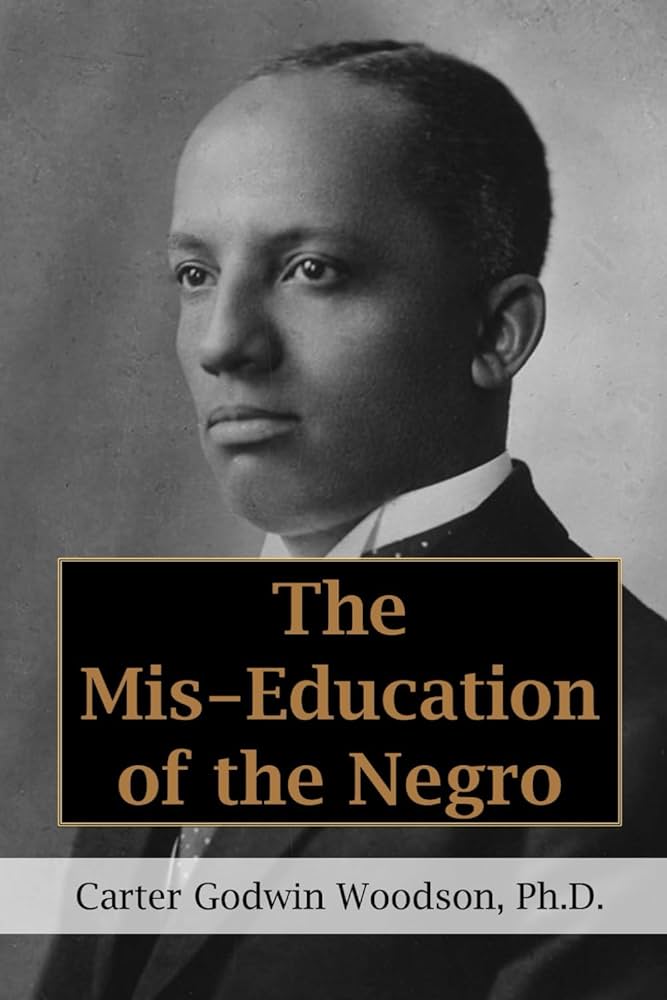
    I read a book recommended by CJ (thanks CJ) that I’ve wanted to write something about ever since reading. It was such an interesting and powerful book. It proposed some thoughts I’d never considered and really opened my mind to a different way of thinking about a particular part of American history.

    The book is titled The Mis-Education of the Negro, written in 1933. When I started the book, I immediately texted CJ and said there was too much in the book and that we should start a podcast series exploring the topics. He jokingly agreed to do a podcast. As I continued to read, I noted 40 topics, each I thought would make for a worthwhile discussion.

    CJ and I are at a combined 6 children 4 years old and younger, so a podcast is definitely on hold.

    I read this book a couple years ago.

    Discussing race is difficult. I’ve debated posting this for some time. Not that I’m saying anything controversial or crazy. Just that I don’t like to think too much about race. But our race is important. It makes who we are.

    Sometimes commenting on race as a white person feels like a lose-lose situation. I’m either so positive about other races that it seems like pandering to the point of insincerity or like I’m trying to make up for something, or I’m not positive enough and come across at best not understanding and at worst a racist.

    I think this is why talking about race in America is so difficult. I’ve written about it before and it still is one of the most difficult things I’ve written. 

    And yet, I continue to hear from my black brothers and sisters say that the best place to start is to just be open about discussing it. Which led me to put this post together. Nothing profound. Just my thoughts on a good book.

    I should mention that the book was written in 1933 which led me to continuously ask, is it still that bad? I think many of the disappointing and sad truths the book lays out have improved. Not yet perfect, but improved.

    I want to list some of the topics I noted as interesting from the book. Then I’ll elaborate on one of them.

    1. The “equality” of black and white people. Are black and white people the same? No, we are different in so many ways. From upbringing, culture, background, experience, etc. And that’s ok.
    2. Black people being nominally free but economically enslaved.
    3. Has education for black people gotten better or worse since 1933? I assume it must have improved, but it was a thought this book made me consider.
    4. This is something I feel like people my age have started talking about more- why didn’t we learn how to do taxes instead of the Nina, the Pinta, and the Sante Maria? – The question I asked from reading this book, what is education good for? Why do we care about random historical facts from Europe? To be clear, I appreciate as much as anyone the importance of understanding history and where we came from. But shouldn’t I also know how to file my taxes and apply for a job? Also, on that note of “where we come from.” I remember a lot of history being taught about Europe. I don’t remember a ton being taught about Africa, Asia, or South America.
    5. The opportunities that are afforded whites because more white people own businesses, etc. compared to black people. I think this was much more prevalent in the 1930’s compared to today.
    6. I really struggled with reading this book because I passionately hate the word in the title of the book. Underlining it over and over throughout the book drove me crazy. I almost put the book down many times because I hated how a group of people was being, I felt, unfairly characterized.
    7. Competing churches taking away from impoverished areas.
    8. Why do we study the domineering, warring nations and not the peaceful, productive nations?  The answer is obvious- the winners of wars write history. But philosophically something to consider.
    9. Interesting point mentioned about former slaves avoiding using art to portray their experiences. There were so few books or art pieces made by former slaves depicting that struggle. I think we see that more embraced today with hip hop. Artists like Tupac, Ice Cube, and Kendrick Lemar come to mind as individuals that fully embrace the struggles they have experienced in life and have made great art out of it.

    I heard this not from this book but 3+3 and 2+4 are the same. Different, but still the same.

    The point I’d like to discuss a little more is point one. The author of this book pointed out that we’re so obsessed with making everyone equal that we disregard that people are different. He points out that maybe black people and white people shouldn’t be taught exactly the same. We come from different backgrounds and different life experiences. Something that resonates with me and helps me learn may not resonate or help someone else with a different culture from mine.

    Still, I think this idea is interesting. Generally speaking, a black person has a different life experience from a white person. I’m not talking about just upbringing, I’m talking about the way we see the world, I’m talking about the way we interact with the world, I’m talking about the way the world interacts with us. Black people and white people can be different. That’s not bad though. We’re not different in an inferior / superior way, just different. Good and bad. Different.

    From the book:

    “The differences of races, moreover, is no evidence of superiority or of inferiority. This merely indicates that each race has certain gifts which the others do not possess. It is by the development of these gifts that every race must justify its right to exist.”

    It makes me think about what is happening with gender. Women and men are different, and that’s ok. We all have our own skills and talents that make us who we are. The fact that I’m a man makes me different from my wife. My wife has many skills and talents I’ll never possess. Recently I heard it put this way – 3+3 and 2+4 are the same. Different, but equal.

    That said, the most important thing is that we remember we are all sons and daughters of God. White and black doesn’t mean anything to God. What matters to God is what’s in our hearts. We are all individuals. That’s ok. We should all be treated equally, of course. But we should remember that we are unique. Our uniqueness is great.

    If you want to read a book that makes you consider race and the history of education for black people, this is a great book to read. I encourage all of us to study these ideas so we can better love and understand each other.

  • Letter to a Sinner

    Letter to a Sinner

    I write this with as much humility as possible.  Fully knowing and understanding my weaknesses have given me perspective.  It is my faults and errors that make me feel like I can write this letter. 

    I remember when I came back to church I was asked to not take the sacrament for three weeks.  It was one of the more difficult things I had to do, although it doesn’t sound like much.  I think it was the moment I realized I had changed.  Something that in the past might not have affected me too much, really hurt.  It was difficult coming back and immediately feeling like maybe I’m not enough.  Maybe I could have gone the route of resentment.  Instead I realized how much I didn’t want to have to go through that again.

    I don’t in any way imply I’m better than someone who can’t take the sacrament and does feel resentment.  We all have our own paths.  Mine was of being completely away, coming back, and realizing I deserved my three weeks.  Some are never officially away so that state of probation seems unfair or not right.  I understand that.

    This is my letter to the sinner.  A reminder, that includes all of us.  This is the sinner who has made mistakes.  This particular sinner might come from a perfect family and part of their struggle is feeling like they don’t fit in in the one place they should feel welcome.  This sinner might feel judged by the very people that should love them the most.  It doesn’t matter if those family, friends, and caring loved ones are right or wrong.  It matters how the sinner interprets things.  We all live our own experiences and encounter the world in different ways.  We must, to the best our abilities, see the world in perfect light and perfect truth.

    Here is my letter to a hypothetical sinner:

    You will never be like the “perfect” people you see around you.  You won’t.  Your path has been set.  Your path has been set partly by different “luck,” different experiences.  Partly by your choices.  My life was set by very bad choices.  But now that I’ve come out of the other side, my joy is greater than I could have ever imagined.  You won’t be “perfect”, but you’ll be who Heavenly Father sees you can be.  You won’t be “better” than those who never made the mistakes you made, but you might be stronger.  Your path will lead you somewhere wholly different.  And if you decide you want to come through to the other side: to truly know your Savior, to know forgiveness, to know what being welcomed home feels like even if you don’t think you’ll ever deserve it – if you come to that other side with that relationship with your Savior, your testimony will be welded in steel, as hard as diamond.  You’ll have gone through the refiner’s fire and come out united with He who gives all strength.  This is no excuse to continue to sin.  You know the light.  You’ve seen and felt the light.  I knew the light and I turned from it.  I hope to help anyone not make the same mistake.

    You will make mistakes.  You will sin.  But no matter what, you have to remember Jesus Christ.  Because while the world will judge you and you’ll have to struggle with that, He will judge you with a perfect love and comprehension.  Remember that those around you are trying to judge you with love.  They’re trying to love you righteously.  Jesus Christ doesn’t try.  He is perfect love.  Don’t forget it.  Don’t forget that those around you whose points of view you can’t understand, they’re trying to be like Jesus Christ.  They may be falling short.  But that’s not for you to judge.  Just as they can’t judge you, you can’t judge their intentions or efforts.  Just love and do your best. 

    I’m sorry you have to go through trials.  But do not lose sight of Jesus Christ.  Do not.  He is the only person true peace can come from.  Whatever you do, whatever mistakes you make, do not forget HIM.  He won’t forget you.  I promise.

    At this point I must apologize.  Throughout this letter I’ve referred to you as “the sinner.”  I know that phrase hurt the whole way through.  I know it because I’ve felt it.  I did it throughout the whole letter to get to this point.  I want to remind you, “sinner” is not who you are.  It will never be who you are.  We all sin but that’s not what God and Jesus Christ see in us.  No matter how many mistakes we make.  No matter how many slip ups or downright wrong things you do, you are not a sinner.  You are a child of Heavenly Father.  You are growing.  You are learning.  I reiterate something I said earlier, this does not excuse your sin.  Sin is wrong, you know that.  Christ will see your sin.  What means much more to Him is your repentance.  He doesn’t see who you were but who you will be. 

    “God cares a lot more about who we are and who we are becoming than about who we once were. He cares that we keep trying.”

    Elder Dale G. Renlund in April 2015 Conference talk “Latter-day Saints Keep on Trying”