Tag: Philosophy

  • Purpose and What Did You Eat Last Week

    Purpose and What Did You Eat Last Week

    I recently did a meditation that I couldn’t get myself into, I disagreed so much with the premise. I can usually go with the flow with any guided meditation, at least the ones I’ve done. Often the guided meditations lead to spiritual thoughts. This meditation led to a spiritual thought, but not in the normal way.

    The voice leading the meditation stated, basically, that we are on this big rock floating through space. None of us know why we’re here or what the true purpose of all this is. The meditation continued advising to set that aside for a moment and focus on your breathing, etc.

    I stopped right there. In my mind I thought, but I do know why I’m here, I do know the purpose of all this. I couldn’t get behind the premise. It’s a common theme of my writing. Where we come from, why we’re here, where we’re going. It hit me that 99% of people listening to that meditation probably don’t bat an eye at that statement. Most people probably gloss right over it like, “Yeah, I don’t know what the meaning of all this is.” That makes me sad.

    I just started a new book that talks about the temporal nature of this life and how silly it is to one, not believe in the things we can’t see, and two, put so much stock into the things we can see, even though they’re so temporary.

    The book asked what I ate 2 weeks ago. I had no idea. It made an interesting point. Food and water are the most critical thing to our survival. We can’t survive without them. Yet, what did you eat 2 weeks ago? You don’t even remember. What about the car that you love then 8 years later is a clunker. Or the house you cherish but inevitably becomes dirty, beat up, and cluttered with other stuff that is inconsequential. The book talked about how much stock we put into these things.

    How many of us consider why we’re here or where we’re going? How many in the world live in complete ignorance, not wanting to consider these great questions? It amazes me.

    We can’t see or describe heartache, fear, doubt, love, the wind, and yet they exist. Faith exists. Our soul exists. Eternity exists. God exists. These are the things that matter. I wish our society could spend a little less time with a Netflix special they won’t remember a year from now and consider more the purpose of this life. 

    The purpose of this life is God’s plan to make us stronger, better, and more like Him. We knew God before we came here. We will remember Him when we leave here. This life is so important. Not for food, or water, or cars, or homes, or Netflix, but for the faith we build, the experiences we go through, and the families and relationships we cultivate. I wish this is something we could all remember more.

  • Meaning in Religious Art

    Meaning in Religious Art

    This was an essay I wrote for a meaning of life through art class I took, thus the official format. I feel it was worth sharing.

    Meaning in Religious Art

                It was with difficulty I prepared to hypothesize about the meaning of life when I believe I know the meaning of life. It occurred to me that if I truly believe I know the meaning of life, and I do believe that, that it would be dishonest to write this essay in any other way than to state what I know in my heart to be true. It’s for that reason that I’ve decided to pick three pieces of artwork; a hymn, a mural, and a piece of literature to give a brief explanation on how those pieces portray what I know to be true about the meaning of life. Given my powerful belief of these principles, and the desire I have to share them in my life, it’s with excitement that I write this essay and explore the meaning of life through art.

    Religion

    It’s important to note that a religious individual cannot begin to explore the topic of “the meaning of life” without their ideologies, beliefs, and understandings that come from their religious upbringing having a huge impact on their exploration. I fully acknowledge that many may disagree with my conclusions and interpretations of these pieces of art. That is what makes art beautiful. Art is completely subjective. My viewpoint on the world will color how I view this art. I look to explore how my viewpoint shapes my perspective on these pieces of art and helps me consider the meaning of life.

    Hymn

                I’d like to start by discussing my favorite hymn which is titled “A Child’s Prayer” (MormonTabChoir, 2014). A main focus throughout this essay will be the emotion elicited through this artwork. I believe that art that makes one ponder the meaning of life is likely evoking strong emotions. I cannot listen to this song without strong emotions welling inside me. I feel a change come over me as I listen to the lyrics, likely because it’s this song I focus on when I most question about the meaning of life.

                “A Child’s Prayer” asks a poignant question: “God, are you there?” That’s the portion I ask myself in difficult times. The song unfailingly leads to the important statement: “Pray, he is there, speak, he is listening” (A Child’s Prayer, 1992). This is an important reminder about life and its meaning. The most important line in this song, and the one that most defines the meaning of life on earth is, “You are his child” (A Child’s Prayer, 1992). The meaning of life is to grow and learn and come closer to our Heavenly Father. This hymn is a powerful piece of art that speaks to the soul and reminds one of things often forgotten, but that will forever be true.

    Mural

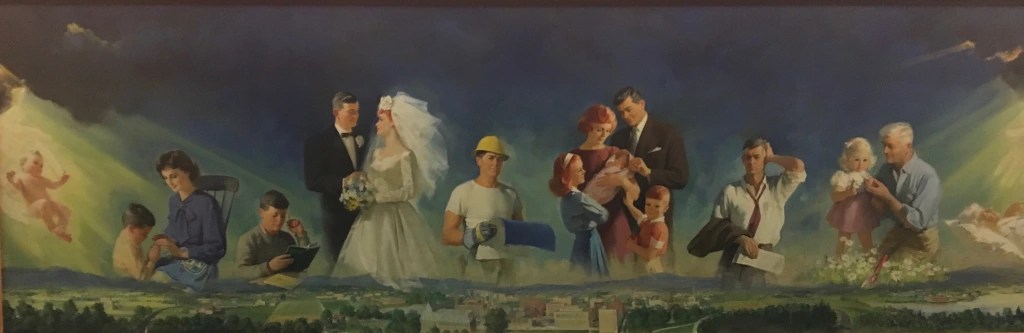
    The second piece of art I’d like to discuss is a mural aptly called, Purpose of Life (Skemp, 1964). Purpose of Life is a simple but compelling representation of the cycles of life and what life is about. Like the hymn, “A Child’s Prayer,” this mural evokes strong feelings within me, and I believe would for anyone who strongly considers its message. 

                The painting starts by showing a child entering the world. There are subtle hands shown coming from the sunlight, appearing to gently lead the child into this life. The depiction follows a young man growing. First, he is at his mother’s side, then reading, and then getting married. These three quick jumps create a feeling inside. As a result, a question develops: is life really that short? The painting continues, showing the boy, now a man, working. The man is shown with his wife and children. The man is shown with graying hair. The man is shown with his grandchild.

                The climax of the painting is the man lying on his deathbed. There is light above him, and the same hands that brought him to earth beckon him home. What could better illustrate the purpose and meaning of life than this painting? The purpose of life is to live, love, grow, learn, and then to come home. As my eyes scroll across the painting, powerful emotions arise. I consider growing up with my family. I consider the family I’ve started. I consider that like everyone before me, my life is heading to the same place, a return trip home. This mural does a fantastic job of illustrating the true meaning of this life.

    Book

    I couldn’t write a paper about the meaning of life without crediting a piece of literature that has given meaning to my life. The Book of Mormon is an entire book that focuses on the question, what is the meaning of life? The Book of Mormon is a piece of literature that literally details the purpose of life (Book of Mormon, 1830). Through my study of it, I have learned many important principles. One of these most important principles that give meaning to my life is that God loves and cares about all people, and that includes me. Others include that God is aware of us and is watching our progress, this life is important and there’s a reason I’m here, and that God keeps His promises. These are the principles that give my life meaning. 

    In a world of chaos and confusion, these basic principles give me hope. They provide light to my world. I simply couldn’t write about the meaning of life without discussing the book that has changed my life, brought me so much comfort, and put me on a path that gives my life meaning and purpose. The Book of Mormon is eloquent in its message and is a powerful work of art that I believe to be from Heaven. I can’t read it without feeling that God is there and being reminded why I’m here. 

    Conclusion

    I am grateful for these pieces of art and the feelings they create inside me. It’s these feelings that tell me there is more to this world than meets the eye and that I’m never alone. Great art provokes thought and emotion. Great art can make one stop and ponder. Great art can make one appreciate beauty and see the world in a different light. As Cooper (2003) says, “art, like philosophy, is the act of bringing truth into being” (p. 109). These three pieces of art, the hymn “A Child’s Prayer, the mural Purpose of Life, and the Book of Mormon, are each art pieces that provide this purpose for me, enlighten my life, and remind me the purpose of being here. I am grateful for art that makes us look beyond ourselves, consider purpose, and even see eternity.
  • Book Review:  The Problem of Pain

    Book Review: The Problem of Pain

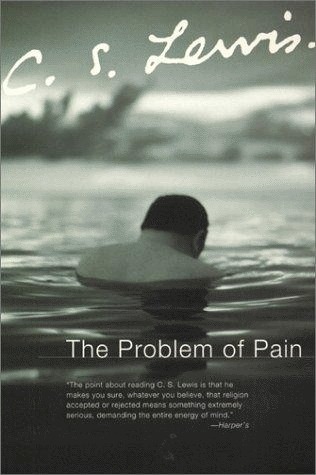
    The Problem of Pain by C.S. Lewis

    Copyright 1940

    ________________________________

    From the front cover: “The point about reading C.S. Lewis is that he makes you sure, whatever you believe, that religion accepted or rejected means something extremely serious, demanding the entire energy of mind.”

    Before starting this book, I was in the precarious position of thinking C.S. Lewis was one of my favorite authors without having ever read one of his books.  I have many of his books on my list of to-one-day-read.  The Lion, the Witch, and the Wardrobe is obviously on that list.  In the Church of Jesus Christ we often hear that C.S. Lewis is one of the most quoted, nonmember of the Church of Jesus Christ of Latter-day Saints, ever.  For good reason.  I came to the conclusion C.S. Lewis was one of my favorite authors because all his quote ARE SO GOOD.  He is brilliant.

    The Problem of Pain was the first C.S. Lewis book I ever read.

    I consider myself a semi-literate and intelligent individual.  That all went out the window while reading this book.

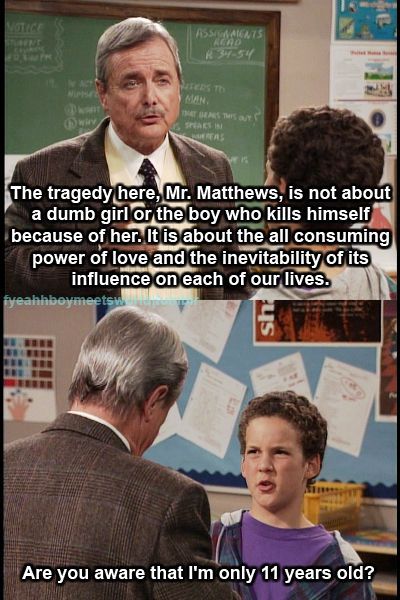
    This is how I felt reading this book:

    My monkey brain couldn’t wrap itself around these eloquent and long sentences.  Here’s another thing, I don’t like huge paragraphs, if you can’t tell.  When a paragraph goes 3 pages long (in the paper-back I was reading) I’m likely to get lost before even starting it.

    All that being said, my simplistic mind could still grasp that it was being stretched.  I could still sense this learning taking place in my mind, even if much of it was going over my head.  There were many quotes that made me stop and think. That was part of the problem.  To truly appreciate this book, I would have had to stop and ponder what I was reading at least 3 times per page.  That makes for a long reading of a 162-page book.

    I will read this book again, mark my words.  I may read it 10 more agains.  It is good and I do desperately want to understand it.  So, I won’t be giving up on it.  I’ll just have to mix in some simple, relaxed reading alongside it.  My mind  can only take so much.

    If you’re much smarter than me, please read it.  If you have read it and understood greater than 20% of it, let’s sit down and talk, but only if you’re prepared to be extremely patient with me.

    I will leave you with one of my favorite parts of this book so you can get a feel for the book, learn something, and see how brilliant C.S. Lewis’s writing is.  It will not be the whole paragraph because I don’t want every reader to get lost midway through like I often did.

    In speaking of hell, C.S. Lewis writes:

    “I willingly believe that the damned are, in one sense, successful, rebels to the end; that the doors of hell are locked on the inside.  I do not mean that the ghosts may not wish to come out of hell, in the vague fashion wherein an envious man ‘wishes’ to be happy: but they certainly do not will even the first preliminary stages of that self-abandonment through which alone the soul can reach any good.  They enjoy forever the horrible freedom they have demanded, and are therefore self-enslaved:  just as the blessed, forever submitting to obedience, become through all eternity more and more free.”

  • Light You Reflect

    Light You Reflect

    Alexandros Papaderos

    In a book titled It Was on Fire When I Lay on It by Robert Fulghum, he tells a story about when he asked Alexandros Papaderos the question, “what is the meaning of life?”

    Robert Fulghum relates that Dr. Papaderos pulled a small round mirror out of his wallet.  He said he had found the mirror and scratched it on a stone until it was round.

    Dr. Papaderos said, “I began to play with it as a toy and became fascinated by the fact that I could reflect light into dark places where the sun would never shine-in deep holes and crevices and dark closets.  It became a game for me to get light into the most inaccessible places I could find… As I became a man, I grew to understand that this was not just a child’s game but a metaphor for what I might do with my life.  I came to understand that I am not the light or the source of light.  But light-truth, understanding, knowledge-is there, and it will only shine in many dark places if I reflect it.

    “I am a fragment of a mirror whose whole design and shape I do not know.  Nevertheless, with what I have I can reflect light into the dark places of this world-into the black places in the hearts of men-and change some things in some people.  Perhaps others may see and do likewise.  This is what I am about.  This is the meaning of my life.”

    Doctrine & Covenants 45:7

    “For verily I say unto you that I am Alpha and Omega, the beginning and the end, the light and the life of the world-a light that shineth in darkness and the darkness comprehendeth it not.”

    The mirror found by Dr. Papaderos was not rounded and clean when he found it.  It took scratching it on a stone.  This symbolizes the refining process Dr. Papaderos undoubtedly went through to become a source that could reflect light.  We are born with the light of Christ.  When you look upon a young child you easily see that light.  As we grow the light we reflect dims, or it brightens.  It is our effort that determines this.

    Members of the Church of Jesus Christ of Latter-day Saints are blessed to know by what source we can reflect light.  We reflect the light of Jesus Christ.  He is the light.  We can all be the reflection. We are made in the design and shape of our Heavenly Father, made in His image.  The source of all light.