Tag: priesthood blessings

  • Blessing Ivy

    Blessing Ivy

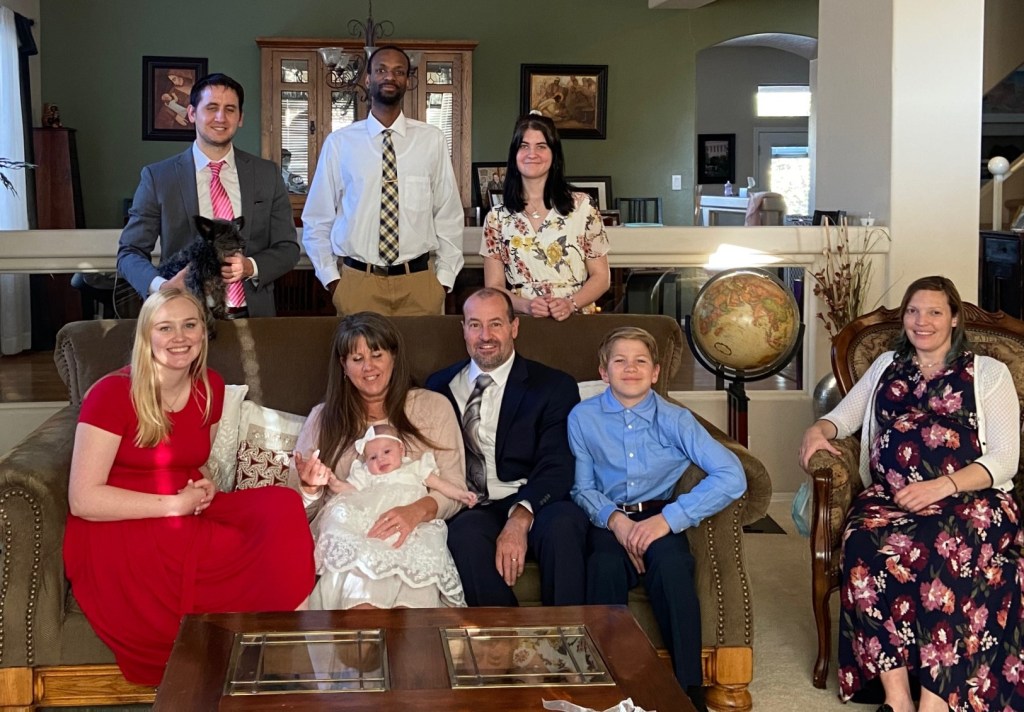
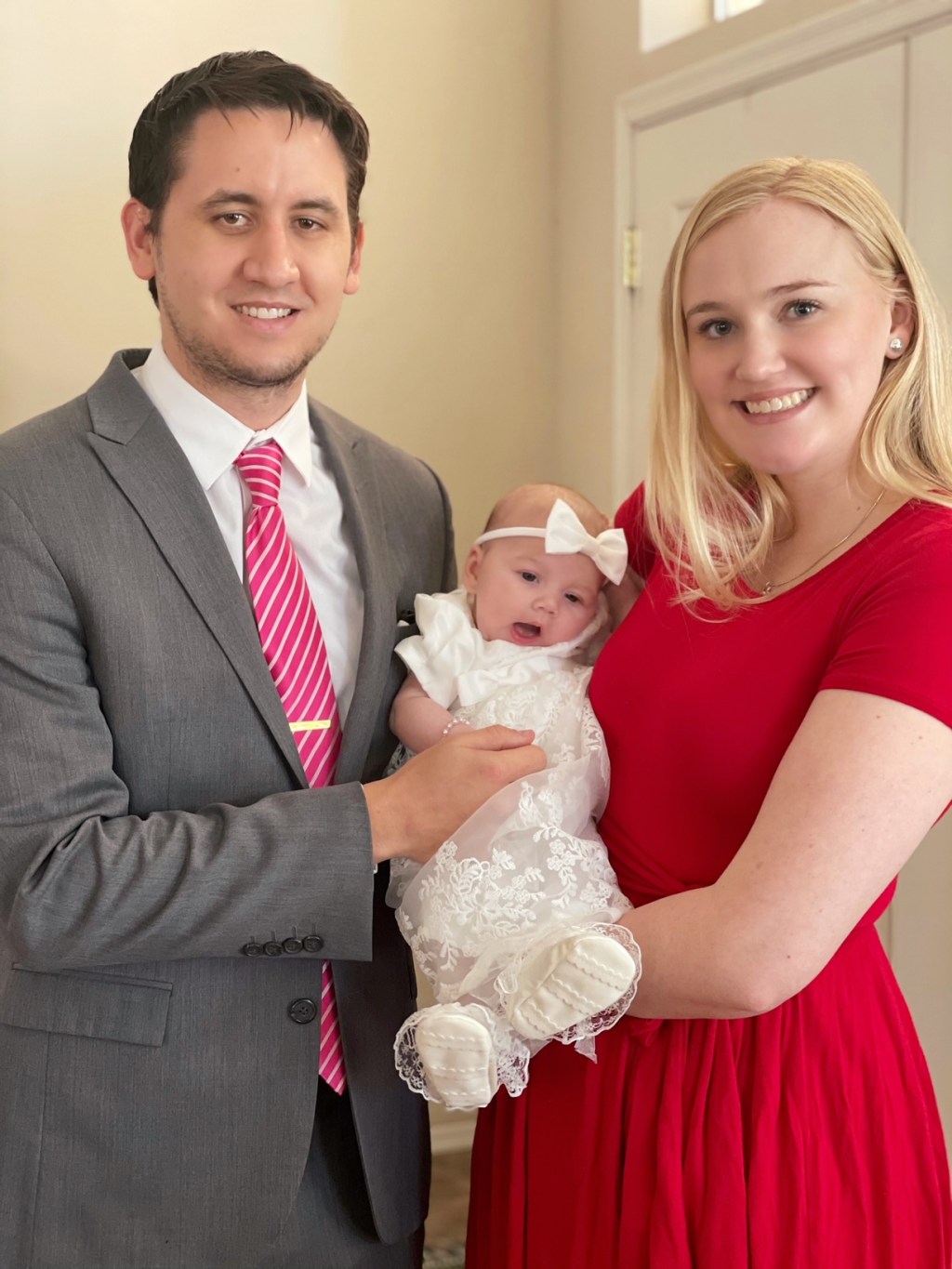
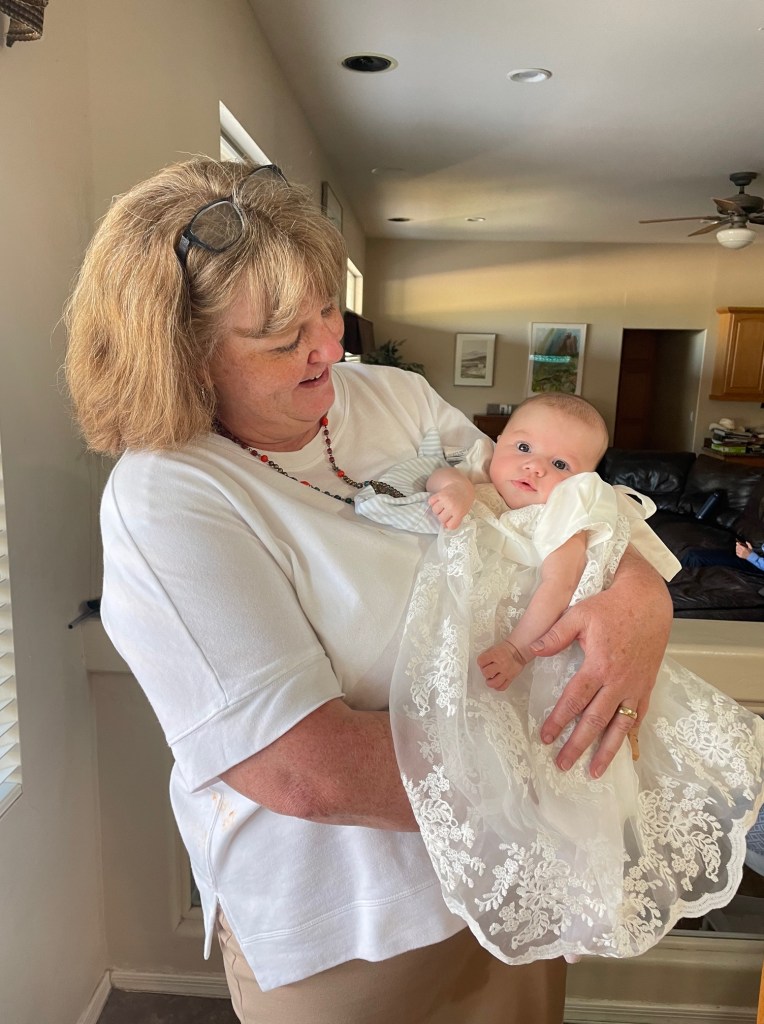
    I recently had the special opportunity to bless Ivy.  Leading up to the blessing, I did some research on the history of blessing children in the Church of Jesus Christ and its significance.  For Ivy’s blessing, Beth put together an event and a description of what a baby blessing is.  Here is that description:

    What is a baby blessing?

    In summary, the naming and blessing of children is a commandment of God. It is proper for a worthy father to name and bless his children. Blessing of children was done during the time of Christ, and it occurred in the early years of the restored Church. The ordinance has become a regular practice followed by Church members ever since.

    Who has the authority to bless a baby?

    A worthy priesthood holder under the direction of the local bishop. It is usually the father or a close family member.

    What is the priesthood?

    The word priesthood has two meanings. First, priesthood is the power and authority of God. It has always existed and will continue to exist without end. Through the priesthood, God created and governs the heavens and the earth. Through this power, He exalts His obedient children, bringing to pass “the immortality and eternal life of man.”

    Second, in mortality, priesthood is the power and authority that God gives to man to act in all things necessary for the salvation of God’s children. The blessings of the priesthood are available to all who receive the gospel.

    What is the format of a baby blessing?

    When blessing a baby, priesthood holders gather in a circle and place their hands under the baby. When blessing an older child, brethren place their hands lightly on the child’s head. The person who gives the blessing:

    1. Addresses Heavenly Father.

    2. States that the blessing is performed by the authority of the Melchizedek Priesthood.

    3. Gives the child a name.

    4. Gives words of blessing as the Spirit directs.

    5. Closes in the name of Jesus Christ.
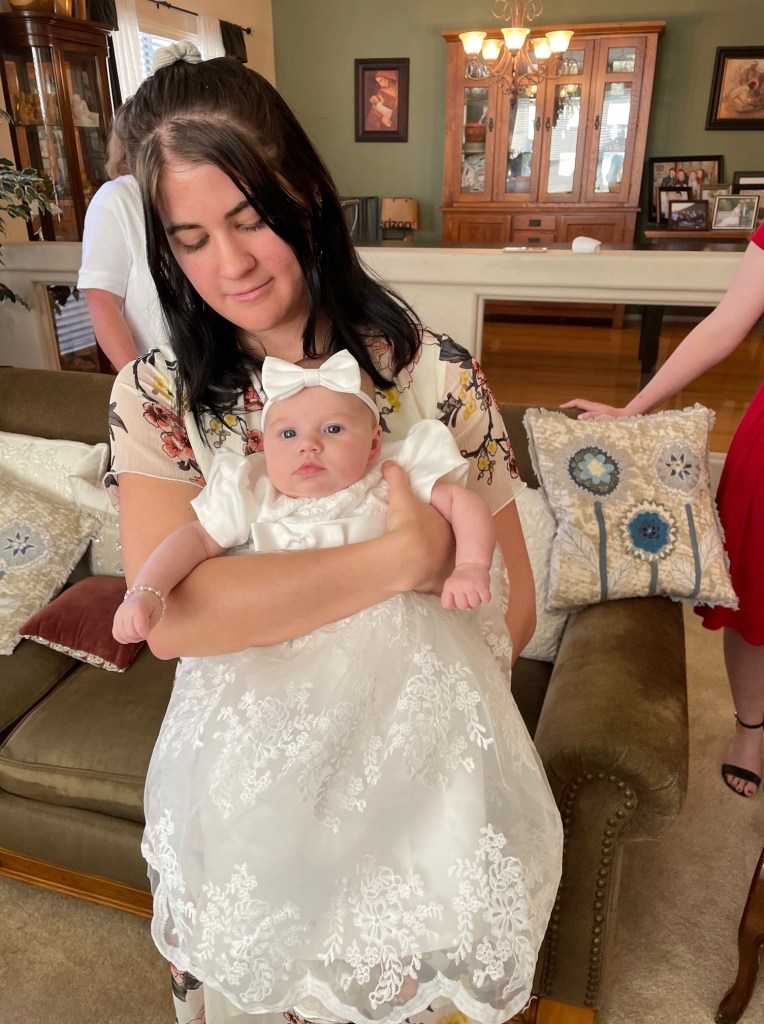
    Ivy and Aunt Cambria

    Reading up on the baby blessing beforehand taught me some interesting things about this sacred practice that I would like to share.

    The below points were taken from this link:

    https://www.churchofjesuschrist.org/study/ensign/1979/12/i-have-a-question/in-blessing-an-infant-should-both-the-naming-and-blessing-be-addressed-to-our-heavenly-father?lang=eng

    1. Unique to giving a blessing to an older child or adult, the naming and blessing of a child is directed to Heavenly Father like prayers are. 
      • This could be because the baby is too young to understand the words directed to him or her. 
    2. It appears that Melchizedek Priesthood holders are authorized to more than ask for a blessing but are able to pronounce a blessing upon the child directly, as the spirit directs.
      • See D&C 20:70
      • Sometimes inspiration (or confidence) to pronounce/give a blessing does not come.  In this case it is of course acceptable to ask Heavenly Father for these blessings.  I believe this is how I felt in giving Ivy her blessing.  It was enough to ask Heavenly Father to bless her with my requests.
    3. It is a commandment to name and bless infants.
      • See again D&C 20:70
      • It is important to remember the naming and blessing of children is not a saving ordinance.  It is still an important and sacred moment seen in heaven.
    4. “It is an awesome responsibility to be a priesthood agent of the Lord, to act in his behalf, and to approximate in one’s words and doings what the Lord would do if he were here.  A father, especially, who is to bless his child, has the delight and responsibility to prepare himself beforehand by pondering and by fasting and prayer, that he may be sensitive to the suggestions of the Spirit when giving the blessing.”
      • “How blessed we are to be able to present our little ones before the Lord, our families and the Church, and then consecrate them to the Lord.  How blessed we are to be able to name them, plead over, pray for, and, yes, to bless them directly and personally in harmony with our finest desires for them, by the authorization and wisdom of heaven.”

    The below points were taken from this link:

    https://www.churchofjesuschrist.org/study/ensign/1988/12/i-have-a-question/why-is-the-naming-and-blessing-of-a-child-important?lang=eng

    1. An interesting account from Joseph Smith on March 13, 1843 says, “Twenty-seven children were blessed, nineteen of whom I blessed myself, with great fervency.  Virtue went out of me, and my strength left me…”
      • “[The next day] Elder Jedediah M. Grant enquired of me the cause of my turning pale and losing strength last night while blessing children.  I told him that I saw that Lucifer would exert his influence to destroy the children that I was blessing, and I strove with all the faith and spirit that I had to seal upon them a blessing that would secure their lives upon the earth; and so much virtue went out of me into the children, that I became weak, from which I have not yet recovered; and I referred to the case of the woman touching the hem of the garment of Jesus. (Luke 8).” (History of the Church, 5:303.)
      • Elder John Taylor said the Savior’s example of blessing children “should be studiously complied with without hesitancy or objection” (by priesthood holders).
      • We see that Joseph Smith followed the example of the Savior who blessed children in both Israel and the American continent.  (Mark 10:14-16 and 3 Nephi 17).  What an amazing and marvelous thought:  our virtue can be passed to our children.  Our blessings are a force Satan must reckon with.  It makes me want to bless my daughter daily.  It also adds insight to a scripture that has always been a bit puzzling in Luke 8:46.  Virtue can literally leave us to help others.
    2. The new name:
      • A new name is often involved when a covenant relationship is formed.
      • When Adam and Eve were given dominion over the earth, Adam named all the animals (Genesis 2:19-20).
      • God blessed them and named Adam after giving him a body (Genesis 5:2).
      • When we get baptized we follow a similar pattern, taking upon us a new name, the name of Christ.
      • Temple covenants also involve the giving and receiving of names.
    3. The responsibility of blessing a child is bestowed, ideally, on he who helped create that child’s body, and who Heavenly Father entrusted His child with in mortality.
      • Joseph F. Smith – “The patriarchal order is of divine origin and will continue throughout time and eternity.  There is, then, a particular reason why men, women, and children should understand this order and authority in the households of the people of God and seek to make it what God intended it to be, a qualification and preparation for the highest exaltation of his children.  In the home, the presiding authority is always vested in the father, and in all home affairs and family matters there is no other authority paramount…This authority carries with it a responsibility, and a grave one, as well as its rights and privileges, and men cannot be too exemplary in their lives, nor fit themselves too carefully to live in harmony with this important and God-ordained rule of conduct in the family organization.”

    It is my experience that giving blessings is often the closest I ever feel to Heavenly Father.  I can feel him speaking through me and it is always a powerful, emotional, and memorable experience.  The opportunity to bless my daughter will be one of the greatest moments of my life.  I have immense gratitude to my Heavenly Father for entrusting Ivy into my care, allowing me to name her, and trusting me to watch over and protect her in this life and through eternity.
  • Listen, Learn, Love

    Listen, Learn, Love

    I recently listened to an episode from a podcast called Listen, Learn Love.  This podcast has opened up my ways of thinking on a few topics.  The episode I listened to recently I basically want to summarize (steal) because the points made are so simple, so well-said, and so true. 

    Here is a link to the website for the podcast if you want to learn more: https://www.listenlearnandlove.org/

    The episode I recently listened to that I’m writing thoughts on here is episode 2 and can be found if you search for podcast “Listen, Learn, and Love.”

    The podcast is hosted by Richard Ostler.  He is a former Young Single Adult Ward Bishop.  He has now done 334 episodes of his podcast which “was created out of the desire to better understand our LGBTQ+ brothers and sisters.  We believe in God and in His decree to love one another.” – from the mission statement on the website. 

    Episode 2 does not focus on the LGBTQ+ topic which I feel is an extremely important topic in the church.  Still, this episode is also important and I learned a lot from it.

    The topic was faith-crisis.  Whether minor or major, any faith crisis is difficult to go through.  When I was returning to church my uncle said something that has stuck with me.  He said he wouldn’t wish the losing of faith on his worst enemy.  You can lose cars, homes, family, money, everything in this world, but losing your faith is the hardest thing that a person can possibly go through.

    As I continue to write I will be presenting many ideas that came directly from Brother Ostler.  Please listen to the episode.  For ease of writing, I won’t reference Brother Ostler in everything I’ll continue to say. Just know most of these thoughts came directly from him, and I hope to re-state them without taking too much away from them.

    In my writing, I often refer to “The Church.” When I say this I am referring to the Church of Jesus Christ of Latter-day Saints.  Something I’d never considered is how important it is to clarify what we mean when we say, “The Church.” The Latter-day Saint Church could mean different things to different people.

    A couple categories for “The Church” are

    1. The Gospel of Jesus Christ.
      • This was described beautifully by Brother Ostler as a pristine, clear-watered pool.  No murkiness.  The Gospel of Jesus Christ is perfect in every way. This hasn’t been completely revealed yet.
    2. The restored Church of Jesus Christ.
      • It has the restored priesthood and priesthood keys. Ideally, this would be perfect.  I think we sometimes confuse this category with the next category I’ll mention.  The restored Church of Jesus Christ should be perfect.  The problem is, as we know, Christ must use fallible men and women to run His church.
    3. The institutional church.
      • This is where we get into a flawed organization. The institutional church has many people, programs, and policies that are meant to implement the Gospel of Jesus Christ.  The institutional church is run by men and women and therefore has flaws.  Christ guides the institutional church, but people make mistakes. Brother Ostler points out in the podcast that as a YSA Bishop he was a part of the institutional church and he knew he made mistakes as a Bishop, a leader in the church.

    Much of the hurt that comes into the souls of God’s children is caused by the institutional church.  It is critical to not confuse “The Church” the institution with the pure and perfect Gospel of Jesus Christ.

    A faith crisis is a serious event that can happen to anybody. You can’t always read and pray a faith crisis away.  We are here to develop faith and while here our faith will be tested.  Sometimes to the very brink.  It’s important to get our roots in the correct place.  Is your faith in a bishop?  It shouldn’t be, it should be in Jesus Christ.  The best bishop in the world can let you down.  Jesus Christ can not.

    The fourth article of faith: “We believe that the first principles and ordinances of the gospel are: FIRST, faith in the Lord Jesus Christ. 

    The Articles of Faith can be read here.  I invite everyone to read and focus on the first four articles of faith in the Restored Church of Jesus Christ.  You’ll notice not only is Jesus Christ’s name in the name of the Church, but that He is referenced three times in the first four articles. 

    Our foundation must be on Christ.

    Brother Ostler talked about the Policy Statement of 2015 and how it created a “mini faith crisis” for him.  These were changes made by the institutional church and have since been reversed.  He talked about how difficult that was for him, personally.  He is not the first person I’ve heard that was impacted in a sad, difficult way by those changes.  He emphasized that the brethren (leaders of the church) were doing their best.  Brother Ostler referred to dominoes, and how the policy statements started to make dominoes fall in his faith.  What saved Brother Ostler’s faith was that all his dominoes didn’t fall.  As he stated so perfectly, some of his dominoes had roots to the center of the earth and couldn’t be shaken.  He referenced Jesus Christ, priesthood blessings, and temples as the foundation of his faith.

    The 2015 Policy Statement is a good example of what separates the institutional church from the Gospel of Jesus Christ. The institutional church can and does make mistakes. Jesus Christ does not reverse. Jesus Christ does not change.

    We must change the way we discuss faith crises.  There are too many people who leave the church because they don’t feel heard.  The idea that you can read or pray away a faith crisis is inaccurate and often leads individuals to feel like the “Church” is avoiding their concerns.  We have to listen, as the Savior did, to those with concerns.  Ask questions.  Having a faith crisis does not mean someone is sinning.  It can mean that, but it doesn’t always.  Brother Ostler is a perfect example.  His self-described “mini faith crisis” came while he was a YSA bishop spending dozens of hours each week in service to others.  He was reading, praying, and serving as much as anyone could at that time.  Imagine telling a bishop he needs to pray more, or read more, or do more to fix your problem.  One could rightfully be turned off by this suggestion.

    We must stop considering a faith crisis as a dirty topic that we must avoid.  Thousands are having one at this moment.  Those with unshaken faith must support and lift those who have a hard time. We must address questions head on and strengthen our faith together. We must strengthen each other. We are family. The Gospel of Jesus Christ is meant for everyone. 

    Now I’d like to share some of my personal story.  I returned to church in 2016.  I narrowly missed being an active member of the church when the policy statements came out.  I know this was a hard time for the church.  I know many people left.  I know many people, like Brother Ostler, were shaken by the announcement. 

    I’ve often thought about my faith.  I feel fortunate and blessed to have never experienced a personal faith crisis.  Even in my time away from the church, I never doubted that Jesus Christ died for me.  I never doubted Joseph Smith was a prophet.  I never doubted the restored Church of Jesus Christ.  I never doubted the Church of Jesus Christ of Latter-day Saints.  While I was living completely opposite to some of the teachings the church, I still knew it was true.  I know I caused many head scratches from those who witnessed my verbal devotion while clearly ignoring all the precepts of the church.

    I said my faith has always been a blessing to me.  I believe it has.  When I was living opposite to the principles of the gospel it felt like a curse.  I’m sure I will need to answer for that one day.  If I knew it so much to be true, I believe I’ll be more accountable for my behavior.  Maybe that’s what gives me so much faith in Jesus Christ.  I know how important His Atonement is to me personally.  I have too many spots on my garments.  Without Him I am a damned soul. 

    Maybe that’s difficult for others who have never grievously sinned.  It’s easy to appreciate a lifeboat when you’re sinking in the ocean.  What if you’re safe on shore, do you still have the same appreciation for the lifeboat?  I’m not implying those who have lived just, kind, good lives start to finish are in anyway unappreciative of the sacrifice Jesus Christ made for them.  I’m truly amazed by those I see that have been faithful and true for all of their mortal journey.  I can only speak for myself.  I was not true for all of my journey and it makes me worship and love my Savior so intensely. 

    I wonder what would have happened if I was in church in 2015.  Would I have struggled?  Would I have left?

    I don’t know the answer to many questions.

    A book I read recently repeated the idea that we (humanity) know so much; space travel, geography, math, science.  Ask someone to give some thoughts about nature or history and everyone can provide some insight.  Ask someone to provide some thoughts about who they are, and they will struggle.  We often know and understand ourselves least of all the things in the world. I take comfort in knowing there are two individuals who know me infinitely better than I currently know myself.

    I want to give advice to anyone currently in a faith crisis.  Fight.  Don’t lose your faith.  Please.  It’s the most valuable thing on this earth.  You can lose your family, money, cars, your home, and you can lose your faith.  I hope we all fight for our faith.  Focus your faith on what is most important.  All your questions – ask them.  Doubt.  Wonder.  Have concern.  Voice your concerns.  But don’t forget where faith should lie.  Jesus Christ is the only name whereby men can be saved (Acts 4:12).

    Sometimes people will hurt, disappoint, or let you down. Sometimes those people may be leaders you trust. We all hurt and disappoint people we love. We must hope that we will receive mercy for the hurt we cause, and therefore should show mercy to those who hurt us. The great giver of all mercy is Jesus Christ. He loves each of us. He wants each of us to do whatever we can to come closer to Him. Stay close to Him and He will never let you down.

    Find those experiences in your memory that remind you that Jesus Christ guides His church.  Read the Book of Mormon and ask yourself if it could be false.  Then ask yourself, if it is false, how can it so perfectly testify of Jesus Christ?

    Find your foundation in sure things.  The pure faith in Christ.  Then fight for that faith.  We hope the Church of Jesus Christ of Latter-day Saints can be a faith building organization for all.  We hope that the covenants we make can strengthen our faith and the faith of those around us.  But at all costs, do not mix the pure, perfect, pristine waters of the Gospel of Jesus Christ with the sometimes-murky institution run by us here on earth.