Tag: priesthood

  • Simplified Husbandship

    Simplified Husbandship

    These are the highlights I typed up for myself from a book called Simplified Husbandship | Simplified Fathership by Richard M. Eyre. I typed this up mostly for myself to refer back to.

    This is only on the simplified husbandship portion of the book. These are the quotes, summaries, and most important points I found from the book.

    “To become a better husband –

    change yourself

    not your wife.”

    “The home should be the center of growth, happiness, of excitement. If your home isn’t a happier place now than it was a year ago, you’re not progressing.”

    “A marriage of oneness should have a Venn diagram that is as circular as possible in the middle. When the marriage doesn’t have enough oneness, the middle is like a football.”

    “This type of marriage, like a football, is erratic and hard to predict. There is no telling where it will bounce.”

    “The best way for a husband to pursue this kind of oneness lies not in efforts to change his wife or even in efforts to change the marriage relationship. His best chance lies in changing himself.”

    Partnership-Plan-Pray

    Communication – “Oneness is an impossibility between two who share only part of what they feel.” This one really hits home for me. I’m not a great communicator.

    Inspiration – “The third partner should be the Lord.”

    One strategy for partnership –

    Wife handles the “inside partnership” of inside-the-home things such as home, children, personal kingdom, etc.

    Husband handles the “outside partnership” of outside-the-home things such as money, providing necessities, involvement in outside causes like church and civic, etc.

    In the above example, the wife would be general manager of inside partnership and husband participating partner and vice versa.

    Each night before prayer each gives a brief report on their stewardship, and receives comments, questions, or insight from the participating partner. Both participate, but one is in charge of each.

    During scheduling, attempt is made to find an hour where roles are reversed. Husband spends time with the children on the inside and wife shifts to outside activities, church, civic, or personal. (This seems extremely structured, to the point that it might border on unrealistic, practically speaking. But I still like the premise).

    Partnership – “day planning” – evening prayer.

    Each has a role and the Lord is the supervising partner.

    Partnership meeting is simple and shouldn’t take more than 10 minutes. The results:

    1. Each learns more about the arena where he or she did not spend the day (and becomes more appreciative of what the other is doing).
    2. Each gives input and ideas for the other’s benefit.
    3. Each thinks about what he or she will do the next day in both the general and the limited role.
    4. The prayer becomes far more specific and meaningful (because it is about things just discussed).
    5. Both sleep better when the next day is clear and challenging rather than hazy and uncertain.

    Things I personally could talk about with the outside responsibilities:

    1. Schedule for work / coaching / gym / church calling / projects
      • Go over my daily items
    2. Investments and status
    3. Finances – budget (handled by Beth, could be a part of her report).

    Once a month dinner date, reviewing the month. Review the past month and set goals for the month ahead.

    Once a year “honey-moon” vacation to review the last year and the year ahead.

    Principles:

    1. Total communication and openness
    2. Complementary roles (separate but shared responsibility)
    3. Shared goals and plans
    4. Adding the Lord to your partnership through earnest, regular prayer together

    “If exaltation is the goal, marriage partnerships must fold together in purpose and communication until they become one. We often imagine that temple marriages differ from civil marriages in quantity (they last longer), but, in fact, their quantity will be great only if their quality is great, only if oneness is obtained.”

    “Agreeing to disagree on some things is fine among friends and business partners but not between marriage partners striving for oneness.”

    “Partners are separated when they compete in any context other than fun.”

    “Emerson said, “Marriages do not fail, people fail. All marriages do is show those failures up.””

    Partnership-Plan-Pray Summary:

    • My wife is my partner in all I do.
    • We share everything, including our deepest feelings.
    • We plan our time together and share objectives for our lives inside and outside our home.
    • We pray together regularly, and preceding the prayer is a discussion of our partnership.

    Protect-Pamper-‘Preciate

    “A woman’s ego is no weaker than a man’s, but hers works in a slightly different way. Hers usually is best fed when she is cared for, complimented, appreciated, protected – even pampered a bit – not with the patronizing implication that she is weaker, less able, but with the implication that she is more special, important, and genuinely valued. A wife who receives sincere compliments, who is appreciated, who feels needed and cherished and protected, seems to gain a soft strength, a kind of clear-headed fulfillment that raises her toward her full potential in many areas.”

    “It’s the old notion of “out-giving” that can make marriages even more beautiful. Have you ever watched what happens to a basketball team when one player is so unselfish that he is always looking for a teammate to get the ball to? Other players respond in kind. The ball moves faster; everyone gets better shots. The teamwork of marriage can be similar.”

    Me – This is similar to the advice I received early in my marriage. When I confided in someone about my frustrations with doing household chores, that someone asked me point blank, “Why are you doing chores?” They asked if it was to one-up or get an edge on my wife. They asked how the Savior served. They pointed out that this life is meant for us to become like the Savior. The Savior never asked for anything in return when he served others. If I’m cleaning the house or doing something so that I’m owed something or appreciated by my wife, what’s the point? It’s not service, it’s a way to get an advantage. They said to love and serve my wife for that simple purpose. Because I love her and I want her to be happy, and for no other reason. My life and marriage are better when I realize and remember this.

    “It is not the addition of responsibility and children that destroy romance. It is the subtraction of courtship, of chivalry, of living to make the other person happy.”

    Protect-Pamper-‘Preciate Summary:

    • I love my wife deeply and understand her need to feel cherished and loved. 
    • I feel tenderness toward her and want to find meaningful ways to compliment her, to be chivalrous and protective of her. 
    • I watch her closely and notice the time she needs the “lift” of a tender kiss, a word of sincere appreciation, a helping hand, a date.” 

    Patriarch-Priesthood

    A wife is asked, “What would you do if your husband were to ask you to do something you didn’t agree with, not something unrighteous, but something you didn’t want to do?” 

    She responds, “I would tell him I didn’t want to, and we would discuss it.” 

    “Yes, and most things you would work out and agree on. But let’s say in this instance you still didn’t agree. You thought it was the wrong decision, but he still wanted it. What would you do?  

    She says, “I wouldn’t do it.” 

    “That’s what I want to talk to you about. You would have two options in that situation. One, to refuse. Or two, to say, ‘Yes, you know my feelings, but if you still feel it is right, I will accept your decision.’ If you take the first option you get into a power struggle and minimize his chance to change or repent if he is wrong (his ego, if you defy him, will lock him into his wrong choice). If you take the second option, you show trust and giving, and you maximize his chance to change if his decision is wrong. (The other side of the husband’s ego is the one which feels the responsibility to protect and be fair with his wife who puts her confidence in him.)” 

    The husband is then asked, “Would you ever do that? Demand that your wife do something she did not agree with? If you do, you will sooner or later destroy your relationship. If you force decisions on her, you abuse her trust and become a tyrant. That is what you do if you demand.” 

    If either the husband or wife remembers this, it will work. If the wife respects the priesthood, the husband will use it well. If the husband counsels and communicates rather than demands, the wife will respect the husband and they will be one, with the priesthood belonging to both together. 

    I would add that this example works the other way around as well. If the wife decides on something and doesn’t respect the disagreement of the husband and the husband refuses to compromise, it becomes a problem.

    “In a baseball game the pitcher throws the ball, the catcher catches it. The roles are equal but different. They could rotate, the catcher throwing every other pitch, but they would do less well in the game. In the patriarchal order, the husband holds the priesthood and the wife shares it. The “head of the home” (the husband’s role) and the “heart of the home” (the wife’s role) are equal but different in that both draw on the great, inherent strengths of each.”

    To be a strong priesthood leader in a home:

    1. Take the lead in planning the week together each Sunday. 
    1. Use the priesthood more in the home (for blessings, etc.). 
    1. Have a short personal interview with each child on Sunday evening. 
    1. Hold a good family prayer each morning and a “partnership prayer” with your wife each night.  

    Patriarch-Priesthood Summary:

    • My wife shares the priesthood with me, and we are equal partners. But I hold that authority and I have the righteous strength that helps her feel secure and fulfilled in her support. 
    • I take the lead in planning and goal-setting, in family prayer, and in personal interviews with each of the children. 
    • I realize that there is no intervening link in the priesthood chain between myself and the Lord. As a father I am entitled to direct inspiration for my wife and children. I ask for that inspiration and receive it. 
    • use the priesthood often in my home for personal blessings and to keep the Lord’s Spirit present.  

    Priority 

    “Lack of commitment is Satan’s key tool in destroying relationships. Without commitment, little problems and disagreements can become final ones.” 

    A “planning” husband: “In addition to planning with my wife, I consciously ‘prioritize’ my wife in my personal planning. When I plan my week, I think about her first, and the fist thing I put on my calendar is our Friday night date. Then I ask her about her schedule and try to work out when she might need me. I try to plan at least one little surprise for her each week.” 

    A less planning husband, “I just watch Pattie and try to notice when she needs a little pick up. Also, and I don’t always remember this, I try to make my last thought of the day, just before I got to sleep, be of Patti. I think, ‘What can I do for Pattie tomorrow?…It’s fun to try to think of her for a moment each night just as I doze off.” 

    Priority Summary:  

    • My wife comes first in my plans, my schedule, my priorities. 
    • When I have decisions to make, my first thought is always how they will affect her. 
    • I consciously try to find “little things” to do for her on a regular basis.  

    Becoming these things 

    “Most husbands, busy with jobs, callings, and concerns of all varieties, cannot be constantly thinking of their roles as husbands. Therefore, becoming these four qualities to the point where you live them naturally is the only practical, workable way to improve your husbandship.” 

    “Self-programming” is the idea of making these qualities subconscious, so they don’t have to constantly be thought about. The point is to become these husband qualities.  

    Methods of self-programming 

    1. Running 
    1. Meditation 
    • The same kind of self-programming can be done in meditation. Simply sit comfortably in a quiet place, close your eyes and quiet your mind as best you can. Then begin – “I put my wife first,” etc. 
    1. Shaving 
    1. The last thought of the day. 
    • The quiet night, with no light or distraction, is a good time to say, “I am the patriarch of my home. I lead righteously through the priesthood. Last week I gave a priesthood blessing to little Nell. I watch for opportunities to use the priesthood.” And so on. 

    “Each method of self-programming can be strengthened by prayer. We have great power to change ourselves, but our Heavenly Father is the true changing force.” 
  • What Really Happened with Noah’s Curse of Ham/Canaan?

    What Really Happened with Noah’s Curse of Ham/Canaan?

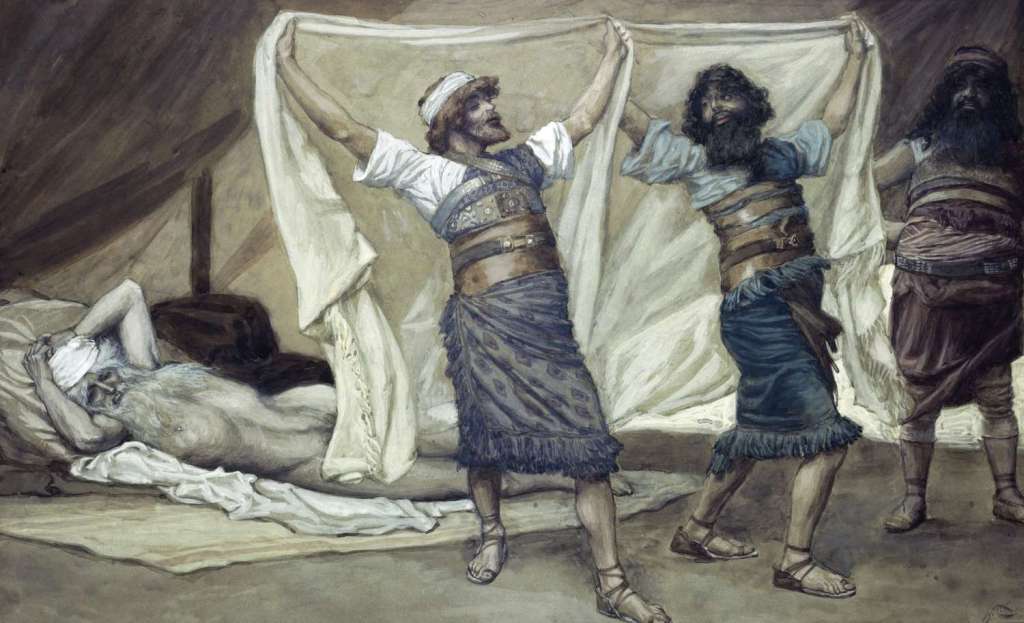
    There’s a story from the Bible that’s never sat right with me. The Bible tells of Noah and his three sons after the flood. As the story goes, Noah planted a vineyard after the flood waters receded. He then drank of the fruit of the vine, got drunk, and passed out naked.

    Ham, finding his father naked, brought his brothers Shem and Japheth in, presumably to mock and make fun of their father.

    This disrespect to Noah is undeniable. What Ham did in this story was wrong.

    But did it warrant this?

    (Genesis 9:24-27 my additions in parentheses):

    24 And Noah awoke from his wine, and knew what his younger son (Ham) had done unto him.

    25 And he said, Cursed be Canaan (Ham’s son, Noah’s grandson); a servant of servants shall he be unto his brethren.

    26 And he said, Blessed be the Lord God of Shem (Noah’s other son); and Canaan shall be his servant.

    27 God shall enlarge Japheth (Noah’s other son), and he shall dwell in the tents of Shem; and Canaan shall be his servant.

    Was Ham’s sin so egregious that his son and their descendants deserved to be “servant of servants” to his brothers?

    Ham did something wrong, but this seems extreme.

    Bible scholars will say Ham violated the edict to honor his father. True. But all his descendants cursed for the rest of time? This is the part I’ve never understood. Seems too harsh a punishment for something that borders on immature and insensitive at worst.

    Which leads to something I read from Hugh Nibley. I read this in a lecture Hugh Nibley gave and he was citing some information he read. (Reference to this story is also in the Book of Jasher).

    “A very early Christian writing tells how Noah’s descendants waged bitter war among themselves after his death, to see who should possess his kingship; finally one of the blood of Ham prevailed, and from this the Egyptians, Babylonians, and Persians derive their priesthood and kingship. “From the race of Ham,” says the text, “came one through the magical (as opposed to the holy) succession named Nimrod, who was a giant against the Lord.”

    First of all, note the vague “before the Lord” of the King James Version (Genesis 10:9) conceals the true meaning, rendered “against the Lord” by the Rabbinical and early Christian writers).”

    Hugh Nibley continues (my emphasis bolded):

    “Nimrod claimed his kingship on the ground of victory over his enemies. His priesthood, however, he claimed by virtue of possessing “the garment of Adam.” The legends of the Jews assure us that it was by virtue of owning this garment that Nimrod was able to claim power to rule over the whole earth, and that he sat in his tower while men came and worshiped him.”

    Doesn’t this give Lord of the Rings vibes? A man in a tower making the peoples of the earth come to worship him. I had to say that, anyways…

    Let’s recap quickly the genealogy of Nimrod:

    Noah begot Ham. Ham had four sons – Canaan, Cush, Mizraim, and Phut. Nimrod was a son of Cush. Remember that Canaan is the one specifically mentioned in the curse of Noah in Genesis 9.

    But let’s continue with Hugh Nibley (emphasis bolded again):

    “The Apocryphal writers, Jewish and Christian, have a good deal to say about this garment. (“the garment of Adam” mentioned above). To quote one of them: “the garments of skin which God made for Adam and his wife, when they went out of the garden, were given . . . after the death of Adam . . . to Enoch”; hence they passed to Methuselah, and then to Noah, from whom Ham stole them as the people were leaving the ark. Ham’s grandson Nimrod obtained them from his father Cush. As for the legitimate inheritance of this clothing, a very old fragment recently discovered says that Michael (AKA Adam, the original owner of the garment) “disrobed Enoch of his earthly garments, and put on him his angelic clothing,” taking him into the presence of God.

    This idea is interesting. When Enoch and his city were taken up to God (Genesis 5:24), he apparently received new “angelic” clothing. This clothing must have been Terrestrial while the garment of Adam given to him from God was Tellestial, as that was the world he was entering. This would mean the garment of Adam, which was handed down to Enoch, would have been held until…

    “This garment of Enoch was supposed to be the very garment of skins that John the Baptist wore, called by the early Christians “the garment of Elias.” An Arabic “Life of John the Baptist” says that Gabriel (AKA Noah, which makes sense, it was stolen from him originally) brought it to John from heaven as “the garment of Elijah”. “It went back,” says John Chrysostom, “to the beginning of the world, to the times before which Adam required covering. Thus it was the symbol of repentance. . . .”

    So let’s recap. The garment belonged to Adam and was handed down to Enoch until it was taken from him when he went to Heaven. It was then given to Noah who may have had it stolen by his son Ham. It was lost to time until the angel Gabriel (Noah) returned to give it to John the Baptist. The part I want to focus on, if you haven’t guessed, is Ham stealing the garment from his father Noah.

    “Incidentally, the story of the stolen garment as told by the old rabbis, including the great Eleazer, calls for an entirely different rendering of the strange story in Genesis 9 from the version in our King James Bible. They seemed to think that the erwath of Genesis 9:22 did not mean “nakedness” at all, but should be given its primary root meaning of “skin covering.” Read thus, we are to understand that Ham took the garment of his father while he was sleeping and showed it to his brethren, Shem and Japheth, who took a pattern or copy of it (salmah) or else a woven garment like it (simlah) which they put upon their own shoulders, returning the skin garment to their father. Upon awaking, Noah recognized the priesthood of two sons but cursed the son who tried to rob him of his garment.”

    Does Ham’s taking of the garment of his father, trying to strip him of it, remind you of anyone?

    “Behold, here am I, send me, I will be thy son, and I will redeem all mankind, that one soul shall not be lost, and surely I will do it; wherefore give me thine honor”.

    Moses 4:1

    -Satan

    Now read Genesis 9:22-23 considering this rabbinical story:

    22 And Ham, the father of Canaan, saw the nakedness of his father, and told his two brethren without.

    23 And Shem and Japheth took a garment, and laid it upon both their shoulders, and went backward, and covered the nakedness of their father; and their faces were backward, and they saw not their father’s nakedness.

    It seems plausible that what Ham did wasn’t simple mockery. It seems he might have stolen something from his father. Shem and Japheth, wanting to be like their father, try to replicate the garment Ham stole. But unlike Ham, they return it to Noah.

    Of course there are some unanswered questions with this theory – how did Ham get it back and hand it down to his sons if it was returned to Noah? Why was it Caanan cursed and not Cush or Ham himself? Still, there is something here that seems to add to this story of why Ham and all his descendants were cursed.

    Let’s continue to theorize..

    If this garment that Ham stole was the original garment of Adam, and signified the power, priesthood, and patriarchy of Noah, doesn’t that make more sense why he would have cursed Ham and his descendants? Noah might have sensed what Heavenly Father sensed (knew) when Satan demanded his honor. Ham might have desired power over those around him. This adds some new potential context to Noah’s great-grandson Nimrod’s story:

    “Nimrod claimed his kingship on the ground of victory over his enemies. His priesthood, however, he claimed by virtue of possessing “the garment of Adam.” The legends of the Jews assure us that it was by virtue of owning this garment that Nimrod was able to claim power to rule over the whole earth, and that he sat in his tower while men came and worshiped him.”

    The parallels to Satan continue.

    The rabbis (through Hugh Nibley) continue:

    “By an extremely common type of substitution, the simlah of Genesis 9:23 could very easily stand for an original tsimlah, a copy, imitation, pattern, or by an equally common type of transposition for Salmah, a garment or mantle, as in Micah 2:8. Even as it stands simlah means only a woven garment and can hardly refer to the original skin article. This is, apparently, the source of the widespread legend that Ham stole the garment of Noah and claimed to possess the priesthood by virtue of his illegal insignia. Ham’s descendants, Cush and Nimrod–both Africans, though Nimrod in his wandering moved to Asia–made the same claim. It is interesting that according to certain ancient scriptures which the Latter-day Saints claim have been restored by revelation in our own age, Pharaoh (who represents the Afro-Asian line of Cush-Nimrod) was blessed as to the kingship but cursed as to the priesthood, and he offered Abraham the privilege of wearing his own royal insignia in hope that Abraham would return the compliment by allowing Pharaoh to wear his priestly ones” (Abraham 1:26-27).

    I would suggest the possibility that Pharaoh wasn’t just trying to get Abraham to return the favor by letting him where his royal insignia. Maybe Pharaoh was trying to get Abraham to worship him in his counterfeit insignia of the priesthood. Abraham ultimately sought after the true priesthood, not the counterfeit.

    It continues…

    “According to a very old tradition, Pharaoh coveted the priesthood of Moses exactly as his ancestor Nimrod did that of Abraham, and it was said that the Pharaohs of Egypt dressed in a skin garment “to show that their origin was older than time itself. (Note, Abraham’s refusal to make the exchange was the real reason for his being expelled from Egypt, according to apocryphal writers.)

    Whatever the details, the priests and kings of antiquity certainly wore such garments, and the skin garment was often imitated in woven materials (see footnote below), in fact, the skin garment was itself held to be a substitute for a still older garment made of the leaves of the ficus religiosus.”

    Footnote (pertinent sentences to this discussion bolded):

    In later times the Egyptian priest wore “no real leopard-skin but a close-fitting coat of fine linen in the form of a leopard-skin,” H.R. Hall, “The Bronze Statuette of Khonserdaisu in the British Museum,” JEA 16 (1930): 1, cf. T.J.C. Baly, “Notes on the Ritual of Opening the Mouth,” 178. The Syrian Christians said that the garment given to Adam was of cotton, the “skin” of the tree, Eisler, Iesous Basileus, 2;34; this doctrine, they say, was known only to Moses, “who called cotton ‘skin’ because among trees it takes the place of skin”‘ hence the idea that John the Baptist took his clothes from trees. The Jews retained traces of the older garment in their phylacteries and in the Sisith, the four strings that every Jew once had on the edge of his garment, Ferris J. Stephens, “The Ancient Significance of Sisith,” JBL 50 (1931):59-70. Compare the Irham of the Moslems in John L. Burckhardt, Travels in Arabia, 2 vols. (London: Colburn & Bently, 1831), 1:104-05; 163-64.

    I provided this extra information from the mentioned footnote because I found it interesting and it added more context. But back to the point –

    It seems there is more to this story in Genesis 9.

    What actually happened with Ham and Noah?

    Was Noah’s nakedness symbolic?

    Was there a cloak or some sort of clothing that held significance that was stolen?

    We currently don’t know the answers to these questions but I find the questions fascinating.

    For now I hope anyone reading enjoyed where these thoughts took them, as I enjoyed the exercise. Possibly there’s more to know and understand about this story of Noah and his sons. There might be a great significance to the priesthood power that the ancients so desired, a significance we’re only scratching the surface of.

    One day we’ll know the answers to these questions.

  • A Kingdom Divided

    A Kingdom Divided

    The first step for Zion is to stop distinguishing ourselves from one another. We are first Children of God.

    President Russell M. Nelson has been clear about the three primary identities we should all focus on for ourselves. Those three identities are:

    First – children of God.

    The first identity is for every person on the face of the earth. Whether they realize it or not, every person is a child or God. The second and third identities are for members of the Church of Jesus Christ of Latter-day Saints. But this does not exclude anyone. The second and third identities are an invitation to the world.

    The second identity is child of the covenant.

    The third identity is disciple of Jesus Christ.

    President Nelson has stressed that anything we give precedence over these three identities distracts from our true potential. As children of God, children of the covenant, and disciples of Jesus Christ, we have a divine inheritance and royal home to return to. Any other worldly designation distracts from our ultimate goal of becoming everything we can be.

    Some of the other designations the world assigns include sexuality, status, race, and political affiliation. There are countless self-defined categories we assign ourselves. None of these things matter, they won’t matter at all when the veil is lifted, and we are reminded of what we always were.

    Zion are the pure in heart (D&C 97:21), Zion are one.

    All who believe in Christ are the children of Christ. But how is Zion established? How can there be unity in Christ given the divisive nature of the world and Christianity?

    A search for all the sects of Christianity brings up THOUSANDS of results. Thousands. How can one know the truth when there are so many claiming to be true? How can Christianity be united under Christ when there are thousands battling for attention, power, and patrons.

    How can God be a God of such confusion and disorder?

    In Luke 11:17 Jesus Christ says:

    Every kingdom divided against itself is brought to desolation; and a house divided against a house falleth.

    How would Jesus Christ feel about the state of the religion that espouses His name?

    I’ve heard it said that Christianity is united, despite its differences, in its faith in Christ. I think this is an admirable way to look at it. In fact, it’s how I try to look at it. It’s my opinion and belief that our faith in Jesus Christ is important and unites us. That said, what really unites us? What enduring principle is it that unites all Christians?

    Is it our belief in what Christ taught? There are a million different interpretations of what Christ taught.  

    Is it our belief in who Christ was? That couldn’t be a more divisive topic. Was He who He claimed to be? Was He the Son of God or wasn’t he?

    Is it our belief in the Atonement of Jesus Christ and what it accomplished? Again, there are different interpretations of Christ’s Atonement, why it was needed, and what it accomplished.

    Surely we can agree on Christ’s resurrection? Was Christ resurrected with His body or wasn’t He? Was there significance to Him eating fish with His disciples after His resurrection? Again, there is contention on this topic.

    What can Christianity be united on? It seems nothing.

    I believe the Church of Jesus Christ of Latter-day Saints provides the only solution to this problem. What Christianity can be united on is a connection to Jesus Christ. A real connection. Not a belief in Him, what He taught, or who He was. The connection must be real and tangible. The connection must be a welding link. The connection must have veracity on earth and in heaven (Matthew 18:18). That connection must be through a covenant.

    A covenant is a two-way promise.

    A covenant binds us to Him.

    When we get baptized, we promise to take upon us the name of Christ, and He becomes our shepherd. From that point on we are inseparably linked with Him.

    Latter-day Saints are a covenant people. The saints of God have always been covenant keepers.

    In the podcast Church History Matters, the hosts were speaking about the early history of temples in the Church of Jesus Christ. Something they said stood out to me as I’ve been working on writing this post.

    “…through the ordinances given to both men and women, living and dead, the human family is being knit or woven or let’s just use the word sealed together into one eternal holy order which we can call the family of God, we can call it the Kingdom of God, we can call it the Church of the Firstborn, we can call it the Celestial Kingdom, or simply the priesthood.”

    In the most recent General Conference of the Church of Jesus Christ of Latter-day Saints, Elder McCune of the Seventy said:

    Joy and eternal perspective come through being bound to the Savior by making and keeping covenants through Christlike discipleship.

    Adam, Abraham, Moses, and Peter; they made covenants with the great Jehovah and became His, and received of His power. Over time, they became more like Him. Over time they became one with Him. Enoch created Zion and was so connected to the Lord that he and his city were taken up to Him. This connection is made through covenants.

    What can unite Christianity? It is a covenant with Jesus Christ.

    Christ’s Church has temples where these covenants can be made.

    We must strive to be one with our brothers and sisters. We can only truly be one as we are united under one banner. The disjointed nature of Christianity is unacceptable. Covenants are needed. It is the banner of covenants with Jesus Christ that will unite Christianity, and nothing else. He died for us. In return, He asked us to believe in Him, follow Him, repent, and be baptized. That was His request of us. There is only one baptism that is acceptable to God the Father and that is the baptism with His authority in the name of His Son. No other baptism is acceptable to Him because it is a baptism not by His authority.

    I wish the Christian world could see that it is covenants that unite us to God. It is covenants that can re-unite us.

    I know as the Millenium approaches that one day all knees will bow and every tongue confess. At some future date the children of God will know and understand the covenants needed to unite the heavenly and eternal family.

    It is here for us now. But the world does not listen. Jesus was sent to this world, but He was not of it. This world struggles with the eternal nature of what God has in store for us. One day the world will have to understand what was always offered to us. What is offered to us is unity under Christ. Eternal families, eternal potential, eternal happiness, eternal inheritance. That is what will come when the world covenants to join with Jesus Christ and be Zion.

  • Why can’t Anyone go in an LDS Temple?

    Why can’t Anyone go in an LDS Temple?

    In the Church of Jesus Christ of Latter-day Saints, our temples are sacred. Many people know this by the fact that they aren’t allowed in. This can, understandably, cause some negative emotions. Nobody likes to be excluded from anything.

    I heard an anecdote that really stuck with me.

    A man was telling a story about when he was a missionary and held Q&A sessions with local churches in the Bible Belt south. One of these sessions, a nice little elderly woman asked a not so nice question, “Why is your church exclusionary and doesn’t let people into your temples?”

    The man explained that he immediately realized this woman wasn’t able to attend the sealing of someone she cared about, which created this understandable animosity. He asked the old woman and learned she wasn’t able to attend the temple sealing of a beloved granddaughter.

    A somewhat standard response to this question is that it is about worthiness, that you must be worthy to enter the temple. Many Biblical examples can be used to illustrate this point.

    As the man was about to respond this way, he felt an impression to not give this standard response. He realized talking about worthiness wouldn’t be right with this woman. This was a Bible loving, Christ loving, Bible belt evangelical Christian. Telling her she wasn’t worthy wouldn’t be fair.

    Personally, I would have explained covenants in this moment. That one needs to make sacred covenants to enter certain places. This man received an altogether different impression, and this is the part that struck me.

    He asked her, “Do you believe that the Book of Mormon is the word of God.”

    She replied, “No offense, but no.”

    He asked her, “Do you believe this is Christ’s true church on the face of the earth?”

    She replied, “No offense, no, I don’t believe that.”

    He asked her, “Do you believe that Joseph Smith is a prophet?”

    She replied, “No offense, no.”

    Each time he told her he didn’t blame her for not believing it. That if it weren’t for the witness of the spirit to him, he wouldn’t believe it himself. He then asked her, “Do you believe that ancient prophets came to earth to bestow the keys of the sealing power to bind on earth what is bound in heaven as Matthew details in chapter 16?”

    She replied, “That’s in Matthew 16? I never thought of that. But no, I don’t believe that.”

    The man told her that’s OK, but he does believe all those things. Then he transitioned somewhere I did not expect, the story of Jairus’s daughter being raised from the dead (Mark 5:22-43, Luke 8:40-56).

    The man asked her if she knew the story and of course this avid Bible studier knew it.

    He directed her attention to the moment when Christ arrived at the home. The girl was dead. Those there mourning mocked Christ when He said she was just sleeping.

    Then what did Christ do?

    He “put them all out.”

    Christ had to remove all the lack of faith from the room. Christ, the Master. He let Peter, James, and John stay. He let the mother and the father stay. They had faith. He removed all those that didn’t believe.

    The man explained that when he goes to a temple, it’s not a marriage ceremony. It’s not until death do us part. Just like when Christ brought that girl back from the dead, telling death that it had no power before Him, the same is happening in temples. The priesthood power of temple sealing is telling death, “You can’t have this couple. This couple is protected. This couple is sealed. Even in death, death can not split them up. They are one. They are united.” It’s as if Christ Himself is saying, “They are mine, and you cannot have them.”

    That is what happens in Christ’s temples. Couples are sealed.

    The man then explained that when he attends a temple sealing, his faith becomes part of it. He contributes his faith to that couple. His provides his belief that they will be sealed for eternity.

    He then explained, “You admitted you don’t believe these things. Would you mingle your lack of belief in a place of faith? Would you have Christ keep the nonbelievers in the room to see the miracle?”

    Now, this isn’t the only reason people who aren’t members of the Church of Jesus Christ of Latter-day Saints can’t enter temples. Worthiness is a part of it. As I already mentioned, covenants are a part of it.

    But I loved this part I’d never thought about, faith is also part of it.

    I am grateful that God provided a plan and His Son so that I can be sealed to my family for eternity. I love my family. I never want to leave them. Now I look at Ivy, Sage, Beth. I can’t fathom a life without them. They are everything. I thank God every day for the sealing power and the gift He has allowed me to be sealed to them for time and all eternity.

  • Me and Moses

    Me and Moses

    Before you start reading, I will be comparing my WEAKNESS to Moses’s weakness. Don’t worry, I’m not comparing myself to Moses in a good way.

    I liked that title for this blog post because it gives off a good ‘ole image of Moses and I getting ready to go do some fishin’ or somethin’.

    There is never a moment I feel more like Moses than when I’m asked to speak in public, especially in church.

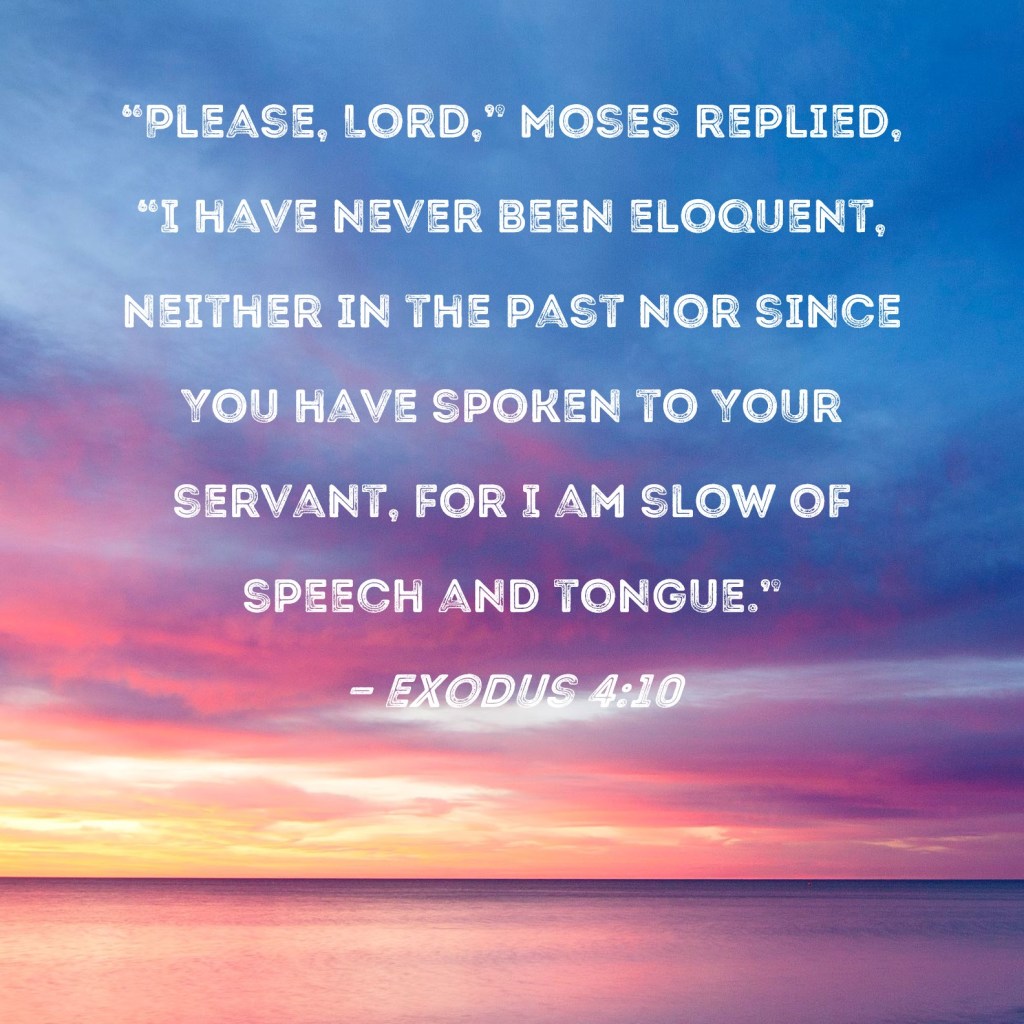
    I’m referring to Exodus 4:10:

    10 And Moses said unto the Lord, O my Lord, I am not eloquent, neither heretofore, nor since thou hast spoken unto thy servant: but I am slow of speech, and of a slow tongue.

    When I first thought about coming back to church in ~2011 there was one overwhelming obstacle in my path: what if I’m asked to speak??? I know to many this seems absurd. But I hope it goes to illustrate how big a fear this was (and still is) for me. I have memories of being a deacon (12–13-year-old) in church and dreading a Sunday School class I learned would be spent reading scripture out loud. It filled my entire body with fear. It made me lock up. It made my throat tight. It made me gulp over and over. It made me sweat. I would start to feel like I might throw up.

    Some of you think you have a fear of public speaking.

    Now do you get how big a fear this was and still is?

    I know others have it worse than me.

    When I did finally come back to church in ~2015, I had to make a decision early on. That decision was that I would not let my fear of speaking hold me back. God had brought me back and I had experiences to share and people to help. Not only that, but I had to learn to lessen the control fear had on my life.

    I decided when I was asked to speak in church, I would accept. That was until that first text came in one morning asking me to give the opening prayer in church that day. I froze. Instead of responding to the text, I called a mentor (I miss you Jessie) and talked it through. He reminded me that if I said no today, when would it stop? By the time I responded to the bishopric member who asked me to give the prayer, he had already reassigned it to someone else. I was off the hook that day, but I promised myself the next time I was asked to speak, I would accept without hesitation, before I could let the fear and excuses set in.

    Little did I know how much that next call would try my faith.

    I was in the middle of studying for a work certification. I’d already failed the test once and this next test was extremely important. I’d been studying for weeks. The test was a couple weeks away when I got the call. I was asked if I could speak in church in two weeks. The excuses flooded my mind: I have this test I’m studying for, I can’t write a talk, and besides, the added stress…! I can’t, I’ll have to accept next time.

    Then I remembered the promise I made myself. 

    “Yes, I will speak.”

    That taught me an important lesson. If we let our fears control us, they will. There are always excuses why NOT to do something that makes us uncomfortable. I spoke two weeks later in church. Beth still talks about that day, hearing me speak, as being the first day I caught her attention.

    From that day forward if I was asked to bless the sacrament, give an announcement in church, say the prayer, teach a lesson, or speak, I always answered yes without hesitation. It petrified me every time. I remember one day I gave someone the Holy Ghost which entailed laying my hands on a friend’s head and giving her a priesthood blessing in front of our entire church. That same day I also blessed the sacrament in front of the whole church, and I gave a talk in front of the whole church.

    Any one of those things in a given day would have given me nightmares.

    Before sacrament, I started to feel sick to my stomach. I thought I was going to be physically ill. I went to an empty classroom, I knelt, and I prayed for help.

    “Please, Heavenly Father, please, just help me get through this. I need you.”

    That may have been the day I solidified my knowledge that I can’t do anything without God, I’m nothing without Him.

    When I gave that blessing to the friend, bestowing the Holy Ghost upon her, I walked up with knees shaking. I thought I was going to, at a minimum fall over, and possibly faint. My throat was dry, and it hurt. I’ll never forget the feeling when I put my hands on her head, with the whole congregation, heads bowed, waiting for me to speak.

    I’ll never forget feeling like a cold bucket of water was poured over my head. From my head down to my toes I felt a tingling. Calm overcame me.

    My grandpa used to say his favorite thing in the world was to give a priesthood blessing because it was the closest he ever felt to God. He said he could feel God in those moments speaking through him.

    That’s what I experienced that day.

    I wrote this on a day that I was speaking in church. I still get kind of sick to my stomach. I still get extremely nervous. I still have to fight back the panic.

    Sometimes people tell me they can’t tell I’m nervous when I speak. I appreciate that, but sometimes I just wish everyone knew. There’s power in putting it out there.

    For others who have this fear, and I know there are many, my biggest advice is to put it out there. Don’t shy away from your fear. When I’m extra nervous, I might just say, “I’m really nervous right now.” Then I feel like I’ve removed the question from those watching and from myself worrying about it. I’ve found this to really help when public speaking.

    I’m grateful for my fear of speaking. It’s assured me, and is a constant reminder, that I can’t do anything without God.

    For those wondering, on the day I wrote this, I did end up speaking and it did go OK. I was supposed to speak for 10 minutes and spoke for 22 due to an excess of time being available. I feel that with practice anything can become more comfortable, and that’s definitely the case with me and public speaking.

    I’ve now taken to challenging myself a little more, to see just how far I can take this reliance on God. The last time I was asked to speak in church I intentionally put zero preparation into my talk. I was asked to speak last minute, a couple days beforehand, due to someone canceling, and the topic was “personal revelation,” so I thought it was a fitting time to try it.

    I got up before the church with little idea of what I was going to share. As I looked around at the congregation, I knew what I wanted to share.

    I’m grateful for the opportunity to speak in church. I’m grateful to be able to share my thoughts and experiences. This fear is a constant reminder that I need God, and I’m grateful for this weakness. Every time I’m asked to speak I’m reminded how weak and silly I am. We can look at all our weaknesses this way, as a reminder of how much we need Him. I know as we do this we come closer to God and better appreciate all He has done and continues to do for us.