Tag: prophets

  • Lighten Up by Chieko N. Okazki

    Lighten Up by Chieko N. Okazki

    These are the highlights of the book Lighten Up that I read in 2021.

    “…” usually indicates the next part of the quote was later in the paragraph.

    Quotation marks indicate the author is quoting someone else.

    A line starting without a capitalized letter indicates my highlight starts in the middle of a sentence.

    This is a book written for members of the Church of Jesus Christ of Latter-day Saints about going easier on themselves, and lightening up.

    Rejoicing in Diversity (Chapter 1-4)

    Chapter 1 Lighten Up!

    The greatest bridge of all is the culture of the gospel.

    Love is not just a nice feeling about someone. It is the pure and joyful pulse of the universe, and being in tune with it means you are in tune with the forces that bind together the stars on one hand and the atoms on the other.

    According to the measurements we usually use, for the most part Jesus did not make people’s lives physically better.

    We are the rainbow, but it is Christ who is the light.

    Chapter 2 Principles and Practices

    We should never compare ourselves spiritually to someone else.

    Sometimes we think we can’t be united unless we’re all the same – doing the same things, talking the same way, understanding a gospel idea the same way. I think the Apostle Paul has a very different opinion.

    Let us be careful not to snicker at jokes that demean and belittle others because of religious, cultural, racial, national, or gender differences.

    (on 300 families surveyed that were considered “Effective Mormon Families” by their stake presidents) 99 percent of these families always paid their tithing; 93 percent said they always accepted Church callings; nearly all of them were sealed in the temple;…When the interviewers asked if they usually had family prayer, 73 percent of them said yes; 66 percent usually held family home evening; 24 percent went to the temple regularly, and 28 percent had regular family scripture study…lots of leeway on practices. Yet all of these families were, in the opinion of their stake presidents, effective and successful. Isn’t that encouraging?

    (effective families continued) “You don’t have to come from a strong LDS family yourself to have one. Forty-nine percent of the husbands and 39 percent of the wives had not graduated from seminary. Only 21 percent of the husbands had been on missions. Twenty percent of the fathers and 18 percent of the mothers were not baptized at age eight. Between 15 and 18 percent were baptized after the age of twelve.

    “At some point, sometimes before marriage, sometimes as a couple, these people decided that their own children would be raised up in a gospel environment…. [And] they followed it up with action.”

    What’s the principle? Teach your children the gospel.

    Lighten up about yourself – and about other people.

    “Ideals are stars to steer by. They are not a stick to beat yourselves with.”

    If we focus on principles instead of practices, we free ourselves from the unwarranted and unnecessary burden of guilt that often ensues when our practices do not match those of everyone else. We also free ourselves from the even more terrible burden of judging others because their practices don’t match ours.

    “The one great stumbling block to our progress in faith is rule-keeping that does not spring from an honest heart…Jesus Christ never condemned the honest heart. His wrath was kindled against the hypocritically empty rule-keeping of the Pharisees.”

    If I know how you feel about Jesus Christ, I am much less worried with how you feel about many other things.

    Chapter 3 Walk in My Zori

    We cannot replay God for his blessings.

    Whatever your season is, enjoy it. Don’t try to concentrate on the tasks of another season.

    A mission…wisdom of our leaders…it is a full-time assignment that deserves and receives the missionary’s complete concentration. 

    Meet the season of your life wholeheartedly.

    Our marriage was like that – a team effort – and It might not have worked so well if we had spent much time thinking about who the leader was.

    I knew that I must not let this time of physical weakness become a time of spiritual weakness as well.

    (Lessons of the zori) One: Mutual obligation to each other…Two: relishing each season of life in turn without trying to rush through them all…Three: knowing that progress comes by teamwork and by each person in a marriage taking turns…Four: there is a time to bear heavy responsibilities and a time to let those responsibilities shift to someone else.

    My great task in this life is the task the Savior has given all of us: “Learn of me.”

    Chapter 4 Limitations: A Fine Line

    We waste tremendous energy when we fret about our limitations instead of getting on with those portions of our life that are under our control.

    (On consecrating what we have and what we are to the Lord’s work, a woman who said she “took my blackness with me…and that was part of what I consecrated. A woman cried saying she never had the privilege of doing this for a black woman before and she replied) “That’s one of the things I can do for you that no one else in the temple today could do.’”

    Magnifying our callings doesn’t mean multiplying our tasks.

    (The earth is ours. Why? Because we’ve deserved it? Because we’ve earned it?) No, because it is our Father’s delight to give it to us: “And it pleaseth God that he had given all these things unto [you]; for unto this end were they made to be used, with judgement…”

    When we can thank God for trials, tribulations, irritations, and afflictions, something happens to transform them into blessings.

    (Being grateful for fleas, concentration camp where guards let them be so they could read their Bible) “My mind rushed back to our first hour in this place. I remembered Betsie’s bowed head, remembered her thanks to God for creatures I cold see no use for” (The Hiding Place, pp. 2018-9.).

    I could have chosen to feel frightened and let the children and parents feel that.

    “And if [you] come unto me, I will show unto [you your] weakness. I give unto [you] weakness that [you] may be humble; and my grace is sufficient for all who humble themselves before me; for if [you] humble [yourself] before me, and have faith in me, then will I make weak things become strong” (Ether 12:27).

    Defining Ourselves (Chapters 5-9)

    Chapter 5 “For Such a Time as This”

    We, like Esther, have come to our place for such a time as this…”we wrestle not against flesh and blood, but against principalities, against powers, against the rulers of the darkness of this world, against spiritual wickedness in high places”

    (Story of Elizabeth Francis Yeates conversion) “When I had read it all,” she wrote, “I said aloud ‘praise the Lord. I have found the right way at last.’”…”I could see no other way but to repent of my sins and to be baptized. I knew my people would bitterly oppose it when they knew it, and that my former friends would treat me coldly but it was worse than I ever thought.” That one sentence, “It was worse than I ever thought,” contains an agony of heartbreak.

    She did not falter. Her last moment of hesitation had come on the very brink of her baptism when she looked down into the dark river at midnight, December 4, 1855. (The ceremony was performed in secret because of the risk of persecution.) She wrote, “[I] felt as though I could not possibly go in it, but a Voice seemed to say ‘There is no other way.’” In faith, she took that step. “It seemed after that,” she wrote, “that every thing had changed. The scales had fallen from my eyes, and the gospel plan was glorious, and I covenanted with my Heavenly Father that however dark the clouds may be, if friends turned to be foes that by His help I would serve Him.

    “And so I discovered that it is not on our forgiveness any more than on our goodness that the world’s healing hinges, but on His. When He tells us to love our enemies, He gives, along with the command, the love itself (The Hiding Place, p. 239).

    “The Holy Ghost filled me with the awareness that my mother had been handicapped in mortal life. She had an emotional handicap, the source of which remains a secret to me. But she is handicapped no longer. And neither am I” (“Forgiving My Mother,” Ensign, August 1990, p. 49).

    Joy comes from serving others and delighting in our sisterhood – in ministering to rather than administering for each other.

    You, in whatever callings you have throughout your own life, will face many choices between serving the program and serving an individual. I believe that if we truly serve individuals in the Lord’s way, we’ll have less trouble with the program. There’s a wonderful story about President McKay that illustrates the distinction. Irene Bates tells the story, which involved her husband, Bill, the first British president of Manchester Stake in England during the 1960s. (The story goes – It was normal for stake presidents and two bishops to be invited to General Conference with all traveling expenses paid. Instructions came to have all bishops and branch presidents come. A stake president named Bill was sure this was an error, but eventually gave the names of all the bishops and branch presidents in his stake. There was one branch president who was overjoyed for the chance to go to General Conference. He and his wife opened up their home in their little town to have church. The local paper featured a story about the trip. Word came down that it was a mistake. The stake president was distraught. He called the president of the British Mission who provided the prophet, David O. McKay’s, direct number. The stake president “looked at the number for a long moment, then said, ‘I’ve got to do it.’” He phoned President McKay and laid the whole situation before him. His response: “You’re quite right, President Bates. It would be very wrong to do that to that good man. We must have them all come. Please do me a favor and let me call President Tanner.” Bill came out of the office with tears streaming down his face.

    Chapter 6 “A House of Glory”

    Each of us wants to be friends with time,
    Comfortable waiting for toast to pop,

    The trick is to find out
    whether a minute is worth more

    Crammed or empty.
    And, either way, to get on with it.

    Heavenly Father doesn’t save up all his spiritual experiences just for sacrament meeting or the temple.

    And that’s because you’re a temple – a living, breathing, walking temple on two legs with a spirit that’s in motion, seeing the needs of many.

    I know that I am nothing; as to my strength I am weak; therefore I will not boast of myself, but I will boast of my God, for in his strength I can do all things.

    Chapter 7 Motherhood: Less Guilt, More Joy

    How grateful the entire house of Israel could be that Moses’ mother did not insist on being Moses’ only mother.

    Our agency is eternal.

    (speaking of her sons) it was far more important to us that they pay their tithing, attend their meetings, and administer the sacrament worthily than it was for their hair to be a certain length.

    “They have their agency.”

    (her son) instantly identifies and summarily rejects attempts to make him feel guilty about not being married. How foolish I would be to pick up the guilt my son has properly rejected and bind it on my own shoulders, to create a burden where none exists!

    (about mothers) guilt is a burden they need not pick up.

    Chapter 8 Defining Ourselves

    Now, the point I want to make is this: Ed was trying to be the best son, the best son-in-law, and the best Mormon he could be. I was trying to be the best daughter, daughter-in-law, and Mormon I could be. Those were three role definitions apiece we were trying to work out with our families and the Church – not to mention trying to be the best husband and wife to each other we could be. How we succeeded had a large impact on our self-esteem. But there came a point where we had to choose. Ed couldn’t be the best son – in terms of Japanese culture and in terms of what his mother wanted – and also be the best Mormon he could be. I couldn’t be the best daughter-in-law – in terms of what his mother wanted – and still be the best Mormon I could be. Being a good daughter-in-law was important to me, but being a good Mormon was more important. Being a good son was important to Ed, but being a good Mormon was more important. So he had to establish that definition of himself without knowing if his mother would ever come to terms with it. 

    Do you feel that newness? Do you feel that strong connection to Jesus and the love that he has for you? If you do, it makes it easy to choose being a good member of the Church first.

    Minimize the areas of conflict.

    You want your family to see that you’re a better, happier person as a result of belonging to the Church.

    Chapter 9 Three Ideas for a Brighter Life

    But it was the fear of making a mistake that paralyzed him, traumatized him, and made him dissolve in tears…. Does that happen to us sometimes?

    Old proverb – “He who makes no mistakes does not usually make anything.”

    Sin involves two characteristics: knowing the law and willfully breaking the law

    D&C 80:3 “it mattereth not, for ye cannot go amiss.”

    The Japanese word for this self-motivated goodness is kigatsuku.

    Embracing Charity (Chapters 10-13)

    Chapter 10 The Pure Spirit of Charity

    (On teaching and knowing the first day what child would be difficult) I learned that I must go immediately to that child and return to him or her often during the day – to give a hug, to ruffle up his hair, to pat her shoulder. If I would do that, by day’s end, whatever in me sensed a difficult difference about that child had dissolved, and we had created the special bond that had come spontaneously with the others.

    (Her husband while Mission President in Japan, when a woman criticized him for helping to setup a tent) “My title may be president, but that only means that I am the Lord’s servant here in Japan.”

    Chapter 11 Surrounded by Samaritans

    We all know why children behave this way. They want to feel special and important – and Satan’s counterfeit way of achieving that goal, even in little children, is to make someone else feel unimportant, unspecial, wrong.

    (dream told by Jude Inmpey of the Aba area of Nigeria) “He dreamed he was at a major social event where an organ was being played, but the sound from the organ was painful. Upon investigation, he found that the organist was playing only on the white keys. The interpretation came to him sometime later at a Church gathering: ‘The Church has for many years played the white keys on the keyboard,’ he said, ‘and now they’re playing both the white and the black, and the music is much sweeter.’”

    But I think of growing up on a plantation in Mahukona. I think of the Hawaiian women in that tiny Mormon branch who welcomed a Japanese Buddhist girl who edged shyly in the door. They made room for her beside their own children, taught her to sing the hymns, and loved her – not because she was going to be the first counselor in the Relief Society general presidency fifty years later, but because she was there and because they had loving hearts.

    Chapter 12 The Power of Charity

    What I’m suggesting is that our expectations need to communicate confidence and joy, rather than anxiety and pressure.

    (Question she and her husband asked themselves when talking about goals for their sons) “If we continue with these same goals and priorities for Ken, will they help him reach his eternal potential?”

    He (Christ) talks about his Father who, in a parched desert land, sends rain “on the just and on the unjust” and permits his sun “to rise on the evil and on the good.” Then he says, “Be ye therefore perfect, even as your Father…is perfect.”  How is our Father perfect? In not withholding the blessings of this sun and rain – which I think are symbols for his love – for anyone.

    love doesn’t make distinctions about whether someone is evil or good, deserving or not deserving. Love will spill over in blessing, simply because that’s the nature of love.

    We only imperfectly grasp his (God’s) immense patience.

    the need we have to achieve perfection. There is no waste. And there is no haste. We will all have all the time we need. We have a loving Father who makes sure we will receive the experiences we need to achieve perfection. 

    we definitely don’t need to inspect other people.

    The reason “charity never faileth” is because we aren’t in charge of the supply department.

    Chapter 13 “Neither Do I Condemn Thee…”

    Neither do I condemn thee (John 8)

    For I am convinced that neither death nor life, neither angels nor demons, neither the present nor the future, nor any powers, neither height nor depth, no anything else in all creation, will be able to separate us from the love of God that is in Christ Jesus our Lord.” (Romans 8)

    Seeking the Light of Christ (Chapters 14-Epilogue)

    Chapter 14 Opening the Door to Christ

    The gospel is not a system that distrusts or despises the world.

    Illness and adversity are not punishments for being alive; they are natural accompaniments of life.

    If one great constant in the universe is the unfailing love of the Savior, the other great constant is his unfailing respect for human agency.

    He wants to hear real prayers, honest prayers.

    But who are we trying to kid? Jesus has just seen the stove where the spaghetti boiled over, and it was pretty obvious that wasn’t the only thing that had ever boiled over on the stove. He heard what you muttered when you picked up that one sock, just as you’ve been doing for the past eight years. He caught that worry about the dentist bill that flashed across your mind when you were putting toothpaste on your brush. He doesn’t want polite platitudes.  He wants you! All of you! He wants to be the center of your total life – the worried you, the mad you, and the sad you as well as the inspired, happy, obedient, loving you. 

    (From a missionary after saying a no substance prayer and wondering why God wouldn’t help her) “This time, I didn’t say a prayer – I prayed.”

    don’t think anything is too small for the Savior’s loving attention.

    Chapter 15 Spiritual Preparation

    But a life centered in the future is not really the kind of life that makes living today worthwhile.

    the gospel brings peace. Even when it stretches us and makes us work hard, it brings peace.

    (After listing all the “shoulds” in the church, or things we’re told we should do) You should do what works for you.

    many of the good women of the world (in whom there is often such an inner sense of spirituality) will be drawn to the Church in large numbers. – Spencer W. Kimball

    Chapter 16 “Learn of Me”

    There are two things I want us to remember about light: First, light doesn’t compete with darkness. It dispels darkness. And second, Christ’s burden is light.

    For all of us – whether we are converts or were born in the Church – there comes a moment when the gospel becomes real to us in a way that it hasn’t been before. These are moments of a reality beyond realness. They make a light go on permanently, a light that never goes off unless a line goes down or a switch gets turned off somewhere. If that’s the light that we share together when we feast on the scriptures and learn of Christ, then it is a light that dispels the darkness in our lives.

    One of the inevitable effects of true spirituality is light-heartedness, a generosity in happiness. 

    Jesus is our yokemate. When we take his yoke upon us, he’s pulling on the other half of the yoke. There aren’t many loads that are too heavy to pull if Jesus is pulling beside us.

    (Paraphrase of Matthew 7:9-10) “What Relief Society president is there among you, who, if a sister ask for comfort, will give her a lecture? Or, if she ask for more spiritually nourishing lessons, will give her guilt instead?

    To have faith in his identity is only half the principle. To have faith in his ability and in his power to cleanse and to save, that is the other half.

    We must have faith in Christ – not only that he is the Savior, but that he is our Savior.

    Stephen Robinson told another story that impressed me. His seven-year-old daughter Sarah asked for a bicycle. She was the only child on the block without one. Brother Robinson didn’t have enough money to buy her a bicycle at the time, so he sidestepped the issue by telling her, “You save all your pennies, and pretty soon you’ll have enough for a bike.” A couple of weeks later, he saw her do a job for Janet, then add the two pennies she earned to some others in a little jar with a slit in the lid. She showed him the pennies in the bottom and said, “You promised me that if I saved all my pennies, pretty soon I’d have enough for a bike. And, Daddy, I’ve saved every single one of them.”

    “My heart melted,” he says. “She was doing everything in her power to follow my instructions.” She didn’t know – though he did – that she would eventually have enough pennies for a bicycle, but by then she would be in high school.  So he took her shopping and they spent all afternoon looking at bicycles:

    Finally we found it – the perfect bicycle, the one she new in the premortal existence. She got up on that bike, and she was thrilled. She then saw the price tag, reached down, and turned it over. When she saw how much it cost, her face fell and she started to cry. She said, “Oh, Dad, I’ll never have enough for a bicycle.”

    So I said, “Sarah, how much do you have?”

    She answered, “Sixty-one cents.”

    “I’ll tell you what,” I said. “You give me everything you’ve got and a hug and a kiss, and the bike is yours.” Well, she’s never been stupid. She gave me a hug and a kiss. She gave me the sixty-one cents. Then I had to drive home very slowly because she wouldn’t get off the bike. She rode home on the sidewalk, and…I drove along slowly beside her. 

    We all want something desperately – but it isn’t a bicycle. We want the celestial kingdom. We want to be with our Father in Heaven. And no matter how hard we try, we come up short. The Savior proposes, “I’ll tell you what. All right, you’re not perfect. How much do you have? What can you do? Where are you now? Give me all you’ve got, and I’ll pay the rest. Give me a hug and a kiss; that is enter into a personal relationship with me, and I will do what remains undone.”

    There is good news and bad news here. The bad news is that he still requires our best effort. We must try, we must work – we must do all that we can.  But the good news is that having done all we can, it is enough (“Believing Christ,” pp 51-52.)

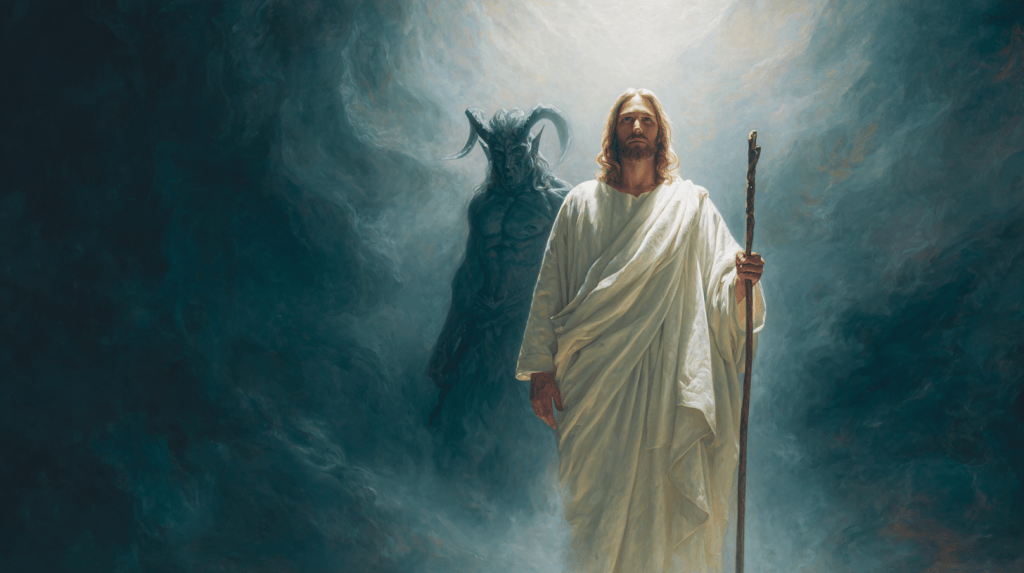
    Chapter 17 Inviting the Dragon

    Epilogue: Strength in Every Season
  • Text to a Friend

    Text to a Friend

    I want to share an exchange with one of my oldest theological friends. I invited this friend to hear me speak in church. My topic was Ephesians 1:10 which reads:

    “That in the dispensation of the fulness of times he might gather together in one all things in Christ, both which are in heaven, and which are on earth; even in him”

    I may share that talk sometime in the future.

    My friend was invited to the talk and like the consistent and reliable friend he has been now for years whether across state lines or in the state of Arizona, showed up. I went about ten different directions before I settled on where I would go with my talk. The direction I finally settled on was one in which I knew this friend would disagree. I knew because it was a topic we had regularly disagreed on.

    Afterwards, this friend gave me expected thoughts regarding his side of things and how they relate to my talk. He was pointing out where he disagreed. This is why we have such good conversations! I already knew his points as we’d had the discussion before.

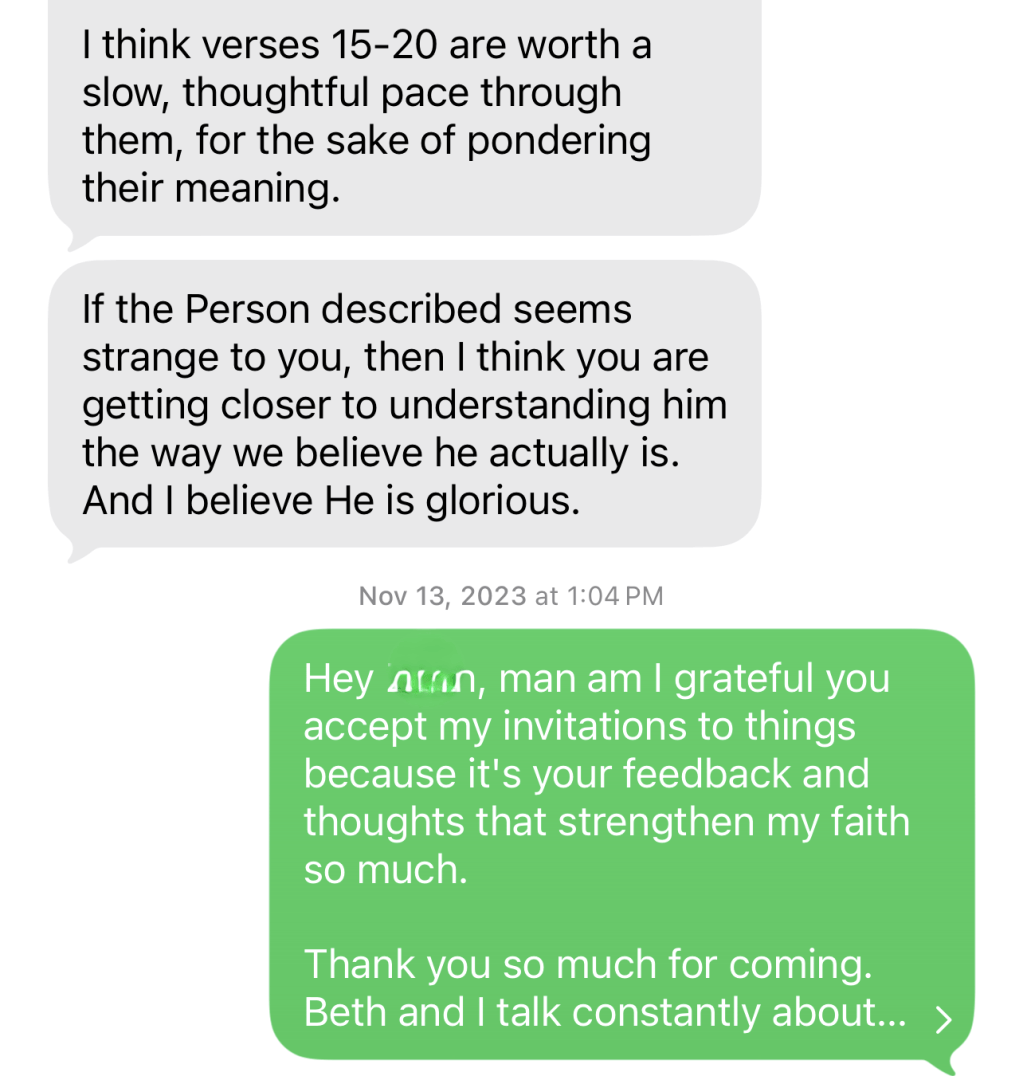
    It resulted in a text I got to send to him that I would like to share (yes, this was one text):

    “Hey, man am I grateful you accept my invitations to things because it’s your feedback and thoughts that strengthen my faith so much.

    Thank you so much for coming. Beth and I talk constantly about how we can’t trust people to keep commitments and do things they say they’ll do. You and [your wife] are one of two couples in our life (outside of family) that when you say you’re going to do something or be somewhere we know you will be. Thank you for that.

    I knew exactly what thoughts you’d have on my talk and I welcome them. I knew it would be somewhat, maybe inflammatory, to you, as I know it touched on things we’ve disagreed on from the beginning. I am glad that you appear to have not been offended by my words. Our disagreement really comes down to one thing, I think. And that’s if the Book of Mormon is true.

    I appreciated the exercise you gave me. As I did it, I came out more convinced that Jesus Christ is the literal Son of God, as the scriptures say. That’s the thing. You read the Bible and see God and Jesus Christ in one way. I see it, without a doubt in my mind, another way. Nothing will change that.

    But why do I see it another way? How can something so clear to you, and something so clear to me, be the opposite?

    As I said in my testimony, it comes down to a prophet. How can I know Jesus Christ is who He is? Because a prophet told me. How do I know he’s a prophet? He would have had to do something miraculous.

    I’ve concluded the Book of Mormon is the miracle God provided so I could know Joseph Smith was who he said he was. And if he was who he said he was, then Jesus Christ is who Joseph Smith said He is: the Son of God, on God’s right hand, as the scriptures say.

    It’s here that I finally thank you for giving me this great gift. It was years ago that you said you couldn’t accept the Book of Mormon because there was no proof the way there was with the Bible – archaeological and otherwise. I have spent the past years seeking “proof” that the Book of Mormon is what Joseph Smith claimed it to be. My list now is well over 400 items (*that was true in 2023 when this was written, now well over 800 individual items) and I am excited to share it with you one day.

    I have you to thank for that. You have built my testimony in a miraculous way and I thank our Heavenly Father, and you for that.

    Of course, “proof” is an interesting word. Despite all the records, eye witnesses, evidences, and testimonies, many still deny Jesus Christ existed, the Bible is the Word of God, etc. My “proof” may not do it for you. But when I review my list, there is not a shred of doubt in my mind that the power of God provided us the Book of Mormon. My faith has become knowledge.

    Until this life ends and we get to review everything, you will never understand how fruitful you have been to building my faith and testimony. Thank you, friend.

    Jesus Christ is the center of everything. He is my King, my Savior, my Redeemer. He is my advocate with the Father. Without Him I have nothing. Without Him I am nothing. I know we see Him differently. That doesn’t change who He is and what He’s done for us. Maybe one of us will change our minds one day. But ultimately, as long as we believe Jesus Christ is our Savior and King, one day we’ll both stand before Him and we’ll know. And it won’t matter who was right or who was wrong. Only He will matter. What a day that will be! Man, I look forward to it!”

    I share this because I think it’s important. The point of Christ is to bring us together. Though we disagree on many, many doctrinal points, this friend and I have fostered a relationship of discussion, debate, and disagreement, always founded on love and respect.

    I am truly grateful for how this person has strengthened me in Christ. That’s what this life is about. There can be good reason there is disagreement in the world – it can be for us to learn how to coexist with those we disagree with. We all have unique experiences in this life. Every moment shapes us and every experience we have changes the way we view the world. It’s through these experiences and listening to the viewpoints of others, someone who has had a vastly different life than we have had, that we can grow and become better.

    The world needs a little more of this.

  • Satan is Jesus’s Older Brother

    Satan is Jesus’s Older Brother

    Stay with me.

    Before I go down this path let me acknowledge some things:

    1. We don’t understand how time works in eternity. It’s likely everything I’m about to say is nonsense from the eternal perspective. Still, have some fun with me. I know I got your attention with that title.
      • It’s very possible that God “adopted” billions of intelligences at the same time. Meaning, It didn’t go Satan, then Jesus, then Moses, then you, then me, etc. It’s probably not that simple. Anyways…

    Now that’s out of the way, I think there is a fun thought experiment/argument to be had that despite Jesus Christ having the title of “Firstborn”, Satan might be “older” than Jesus.

    Everything in this world symbolizes Jesus Christ. Everything points to Him (Moses 6:63, 2 Nephi 11:4). 

    There are some individuals from history that are clear types and shadows of Jesus Christ.

    Examples:

    1. Joseph of Egypt
      • Savior of his people and all of Egypt
    2. Moses
      • Liberator of Israel
    3. Nephi
      • Led his people to the Promised Land
    4. David
      • King of Israel
    5. Isaac
      • Inheritor of all that Abraham had and father of Israel (Jacob)
    6. Jacob (Israel)
      • Father of the covenant people of Earth
    7. Joseph Smith
      • Restorer of the Gospel on Earth (through Jesus Christ, of course)
    8. Peter
      • Leader of Christ’s church after Christ’s ascension
    9. Abel
      • In the likeness of his father, hearkened to the voice of the Lord
    10. Ephraim
      • Received the birthright, descendents are responsible for the gathering of Israel

    All of these men represent Jesus Christ in different but very clear and obvious ways. 

    What do all these men have in common? None of them are the oldest in their family. None of them are the firstborn.

    Interesting, right?

    “Well, but, the scriptures say Jesus Christ is the firstborn of God. Clear as day,” said a hypothetical someone arguing against my point.

    What if “firstborn” has meaning closer to heir, covenant son, preeminent one?

    Psalm 89:27 speaking of David, King of Israel, reads:

    “I will make him my firstborn, higher than the kings of the earth.”

    David was the youngest son in his family.

    In Genesis 22:2 God says to Abraham:

    “Take now thy son, thine only son Isaac, whom thou lovest…”  

    But Isaac wasn’t Abraham’s only son. He also had Ishmael. Maybe Isaac was his covenant son. 

    Jeremiah 31:9 reads:

    “For I am a father to Israel, and Ephraim is my firstborn.”

    None of Ephraim, David, or Isaac were the firstborn. Yet they were each described as such in varying ways.

    Now Jesus’s words about Himself:

    “I was in the beginning with the Father, and am the Firstborn” (D&C 93).

    This is a captivating feature of scripture. There is a repeated theme of an older brother rejecting His younger brother who receives stewardship over him. 

    Cain opposed Abel.

    Ishmael yielded to Isaac.

    Esau opposeed Jacob.

    Joseph of Egypt was rejected by his older brothers.

    David was initially overlooked by his older brothers.

    Are these older brothers representative of Satan, the way the younger brother is representative of Jesus?

    Sound familiar? (Satan’s Story and Satan’s Story Continued)

    Maybe all these examples are meant to teach us something. It’s hard to be an older brother and yield leadership to your younger brother. What if Satan had taken another route and humbly accepted Jesus Christ? What if he accepted Jesus Christ’s position as “firstborn of the Father”, the chosen one, God’s beloved? What if Cain didn’t oppose Abel? Where would Cain be now?

    Also, what if Joseph of Egypt’s brothers accepted his position of power over them from the beginning? Joseph wouldn’t have been able to complete his earthly mission of saving all of Egypt. Sometimes, maybe, we need opposition (2 Nephi 11).

    But what happens when older brothers do humbly yield to their younger brother? Joseph Smith’s older brothers were legendarily supportive of his calling as God’s prophet. Esau famously humbled himself and reconciled with Jacob. Moses’s older brother Aaron appears to have accepted Moses’s role as prophet most of the time. Amazing things happen when older brothers can humble themselves.

    What if Laman and Lemuel could have humbled themselves before Nephi? Think of the love, peace, and prosperity that could have existed among the Nephites in the Americas. But then we wouldn’t have had all the lessons the Book of Mormon teaches us about opposition.

    God’s plan is perfect.

    It’s fascinating to look at scripture from a broader perspective, look for patterns, and try to grasp all that God wants us to learn and understand.

    While I prefaced this post saying it could be somewhat silly of an exercise, I stand by it. I think it’s a good exercise to review the scriptures in out-of-the-box ways and try to see the patterns God may be trying to teach us.

    Wherever in the birth order Jesus Christ and Satan landed, we know they were “older.” We know that God chose Jesus Christ to be His Son, the Redeemer of the world, the Savior of mankind. We know God doesn’t make mistakes. I’m grateful for what the scriptures teach me about Jesus Christ and that they can constantly strengthen my testimony of Him and all that He did for me.

  • Profession of Faith

    Profession of Faith

    *Before I post this I want to unequivocably say that I respect any church and its teachings, especially if they bring people and families closer to Jesus Christ. I don’t get to interact with teenagers much outside of coaching, but from what I’ve seen with the girls I’ve gotten to coach at two catholic schools, they are kind, compassionate, intelligent, awesome young women.

    When I started coaching basketball at my second catholic high school, I had to sign a Profession of Faith.

    I started reading through the document.

    I believe in one God, the Father almighty, maker of heaven and earth, of all things visible and invisible.”

    Okay, yeah, I can get behind that, we’re off to a good start.

    “I believe in one Lord Jesus Christ, the Only Begotten Son of God, born of the Father before all ages.”

    We’re good here. This is going to be easier than I thought!

    “God from God, Light from Light, true God from true God, begotten, not made, consubstantial with the Father;”

    Wait, hold on, what’s that word mean?

    Consubstantial: “Of the same substance or essence (used especially of the three persons of the Trinity in Christian theology).

    Uh oh.

    But wait. Didn’t I just say I believe in one God, the Father almighty? Also, I believe in one Lord Jesus Christ, the Only Begotten Son of God?

    “through him all things were made. For us men and for our salvation he came down from heaven, and by the Holy Spirit was incarnate of the Virgin Mary, and became man. For our sake he was crucified under Pontius Pilate, he suffered death and was buried, and rose again on the third day in accordance with the Scriptures. He ascended into heaven and is seated at the right hand of the Father.”

    Yes! Exactly. Seated at the right hand of the Father. Okay, we’re back on track again.

    “He will come again in glory to judge the living and the dead and his kingdom will have no end. I believe in the Holy Spirit, the Lord, the giver of life, who proceeds from the Father and the Son, who with the Father and the Son is adored and glorified, who has spoken through the prophets.”

    Yeah! Okay, this is great!

    “I believe in one, holy, catholic and apostolic Church.”

    Uh oh.

    “I confess one Baptism for the forgiveness of sins and I look forward to the resurrection of the dead and the life of the world to come. Amen.”

    I wholeheartedly agree (does the Catholic Church have one baptism? I personally don’t know, I’m curious… to Google we go… quick Google search says no, the Catholic Church does not have one method of baptism).

    “With firm faith I also believe everything contained in God’s word, written or handed down in tradition and proposed by the Church, whether by way of solemn judgment or through the ordinary and universal magisterium, as divinely revealed and calling for faith.”

    Another word I have to look up, let’s see.

    Magisterium: “the teaching authority of the Roman Catholic Church, especially as exercised by bishops or the Pope.”

    Hmm.

    I also firmly accept and hold each and every thing that is proposed definitively by the Church regarding teaching on faith and morals.”

    Uhm, I’m not sure. But I hope we can agree on principles of faith and morals.

    “Moreover, I shall always teach in accord with the Official Magisterium of the Church as it is proclaimed by the Pope and the College of Bishops.

    I then re-read it to see if I could make it work. I kept coming back to this:

    “God from God, Light from Light, true God from true God, begotten, not made, consubstantial with the Father; through him all things were made. For us men and for our salvation he came down from heaven, and by the Holy Spirit was incarnate of the Virgin Mary, and became man. For our sake he was crucified under Pontius Pilate, he suffered death and was buried, and rose again on the third day in accordance with the Scriptures. He ascended into heaven and is seated at the right hand of the Father.

    How can Christ be consubstantial with the Father and then sit on His right hand?

    “I believe in one, holy, catholic and apostolic Church.”

    That one I couldn’t wiggle around. I don’t believe that.

    This wasn’t going to work. I couldn’t sign this. I so looked forward to coaching at this new school. I looked forward to continuing our work as a coaching staff. I looked forward to a new group and new challenges, though I’d miss my girls at St. Mary’s so much. I was excited to coach closer to home. I was excited to start taking Ivy to practice with me so she could hopefully start to develop a love for basketball like I had.

    I had to call Patricia and tell her we had a problem, that I couldn’t sign the Profession of Faith.

    I picked up my phone to call Patricia to see if there were any options available to us. I hit dial. The phone rang. I scrolled down a little bit more on my  screen and saw this:

    “FOR NON-CATHOLICS

    Roman Catholic Diocese of Phoenix
    Division of Education and Evangelization
    Profession of Faith

    I accept and hold each and every thing that is proposed definitively by the Catholic Church regarding teaching on faith and morals.

    Patricia answered.

    “Never mind, we’re in the clear!”

    She was confused. I explained. All I had to do was enter the church I belonged to and I was good.

    How grateful I was for that last part, that I could submit my belief and move on. Was I prepared to refuse to sign that Profession of Faith? Yes, I was. I could not deny what I know. I couldn’t sign something I didn’t believe to be true.

    As I thought more about this, I thought more about the United States of America. How grateful I am to belong to a free country. How grateful I am to have the first amendment of the U.S. Constitution which grants me freedom of religion. How grateful I am that, even at a Catholic high school, which I just detailed might have some strong opinions about my beliefs, I can still click “other religion,” enter what church I belong to, and an institution with different beliefs accepts that. I am grateful for different beliefs. I am grateful for different opinions. I am grateful for debate and disagreement – as long as it is done with love. I am grateful for freedom.

    I’ve now coached three seasons at this new school. Of course there have been no issues. I hope through my example and love I can teach these girls about becoming great young women. I don’t proselytize them.

    It’s ended up being an amazing transition and I’m glad I’ve gotten to coach at a great Catholic high school. Andddd I checked with Patricia before posting this, just to be safe.

  • Amos and Joseph Smith

    Amos and Joseph Smith

    The book of Amos in the Old Testament is an underrated book of scripture which I believe is extremely important to the Church of Jesus Christ of Latter-day Saints.

    In 2021 I was reading through the entire Old Testament for the first time and got to Amos. I’d like to share some things I learned from this book that I seldom hear talked about.

    Amos 3:7 is a scripture often quoted by latter-day saints. It reads:

    “Surely the Lord God will do nothing, but he revealeth his secret unto his servants the prophets.”

    This has obvious significance to the message of the restored Gospel of Jesus Christ. God reveals nothing, save it is revealed to a prophet.

    As I’ve read this short book of only 9 chapters, other significant scriptures have stood out. 

    An example is chapter 7. It is well-known that God chooses the most meek and humble of the earth to be His mouthpiece on the earth. This is a common theme in the Old Testament. It is common for herders and fisherman (symbolic much?), and others of little means to be called to God’s service.

    Chapter 7 starts with Amos relating a vision he had wherein he was called to prophesy to Israel of their sins and upcoming destruction if they did not repent. 

    Verse 9 of chapter 7 reads:

    “And the high places of Isaac shall be desolate, and the sanctuaries of Israel shall be laid waste; and I will rise against the house of Jeroboam with the sword.”

    This prophesy, naturally, led to a scorned priest going to the king and tattling. The modern day equivalent of going to the teacher and whining about a classmate. 

    “Then Amaziah the priest of Beth-el sent to Jeroboam king of Israel, saying, Amos hath conspired against thee in the midst of the house of Israel: the land is not able to bear all his words.”

    Boo-hoo Amaziah.

    boo hoo Memes & GIFs - Imgflip

    Amos’s reply is a classic prophet response.

    “Then answered Amos, and said to Amaziah, I was no prophet, neither was I a prophet’s son; but I was an herdman, and a gatherer of sycamore fruit.”

    Amos is basically saying, ‘Who am I to lead an insurrection against the king?  What is my motivation? Yesterday I was minding my own business herding sheep. The Lord has commanded me to say these words and so I must say them.’ Amos is pointing out that he is a humble shepherd. Someone of little consequence.

    The footnote to the word prophet in this verse is what really jumped out to me. The footnote referred to Joseph Smith-History 1:22-23 which reads:

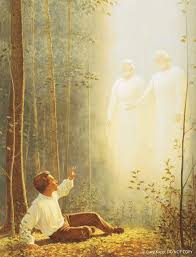
    22 I soon found, however, that my telling the story had excited a great deal of prejudice against me among professors of religion, and was the cause of great persecution, which continued to increase; and though I was an obscure boy, only between fourteen and fifteen years of age, and my circumstances in life such as to make a boy of no consequence in the world, yet men of high standing would take notice sufficient to excite the public mind against me, and create a bitter persecution; and this was common among all the sects—all united to persecute me.

    23 It caused me serious reflection then, and often has since, how very strange it was that an obscure boy, of a little over fourteen years of age, and one, too, who was doomed to the necessity of obtaining a scanty maintenance by his daily labor, should be thought a character of sufficient importance to attract the attention of the great ones of the most popular sects of the day, and in a manner to create in them a spirit of the most bitter persecution and reviling. But strange or not, so it was, and it was often the cause of great sorrow to myself.

    Here we find something of simple but important significance. The pattern continues. Just as Joseph Smith, a boy of little confidence and almost no education was vilely attacked for his claims, claims that, as he said, should have made these men of God want to bring him close and set him straight to help him, instead lead to persecution and hatred. Such it is when corrupt men are brought before light and truth.

    Just as Joseph Smith was attacked for his claims, so was Amos. A humble herdman, minding his own business, but one day called upon by God.

    Profound teachings can be found throughout the scriptures. All of the written word of God should be pondered by us as latter-day saints. We can find truths everywhere. This pattern is one that adds to my testimony that Joseph Smith was a prophet. I’m grateful that like Amos, Joseph Smith fought the persecution he received to bring forth the word of God. Just as Amos thousands of years earlier had to do the same.