Tag: religion

  • Churches for Profit

    Churches for Profit

    This often happens with a blog post.

    I start with a simple anecdotal story.

    I start telling that story and as I start to make a point I realize I don’t know enough about the topic. I start researching. I go down rabbit holes. I end up with thousands of words, quotes, videos, links, and information.

    My simple story gets lost in a lot of information and I never finish my thought.

    This happened with a story about a woman I met.

    This was back when our dog Bengie was still with us. I was walking him when I got into a conversation with an elderly woman sitting on her doorstep. She was very sweet. We discussed her kids, Bengie, and the neighborhood.

    During our conversation she made a simple comment that made me very sad.

    This lady was talking about her church and how it was close enough for her to walk to.

    Internally I was thinking, “Awesome!”

    Then, unprompted, she said, “I don’t give them much money though… just sometimes when I go, I give them a little.”

    Why did this little old lady, a stranger, feel the need to clarify that she didn’t give her church too much money? When talking about her church, the first two things she told me were that it was close and that she didn’t give it too much money. That is sad.

    She didn’t tell me anything about how her church helps her feel closer to God, nothing about how amazing her pastor is, nothing about the community her church brings her life.

    1 – She can walk to it

    2 – She’s not giving it too much money

    When did that become one of the first things you have to say about your church?

    This got me thinking about the progression of churches. Satan has been corrupting religious institutions since the Earth began.

    All institutions, including churches, need money to operate. Where is the line drawn? I think the line may get drawn at extravagance, excess, and greed.

    That’s why this post originally got derailed. I started talking about this woman’s comments about her church, thinking about how sad that she had to mention her donations, and it led to me defending the Church of Jesus Christ of Latter-day Saints and its finances.

    I’m going to set that discussion aside for another day. As I said, there’s a lot to be discussed there.

    Ultimately, it’s sad that profit has to be discussed about any church.

    Churches are for the benefit of man. Not for the profit of man. Churches are for the eternal benefit of man.

    What does the Book of Mormon say on this topic?

    The Book of Mormon takes a strong stance against churches for profit. See Mormon 8:32-37, 4 Nephi 1:26-27, 2 Nephi 26:20-22, 2 Nephi 26:31, and Alma 1:12 for examples.

    I think so many people have been turned away from organized religion due to this corruption for personal gain.

    I think it’s interesting to take a look at the things Satan attacks. Some of the first things to come to mind.

    1. Our true identity – Divine, Children of God
    2. Who God is – our Eternal Father
    3. Truth – what is truth, really?
    4. Churches

    That last one I think is shown in all the things churches have done wrong over the centuries. Judgement, wealth, greed, manipulation, abuse. These are the things Satan has brought into religious institutions and it has resulted in generations of people who then spurn religion, which in turn allows them to spurn the big questions about life.

    I don’t think the major issue with people not going to church is people not being in church, I think it’s them not thinking about who they are, how they got here, who sent them here, and who they’re going to see when the finish here.

    If you’re not asking these questions, you’re not seeing the big picture.

    And that’s what Satan wants. He wants us to miss the bigger picture.

    With technology, the busy-ness of life, and the corruption of churches, Satan is making us forget the real reason we’re here.

    The main benefit of church is thinking about Jesus Christ each week. After that it’s community and support. That’s it, I think. Outside of that, church doesn’t do much. If we all had a strong relationship with Jesus Christ and showed that in a covenantal way as a community by supporting one another and showing our devotion to Jesus Christ regularly in the other ways He’s asked us to, we wouldn’t really need a church. Life would be church.

    That’s the goal.

  • Discipline, Sharks, and Freedom

    Discipline, Sharks, and Freedom

    I watched a video recently. You can watch it here:

    In the video, some surfers are complaining about a barrier in the ocean. They’d travelled for a once in a lifetime surf trip and a barrier was keeping them from being able to surf the big waves.

    As they were complaining, an older surfer walked up and let them use his binoculars. Through the binoculars, just beyond the barrier, the young surfers could see a feeding frenzy. Sharks were just beyond the barrier.

    What seemed like the worst thing in the world quickly turned into a great protection and a great blessing.

    How often do we look at life as though through a murky glass? If we only had binoculars, or could see and understand the bigger picture, the way God sees things, how differently this world would look.

    1 Corinthians 13:11-13

    11 When I was a child, I spake as a child, I understood as a child, I thought as a child: but when I became a man, I put away childish things.

    12 For now we see through a glass, darkly; but then face to face: now I know in part; but then shall I know even as also I am known.

    13 And now abideth faith, hope, charity, these three; but the greatest of these is charity.

    I think back on my teenage years. I wasn’t the most rebellious teenager. I was far from the most obedient. I pushed boundaries. I experimented with what I thought would bring me joy.

    As I’m now in my 30s, I realize just how stubborn and rebellious I am. This life is an opportunity for my spirit to prove whether or not I will choose God. I try my best. I realize that I am still just a child. Thinking I know best while God watches and lets me stumble around, making all the mistakes I need to so I eventually develop the humility, faith, and trust He knows I need.

    As I consider teenagers today, my heart fears for them. I remember when I thought I needed to drink, try drugs, do all the worldly things or else I would miss out. Or just to feel like I belonged.

    I think back on how lucky I was to try these things and escape with my free-will intact. Many are not so lucky.

    We look at so many destructive habits and activities from the perspective that they are fun and exciting. They are the big wave. But beneath the big wave are dangers we don’t perceive. Beer commercials always show the party. There is always a picture of abject excitement, freedom, liberation, and joy. What is never shown is what is lurking underneath: addiction, sadness, loneliness, emptiness, fear, doubt, dependance, despair, danger, suffering.

    The products of a worldly life are these things. I’ve seen it. We all have. And yet we think we want to be a part of these things, a part of this world.

    Thrilling and tantalizing waves.

    A feeding frenzy underneath. 

    Some quotes from that video –

    “The Lord’s commands do not constitute some grueling underwater barriers that we must learn to grudgingly endure in this life so that we might be exalted in the next.”

    “The Lord’s commandments are given out of love and caring. They are intended for our joy in this life just as much as they are intended for our joy and exaltation in the next.”

    There is this worldly perspective that restrictions and the commandments of God take away our freedom. Let me be free! Let me party! Let me eat, drink, and be merry!

    “Seek freedom and become captive of your desires. Seek discipline and find your liberty.”

    -Frank Herbert, Chapterhouse: Dune

    We think real freedom is drinking what we want to drink, not realizing we become a slave to that drink.

    Real freedom is eating what we want to eat, not realizing we become a slave to our appetites.

    Real freedom is going to the party, not realizing we are a slave to the fear of missing out.

    We are commanded to avoid things because those things take away our freedom, they do not liberate us.

    Real freedom is not being dependent on any substance, food, drug, or activity. Real freedom is discipline.

    Why does God give us commandments? Not to restrict us but to protect us. Not to hold us back but to let us fly to our highest potential.

  • Responsibility to Love

    Responsibility to Love

    I’ve written on this topic before. What to do With All the Love. Love Has Afforded Me Much. A slightly new thought came to me on this topic.

    There is a great responsibility for firstborns to love.

    Think about it.

    I was thinking about Sage. For her whole existence up to a point she will have shared, to some extent, the love and affection she receives with Ivy. Does this mean Sage is loved any less? No, absolutely not. She is endlessly loved.

    That said, she has shared her love with Ivy.

    It made me think, yet again, of all the singular love poured out on Ivy in her first 21 months.

    It made me reflect on the love I received in the 45 months before Adie joined our family.

    How did that shape me?

    Given the measure of love and affection I received from two loving parents, singularly focused attention and love for 45 months, does that increase my responsibility to love?

    Given this theory, I think firstborns have a higher responsibility to love. With great power comes great responsibility. There is no greater power in the world than love.

    Maybe this is why the firstborn gets the birthright (wink face).

    Thos of us who have experienced love, been given love, have felt love, it’s important for us to share that. There are so many in the world that don’t grow up in a loving household. If you’re reading this and you did grow up in a loving household, you’ve been given an advantage in life worth more than a huge inheritance. You’ve been given a huge leg up in this life if you were born into a loving home.

    Share it.

    Don’t waste the gift you’ve been given.

    Now, here’s some food for thought to counter my “firstborn love theory” (Trademark pending) –

    Other ideas to consider, did my love actually expand with the arrival of Adie (my little sister) because I had experienced love and now I got to share it with my little sister? Did my first learning experience of giving love outside of my parents who already loved me so much grow my capacity to love even more? Did getting to love somebody who couldn’t do anything for me help my capacity to love, learning at a young age to love somebody without getting anything in return? Does that add to my responsibility as the firstborn?

    Or is Adie’s capacity to love greater than mine because she was born into loving a 3 person family, unlike myself? Does that make Easton’s (youngest of 6) capacity to love 3x mine since he was born into a family 3 times bigger than the one I was born into? How does this balance with my personal capacity to love expanding every time a new baby joined our family?

    Love.

    We need to think about it more.

    Which leads to the ultimate, and powerful question: is love in limited supply?

    We all have an infinite capacity to love. I don’t believe there is any limit on how we can love. I think God is our example in this. Think about how much He loves you. Whether you come from a loving household or not, whether you’re the firstborn of 10, an only child, an orphan, the youngest of 2, and all examples in between, you have a divine capacity to love. Divine. Your Father is God. He loves you. Your capacity to love is infinite. Use it. Share it.

    Epilogue

    The above post was written in May of 2023. I kid you not, as I opened it to review and post in 2026, Beth sent me a video with a text attached.

    The text read: “Wren kept asking, “Where Ivy?” Then Ivy came down and Wren waved and said, “Good morning Ivy!” And gave her a hug. But Ivy was still waking up a bit so when she sat down to eat, Wren came over, gave her another gentle hug, and started gently rubbing Ivy’s back. It’s like Wren is teaching them how to love.”

    I replied, “Reminding them.”

    And Beth said, “Blog post!”

    She knows me too well. But I didn’t realize I was about to post this!

    We’ve been struggling a little with Ivy and Sage being gentle and loving with Wren as they get older. They are the older sisters, a lot more rambunctious and a lot more physical. Sometimes Wren messes up their “set ups” (toys they’ve setup). Wren wants to be with them and play with them but she’s very destructive. They struggle sharing with Wren. Wren is still little. So they’ve had a hard time.

    But I know that Ivy was sent here to be an example as the oldest sister. I know that Sage was sent here to be a peacekeeping, independent, strong second daughter to keep everyone connected. Maybe Wren was sent to remind us all how to love. Maybe she’s meant to teach us to be a little more patient with one another.

    EternalPerspective.

  • Satan is Jesus’s Older Brother

    Satan is Jesus’s Older Brother

    Stay with me.

    Before I go down this path let me acknowledge some things:

    1. We don’t understand how time works in eternity. It’s likely everything I’m about to say is nonsense from the eternal perspective. Still, have some fun with me. I know I got your attention with that title.
      • It’s very possible that God “adopted” billions of intelligences at the same time. Meaning, It didn’t go Satan, then Jesus, then Moses, then you, then me, etc. It’s probably not that simple. Anyways…

    Now that’s out of the way, I think there is a fun thought experiment/argument to be had that despite Jesus Christ having the title of “Firstborn”, Satan might be “older” than Jesus.

    Everything in this world symbolizes Jesus Christ. Everything points to Him (Moses 6:63, 2 Nephi 11:4). 

    There are some individuals from history that are clear types and shadows of Jesus Christ.

    Examples:

    1. Joseph of Egypt
      • Savior of his people and all of Egypt
    2. Moses
      • Liberator of Israel
    3. Nephi
      • Led his people to the Promised Land
    4. David
      • King of Israel
    5. Isaac
      • Inheritor of all that Abraham had and father of Israel (Jacob)
    6. Jacob (Israel)
      • Father of the covenant people of Earth
    7. Joseph Smith
      • Restorer of the Gospel on Earth (through Jesus Christ, of course)
    8. Peter
      • Leader of Christ’s church after Christ’s ascension
    9. Abel
      • In the likeness of his father, hearkened to the voice of the Lord
    10. Ephraim
      • Received the birthright, descendents are responsible for the gathering of Israel

    All of these men represent Jesus Christ in different but very clear and obvious ways. 

    What do all these men have in common? None of them are the oldest in their family. None of them are the firstborn.

    Interesting, right?

    “Well, but, the scriptures say Jesus Christ is the firstborn of God. Clear as day,” said a hypothetical someone arguing against my point.

    What if “firstborn” has meaning closer to heir, covenant son, preeminent one?

    Psalm 89:27 speaking of David, King of Israel, reads:

    “I will make him my firstborn, higher than the kings of the earth.”

    David was the youngest son in his family.

    In Genesis 22:2 God says to Abraham:

    “Take now thy son, thine only son Isaac, whom thou lovest…”  

    But Isaac wasn’t Abraham’s only son. He also had Ishmael. Maybe Isaac was his covenant son. 

    Jeremiah 31:9 reads:

    “For I am a father to Israel, and Ephraim is my firstborn.”

    None of Ephraim, David, or Isaac were the firstborn. Yet they were each described as such in varying ways.

    Now Jesus’s words about Himself:

    “I was in the beginning with the Father, and am the Firstborn” (D&C 93).

    This is a captivating feature of scripture. There is a repeated theme of an older brother rejecting His younger brother who receives stewardship over him. 

    Cain opposed Abel.

    Ishmael yielded to Isaac.

    Esau opposeed Jacob.

    Joseph of Egypt was rejected by his older brothers.

    David was initially overlooked by his older brothers.

    Are these older brothers representative of Satan, the way the younger brother is representative of Jesus?

    Sound familiar? (Satan’s Story and Satan’s Story Continued)

    Maybe all these examples are meant to teach us something. It’s hard to be an older brother and yield leadership to your younger brother. What if Satan had taken another route and humbly accepted Jesus Christ? What if he accepted Jesus Christ’s position as “firstborn of the Father”, the chosen one, God’s beloved? What if Cain didn’t oppose Abel? Where would Cain be now?

    Also, what if Joseph of Egypt’s brothers accepted his position of power over them from the beginning? Joseph wouldn’t have been able to complete his earthly mission of saving all of Egypt. Sometimes, maybe, we need opposition (2 Nephi 11).

    But what happens when older brothers do humbly yield to their younger brother? Joseph Smith’s older brothers were legendarily supportive of his calling as God’s prophet. Esau famously humbled himself and reconciled with Jacob. Moses’s older brother Aaron appears to have accepted Moses’s role as prophet most of the time. Amazing things happen when older brothers can humble themselves.

    What if Laman and Lemuel could have humbled themselves before Nephi? Think of the love, peace, and prosperity that could have existed among the Nephites in the Americas. But then we wouldn’t have had all the lessons the Book of Mormon teaches us about opposition.

    God’s plan is perfect.

    It’s fascinating to look at scripture from a broader perspective, look for patterns, and try to grasp all that God wants us to learn and understand.

    While I prefaced this post saying it could be somewhat silly of an exercise, I stand by it. I think it’s a good exercise to review the scriptures in out-of-the-box ways and try to see the patterns God may be trying to teach us.

    Wherever in the birth order Jesus Christ and Satan landed, we know they were “older.” We know that God chose Jesus Christ to be His Son, the Redeemer of the world, the Savior of mankind. We know God doesn’t make mistakes. I’m grateful for what the scriptures teach me about Jesus Christ and that they can constantly strengthen my testimony of Him and all that He did for me.

  • Abraham’s Sacrifice

    Abraham’s Sacrifice

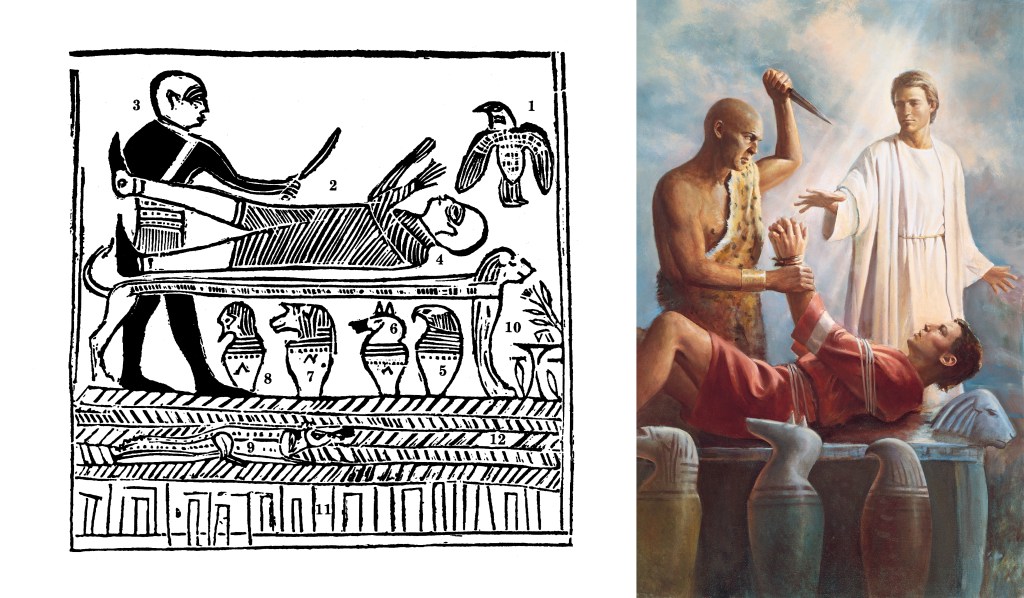
    “Yet Abraham himself came from a troubled family – his father, who had abandoned the true worship of God, tried to have Abraham sacrificed to false gods.”

    Come Follow Me Curriculum

    And you thought your parents were bad. They ever try to sacrifice you to false gods? 

    When I read that above quote, I thought about something I’d never connected in my mind before.  

    The story of Abraham almost sacrificing his son Isaac is a well-known biblical story of true faith. What I’d never connected with this, though, was the almost sacrifice of Abraham by his father many years prior. 

    There’s a lot to unravel there. 

    What occurred to me was this: Not only was this an unbearably difficult test Abraham was given; to sacrifice and kill his most precious, only son. It also, likely, spurred up painful memories of when Abraham’s father offered him as a sacrifice. (If all things are a type and a shadow of greater things, and Abraham represents God in sacrificing His only begotten son, what does this say about God?) 

    In that moment, with the added guilt and pain of losing his precious son, did Abraham also wonder about the damage he was causing his son? If by some miracle Isaac surived, how would he feel about almost being sacrificed? Abraham went through the same with his father.

    Another way to think about this – Abraham’s father is demonized for his part in almost sacrificing his son. Abraham is revered for his almost role in sacrificing his son. What is the difference? Well, the difference, I assume, is the intent, the heart, and the being to whom the sacrifice was being offered. 

    But how, in that moment, did Abraham have such faith, such trust, such knowledge, such understanding to know he was doing the right thing and sacrificing his son to the right God? Didn’t his father believe the same thing once upon a time? 

    This is one of those blog posts where I don’t have answers to my own questions. This is something I will have to ponder upon, research, and think more about.   

    If anyone has comments or can enlighten me, please do.