Tag: restoration

  • Text to a Friend

    Text to a Friend

    I want to share an exchange with one of my oldest theological friends. I invited this friend to hear me speak in church. My topic was Ephesians 1:10 which reads:

    “That in the dispensation of the fulness of times he might gather together in one all things in Christ, both which are in heaven, and which are on earth; even in him”

    I may share that talk sometime in the future.

    My friend was invited to the talk and like the consistent and reliable friend he has been now for years whether across state lines or in the state of Arizona, showed up. I went about ten different directions before I settled on where I would go with my talk. The direction I finally settled on was one in which I knew this friend would disagree. I knew because it was a topic we had regularly disagreed on.

    Afterwards, this friend gave me expected thoughts regarding his side of things and how they relate to my talk. He was pointing out where he disagreed. This is why we have such good conversations! I already knew his points as we’d had the discussion before.

    It resulted in a text I got to send to him that I would like to share (yes, this was one text):

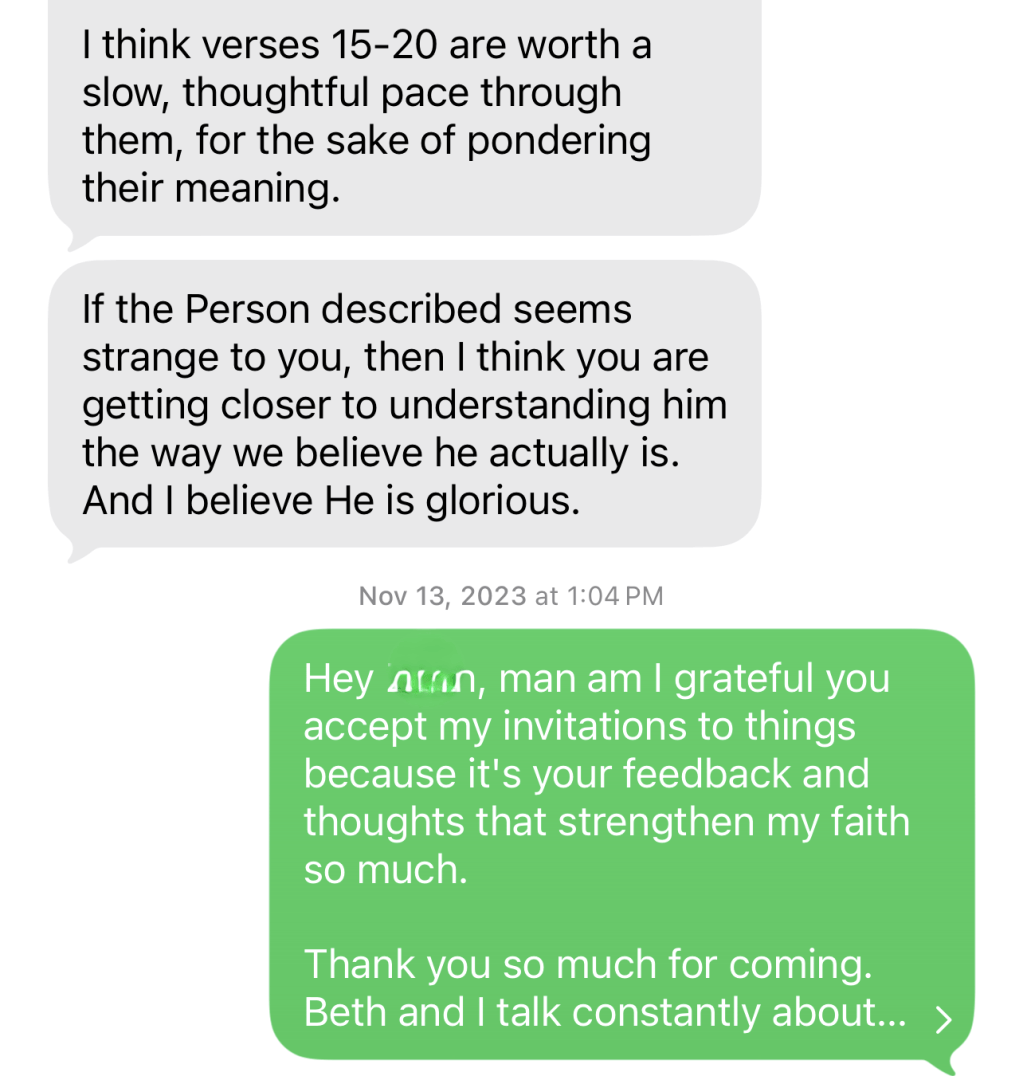
    “Hey, man am I grateful you accept my invitations to things because it’s your feedback and thoughts that strengthen my faith so much.

    Thank you so much for coming. Beth and I talk constantly about how we can’t trust people to keep commitments and do things they say they’ll do. You and [your wife] are one of two couples in our life (outside of family) that when you say you’re going to do something or be somewhere we know you will be. Thank you for that.

    I knew exactly what thoughts you’d have on my talk and I welcome them. I knew it would be somewhat, maybe inflammatory, to you, as I know it touched on things we’ve disagreed on from the beginning. I am glad that you appear to have not been offended by my words. Our disagreement really comes down to one thing, I think. And that’s if the Book of Mormon is true.

    I appreciated the exercise you gave me. As I did it, I came out more convinced that Jesus Christ is the literal Son of God, as the scriptures say. That’s the thing. You read the Bible and see God and Jesus Christ in one way. I see it, without a doubt in my mind, another way. Nothing will change that.

    But why do I see it another way? How can something so clear to you, and something so clear to me, be the opposite?

    As I said in my testimony, it comes down to a prophet. How can I know Jesus Christ is who He is? Because a prophet told me. How do I know he’s a prophet? He would have had to do something miraculous.

    I’ve concluded the Book of Mormon is the miracle God provided so I could know Joseph Smith was who he said he was. And if he was who he said he was, then Jesus Christ is who Joseph Smith said He is: the Son of God, on God’s right hand, as the scriptures say.

    It’s here that I finally thank you for giving me this great gift. It was years ago that you said you couldn’t accept the Book of Mormon because there was no proof the way there was with the Bible – archaeological and otherwise. I have spent the past years seeking “proof” that the Book of Mormon is what Joseph Smith claimed it to be. My list now is well over 400 items (*that was true in 2023 when this was written, now well over 800 individual items) and I am excited to share it with you one day.

    I have you to thank for that. You have built my testimony in a miraculous way and I thank our Heavenly Father, and you for that.

    Of course, “proof” is an interesting word. Despite all the records, eye witnesses, evidences, and testimonies, many still deny Jesus Christ existed, the Bible is the Word of God, etc. My “proof” may not do it for you. But when I review my list, there is not a shred of doubt in my mind that the power of God provided us the Book of Mormon. My faith has become knowledge.

    Until this life ends and we get to review everything, you will never understand how fruitful you have been to building my faith and testimony. Thank you, friend.

    Jesus Christ is the center of everything. He is my King, my Savior, my Redeemer. He is my advocate with the Father. Without Him I have nothing. Without Him I am nothing. I know we see Him differently. That doesn’t change who He is and what He’s done for us. Maybe one of us will change our minds one day. But ultimately, as long as we believe Jesus Christ is our Savior and King, one day we’ll both stand before Him and we’ll know. And it won’t matter who was right or who was wrong. Only He will matter. What a day that will be! Man, I look forward to it!”

    I share this because I think it’s important. The point of Christ is to bring us together. Though we disagree on many, many doctrinal points, this friend and I have fostered a relationship of discussion, debate, and disagreement, always founded on love and respect.

    I am truly grateful for how this person has strengthened me in Christ. That’s what this life is about. There can be good reason there is disagreement in the world – it can be for us to learn how to coexist with those we disagree with. We all have unique experiences in this life. Every moment shapes us and every experience we have changes the way we view the world. It’s through these experiences and listening to the viewpoints of others, someone who has had a vastly different life than we have had, that we can grow and become better.

    The world needs a little more of this.
  • Amos and Joseph Smith

    Amos and Joseph Smith

    The book of Amos in the Old Testament is an underrated book of scripture which I believe is extremely important to the Church of Jesus Christ of Latter-day Saints.

    In 2021 I was reading through the entire Old Testament for the first time and got to Amos. I’d like to share some things I learned from this book that I seldom hear talked about.

    Amos 3:7 is a scripture often quoted by latter-day saints. It reads:

    “Surely the Lord God will do nothing, but he revealeth his secret unto his servants the prophets.”

    This has obvious significance to the message of the restored Gospel of Jesus Christ. God reveals nothing, save it is revealed to a prophet.

    As I’ve read this short book of only 9 chapters, other significant scriptures have stood out. 

    An example is chapter 7. It is well-known that God chooses the most meek and humble of the earth to be His mouthpiece on the earth. This is a common theme in the Old Testament. It is common for herders and fisherman (symbolic much?), and others of little means to be called to God’s service.

    Chapter 7 starts with Amos relating a vision he had wherein he was called to prophesy to Israel of their sins and upcoming destruction if they did not repent. 

    Verse 9 of chapter 7 reads:

    “And the high places of Isaac shall be desolate, and the sanctuaries of Israel shall be laid waste; and I will rise against the house of Jeroboam with the sword.”

    This prophesy, naturally, led to a scorned priest going to the king and tattling. The modern day equivalent of going to the teacher and whining about a classmate. 

    “Then Amaziah the priest of Beth-el sent to Jeroboam king of Israel, saying, Amos hath conspired against thee in the midst of the house of Israel: the land is not able to bear all his words.”

    Boo-hoo Amaziah.

    boo hoo Memes & GIFs - Imgflip

    Amos’s reply is a classic prophet response.

    “Then answered Amos, and said to Amaziah, I was no prophet, neither was I a prophet’s son; but I was an herdman, and a gatherer of sycamore fruit.”

    Amos is basically saying, ‘Who am I to lead an insurrection against the king?  What is my motivation? Yesterday I was minding my own business herding sheep. The Lord has commanded me to say these words and so I must say them.’ Amos is pointing out that he is a humble shepherd. Someone of little consequence.

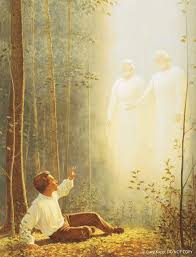
    The footnote to the word prophet in this verse is what really jumped out to me. The footnote referred to Joseph Smith-History 1:22-23 which reads:

    22 I soon found, however, that my telling the story had excited a great deal of prejudice against me among professors of religion, and was the cause of great persecution, which continued to increase; and though I was an obscure boy, only between fourteen and fifteen years of age, and my circumstances in life such as to make a boy of no consequence in the world, yet men of high standing would take notice sufficient to excite the public mind against me, and create a bitter persecution; and this was common among all the sects—all united to persecute me.

    23 It caused me serious reflection then, and often has since, how very strange it was that an obscure boy, of a little over fourteen years of age, and one, too, who was doomed to the necessity of obtaining a scanty maintenance by his daily labor, should be thought a character of sufficient importance to attract the attention of the great ones of the most popular sects of the day, and in a manner to create in them a spirit of the most bitter persecution and reviling. But strange or not, so it was, and it was often the cause of great sorrow to myself.

    Here we find something of simple but important significance. The pattern continues. Just as Joseph Smith, a boy of little confidence and almost no education was vilely attacked for his claims, claims that, as he said, should have made these men of God want to bring him close and set him straight to help him, instead lead to persecution and hatred. Such it is when corrupt men are brought before light and truth.

    Just as Joseph Smith was attacked for his claims, so was Amos. A humble herdman, minding his own business, but one day called upon by God.

    Profound teachings can be found throughout the scriptures. All of the written word of God should be pondered by us as latter-day saints. We can find truths everywhere. This pattern is one that adds to my testimony that Joseph Smith was a prophet. I’m grateful that like Amos, Joseph Smith fought the persecution he received to bring forth the word of God. Just as Amos thousands of years earlier had to do the same.

  • Why Do I Care?

    Why Do I Care?

    I’ve been thinking recently. Why I care about this?

    This being – the Gospel, the Church of Jesus Christ, the Church of Jesus Christ of Latter-day Saints, Jesus Christ in general.

    Let’s start with Jesus Christ in general. I feel like I write about this constantly and it’s the constant conclusion to one of my posts, so I’ll be brief here. I care about Jesus Christ in general because He has given me everything. The least I can do in return is share Him, follow Him, try my best to be like Him.

    Let’s go broader. Why do I care about the Gospel and the Church of Jesus Christ? That, I think goes in line with why I care about Jesus Christ Himself. If I care about Him, then I would care about His church, and I’d want to share His gospel. That lines up.

    You’ll notice I distinguished the Church of Jesus Christ with the Church of Jesus Christ of Latter-day Saints. This is what I want to focus on and think about here.

    Why do I care to share that I’m a member of the Church of Jesus Christ of Latter-day Saints? Why do I invite people to church? Why do I invite people to activities? Why do I share Book of Mormons? Why do I invite people to meet with the missionaries? Why do I share being a latter-day saint? Why do I talk about it? Why does it matter? Why do I care? Why do I keep doing it with such little success?

    It’s something I think about relatively often. The why?

    How do I stay motivated to write spiritually themed blog posts every week not very many read and fewer still are interested in?

    Why do I keep having gospel discussions with people and trying to convince them that this is the restored Church of Jesus Christ – when everyone I talk to disagrees, or worse, doesn’t care?

    Why do I keep inviting people to church and activities when they never come?

    Why do I keep sharing scriptures and conference talks that no one reads or listens to?

    Why is being a “Mormon” important?

    Hmm.

    Sounds depressing right? Sometimes it’s hard. Being a member missionary is hard. It’s discouraging. It seems like an endlessly fruitless effort.

    And yet I’m not being persecuted or crucified so I have really nothing to complain about compared to saints from earlier times.

    So, I’ve distinguished “The Church of Jesus Christ of Latter-day Saints” from “The Church of Jesus Christ” but that’s really the answer to the question of why. I do all these things, no matter how hard or discouraging, because I believe the Church of Jesus Christ of Latter-day Saints is the Church of Jesus Christ. I believe they are one and the same. I believe this is Christ’s restored church. I believe it is the way back to Him. I believe I was called and sent here to share it. That’s why I do it. That’s why I care.

    I have a friend who converted to this church who once said something I found fascinating. He said, basically, “Whether it’s true or not, I don’t care. This church brings me happiness. It’s made my life better. It’s made me a better person. It’s made me feel closer to God. Is it true? Is it the One True Church? I don’t know. Really, I don’t care.”

    He doesn’t care because for him it’s about his well-being. This church has helped his life and brought him joy. What does he care about the rest of it? While I think in a completely different way, I can appreciate this line of logic, this way of thinking. This person is an extreme pragmatist. So when he said this statement, it told me a lot about him.

    Does what this individual said make him any less of a latter-day saint and disciple of Christ than me? I’ll say, I think it could, but it doesn’t. This person is still one of the most faithful, serving, selfless, Christ-like individuals I know. Ultimately his why doesn’t matter as much as who he is becoming, which is more like Jesus Christ.

    I consider that person’s why somewhat temporal. ‘This church has been good to me and brought me joy, I’m for it.’

    My why is different.

    My question is, what if the church doesn’t bring you joy? What if it makes your life worse? This friend of mine might leave if that were the case. Right now he has no reason to leave.

    Maybe this is why so many leave. They don’t see how the church is benefitting them.

    This friend and I have a mutual friend. The mutual friend is very interested in religion and so we’ve had religious conversations together. After a few discussions, my friend said the mutual friend would never join the church. He said the mutual friend had too much to lose. His family would disown him, his wife would hate him, his whole life would change. It would be too hard. Should that person join the church?

    My friend would say no.

    Again, my why is different.

    I look at that and say, “Is it true?”

    Response from hypothetical person, “Well…”

    “No well, is it true?”

    If it’s true, if God sent a prophet, and that prophet established a church, and it’s Christ’s church – if it’s true – what else matters?

    Is it true?

    I believe it is.

    That’s why it matters. That’s why I care. That’s why it’s so important to me.

    I’ll write more on the temporal vs spiritual benefits of the church another time. But for now, I wanted to share that.

    Is it true?

    Yes.

    Then it matters. It matters more than anything else on this entire earth.

  • A Miracle that Changed the World

    A Miracle that Changed the World

    These are thoughts from a book I read recently called A Miracle that Changed the World. It was an awesome book that laid out just how spectacular the establishing of America was. This was a section of the book I had some thoughts on. I’m quoting sections of the book with my thoughts.

    p. 52:

    The Tide of Reform

    “Many Americas became extremely self-conscious about their lack of “public virtue” because of non-involvement in the affairs of government. They began to acknowledge their obsession with self-interest, the neglect of public affairs, and their disdain for the needs of the community as a whole. Gradually, a spirit of “sacrifice and reform” became manifest in all thirteen colonies.”

    This occurred in America in the couple of years leading up to the Declaration of Independence being signed. Is it any coincidence that a spirit of sacrifice, public virtue, and selflessness preceded the greatest revolution in the history of the world and the rise of the greatest nation ever to exist on earth? God needed a self-sacrificing and humble people to inherit the new world. When they exhibited these qualities, they became His chosen people to enact this major event. This led to a revolution and the freedom from tyranny that allowed the explosion of religious freedom that God planned, that couldn’t have happened under the rule of a monarchy. It started with sacrifice, service, and humility.

    “In the eyes of the Whigs, the two or three years before the Declaration of Independence always appears to be the great period of the Revolution, the time of greatest denial and cohesion, when men ceased to extort and abuse one another, when families and communities seemed peculiarly united, when the courts were wonderfully free of that constant bickering over land and credit that had dominated their colonial life.”

    Two things especially stand out to me from that statement –

    1. “families and communities seemed peculiarly united.”
      • From the Family Proclamation: “We call upon responsible citizens and officers of government everywhere to promote those measures designed to maintain and strengthen the family as the fundamental unit of society.”
      • As the fundamental unit of society, strong families make for strong society. No wonder Satan has so adamantly attacked the family. Look at divorce rates, look at what has happened to the American family. The dismantling of families is the the beginning of the downfall of a great society, and we’re seeing it happen right before our eyes.
    2. “the courts were wonderfully free of that constant bickering…”
      • Could the 13 original colonies have broken from the greatest world power at that time, colonies v. Greatest World Power, if they were busy bickering amongst themselves? It took unity for the freedom of America to be established.
      • D&C 38:27: “be one; and if ye are not one ye are not mine.”

    This is what we need – Americans to become self-conscious about how selfish we’ve become. This is the eternal principle of unity. America needed to be united under one cause and one heart before they could break free from tyranny. God wants us to be one. What has happened to that unity?

    I read in a Doctrine and Covenants commentary how early church members, going back to the very earliest days of the church, were advised to avoid courts. It was said that if a dispute couldn’t be resolved by arbitration, then there was discord and discontent too strong amongst the parties, and they needed to evaluate what they truly valued. One early church leader, Oliver Cowdery, was chastised for becoming too involved in the courts, and it ultimately began to descent towards his excommunication.

    “When Oliver moved to Missouri in 1837, he sought to alleviate personal debts by starting a legal career. Witnesses testified that Oliver had urged people to sue others in court who “fired guns in town,” who broke “the Sabbath day,” he “frequently solicited for business in collecting debts,” and “urge[d] on lawsuits with others.””

    There can’t be unity where there is constant bickering and lawsuits. Those needed to be removed from public standards before the 13 colonies could think to stand up against Britain.

    The book continues:

    “How the Moral Reform Accelerated the Revolution

    “Many Americans became so impressed with the improvement in the quality of life as a result of the reform movement that they were afraid they might lose it if they did not hurriedly separate from the corrupting influence of British manners. They attributed this corruption to the monarchal aristocracy of England. Even Americans such as John Jay, Robert Morris, and Robert Livingston were beginning to see that the people were exhibiting a potential capacity for virtue and morality which would guarantee the success of a free, self-governing society. Therefore, it became popular to express the sentiment that the sooner they became independent the better” (emphasis added).

    The underlined portion is the part that stood out to me. Imagine if society today could be said to have such a high standard of virtue and morality. This is what guaranteed the success of the United States: A virtuous and morally upright people. This is why they could self-govern themselves, because they self-governed in righteousness. Imagine describing our society like that today – excess of virtue and morality.

    The definition of virtue is “behavior showing high moral standards.”

    The definition of morality is “principles concerning the distinction between right and wrong or good and bad behavior.”

    We couldn’t be farther from such a standard. We’ve gone so far off the path that we have reversed morality so that right is wrong and wrong is right. We have molded morality to be what we want it to be. The early Americans who established this nation were moral and upright in all their dealings, which allowed them the honor of being the people to establish the most free, most righteous, and most powerful nation in history. Freedom and righteousness are power.

    Another motivating factor for the colonies wanting freedom from England was to avoid developing all the negative attributes of the British.

    “British influence was already taking its toll. One alarmed American wrote, “Elegance, luxury and effeminacy begin to be established.” David Ramsay declared that if Americans had not revolted “our frugality, industry, and simplicity of manners, would have been lost in an imitation of British extravagance, idleness and false refinements” (emphasis added).

    America has gotten closer to extravagance, idleness, and false refinements than frugality (look at our national debt), industry (look at our bail outs), and simplicity (look at social media).

    It’s time for unity in America. It’s time for virtue and morality. It’s time to protect and re-establish the importance of the family. It’s time to return to frugality, industry, and simplicity. If America can return to these values, maybe it stands a chance to stay a chosen nation and be protected from the tribulations that are to come.

  • Maybe (The Story of the Chinese Farmer)

    Maybe (The Story of the Chinese Farmer)

    “There once was a farmer whose horse ran away. Upon hearing the news, his neighbors came to visit. ‘Such bad fortune,’ they said, full of sympathy.

    “‘Maybe,’ the farmer replied.

    “The next morning the horse returned, bringing with it three other wild horses. ‘What great fortune!’ The neighbors exclaimed.

    “‘Maybe,’ replied the old man.

    “The following day, the farmer’s son tried to ride one of the untamed horses. He was thrown off and broke his leg. The son would forever limp. ‘What terrible fortune!’ The neighbors cried.

    “‘Maybe,’ answered the farmer.

    “The next morning the army came through the farmer’s village to draft young able-bodied men for the war. Seeing his son’s limp, they passed him by. The neighbors congratulated the farmer. ‘What wonderful fortune!’ They said.

    “‘Maybe,’ said the farmer.”

    So, it’s hard to know which experiences will turn out to be fortuitous and which will be unfortunate.

    Another story to consider.

    A dog is at the vet. It is there with its wonderful owner. The dog knows his owner loves him very much. The dog’s owner provides food and shelter to him every day. His owner takes him for walks every day and loves him so much. His owner would never do anything to harm him.

    At the vet, the dog is due to get shots.

    The owner knows the importance of these shots. The owner knows the dog needs the shots to keep him healthy. The owner knows the shots are for her dog’s ultimate benefit.

    While the dog is getting shots, all he can think is, “why oh why is my owner letting them do this to me? It hurts so bad! Why is she letting this happen?” The dog looks at his owner and cries and cries. He’s in so much pain. “Why is she standing there ignoring my pain? Why isn’t she doing anything? Doesn’t she love me?”

    The gap between the dog’s understanding and his owner’s understanding is vast. If the owner tried to explain to her dog germ theory and why he needed his shots, he wouldn’t understand any of it.

    The gap between God and us must be infinitely more expansive than the gap between our understanding and that of our pets.

    We don’t know completely why bad things happen to good people. We don’t know why some live while some die.

    The restored gospel of Jesus Christ tells us some key information. This information doesn’t completely answer the question of why bad things happen to good people, but it does add important information.

    We all chose to come here.

    We all knew it would be hard.

    Some knew they would experience unimaginable pain.

    We all chose to come here.

    The good news of the Gospel of Jesus Christ is that no pain, no hardship, no difficulty, no tragedy, is without meaning or purpose. It’s all for one great design: to make us better and stronger. Even as I say that, “to make us better and stronger” those words fall flat. Someone experiencing immense pain doesn’t care that they’ll be stronger in the end. Saying “to make us better and stronger” is akin to telling the dog, it’s going to be ok. Our understanding is limited. That doesn’t take away from the fact that everything that happens here is meant for our ultimate good. Everything here is to help us to reach our full potential.

    Do you think that dog understands those shots will help him live longer? Could we possibly understand if God tried to explain to us the mysteries of the universe and how that unimaginable pain can be for our benefit?

    Does this make unimaginable pain easier to endure? I think it does. I’m not in the throes of pain at the moment, though.

    When I thought I might die, and I thought how desperately I would miss my wife and my one month old daughter, when I thought about how I wouldn’t get to teach her to talk, shoot a basketball, or ride a bike, my heart hurt. But then I knew something amazing. I knew that, even if I had to leave my daughter and my wife, I’d see them again. Life is one eternal round with God and nothing would be lost. I knew that if I had to leave, it was for my ultimate benefit, and the benefit of my family. I had to trust God in that moment. That brought me peace.

    Could the farmer’s son have realized that breaking his leg and being limp for the rest of his life would actually save his life? He couldn’t know it. But someone did.

    When bad things happen, take comfort. Trust Him.

    How do we know what is a blessing and what isn’t? We don’t. Someone does. Trust Him.