Tag: Restored Gospel

  • Amos and Joseph Smith

    Amos and Joseph Smith

    The book of Amos in the Old Testament is an underrated book of scripture which I believe is extremely important to the Church of Jesus Christ of Latter-day Saints.

    In 2021 I was reading through the entire Old Testament for the first time and got to Amos. I’d like to share some things I learned from this book that I seldom hear talked about.

    Amos 3:7 is a scripture often quoted by latter-day saints. It reads:

    “Surely the Lord God will do nothing, but he revealeth his secret unto his servants the prophets.”

    This has obvious significance to the message of the restored Gospel of Jesus Christ. God reveals nothing, save it is revealed to a prophet.

    As I’ve read this short book of only 9 chapters, other significant scriptures have stood out. 

    An example is chapter 7. It is well-known that God chooses the most meek and humble of the earth to be His mouthpiece on the earth. This is a common theme in the Old Testament. It is common for herders and fisherman (symbolic much?), and others of little means to be called to God’s service.

    Chapter 7 starts with Amos relating a vision he had wherein he was called to prophesy to Israel of their sins and upcoming destruction if they did not repent. 

    Verse 9 of chapter 7 reads:

    “And the high places of Isaac shall be desolate, and the sanctuaries of Israel shall be laid waste; and I will rise against the house of Jeroboam with the sword.”

    This prophesy, naturally, led to a scorned priest going to the king and tattling. The modern day equivalent of going to the teacher and whining about a classmate. 

    “Then Amaziah the priest of Beth-el sent to Jeroboam king of Israel, saying, Amos hath conspired against thee in the midst of the house of Israel: the land is not able to bear all his words.”

    Boo-hoo Amaziah.

    boo hoo Memes & GIFs - Imgflip

    Amos’s reply is a classic prophet response.

    “Then answered Amos, and said to Amaziah, I was no prophet, neither was I a prophet’s son; but I was an herdman, and a gatherer of sycamore fruit.”

    Amos is basically saying, ‘Who am I to lead an insurrection against the king?  What is my motivation? Yesterday I was minding my own business herding sheep. The Lord has commanded me to say these words and so I must say them.’ Amos is pointing out that he is a humble shepherd. Someone of little consequence.

    The footnote to the word prophet in this verse is what really jumped out to me. The footnote referred to Joseph Smith-History 1:22-23 which reads:

    22 I soon found, however, that my telling the story had excited a great deal of prejudice against me among professors of religion, and was the cause of great persecution, which continued to increase; and though I was an obscure boy, only between fourteen and fifteen years of age, and my circumstances in life such as to make a boy of no consequence in the world, yet men of high standing would take notice sufficient to excite the public mind against me, and create a bitter persecution; and this was common among all the sects—all united to persecute me.

    23 It caused me serious reflection then, and often has since, how very strange it was that an obscure boy, of a little over fourteen years of age, and one, too, who was doomed to the necessity of obtaining a scanty maintenance by his daily labor, should be thought a character of sufficient importance to attract the attention of the great ones of the most popular sects of the day, and in a manner to create in them a spirit of the most bitter persecution and reviling. But strange or not, so it was, and it was often the cause of great sorrow to myself.

    Here we find something of simple but important significance. The pattern continues. Just as Joseph Smith, a boy of little confidence and almost no education was vilely attacked for his claims, claims that, as he said, should have made these men of God want to bring him close and set him straight to help him, instead lead to persecution and hatred. Such it is when corrupt men are brought before light and truth.

    Just as Joseph Smith was attacked for his claims, so was Amos. A humble herdman, minding his own business, but one day called upon by God.

    Profound teachings can be found throughout the scriptures. All of the written word of God should be pondered by us as latter-day saints. We can find truths everywhere. This pattern is one that adds to my testimony that Joseph Smith was a prophet. I’m grateful that like Amos, Joseph Smith fought the persecution he received to bring forth the word of God. Just as Amos thousands of years earlier had to do the same.


  • Purpose and What Did You Eat Last Week

    Purpose and What Did You Eat Last Week

    I recently did a meditation that I couldn’t get myself into, I disagreed so much with the premise. I can usually go with the flow with any guided meditation, at least the ones I’ve done. Often the guided meditations lead to spiritual thoughts. This meditation led to a spiritual thought, but not in the normal way.

    The voice leading the meditation stated, basically, that we are on this big rock floating through space. None of us know why we’re here or what the true purpose of all this is. The meditation continued advising to set that aside for a moment and focus on your breathing, etc.

    I stopped right there. In my mind I thought, but I do know why I’m here, I do know the purpose of all this. I couldn’t get behind the premise. It’s a common theme of my writing. Where we come from, why we’re here, where we’re going. It hit me that 99% of people listening to that meditation probably don’t bat an eye at that statement. Most people probably gloss right over it like, “Yeah, I don’t know what the meaning of all this is.” That makes me sad.

    I just started a new book that talks about the temporal nature of this life and how silly it is to one, not believe in the things we can’t see, and two, put so much stock into the things we can see, even though they’re so temporary.

    The book asked what I ate 2 weeks ago. I had no idea. It made an interesting point. Food and water are the most critical thing to our survival. We can’t survive without them. Yet, what did you eat 2 weeks ago? You don’t even remember. What about the car that you love then 8 years later is a clunker. Or the house you cherish but inevitably becomes dirty, beat up, and cluttered with other stuff that is inconsequential. The book talked about how much stock we put into these things.

    How many of us consider why we’re here or where we’re going? How many in the world live in complete ignorance, not wanting to consider these great questions? It amazes me.

    We can’t see or describe heartache, fear, doubt, love, the wind, and yet they exist. Faith exists. Our soul exists. Eternity exists. God exists. These are the things that matter. I wish our society could spend a little less time with a Netflix special they won’t remember a year from now and consider more the purpose of this life. 

    The purpose of this life is God’s plan to make us stronger, better, and more like Him. We knew God before we came here. We will remember Him when we leave here. This life is so important. Not for food, or water, or cars, or homes, or Netflix, but for the faith we build, the experiences we go through, and the families and relationships we cultivate. I wish this is something we could all remember more.

  • Maybe (The Story of the Chinese Farmer)

    Maybe (The Story of the Chinese Farmer)

    “There once was a farmer whose horse ran away. Upon hearing the news, his neighbors came to visit. ‘Such bad fortune,’ they said, full of sympathy.

    “‘Maybe,’ the farmer replied.

    “The next morning the horse returned, bringing with it three other wild horses. ‘What great fortune!’ The neighbors exclaimed.

    “‘Maybe,’ replied the old man.

    “The following day, the farmer’s son tried to ride one of the untamed horses. He was thrown off and broke his leg. The son would forever limp. ‘What terrible fortune!’ The neighbors cried.

    “‘Maybe,’ answered the farmer.

    “The next morning the army came through the farmer’s village to draft young able-bodied men for the war. Seeing his son’s limp, they passed him by. The neighbors congratulated the farmer. ‘What wonderful fortune!’ They said.

    “‘Maybe,’ said the farmer.”

    So, it’s hard to know which experiences will turn out to be fortuitous and which will be unfortunate.

    Another story to consider.

    A dog is at the vet. It is there with its wonderful owner. The dog knows his owner loves him very much. The dog’s owner provides food and shelter to him every day. His owner takes him for walks every day and loves him so much. His owner would never do anything to harm him.

    At the vet, the dog is due to get shots.

    The owner knows the importance of these shots. The owner knows the dog needs the shots to keep him healthy. The owner knows the shots are for her dog’s ultimate benefit.

    While the dog is getting shots, all he can think is, “why oh why is my owner letting them do this to me? It hurts so bad! Why is she letting this happen?” The dog looks at his owner and cries and cries. He’s in so much pain. “Why is she standing there ignoring my pain? Why isn’t she doing anything? Doesn’t she love me?”

    The gap between the dog’s understanding and his owner’s understanding is vast. If the owner tried to explain to her dog germ theory and why he needed his shots, he wouldn’t understand any of it.

    The gap between God and us must be infinitely more expansive than the gap between our understanding and that of our pets.

    We don’t know completely why bad things happen to good people. We don’t know why some live while some die.

    The restored gospel of Jesus Christ tells us some key information. This information doesn’t completely answer the question of why bad things happen to good people, but it does add important information.

    We all chose to come here.

    We all knew it would be hard.

    Some knew they would experience unimaginable pain.

    We all chose to come here.

    The good news of the Gospel of Jesus Christ is that no pain, no hardship, no difficulty, no tragedy, is without meaning or purpose. It’s all for one great design: to make us better and stronger. Even as I say that, “to make us better and stronger” those words fall flat. Someone experiencing immense pain doesn’t care that they’ll be stronger in the end. Saying “to make us better and stronger” is akin to telling the dog, it’s going to be ok. Our understanding is limited. That doesn’t take away from the fact that everything that happens here is meant for our ultimate good. Everything here is to help us to reach our full potential.

    Do you think that dog understands those shots will help him live longer? Could we possibly understand if God tried to explain to us the mysteries of the universe and how that unimaginable pain can be for our benefit?

    Does this make unimaginable pain easier to endure? I think it does. I’m not in the throes of pain at the moment, though.

    When I thought I might die, and I thought how desperately I would miss my wife and my one month old daughter, when I thought about how I wouldn’t get to teach her to talk, shoot a basketball, or ride a bike, my heart hurt. But then I knew something amazing. I knew that, even if I had to leave my daughter and my wife, I’d see them again. Life is one eternal round with God and nothing would be lost. I knew that if I had to leave, it was for my ultimate benefit, and the benefit of my family. I had to trust God in that moment. That brought me peace.

    Could the farmer’s son have realized that breaking his leg and being limp for the rest of his life would actually save his life? He couldn’t know it. But someone did.

    When bad things happen, take comfort. Trust Him.

    How do we know what is a blessing and what isn’t? We don’t. Someone does. Trust Him.

  • Sidney Rigdon Miracle

    Sidney Rigdon Miracle

    21 August, 1842. 

    Apparently, it had been thought that Sidney Rigdon meant “to renounce his faith in Mormonism” when he took the stand on 21 August 1842.  Instead, he “appeared to bear his testimony of its truth, and add another to the many miraculous evidences of the power of God.”

    I stumbled upon this story while reading a commentary on Doctrine and Covenants section 124 verses 103-110.  In these verses Sidney Rigdon is admonished to continue to stand by the Prophet Joseph Smith, along with other commandments, and “if he will hearken unto my voice, it shall be well with him” (verse 110).

    Smith and Sjodahl remark that, “Sidney Rigdon, according to a generally prevailing impression, was more or less under the influence of a spirit of apostasy.  It is related that, in Liberty jail, he declared to his fellow-prisoners that the sufferings of the Lord were nothing compared with his, and while the faithful Saints were straining every nerve to complete the Nauvoo Temple, he had no word of encouragement to them.  As a consequence of his disposition, he did not have good health.  Like the Corinthians who partook unworthily of the Sacrament (1 Cor. 11:30), he was ‘weak and sickly.’  The Lord, therefore, points out to him the cause of his ailments and promises to heal him, if he will do his duty and stand by the Prophet as a true counselor.”

    The admonition from the Lord in section 124 was given on January 19, 1841 so it was 19 months later that he took the stand to detail the miracle he had experienced to those gathered.

    As mentioned, given Sidney’s recent state of apostasy, I’m sure the gathered congregation was expecting to see some potential fireworks.  They got fireworks, but not the apostasy-themed ones they were expecting. 

    Sidney told the congregation that his daughter Eliza died.  She was pronounced dead by a physician.  I will quote the story from the Joseph Smith Papers.  “after a considerable length of time she rose up in the bed and spoke in a very powerful tone to the following effect in a supernatural manner: she said to the family that she was going to leave them (being impressed with the idea herself that she had only come back to deliver her message and then depart again,) saying the Lord had said to her the very words she should relate; and so particular was she in her relation, that she would not suffer any person to leave out a word or add one.  She called the family around her and bade them all farewell with a composure and calmness that defies all description, still impressed with the idea that she was to go back.  Up to the time of her death she expressed a great unwillingness to die, but after her return she expressed equally as strong a desire to go back.  She said to her elder Sister, Nancy, ‘it is in your heart to deny this work, and if you do, the Lord says it will be the damnation of your soul.’  In speaking to her sister Sarah she said, ‘Sarah, we have but once to die, and I would rather die now than wait for another time.’  She said to her Sisters that the Lord had great blessings in store for them if they continued in the faith, and after delivering her message she swooned, but recovered again.”

    It goes on to say that she continued in a near death fashion for 36 hours before she called her father, Sidney to her.  Continuing from the Joseph Smith Papers: “the Lord had said to her, if he (Sidney) would cease weeping for his sick daughter, and dry up his tears that he should have all the desires of his heart; and that if he would go to bed and rest, he should be comforted over his sick daughter, for in the morning she should be getting better and should get well.”  Sidney had wept and prayed for his daughter’s life.  His daughter told him the Lord had commanded her to stay for Sidney’s prayers.

    The account continues, (Sidney speaking), “It has also been rumored that I believe that Joseph Smith is a fallen prophet.  In regard to this, I unequivocally state that I never thought so, but declare that I know he is a prophet of the Lord, called and chosen in this last dispensation, to roll on the kingdom of God for the last time.  He closed by saying as it regards his religion he had no controversy with the world, having incontrovertible evidence, that through obedience to the ordinances of the religion he now believes, the Lord had actually given back his daughter from the dead.”

    There is so much to unpack here.  A few things that caught my attention –

    Sydney being weak due to taking the sacrament unworthily. 

    The statement potentially made by Sidney Rigdon to the effect that the Lord’s sufferings were nothing in comparison to his, blasphemous indeed. 

    Interesting that Eliza was commanded to give the precise words of the Lord.  Shows the importance of the Lord’s words, when He speaks, we listen and when we relay His message it must be precise.

    Also, interesting that Eliza at first didn’t want to die, but once she had met the Lord, she didn’t want to come back to life.  Why did she ultimately come back?  Because the Lord commanded her.  I believe this not to be out of duty to Him (though of course it was) but out of love.  The Lord doesn’t force. 

    My concluding thought is on the cunningness of the devil.  I haven’t studied the life of Sidney Rigdon much after he officially left the church.  After reading this story I looked a little more into Sidney Rigdon.  Apparently, after Joseph Smith’s martyrdom Sidney went on missions to the East to preach and gather followers to his new church.  Sidney called it, “the most successful mission he had ever undertaken.”  Where is this church today?

    What I thought about the cunningness of Satan is this: Sidney Rigdon appears to never have denied the faith. Maybe that source exists and I haven’t seen it.  What Sidney did instead was claim the authority as his own.  He was misguided and pride took over.  He believed the authority rested with him and so, instead of denouncing the faith, he tried to promote it in his own way.  God had chosen his prophet.  Sidney Rigdon couldn’t upheave that.

    I believe there is a lot to be learned from this story from Church history. I noted just a couple of the interesting points that could result in their own post. Ultimately I settled on this important point –

    I’m not sure where Sidney Rigdon’s church is today.  I know where the Church of Jesus Christ is today.

  • Godhead – My Understanding

    Godhead – My Understanding

    Two posts ago I discussed the doctrine of the Trinity and my opposition to it.

    This will be a much gentler post, detailing how I personally come to the belief and understanding of the Godhead as true doctrine. 

    First, an explanation I didn’t give last time. Definitions:

    1. Trinity or Trinitarian belief:  God is one God, but three coeternal and consubstantial persons; the Father, the Son, and the Holy Spirit.  The three persons are distinct, yet are one “substance, essence or nature” (homoousios).  In this context, a “nature” is what one is, whereas a “person is who one is. (From https://en.wikipedia.org/wiki/Trinity).  (Also, huh?).
    2. Godhead: God the Father, Jesus Christ, and the Holy Ghost form a group known as the Godhead.  Each member is a different, individual being, yet all three are united in thought, desire, knowledge, power, and purpose. (From https://www.churchofjesuschrist.org/media/video/2019-08-0080-godhead?lang=eng). (Also, visit that link to watch a 7-minute video to learn more).

    How can I say “I know” the Godhead to be true?

    The Godhead is one of the unique beliefs of the Church of Jesus Christ of Latter-day Saints. 

    A majority of Christianity believes in the Trinity.

    In this post, I won’t go into detail on the doctrine, differences, importance, history, etc. of the distinctions between Trinitarian and Godhead belief.  That I’ll likely save for another day.  In this post I simply want to explain how I have come to know for myself that the Godhead is true and correct doctrine.

    The short answer to how I can know the Godhead to be true is:

    Through study, prayer, and upbringing.

    My understanding of this principle and the knowledge I have of it can be broken down very simply.  It’s a similar breakdown that explains much of my testimony in the restored gospel.

    In reading the Book of Mormon, I know without a shadow of a doubt that it is the word of God.  I know that it was translated through the power of God.

    If the Book of Mormon is true, then Joseph Smith is a prophet. 

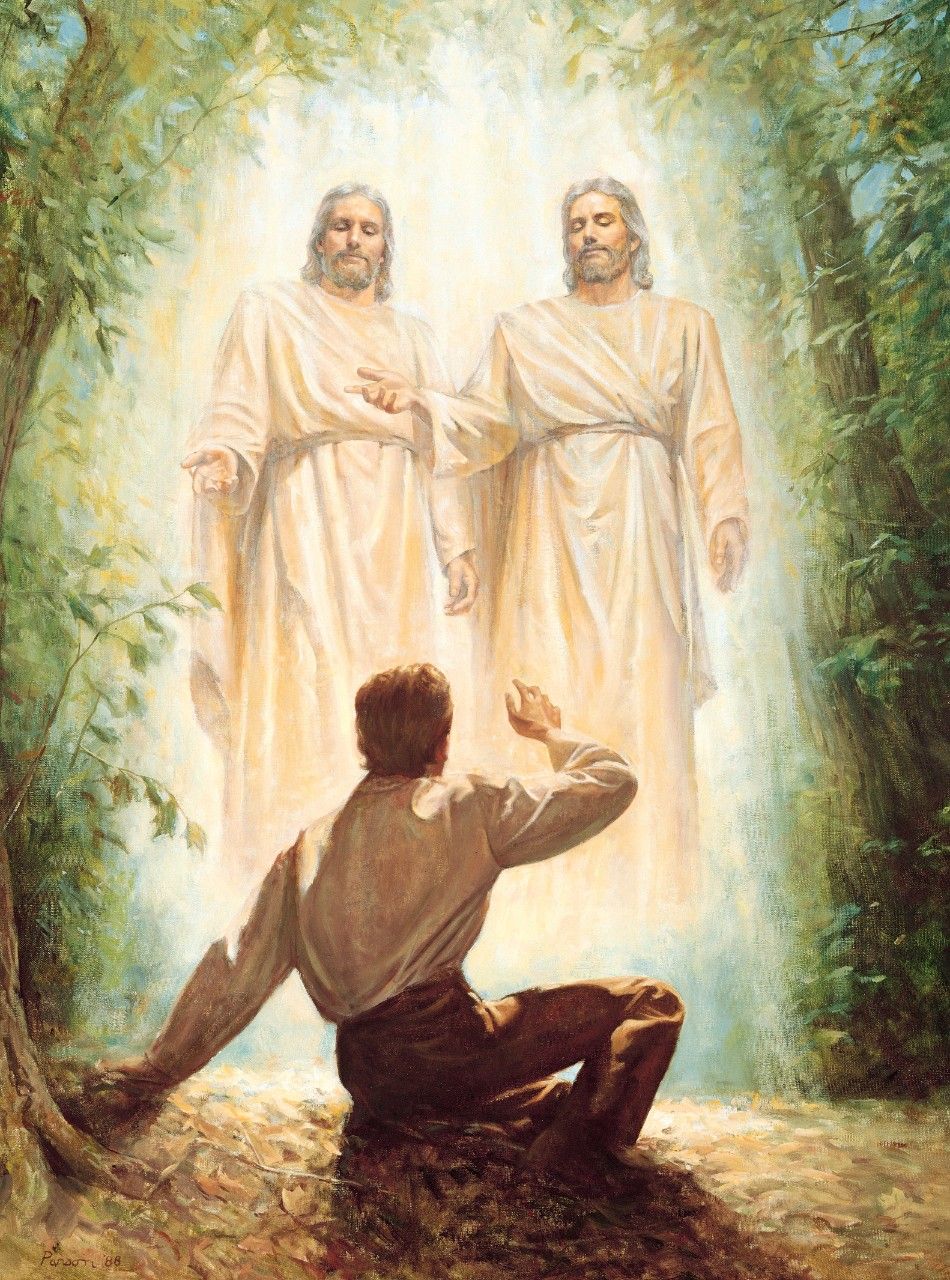
    Joseph Smith told us he saw God the Father, and Jesus Christ on His right hand.

    Joseph Smith History 1:17:

    It no sooner appeared than I found myself delivered from the enemy which held me bound. When the light rested upon me I saw two Personages, whose brightness and glory defy all description, standing above me in the air. One of them spake unto me, calling me by name and said, pointing to the other-This is My Beloved Son, Hear Him!

    Joseph Smith never wavered on this fact. 

    This could be where it ends, but I’ll add some notes on upbringing and study.

    Upbringing – obviously, I must mention that my upbringing played a role in my believing this to be true.  I was raised to believe in the Godhead; therefore, it is much easier for me to accept as truth.  That said, it was up to me to ask questions, read the book for myself, study Joseph Smith’s history and understand the principle for me to come to the knowledge.  Because I was raised to believe it to be true didn’t make it true.  Which leads to the next point.

    Study – As I said, through study and research I have determined the Book of Mormon to be the word of God.  It is an inspired book. 

    Prayer – My testimony of the Book of Mormon, mentioned in study, not only comes from logical, mind-centered study, but from personal revelation.  I’ve felt the Book of Mormon is true.  I’ve prayed to know the Book of Mormon is true.  I’ve received my answer, through prayer, that the Book of Mormon is true.  Prayer is an irreplaceable ingredient. 

    The principle of the Godhead has been distorted, attacked, and misunderstood for centuries.  One of the first attacks Satan always makes is on the nature of God.  If Satan can confuse us on who God is, he can confuse us on who we are.  We are children of the Almighty God. 

    I am grateful for modern revelation and prophets that make simple and powerful truths known.  I am grateful to know that while God is magnificent and powerful, He is not un-knowable.  The understanding of God as my Heavenly Father and Jesus Christ as my brother, who gave His life for me, strengthens my faith and helps me put my trust in them.

    This truth is eternal, and this truth is important.