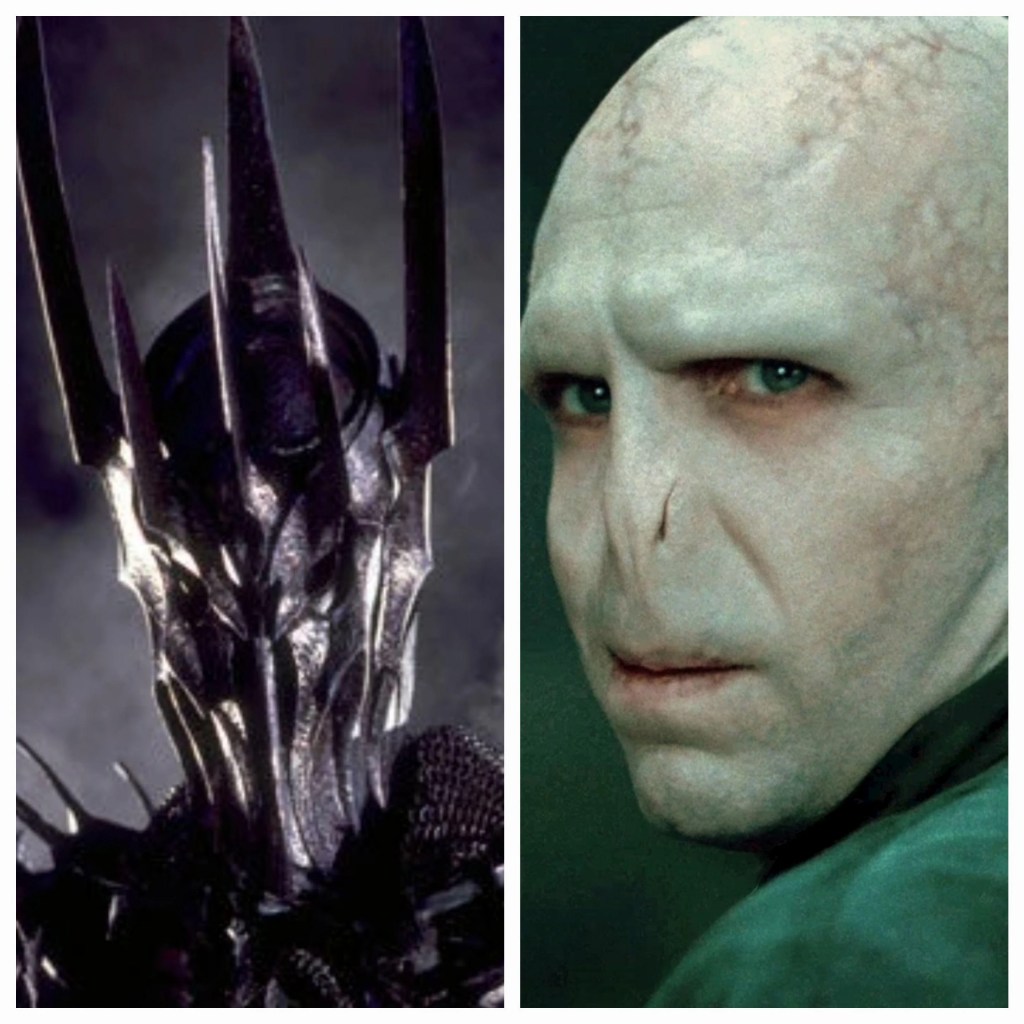
I’ve always been struck by the parallels to Satan made in so many fantasy fiction books. I think the authors of these fictions are writing from a place that their soul understands, even if they don’t fully remember it here on earth, in this life. I guess these parallels aren’t too surprising given that Satan is the personification of evil, so, if you’re writing a fiction with evil characters, your evil will mirror him at least in some way.
One major example is Voldemort. It’s been a long time since I read the Harry Potter books. I just re-read book 1 with Ivy. I’m anxiously awaiting Ivy getting older so we can continue this greatest books series of all time together. Since it’s been so long since I read them, I can’t remember all the intricacies of Satan’s comparisons to Voldemort. There is the obvious – great wizard (Son of the Morning) turned evil and selfish, wanting dominion, power, and control. Voldemort was opposed to all things love. It was ultimately love that was his downfall because he couldn’t see its power.
I recently read A Guide to Tolkien by David Day which is essentially an encyclopedia of Tolkien information – all things Lord of the Rings. It is not meant to be read cover to cover (I’m weird), but I still thoroughly enjoyed it. I learned so much about the mythology Tolkien created that gave me so much more appreciation for The Hobbit and the Lord of the Rings series. I’ve read all those books and seen the movies, but reading this book gave me a glimpse into the wonderful world Tolkien produced from his mind.
In The Lord of the Rings world, Sauron was not the first evil of Arda (earth, or Middle-Earth). Sauron was actually the first leitenant of a greater evil called Melkor. In the Lord of the Rings mythology, there are 15 beings called Valar. They are essentially Gods who helped create and maintain the earth. One of these Gods was Melkor, one of the greats. Here is what is said about him in A Guide to Tolkien:
“Last of the Valar is he who in the beginning was mightiest of the Ainur. He was named Melkor, “He who arises in Might”. He owned in part the powers of all the Valar (children of God), but chiefly his realm was Darkness and Cold. He moved over Arda (earth) like a black cloud that was dreadful to behold, like the World’s nightmare come into daylight. All evil that was and is in the World had its beginning in Melkor, for he revolted against Iluvatar (God) in the Timeless Halls and came to Arda in rage, wishing to make his own kingdom. He brought corruption into the World, and with him came a part of the Maiar (people who followed or served the Valar) twisted by his malice. He made his fortress, Utumno, and his armoury, Angband, deep under the mountain roots of Middle-earth. In Arda he waged five great wars against the Valar and put out the fairest lights of the World by destroying both the Great Lamps and the Trees of the Valar.
“In the beginning Melkor appeared in forms both fair and evil: his wiles were many and even Manwe the First King was deceived. Yet after the Darkening of the Valinor, he always assumed his evil form and the Elves called him Morgoth, the “dark enemy of the World”… His countenance was evil, for the fire of malice was in his eyes and his face was twisted with rage…Yet, in the War of Wrath, all this power was destroyed, though Melkor summoned Dragons, Balrogs, Orcs, Trolls and every other evil being to his aid. This was the end of him, and, though much of his evil and some of his servants remained, he alone of the Valar was driven from the spheres of the World and now dwells for ever in the Void.”
Sound familiar?
All evil in the world had its beginning in him.
He revolted.
He came to Earth in rage.
He wished to make his own kingdom.
He brought corruption into the world.
He brought with him followers (the sons and daughters or God, or in this case, the followers of the Valar).
He made his home deep in the mountain roots of Earth.
He waged war against God (the Valar).
In the beginning he appeared in forms both fair and evil.
The dark enemy of the world.
His countenance was evil.
He was driven from the spheres of the World and now dwells forever in the void.
Tolkien was a religious man. But his religious traditions knew nothing of the true premortal scope of Satan’s actions. In writing this, it was like Tolkien was creating a character he knew from a previous life, someone his soul remembered, though his mind did not.
Art imitates life. In this case, art imitates eternity.
 No Coincidences