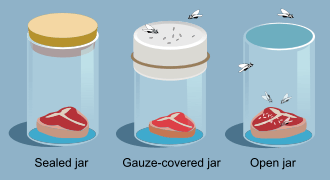
Do you know what spontaneous generation is?
Spontaneous generation is the outdated idea that living organisms can spontaneously come from other living organisms. For example, it used to be believed that a horse was how bees were created. People used to observe that a horse would die, and bees would “spontaneously generate” from the corpse. Crazy huh? Of course, now we know better. I wrote the below for a discussion post in my Science 301 class, Understanding Formal Processes.
The once prevalent fallacy of spontaneous generation goes to show that we can be extremely wrong about simple and obvious things by relying on what our eyes tell us. When I initially started reading about spontaneous generation in Bondeson’s book, The Feejee Mermaid and Other Essays in Natural and Unnatural History, I could hardly believe that spontaneous generation was debated into the 1800s (Bondeson, 2014, p. 248). As I thought about it more, though, I understood how this theory took hold of observable logic and persisted for so long. An animal decays in the sun and maggots appear. Where did they come from? An obvious conclusion was the decaying flesh of the animal created the maggots.
Scientific progress is filled with examples of people being sure of something that ends up being absurd. The relationship between observable scientific knowledge and the scientific method is that as the scientific method is improved upon, meaning, as theories and ways of experimenting on those theories improve, scientific knowledge grows in proportion. It’s interesting to note what Herman van Booerhave said of the brilliant mathematician Girolamo Cardano, that he was exceptional when correct in his theories but, “When he advocated erroneous theories, he surpassed them all in folly” (Bondeson, 2014, p. 197).
Often, we see how outlandish proposed experiments can become. Take Paracelsus’s proposed experiment to create a human being by mixing excrements, semen, broth, and nutritious fluids (Bondeson, 2014, p. 196). While seemingly absurd, scientists have always been ridiculed for outlandish theories, and those theories only go the direction of proven or disproven by what Paracelsus proposed: an experiment. Even the most outlandish experiment using the scientific method is an improvement on assumptions based solely on simple observations.
When I was in 7th grade my science teacher gave us a very simple assignment. The assignment was to take something, anything that we could test, and observe each day, make a hypothesis, then keep the data and see if our assumption was correct. Many of my classmates repeated a couple simple observations. I wanted to be more creative. I chose to check the thermostat in my home each day and monitor the fluctuations in temperature. My hypothesis was that as it got hotter outside during the summer, the temperature would go up in my home. This seemed an obvious assumption to a 7th grader.
I was shocked when I learned, from checking the temperature every morning, that it was 72 degrees in my home every morning, no matter what. My hypothesis was foiled by the scientific progress of a simple thermostat. A device I always assumed to simply tell the temperature, I learned, was actually monitoring the temperature and turning on cool air as it got hot, or hot air as it got cool, to always keep our home at a consistent temperature. I learned from this how something that can seem obvious can be so wrong when ignorance exists. The ignorance here was a 7th grader who didn’t yet understand the simple workings of the things around him. We see in society every day how detrimental ignorance is. Ignorance exists in science, religion, everywhere around us. As we experiment and try new theories, our ignorance is lessened as we come to better understand the world around us.
What seems so ridiculous now, spontaneous generation was an obvious observation given the tools available to science at the time. In a world that debates all things spiritual – the after-life, the soul, and all things we can’t see – science ridicules theories that can’t be proven. Because science can’t prove the existence of the soul, it says there is no soul. Like those who could observe that maggots spontaneously appeared but couldn’t know how because they didn’t have the tools and capacity to do so, one day all things we still don’t understand will be proven. This includes premortal existence, the soul, spirits, resurrection, and the after-life.
There’s this secular belief that spiritual things inherently non-scientific. Those with faith understand that one day all these spiritual concepts will be proven through scientific methods. It will all be so clear to us one day, when our eyes are opened and we are given additional knowledge and understanding. What a day for science that day will be.
 No Coincidences