Tag: scripture

  • An Epistle from the New Testament Apostles

    An Epistle from the New Testament Apostles

    I read a book titled An Epistle from the New Testament Apostles.

    A sentence in the second paragraph of the preface caught my attention and helped me to read this book in a different light. That sentence read:

    “Imagine for a moment how you might feel if you were to go to your mailbox only to find there a long letter addressed personally to you from the First Presidency and the Quorum of the Twelve Apostles as those church leaders were constituted shortly after the resurrection of Christ.”

    Huh. Do we read the Bible in this way? Do we read the Bible as if Simon Peter, Paul of Tarsus, or John the Beloved were writing to us? How much more power comes from the words as we consider them a personal letter directly sent to us? What is the Bible really, but a letter sent directly to us from these prophets? You could also consider the Bible a letter sent to you from God.

    I’d like to share a part of this book that was especially significant to me. As I said, the book takes all the epistles of the prophets in the New Testament and categorizes them. It’s also worth noting that where there are multiple translations or interpretations of what may have been originally written, this book showed some of those different options. Keep that in mind when reading the quotes below. One category that stood out to me was titled:

    Unity in the Church

    From James 3:14-16 “But if ye have bitter envying and strife in your hearts, glory not/do not assume superiority over/ and lie not against the truth. This wisdom descendeth not from above, but is earthly, sensual, devilish. For where envying and strife is, there is confusion and every evil work.”

    Sounds like Christianity today.

    Another section.

    A Call to Unity in the Body of Christ

    From Ephesians 4:1-6 “I therefore, the prisoner of the Lord, beseech you that ye walk worthy of the calling wherewith ye are called, With all lowliness and meekness, with longsuffering, forbearing one another in love; Endeavouring to keep the unity of the Spirit in the bond of peace. There is {In} one body, and one Spirit, even as ye are called in one hope of your calling; One Lord, one faith, one baptism, One God and Father of all, who is above all, and through all, and in you all.” 

    Ephesians 4:11-15: “And he gave some, apostles; and some, prophets; and some, evangelists; and some, pastors and teachers; For the perfecting of the saints, for the work of the ministry, for the edifying of the body of Christ: Till we in the unity of the faith, all come and of {to} the knowledge of the Son of God, (MISSING ERASED CONTENT FROM KJV). That we be no more children, tossed to and fro, and carried about with every wind of doctrine, by the sleight of men, and cunning craftiness, whereby they lie in wait to deceive, But speaking the truth in love, may grow up into him in all things, which is the head, even Christ.”

    Unity.

    I point out the lack of it in Christianity not to try to “dispute” or to create “contention” but to point out the obvious.

    It’s interesting the first things Jesus Christ did when he appeared to His other flock in the Americas.

    1. He proclaims His Atonement, announcing that He accomplished what the prophets said would be fulfilled, announcing that He can save His people.
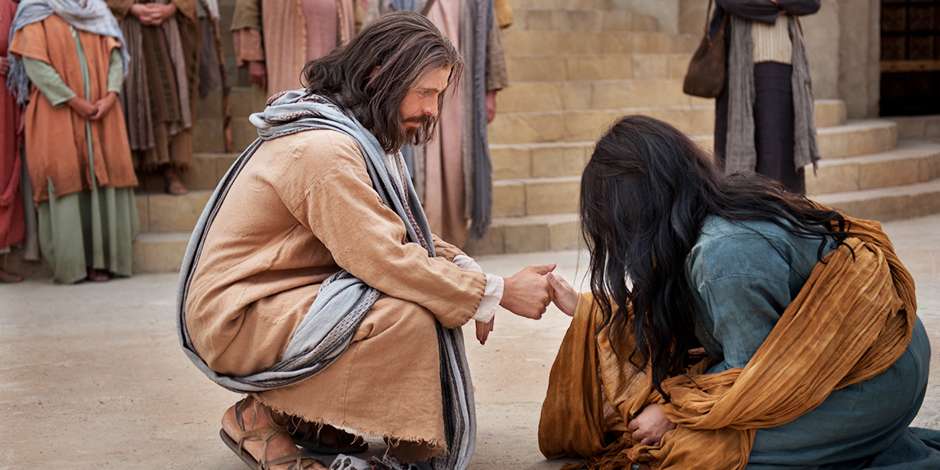
    2. He ministers to His people one by one. They are each individually allowed to come up and feel the wounds in His hands, feet, and sides.
    3. After the people cry out “Hosana!” literally, “God save us” or “Save now, we pray,” Jesus Christ sets forth the mode of baptism, the way He can save them.

    From here Christ’s complete focus is on unity. He elaborates on the oneness of Himself, God the Father, and the Holy Ghost.

    Then He says (3 Nephi 11:28-30), “And according as I have commanded you thus shall ye baptize. And there shall be no disputations among you, as there have hitherto been; neither shall there be disputations among you concerning the points of my doctrine, as there have hitherto been. For verily, verily I say unto you, he that hath the spirit of contention is not of me, but is of the devil, who is the father of contention, and he stirrith up the hearts of men to contend with anger, one with another. Behold, this is not my doctrine, to stir up the hearts of men with anger, one against another; but this is my doctrine, that such things should be done away.”

    May we all avoid disputations and contention. May we always serve with meekness, longsuffering, and love. I hope that one day Christianity can be unified in our faith in Jesus Christ. That will likely not come until the millennium, when we can all look to who we serve, and know without a doubt that we know Him. But we can do our part today to not let the devil have power over us. We can do our part by removing contention and argument from our lives.

  • This is Repentance

    This is Repentance

    Sometimes I struggle with the idea that my sins have been made completely white through the Atonement of Jesus Christ, that I’m completely forgiven for everything I’ve done.

    I know this disrespects the Atonement of Jesus Christ and that’s part of my biggest struggle. The last thing I ever want to do is belittle what Christ did for me.

    The thing is, sometimes I still dwell on my past sins. Sometimes I still think about them. Sometimes I still feel remorse and guilt. Sometimes I wonder if I’ve paid the full penitence to those I hurt. Have my sins been washed away? Are they completely gone if I still remember them?

    I rationalize this, and I believe it’s true, that I remember them for my benefit. I have to remember them or I might return to them. It’s the remembrance of guilt that keeps me from wanting to go back to being that person.

    I understand this intellectually.

    Still, sometimes it’s hard for me to understand how Christ can have forgotten my sins, washed them away as if they never happened, when I can’t forget them myself.

    The young men I work with and I recently studied Isaiah chapter 1.

    Isaiah 1:18 reads:

    “Come now, and let us reason together, saith the Lord: though your sins be as scarlet, they shall be as white as snow; though they be red like crimson, they shall be as wool.”

    After reading that I emphatically emphasized something to those young boys. What I emphasized was this:

    “When you truly repent, and show remorse, and try your absolute hardest to not do it again, Christ forgives and forgets your sins. Period. White as snow. It’s as if they never happened. Don’t be deceived. Satan will have you believe you can never be forgiven for a mistake. This is the great lie. You can be forgiven. If you repent, Christ will forgive. Not only that, He won’t even remember it. It’s like it never happened. I can’t stress this enough.”

    That’s what I said to my young men, and I believe it’s true.

    But… do I believe it’s true?

    Given what I just wrote?

    I had a thought today for the first time ever. I often think about the time of judgement. That time when we stand before Christ and have our life reviews. I’ve never feared that moment. The thought that occurred to me today is: why don’t I fear that moment? I have so much to be embarrassed by, so much to be ashamed of in my past behavior. Why haven’t I worried about it before? It occurred to me that one day my wife, Beth, will see how I once was. I’ve tried to tell her, but I don’t think she gets it. Then it occurred to me that my family will see it too. I will be so ashamed! Why haven’t I feared this before?

    Then it hit me.

    Maybe that’s repentance.

    Repentance is knowing – yes, I did those things. Yes, I made many mistakes. But though my skins be scarlet (they are and were) they shall be as white as snow. As I type this, I hold back tears. That’s what Christ has done for me. That’s what repentance is.

    Luke 15:7:

    “I say unto you, that likewise joy shall be in heaven over one sinner that repenteth, more than over ninety and nine just persons, which need no repentance.”

    D&C 18:13:

    “And how great is his joy in the soul that repenteth!”

    I am that soul. I don’t know how the life review will go. If my sins are forgiven and forgotten, are those parts reviewed? I don’t know. But what I realized was, and why I’ve never feared that moment, is even if all my abhorrent behavior is shown, it will be ok. It will be ok because I changed.

    That thought of Beth seeing how I used to be? It occurred to me that maybe she’ll love me even more after seeing all of it because she’ll see how much I changed. She’ll be able to see the full picture of how far I came to be a semi-decent husband and father.

    I think that’s what repentance is. Knowing that even if all your sins are laid out, you’re still forgiven.

    That’s repentance.

  • The Ten Virgins and Parenting

    The Ten Virgins and Parenting

    Ivy was recently watching a child’s video before church on Sunday.

    In the video, ten children were standing outside waiting for a bus to take them on a field trip. The children were going to a zoo and the ten children each listed what animal they were excited to see.

    In the animated video, 5 of the children were holding lunch sacks. The other 5 children were empty-handed. The 5 children with lunch sacks asked the 5 children without lunch sacks where their lunches were. The 5 children without lunch sacks had been busy playing and hadn’t prepared their lunches.

    The 5 children without lunch sacks said it would be fine. They said they would go make their lunches. But at that moment the bus pulled up.

    You know the story.

    I’m not going to reiterate the parable of the ten virgins here. What I’m going to do is elaborate on what this particular video made me think about with this parable.

    In this video, the children were irresponsible and didn’t prepare for their field trip and therefore would go hungry on their field trip. This is consistent with the traditional ten virgins story.

    What this representation made me think of, as many things do now, is of parenting. I looked at those 5 children without lunch sacks as young children, let’s go with kindergarten. As I watched, it was my opinion that it wasn’t fully those kindergarteners’ responsibility to prepare their lunch. It was likely their parents who didn’t prepare a lunch for them to take to the field trip. As my mind expounded upon this thought, I thought of all the reasons parents might not prepare a lunch for their children. Reasons include not having enough money to pack their child a lunch, not having enough time due to a busy work schedule, not being organized enough to remember to prepare their child a lunch, forgetting because a million other things are going on, or simply not caring enough to pack their child a lunch.

    I felt bad for those 5 children. It wasn’t their fault they didn’t have sack lunches. They were not prepared because their parents didn’t prepare them.

    As a kid who literally went on some field trips without lunch, I could sympathize with these children (love you Mom and Dad).

    You get this isn’t about sack lunches right?

    It is the responsibility of parents to prepare our children for the second coming of Jesus Christ. Just writing that, I realize most people mock the very idea. This is why we go to church. This is why we study scriptures as a family. This is why I read Ivy and Sage Bible and Book of Mormon stories. This is why we pray before every dinner and before bedtime. This is why I take Ivy with me to church meetings and to visit members of the ward.

    I’m grateful I was prepared with a spiritual sack lunch as I was raised. Even if my parents don’t think they prepared my sack lunch with enough sustenance, it was prepared. I was given the preparation, and I hope, despite all the shortcomings I’ll demonstrate in raising my girls, that my girls have a lunch with them on their field trip of life.

    I’d like to briefly go over those reasons parents don’t prepare their children.

    1 – Not having enough money to pack their child a lunch – this represents not having enough resources themselves. The church and those around you will make up the difference. Try.

    2 – Not having enough time due to a busy work schedule – I get being busy, I get it as much as anyone. We must make time for the most important things. We are preparing ourselves and our children to survive in a turbulent world and the world to come. NOTHING is more important.

    3 – Not being organized enough to remember to prepare their child a lunch – this one hits home hard. Sometimes I feel like I’m not organized enough and can’t give my children, my ward members, my family, and everyone around me all I can give. All we can do is try our best. Christ sees our efforts and He sanctifies and then magnifies those efforts.

    4 – Forgetting because a million other things are going on – feigned ignorance will not be an adequate excuse when we stand before the Lord and tell Him we didn’t prepare these tender little ones to know Him because we were too busy and forget. Realign your priorities.

    5 – Not caring enough to pack their child a lunch – this goes with point four above but is absolutely inexcusable.

    We have been given the stewardship of these children. We must rear them in righteousness.

    Jesus Christ is coming. It’s a fact. The world wants to deny it and focus on everything else. But it’s happening, and it’s important we prepare ourselves and our children.

    I am grateful to be a member of Christ’s Church and to have the great honor of raising two chloice spirits to know and worship Him. This is the greatest honor I could have in this life. It is a great honor and a great responsibility. I hope to one day stand before the judgment seat of Jesus Christ and tell Him, “I’m sorry. I know I made many mistakes. But I hope I did my best. Thank you for giving me these daughters that blessed me so. I hope that I made you proud.”

  • Lehi’s Dream

    Lehi’s Dream

    Some thoughts I had while reading about Lehi’s dream. I will not relate every detail of the dream so for those who are unfamiliar, it can be read in 1 Nephi chapter 8.

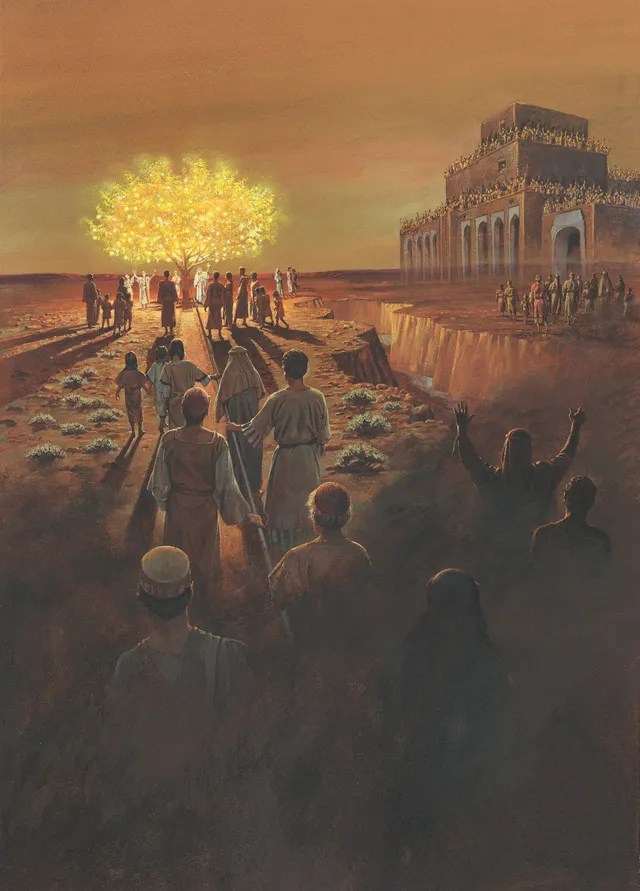
    The first thing I noticed is the location where Lehi starts in his dream. The people he sees later all start at the head of a fountain of water. It could be this is where they started or this is where Lehi first sees them. What seems significant to me is this: Lehi is wandering blindly through the dark and dreary wilderness (verse 4). It is then that Lehi encounters a man dressed in a white robe who bade Lehi to follow (verses 5, 6).

    What I find significant is that later in the dream Lehi beckons Sam, Sariah, and Nephi, along with others, to come to the tree. Where is their man in a white robe? I think what we’re learning here is the significance of prophets in God’s plan. Lehi was led to the Tree of Life, the fruit, the gospel of Jesus Christ by a man in a white robe. Let’s assume the being in the white robe is Jesus Christ Himself (Sidenote: Let’s be clear, in Lehi’s dream I don’t know that the man in the white robe is necessarily Jesus Christ. It could be someone Christ sent like Gabriel or Adam to lead Lehi. But the principle stands and for simplicity, I’ll refer to the white-robed being as Christ). So, Christ leads Lehi to the gospel. It’s then that Lehi guides others there. Not to say that others don’t have a personal relationship with Jesus Christ, just that if we follow the guidance of and heed the prophet, he will guide us to the Gospel of Christ and keep us connected to the iron rod.

    The significance of a prophet is further illustrated by verse 8. Lehi doesn’t encounter Christ and immediately show up at the Tree. He “traveled for the space of many hours in darkness.” I think this represents the trials and tribulations Lehi had to go through. He was scorned, threatened death, and ultimately had to leave his home for his testimony of Christ. Prophets don’t become prophets overnight. They’re often the most persecuted among us. Then Lehi “began to pray unto the Lord that he would have mercy on me, according to the multitude of his tender mercies” (verse 8). It was when Lehi humbly cried out that he beheld “a tree, whose fruit was desirable to make one happy” (verse 10).

    Lehi is led to the gospel. In a way I think he is ordained a prophet in that moment. From there he beckons and leads others to the fruit.

    Another way this can be looked at is that anyone who leads others to the tree of life, like Lehi led his family, can be a type and shadow of Christ. If you are an example to someone of Christ-like love and lead someone to come closer to Jesus Christ, you are acting in the role of the white-robed person, or Jesus Christ. You become a Savior on Mount Zion.

    Another significant feature of Lehi’s dream is the river of water. It can become confusing what exactly the river of water represents if you read Lehi’s dream, then Nephi’s interpretation of it. In chapters 12 and 15 Nephi is clear, the water was filthy and represents the depths of hell (12:16). If you read 11:25 it reads, “the rod of iron…led to the fountain of living waters, or to the tree of life.” I think the significance here is the water is “living water” as it approaches the tree of life. As the water distances from the Tree of Life it becomes filthy. Therefore, at the head of the river, away from the Tree of Life, it was filthy and represented hell.

    Those in the great and spacious building mocked those who sought the Tree of Life. I think one interpretation could be that those in the building were products of ignorance. They knew no better. They were deceived by the “wisdom thereof, the pride of the world.” Laman and Lemuel can not plead ignorance. They had seen an angel (1 Nephi 3). Their father was a prophet. They started from a different point than someone who ended up in the great and spacious building. When Laman and Lemuel denied what they knew and denied all the light they’d been given, they were swept away. To whom much is given, much is required (Luke 12:48). “He who sins against the greater light shall receive the greater condemnation” (D&C 82:3).

    1 Nephi 12:18 “the large and spacious building…is the vain imaginations and the pride of the children of men. And a great and a terrible gulf divideth them; yea, even the word of the justice of the Eternal God, and the Messiah who is the Lamb of God.”

    The gulf that separates the people in the great and spacious building from the Tree of Life is their ignorance, not always of their own fault. Their upbringing might have brought them to the building. They may have been more easily deceived by Satan because of their upbringing and experiences. They may have started with an unfair disadvantage that made them unable to accept the gospel, “a terrible gulf” that made it too difficult to understand “the word of the justice of the Eternal God.” If they only understood how kind and loving their Father in Heaven is, or even that He is their Father, they likely wouldn’t laugh and scoff at those who embrace this great truth and find comfort from this truth.

    That’s why it’s so important that this message is shared with the world.

    This, I believe, is also why we must never judge others. We don’t know the experiences of others. It may be that if we were raised in a certain house, with a certain culture, with a certain understanding, with a certain life, with certain experiences, we would be just like the individual who scoffs at the Gospel. We don’t know the circumstances of someone else. We don’t know why they are the way they are. In their shoes, we may be no different. This is why it is to our greater condemnation to judge others. Don’t judge someone. You can’t comprehend all there is to know about them. Only one person can do that. He will rightfully and righteously judge them.

    Back to Laman and Lemuel and the filthy water that sweeps them away – as said, they are worse off. This is also why those who partake of the fruit and are brought to be ashamed by the scorn of the world “fell away into forbidden paths and were lost.” They didn’t make it to the spacious building. They were lost to wander forbidden paths. Once you’ve tasted the sweet truth of the Gospel of Jesus Christ there is no going back. You can try to go back to the world, but most find they are more lost than ever. There are so many examples of individuals who leave the church but can’t ever really leave it. They become lost, always seeking to find something to fill the void the Church of Jesus Christ left. They can’t fill the void so they end up attacking it.

    11:35 reads, “The multitude of the earth was gathered together; and I beheld that they were in a large and spacious building, like unto the building which my father saw. And the angel of the Lord spake unto me again, saying: Behold the world and the wisdom thereof; yea behold the house of Israel hath gathered together to fight against the twelve apostles of the Lamb.”

    Many of these people are deceived, and therefore they fight against God, unknowingly sometimes. The wisdom and pride of the world can be churches that look at the poor and needy and manipulate them. Or it can be individuals who look at any other church and scoff and mock. Oftentimes, these actions are done in the guise of defending God. More evil has been perpetuated under the guise of doing what’s right than just about anything. God needs us to defend Him by our kind actions and good examples, not by slandering, judging, or hating others. Many today of other faiths openly mock what they don’t realize is Christ’s true and living church. They have been deceived by the wisdom of the world. And in mocking “they never knew Him” (JST Matt. 7:33).

    These are just a few of my thoughts from Lehi’s dream of the Tree of Life. I feel there is so much to learn from this simple story. As with all things in the Book of Mormon, this points to Jesus Christ and helps point me in the direction of trying to be more like Him.

  • Why Polygamy?

    Why Polygamy?

    The question is often asked: Why did God command Joseph Smith to enact the practice of polygamy, or multiple wives.

    The answer is sometimes given that it was for God to raise up righteous seed. to increase the number of children born in the gospel covenant in order to “raise up seed unto [the Lord]” (Jacob 2:30). I will come back to this.

    Another reason that isn’t often spoken of. Joseph Smith’s calling as a prophet was to restore all things. Not some things. Not most things.  All things.

    If a Priesthood power was had or executed in this earth, it was Joseph Smith’s duty to restore it in this, the dispensation of the fullness of times.

    To many people distraught at the idea of polygamy I would ask, “Do you believe in the Bible? Do you believe in Abraham, the great Patriarch?” How can a practice so wholeheartedly be condemned in the 19th century but be acceptable to you in the past? God is eternal. He doesn’t care about 2000 BC or the 1830s. To Him it is all one eternal round.

    It’s amazing that the staunchest denouncers of plural marriage never speak of Abraham, Isaac, and Jacob. The same Abraham, Isaac, and Jacob whom they pronounce with vigor, “I believe in the God of Abraham, Isaac, and Jacob.” Israel, whom the 12 tribes of Israel come from, exist because of this practice so condemned by modern critics.

    I want to touch back on the “righteous seed” theory. Some I think at least slightly scoff at the idea. It’s such a broad concept that most simple human minds can’t see such a big picture. Couldn’t God raise children to Him in a different way? He’s God, right?

    Maybe.

    But God has always worked through us, here on earth, to do, build, create, and work. He doesn’t magically insert tens of thousands of people because He needs them here. He commands and we either react with faith or with stubbornness.

    I’d like to give a real-life example of this principle of raising seed unto Him.

    I am a descendant of polygamy. Me. Someone you know is here because of this practice. Where would I be if not for this practice? I would have either been born to another family, outside of the covenant, outside of this Church, or I’d still be in line waiting to come to earth.

    I’m grateful for the practice of polygamy. I know it was difficult. I know it was a great test of faith. It was an incredible trial for those who had to live it. Those who endured it faithfully, like my great-great-great grandfather, Benjamin F. Johnson, have blessed me and the life of countless others. I’m grateful to him.

    It is pretty well documented how much Joseph Smith struggled with the principle. He all but avoided it for many years. Do you think Joseph Smith who was already persecuted and hated, driven from state to state, wanted to institute something that would make his enemies more hateful? Do you think he wanted to institute something that gave his enemies more anger and vitriol towards him and the Church? It was hard enough. It was not easy for Joseph Smith to institute polygamy.  Ultimately, he had to learn obedience to all of God’s commands. Even the hard ones. Even the ones he didn’t understand.

    We don’t know exactly why God instituted the practice of polygamy, anciently or modernly. We can guess, we can hypothesize. But like many other principles or workings of God, it comes down to faith. I wouldn’t be here without the faith of someone else who accepted something difficult. It’s a small act of faith on my part to accept and show gratitude for their great faith in times past.