Tag: state of mind

  • What is Hell?

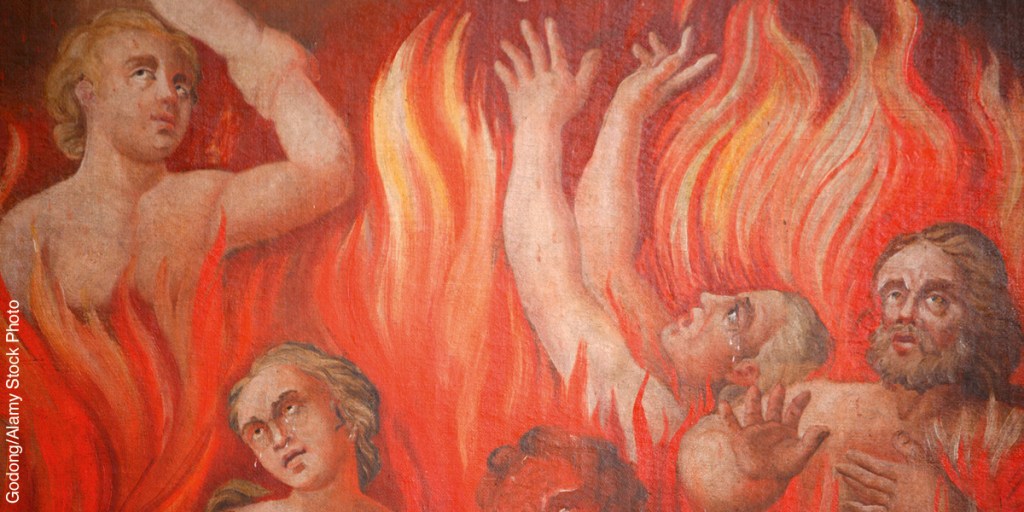
    What is Hell?

    Studies have shown that humans will prefer pain over boredom. We as humans need stimulation. When left in a room with the options being complete boredom or a painful electric shock, many will choose the electric shock just to feel something.

    You can watch this YouTube video for an interesting study on this:

    There is this idea that perpetuates throughout Christianity that hell is fire and pain. I don’t think that’s actually the case. I think hell is boredom, stagnation, lack of growth, lack of purpose, selfishness to the point of looking only at oneself. I think hell is being stuck.

    Mark 9:43-44 reads:

    43 And if thy hand offend thee, cut it off: it is better for thee to enter into life maimed, than having two hands to go into hell, into the fire that never shall be quenched: 

    44 Where their worm dieth not, and the fire is not quenched.

    Doctrine and Covenants 76:43-44 reads:

    43 Who glorifies the Father, and saves all the works of his hands, except those sons of perdition who deny the Son after the Father has revealed him. 

    44 Wherefore, he saves all except them-they shall go away into everlasting punishment, which is endless punishment, which is eternal punishment, to reign with the devil and his angels in eternity, where their worm dieth not, and the fire is not quenched, which is their torment-

    The word translated “hell” in Mark 9:43 is the Greek word Gehenna. Gehenna was a garbage dump in ancient Jerusalem.

    “Gehenna was located on the south end of Jerusalem and had been a site for pagan child sacrifices during Old Testament times (2 Kings 23:10). During Jesus’ lifetime, Gehenna had a constant fire burning to dispose of the waste that was left there—from regular household trash to the carcasses of animals and convicted criminals (Jeremiah 7:31–33). Because of this, the Jews considered Gehenna to be a cursed place full of filth.” (See this link for more information).

    This is where we get the reference in Mark 9:44 “fire is not quenched.” Gehenna or hell was literally a place where fire never stopped, and I believe this is where the popular idea of hell being a place of fire comes from. I think the more critical point in those verses is the phrase, “Where their worm dieth not.” This is not referring to a literal worm, as I don’t believe the endless fire represent literal fire in hell. I believe the fire represents never ending torment.

    But what is this torment? Is it physical pain? Worse.

    As I mentioned earlier for that study, people would prefer any sensation to that of no sensation. I think the endless torment is being stuck for eternity.

    I read a book that once described what hell might be like. It considered hell to be like being a worm deep within mud. The worm squirms around, with no purpose or meaning. The worm can’t see, it can’t feel, it can’t think. It’s getting nowhere. It endlessly squirms in the mud.

    I believe the worm that dieth not is our eternal soul. What could be worse than an eternity of… nothing? What could be worse than being the equivalent of a worm squirming within mud, forever?

    Just the thought should terrify you.

    God has provided us a plan of growth and progression. He has provided us a way to become like Him. Those who reject Him will be stuck, forever. There will be no progressing for them. Their “worm dieth not.”

    I am grateful to God for all that He has given me and all that He has afforded me. I know that because He loves me He has allowed me to grow and progress in eternity. Not to be stuck and stagnant. Growth. I am grateful for that gift He has provided me. 

  • What is a Place?

    What is a Place?

    Prepare for one of my more “out there” posts. You’ve been warned. Here we go.

    I often hear statements like, “When we die, we may not be in the same place as our family but…”

    For those who don’t know the doctrines of the Church of Jesus Christ of Latter-day Saints on the kingdoms of heaven, this will be something I’ll likely write about another time. In the meantime, read this link.

    We know that here on earth, time is much different than in heaven. In the afterlife, time will be a completely different concept. Our understanding of time is completely impacted by our mortal experience. There’s a good chance in the next life there will be no “time.” This is a difficult concept to wrap our mortal brains around, but I believe it to be true.

    I think the next life might have a similar application for “place.” Here on earth, we have such a finite understanding of “places.”  You’re here or you’re there. Then how can God be everywhere?

    I wonder if our understanding of “place” will be much altered in the next existence, just like time. Space and time; I’m sure a quantum physicist can speak on this topic with much more eloquence.

    The point I’m trying to make is, here on earth we get hung up on many things. Who will be married to who in heaven? Where will I be? What will I be doing? How will I spend my “time”? On and on our questions go. It’s natural for us to ask these questions. A constant topic of my writing is the wish that people would ask these questions more.

    These questions are good, but here’s another one: what if the next existence is so out of our realm of understanding that these questions don’t even make sense?

    Where will I be?

    Where will my family be?

    Back to that original statement I hear often: “I may not be in the same kingdom (place) as my relative, but I will still be able to see them.” 

    What if this is a wholly incorrect way of thinking about it? Yes, there will be kingdoms. What if this concept of kingdoms is a way for God to help us try to understand the next life? What if the kingdoms of heaven are analogous to our state of mind?

    This applies, I think, to the Telestial Kingdom which we are told is as numerous as the stars. Will each person really have a star as their own “place?” I don’t know. Maybe. Maybe it’s a state of mind. The Telestial Kingdom could be our state of mind, our paradise, our new home – as numerous as the stars which are as numerous as different states of mind.

    This state of mind idea also applies to visits and how those of a higher kingdom can visit those of a lower. Where will my family be and can I visit them? Do I want to be in the Celestial Kingdom if my family is in the Terrestrial Kingdom? If our “kingdom” is a state of mind or a state of consciousness, this explains how easily we could visit other “places.” Someone with a certain level of consciousness could easily visit, temporarily, a lower plain or consciousness to be with loved ones. But a lower state of consciousness can’t just raise its level to the higher “kingdom.” If they could, then they would join that kingdom.

    I know. Now I’m in full matrix, take the red pill and raise your “consciousness” talk, but hear it out, read it again, consider it. Maybe there’s something there to ponder.

    We know that only those who wish to obtain the highest glory will attain it. God will not force individuals to be “somewhere” “better” if they don’t want to be there. The greatest sinner doesn’t want to be in the presence of God. They would rather be outside of His presence than endure the glory that He is and feel how short they fall. The pain of being without God is less than being in front of Him and knowing what you could have been, and what you refused to be.

    What if hell is a state of mind and being, not a place?

    This thought came completely new to me from a (questionable) book called Ye Are Gods. But all books can open our minds or thinking or teach us something:

    “Each degree of glory is merely a state of consciousness in the mind of each individual, from those who live in the filth of the gutters and the slums to those who travel a highway of light. Celestial glory is a state of consciousness or awareness and understanding. It is man’s heritage to look unto his Father and to claim his divine birthright.”

    Hopefully I’m not being blasphemous here. I think this is an interesting thought experiment. I think this is a curious idea.

    I need to ponder upon this more, but I believe I’m touching the iceberg of some truth here. This is not doctrine or anything church official I’ve read, just my thoughts. If you ever ask yourself these questions, I would love to hear yours.