Tag: work for the dead

  • Thomas Edison and the Unimaginable

    Thomas Edison and the Unimaginable

    How do you imagine something unimaginable?

    This thought is motivated by an awesome podcast called “How to Take Over the World.” I highly recommend it.

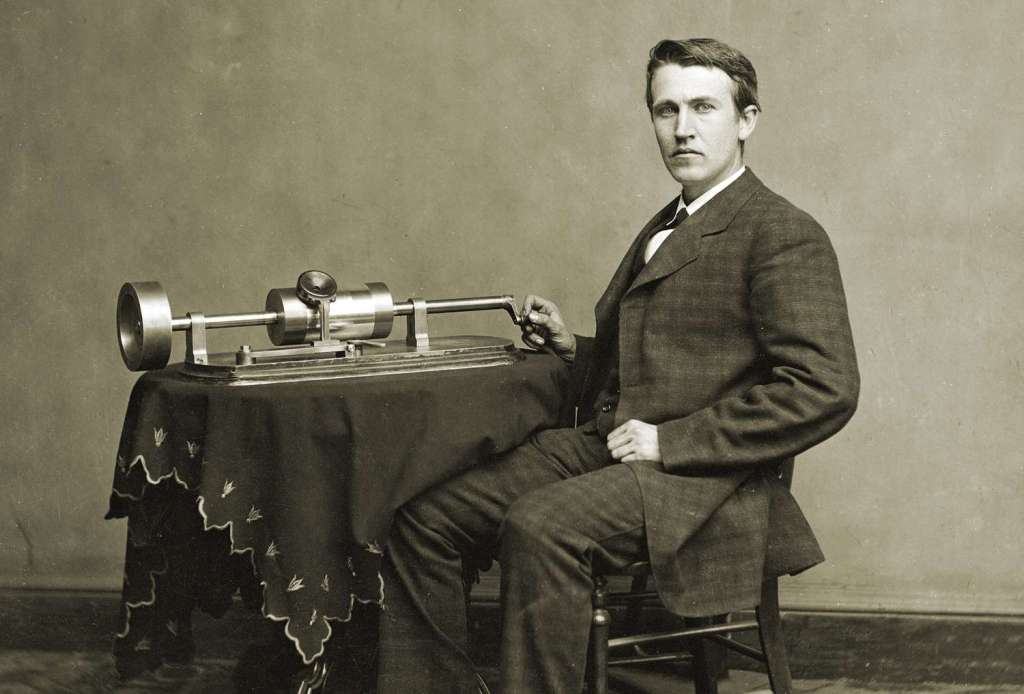
    When Thomas Edison discovered the ability to replay the voice using an invention that would become the phonograph, people couldn’t begin to fathom what they were hearing.

    When Edison started showing his new invention to individuals who had never seen anything like it before, this was a regular occurrence:

    A person would come in. Edison’s invention would be used to play back some recorded statement. The person would be asked what they just heard. The person would have no idea.

    The person would then be told that what they were about to hear was a human voice. The same recording would be replayed. The person would be able to repeat every word from the recorded statement.

    People who had never “seen” (heard) this before literally couldn’t fathom what was happening, so much so that their brains couldn’t even quantify it. How crazy is that? Makes you think how amazing it is that hearing the recorded voice has become so second nature to us. Up until 150 years ago, no human ears had ever heard the human voice from anything other than a human mouth.

    This new invention led to tons of confusion and misinformation about this device. People thought that dead spirits were speaking or the machine itself was talking. People just couldn’t wrap their minds or imaginations around the human voice being replayed.

    There is even a story of a scientist writing Edison after reading an article about the new invention/wonder in a magazine. The scientist asked Edison to issue a public statement refuting the absurdity, as it was not scientifically possible.

    This invention created a worldwide phenomenon. Thomas Edison became a celebrity overnight.

    This story leads to many interesting thoughts.

    The first interesting thing to consider is the idea of thinking about something that you can’t comprehend. When was the last time you were truly shocked by something? In the day and age we live in, nothing shocks us anymore. We’ve become numb to the fantastic world we live in. Moving stairs, cold boxes for food, flying tubes of steel, speeding metal squares: these things are amazing. We don’t even marvel at UFOs anymore, for crying out loud.

    I’m fascinated by inventors. I’m fascinated by people that can create something most of us never even dreamed possible. That was the phonograph, that was playing the human voice. Think how second nature the recorded voice has become to us. But back then, it was UNFATHOMABLE.

    The second thought that came to me from this story was, what do we really know about the world around us? We consider our society so intellectually mature and advanced, and yet, what do we really know about science? When we discover a fourth dimension, will we be shocked? When we learn there’s a spiritual realm all around us that we can’t see, how amazed will people be?

    This is also a lesson in trusting our senses. People back then couldn’t believe their eyes or ears. Today this has become a saying flippantly thrown about: “I couldn’t believe my eyes.” No, back then, they really couldn’t believe their eyes or ears. How much trust do we put in our senses? When it comes down to it, we can so quickly feel like our senses are deceiving us.

    Another noteworthy thing about this story is what the public latched onto when they heard of this invention. People got it into their heads that what was being played when the phonograph spoke were the voices of the dead. This kind of made sense. It was such a foreign concept to them, they just went to the most fantastical thing. Soothsayers and fortune tellers have existed for millennia. The natural assumption by people at that time was, if an unexplainable, miraculous, disembodied voice is speaking, it must be the dead talking.

    Not only did people jump to the conclusion that it was the dead speaking, they latched to the idea with an abundance of enthusiasm. Our fascination with the dead is endless, especially today. Why are we so enthralled by the idea? Why is it so important to us? Well, I believe, it’s because the hearts of the fathers are being turned to the children and the hearts of the children being turned to the fathers (Malachi 4:6, D&C 2, D&C 110:13-16, D&C 138:46-48, JSH 1:37-39).

    It’s our natural hope and desire to speak to our loved ones on the other side. We are drawn to them.

    There is an invention today, also from the 1800s, that is magnitudes more magnificent than the phonograph. This invention is equally as mystifying. In 1836 Joseph Smith, Jr. dedicated a temple to the Lord. This “invention” allowed the sealing of families for eternity. This miraculous invention, like the phonograph, is little understood by the world. Much of the world doesn’t realize this “invention” exists. Coincidentally, the phonograph was invented in 1877. The oldest standing Temple of God is the St. George temple which was dedicated in 1877.

    How amazing to see the temple work of this dispensation where so many of our hearts are turned to our progenitors who have already passed through the veil. When temple work is done for a family member, a real bond is created. We are all connected.

    This, I believe, is why people were hopeful the phonograph was a way for them to speak to their dead.

    The phonograph is an invention that has blessed the lives of so many with the ability to communicate here on Earth. Temples bless every person who has ever lived, does now live, or will ever live. The temple is eternal. I’m grateful to live in a time when we know of temples and of their eternal significance. I’m grateful to have temples nearby. I’m grateful to be sealed to my family for eternity. I’m grateful to know I will see all my loved ones again.

    How powerful is that? How amazing is that? We get to do work for our dead, be linked to them forever, and create a connection for eternity. Now that’s an amazing invention.


    Columbus, Ohio Temple
  • TRUTH about Heaven

    TRUTH about Heaven

    On November 19, 1823, a young man named Alvin Smith died.  The Smith family asked a Presbyterian minister to officiate at Alvin’s funeral.  “As Alvin had not been a member of the minister’s congregation, the clergyman asserted in his sermon that Alvin could not be saved.  William Smith…recalled: ‘[The minister]… intimated very strongly that [Alvin] had gone to hell, for Alvin was not a church member, but he was a good boy and my father did not like it.” (Teachings: Joseph Smith, 401, 403).

    On January 21, 1836, while in the temple at Kirtland, Ohio, the heavens were opened up to a still young man named Joseph Smith.  It was recorded:

    1 The heavens were opened upon us, and I beheld the celestial kingdom of God, and the glory thereof, whether in the body or out I cannot tell. 

    5 I saw Father Adam and Abraham and my father and my mother; my brother Alvin, that has long since slept;

    6 And marveled how it was that he had obtained an inheritance in that kingdom, seeing that he had departed this life before the Lord had set his hand to gather Israel the second time, and had not been baptized for the remission of sins.

    7 Thus came the voice of the Lord unto me, saying: All who have died without a knowledge of this gospel, who would have received it if they had been permitted to tarry, shall be heirs of the celestial kingdom of God; 

    8 Also all that shall die henceforth without a knowledge of it, who would have received it with all their hearts, shall be heirs of that kingdom;

    9 For I, the Lord, will judge all men according to their works, according to the desire of their hearts.

    10 And I also beheld that all children who die before they arrive at the years of accountability are saved in the celestial kingdom of heaven. 

    Matthew 7 of the Joseph Smith translation has an important clarification:

    Now these are the words which Jesus taught his disciples that they should say unto the people.

    Judge not unrighteously, that ye be not judged; but judge righteous judgment.

    What is, righteous judgement, then? From the New Testament Student Manual:

    “President Dallin H. Oaks explained these teachings and their application, basing his comments on the principle “that there are two kinds of judging: final judgments, which we are forbidden to make, and intermediate judgments, which we are directed to make, but upon righteous principles:

    First, a righteous judgment must, by definition, be intermediate. It will refrain from declaring that a person has been assured of exaltation or from dismissing a person as being irrevocably bound for hellfire. It will refrain from declaring that a person has forfeited all opportunity for exaltation or even all opportunity for a useful role in the work of the Lord. The gospel is a gospel of hope, and none of us is authorized to deny the power of the Atonement to bring about a cleansing of individual sins, forgiveness, and a reformation of life on appropriate conditions.

    Second, a righteous judgment will be guided by the Spirit of the Lord, not by anger, revenge, jealousy, or SELF-INTEREST(my emphasis added). …

    Third, to be righteous, an intermediate judgment must be within our stewardship. We should not presume to exercise and act upon judgments that are outside our personal responsibilities. …

    Fourth, we should, if possible, refrain from judging until we have adequate knowledge of the facts. …

    “A fifth principle of a righteous intermediate judgment is that whenever possible we will refrain from judging people and only judge situations. … We can set and act upon high standards for ourselves or our homes without condemning those who do otherwise. …

    Sixth, forgiveness is a companion principle to [this] commandment. … In modern revelation the Lord has declared, ‘I, the Lord, will forgive whom I will forgive, but of you it is required to forgive all men’ (D&C 64:10).

    Seventh, a final ingredient or principle of a righteous judgment is that it will apply righteous standards” (“‘Judge Not’ and Judging,” Ensign, Aug. 1999, 7, 9–12).”

    I will refrain from judging that minister at Alvin’s funeral who failed in almost all these points laid out by President Oaks.  I will leave that judgement to God for such behavior.

    What I will say is this:  the hateful, vengeful God that condemns young children and the ignorant to eternal hellfire, is not my God.  My God doesn’t create someone, give them a body, send them to earth, only to condemn them to eternal damnation because they never committed to a God they never heard of.

    Where is the justice, mercy, and LOVE of that God?  There is no love in that God.  That is not my God.

    My God loves all His children.

    1 Peter 4:6 “For for this cause was the gospel preached also to them that are dead, that they might be judged according to men in the flesh, but live according to God in the spirit.” 

    How can it be, then? How can men be judged in the flesh when their flesh has long since been laid in the ground and returned to the dust from which it was formed?

    Salvation for the dead through ministering to the dead.  Baptisms and ordinances for the dead.  Ordinances that the dead cannot, once dead, perform for themselves.  For we, without them, cannot be made perfect, as they, without us, cannot be made perfect (Hebrews 11:40, D&C 128:18).

    Truth.

    Pure.

    Simple.

    If this doesn’t make sense to you, please, re-read it.  Then read it again, then read it again.  New wine is difficult to fit in old bottles.  Then ask me, and maybe I can explain in better.  I know the missionaries can.

    God doesn’t condemn you or your loved ones to hell because you haven’t met or been taught of the true Him.  This is the great evil that Satan has perpetuated throughout Christianity.

    THAT IS NOT GOD.

    God is love.  You, your father, your father’s father.  He loves all of you.  And you will all be able to hear the truth before any judgement is made.  I love that God, and I am grateful for Him.  And I am grateful for Joseph Smith for these pure, simple truths that he restored.  And I am grateful for my Savior, Jesus Christ, who affords me all this: forgiveness, love, peace, eternity with my family.  Because He suffered for me.  Again, and again and again and again I say, thank you.

    To learn more about TRUTH:

    CLICK HERE