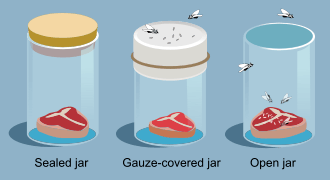
Spontaneous generation is the outdated idea that living organisms can spontaneously come from other living organisms. For example, it used to be believed that a horse was how bees were created. People used to observe that a horse would die, and bees would “spontaneously generate” from the corpse. Crazy huh? Of course, now we know better. I wrote the below for a discussion post in my Science 301 class, Understanding Formal Processes.
The once prevalent fallacy of spontaneous generation goes to show that we can be extremely wrong about simple and obvious things by relying on what our eyes tell us. When I initially started reading about spontaneous generation in Bondeson’s book, The Feejee Mermaid and Other Essays in Natural and Unnatural History, I could hardly believe that spontaneous generation was debated into the 1800s (Bondeson, 2014, p. 248). As I thought about it more, though, I understood how this theory took hold of observable logic and persisted for so long. An animal decays in the sun and maggots appear. Where did they come from? An obvious conclusion was the decaying flesh of the animal created the maggots.
Scientific progress is filled with examples of people being sure of something that ends up being absurd. The relationship between observable scientific knowledge and the scientific method is that as the scientific method is improved upon, meaning, as theories and ways of experimenting on those theories improve, scientific knowledge grows in proportion. It’s interesting to note what Herman van Booerhave said of the brilliant mathematician Girolamo Cardano, that he was exceptional when correct in his theories but, “When he advocated erroneous theories, he surpassed them all in folly” (Bondeson, 2014, p. 197).
Often, we see how outlandish proposed experiments can become. Take Paracelsus’s proposed experiment to create a human being by mixing excrements, semen, broth, and nutritious fluids (Bondeson, 2014, p. 196). While seemingly absurd, scientists have always been ridiculed for outlandish theories, and those theories only go the direction of proven or disproven by what Paracelsus proposed: an experiment. Even the most outlandish experiment using the scientific method is an improvement on assumptions based solely on simple observations.
When I was in 7th grade my science teacher gave us a very simple assignment. The assignment was to take something, anything that we could test, and observe each day, make a hypothesis, then keep the data and see if our assumption was correct. Many of my classmates repeated a couple simple observations. I wanted to be more creative. I chose to check the thermostat in my home each day and monitor the fluctuations in temperature. My hypothesis was that as it got hotter outside during the summer, the temperature would go up in my home. This seemed an obvious assumption to a 7th grader.
I was shocked when I learned, from checking the temperature every morning, that it was 72 degrees in my home every morning, no matter what. My hypothesis was foiled by the scientific progress of a simple thermostat. A device I always assumed to simply tell the temperature, I learned, was actually monitoring the temperature and turning on cool air as it got hot, or hot air as it got cool, to always keep our home at a consistent temperature. I learned from this how something that can seem obvious can be so wrong when ignorance exists. The ignorance here was a 7th grader who didn’t yet understand the simple workings of the things around him. We see in society every day how detrimental ignorance is. Ignorance exists in science, religion, everywhere around us. As we experiment and try new theories, our ignorance is lessened as we come to better understand the world around us.
What seems so ridiculous now, spontaneous generation was an obvious observation given the tools available to science at the time. In a world that debates all things spiritual – the after-life, the soul, and all things we can’t see – science ridicules theories that can’t be proven. Because science can’t prove the existence of the soul, it says there is no soul. Like those who could observe that maggots spontaneously appeared but couldn’t know how because they didn’t have the tools and capacity to do so, one day all things we still don’t understand will be proven. This includes premortal existence, the soul, spirits, resurrection, and the after-life.
There’s this secular belief that spiritual things inherently non-scientific. Those with faith understand that one day all these spiritual concepts will be proven through scientific methods. It will all be so clear to us one day, when our eyes are opened and we are given additional knowledge and understanding. What a day for science that day will be.
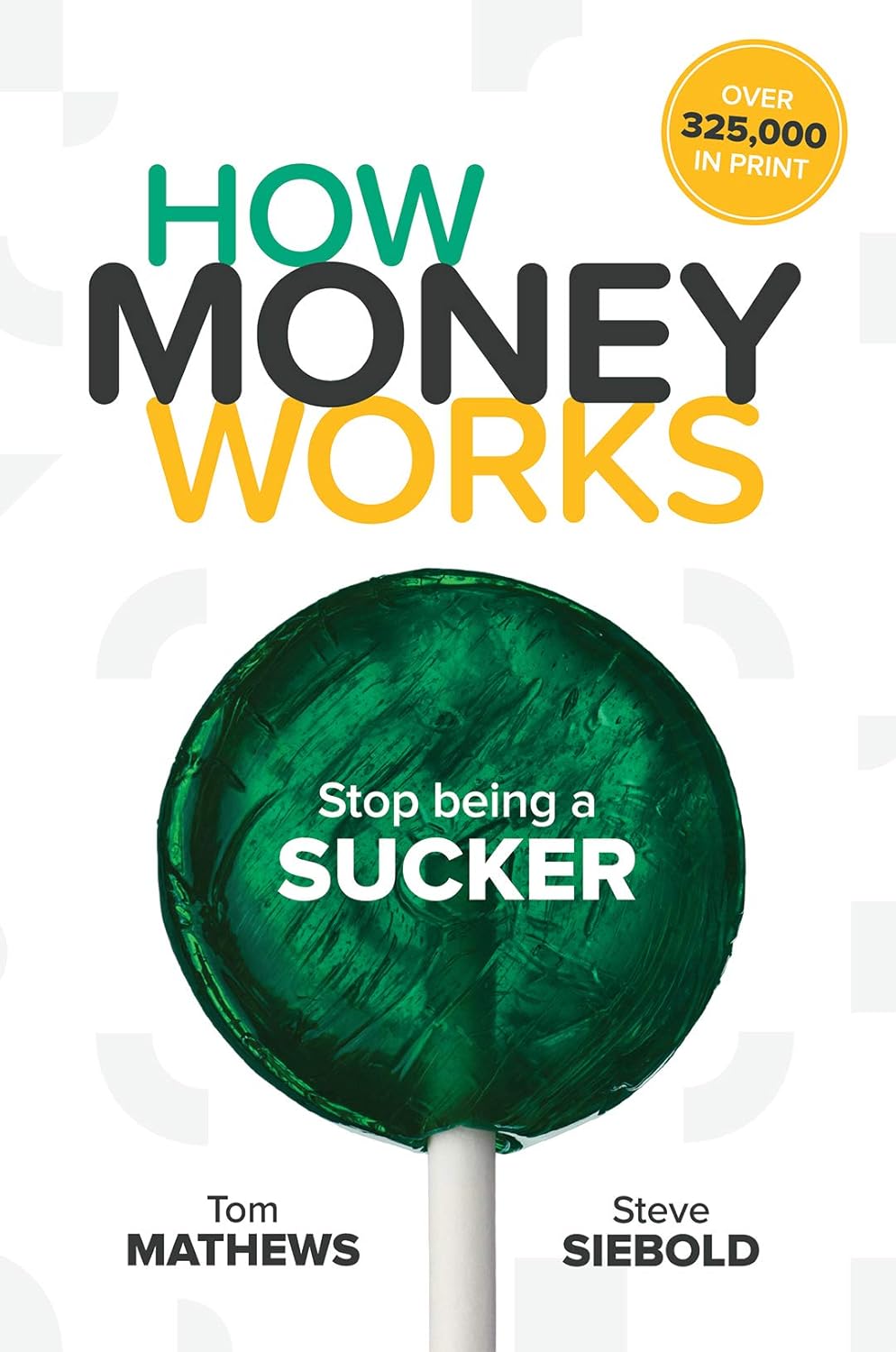
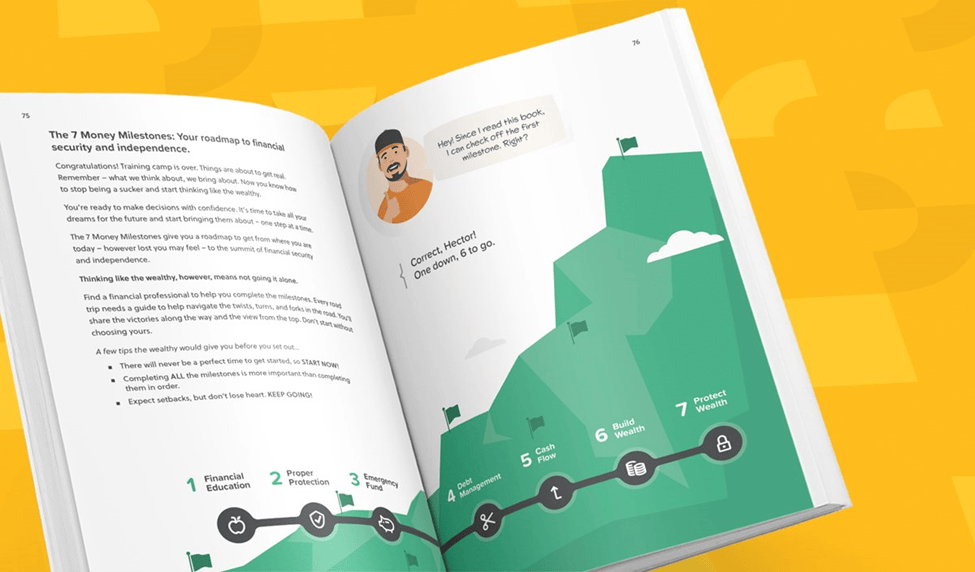
This book was given to me to help me understand finances. I’m still pretty much hopeless in this category. This book could be described as “a short read that covers financial concepts that should be taught In school, but are not.” There are so many financial concepts not covered in school that are important.
As a known financial sucker, I was grateful for this book. I seriously think everybody could benefit from reading this book. The most important thing it brought to my attention was how poorly I was handing my money and how important time was when setting up for financial stability in the future.
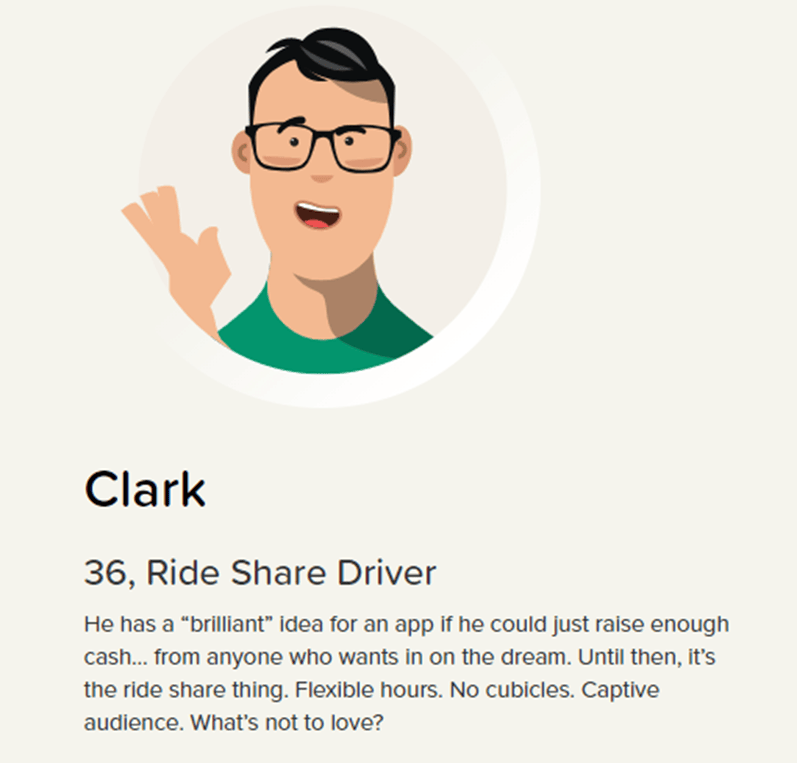
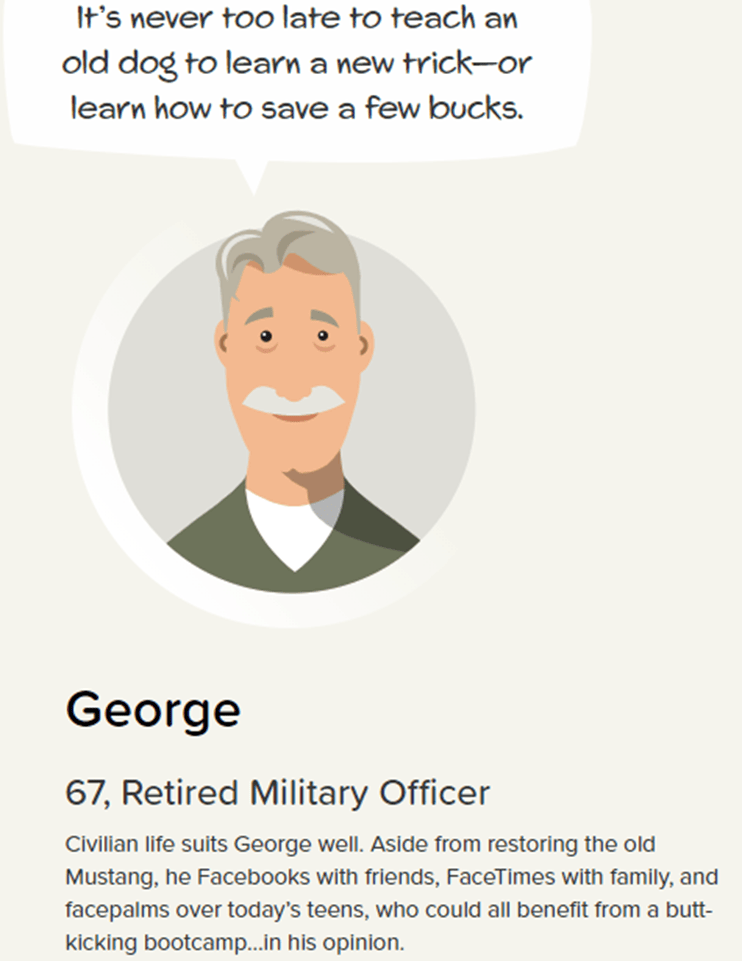
The book is written in a fun, comic book-like setup. There are pictures throughout. There are characters you’re introduced to in the beginning that the book uses to have conversations with and teach financial concepts without putting you to sleep. I appreciated this structure a lot. As someone who struggles looking into these financial concepts because of all the words I don’t understand, concepts I’m unfamiliar with, and it’s sooo boring, this book helped to easily and quickly give the overview of what important information I needed to know.
I found myself relating to two of the characters for various reasons.
Clark –
And
George –
Clark because I have lots of brilliant ideas (and he’s kind of the dummy character in the book) and George because I think I’m already a grumpy old person facepalming over teenagers.
I’m lucky to have people in my life who have already started helping me get my finances organized and make money “work for me” better. We’d all like to retire at some point. Moving forward, social security is an uncertainty. It’s up to us to prepare for our retirement.
As I have a third daughter on the way, life insurance has gone from something I laughed at to something that seems absurd not to have. I couldn’t imagine passing away and leaving my wife and daughters with nothing, let alone with potential debts and financial responsibilities to take care of.
If you don’t have a life insurance policy – get this book and then get one. It doesn’t matter if you’re 20 years old. In fact, it’s better if you’re 20 years old. The earlier the better. The book did a great job of showing this principle with graphs. The earlier you invest even a small amount of money, the more time it has to grow, with no work on your end.
Here’s an interview with the author on Good Morning Texas:
On 11/2/24 I learned an Olympic Triathlon includes a .93 mile swim, 25 mile cycle, and 6.2 mile run. I also learned an Ironman includes a swim of 2.4 miles, cycle of 112 miles, and run of 26 miles.
I learned this at the tail end of completing roughly 2x an Olympic Triathlon or roughly ½ an Ironman. At no point, until I was near the end of this challenge, did I know that’s what I was doing.
Here is the story.
The word Misogi is a Japanese word that means “water cleansing.”
Misogi has come to represent a challenge that pushes your limits to help expand what you believe is possible.
There are two requirements to a Misogi challenge:
1 – There must be no risk of death.
2 – There must be at least a 50% chance of failure.
I heard about the concept of a Misogi a few months ago. I immediately started putting together my list of possible Misogi challenges.
Another important aspect of a Misogi challenge is that it should be unexpected. The idea is to be physically and mentally prepared at all times.
I discussed it with my brother when I first heard of the idea. He had heard of it already. I sent him my list of ideas.
Flash forward a few months and Misogi couldn’t be farther from my mind.
Beth had an unknown appointment on our family calendar labeled “Beth Plans.” Mysterious. I assumed it was a shopping appointment or something. My second hint was my work’s on-call schedule was being put together and I asked Beth about “Beth Plans.” She let me know I would not have cell service all of Saturday.
I didn’t have much time to think about this though, because life is busy.
Friday night I went to sleep not knowing what was happening the next day.
I woke up to a message from Beth:
“Pack a bag with:
Swimsuit and goggles and towel
Running clothes and good socks (including your basketball tights)
Wear:
Basketball tights and basketball shorts
Athletic top
Athletic jacket
Your best shoes for running
Good socks”
30 minutes later I opened our front door to my mom and dad, brothers Garrick and Easton, and soon-to-be sister-in-law Arielle.
It wasn’t until then that I noticed the last line of Beth’s text:
“Stretch like you would for basketball.”
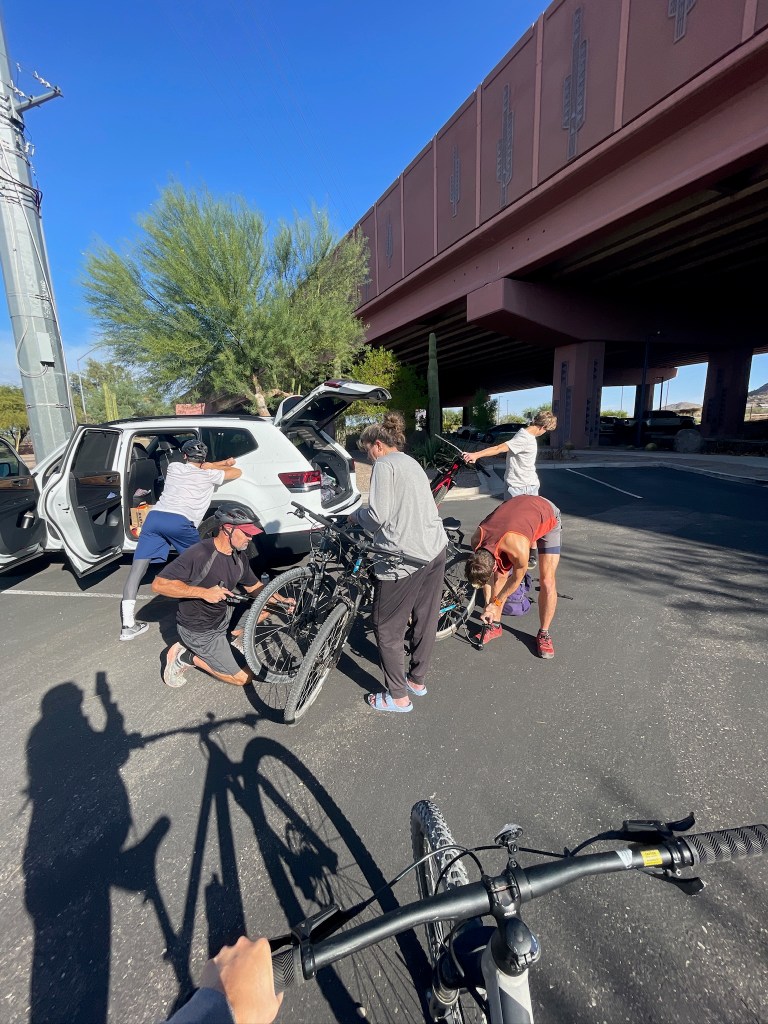
I got a little stretching in before I was off to I didn’t know what. I received another hint from the bikes on the back of my parents’ car. It was during the drive that I learned we were doing a Misogi.
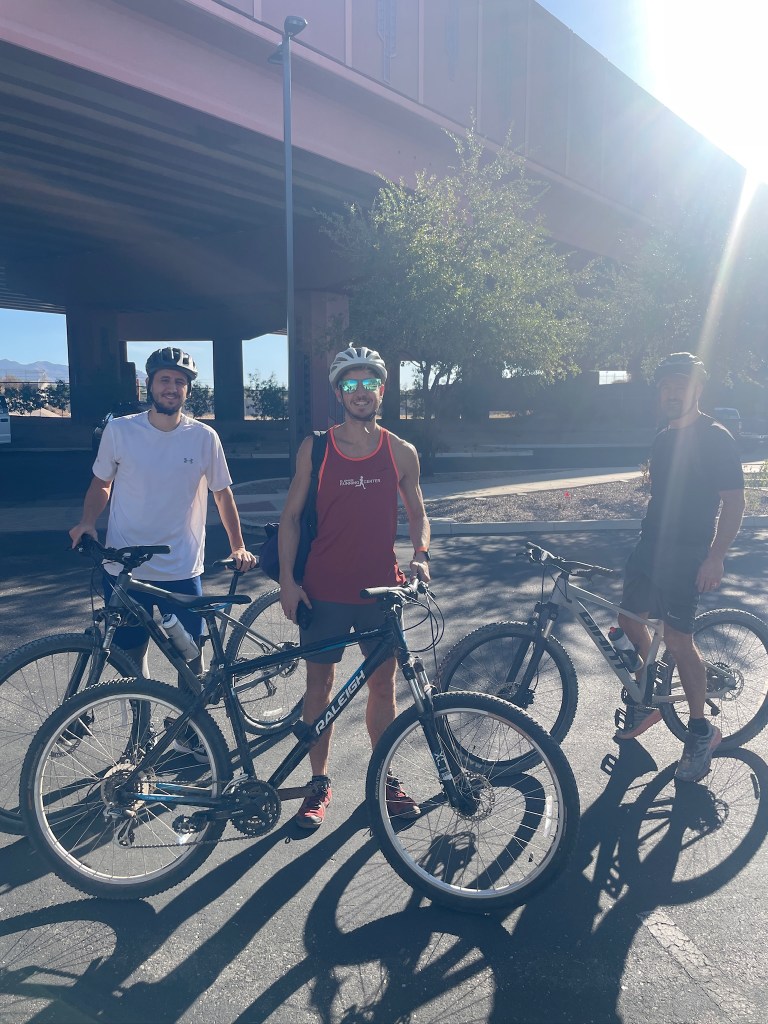
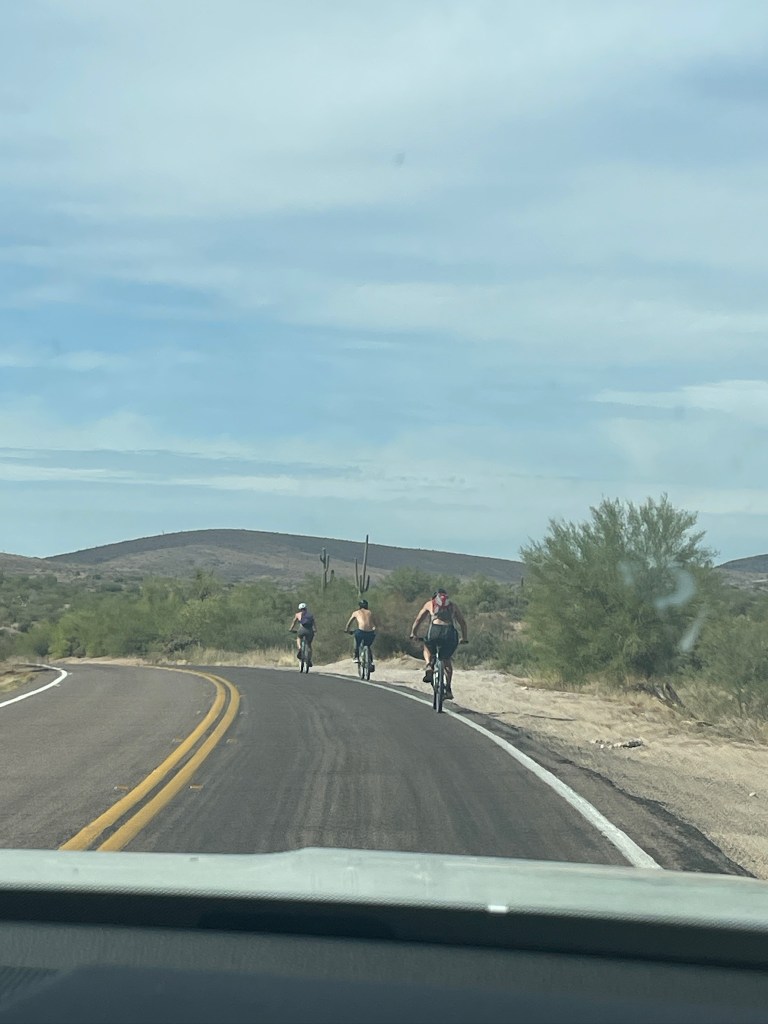
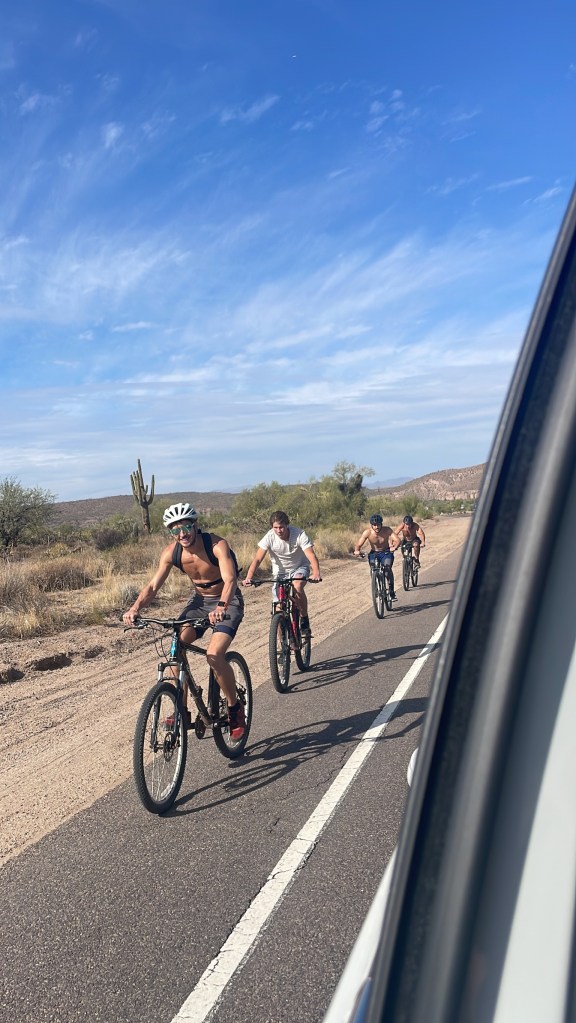
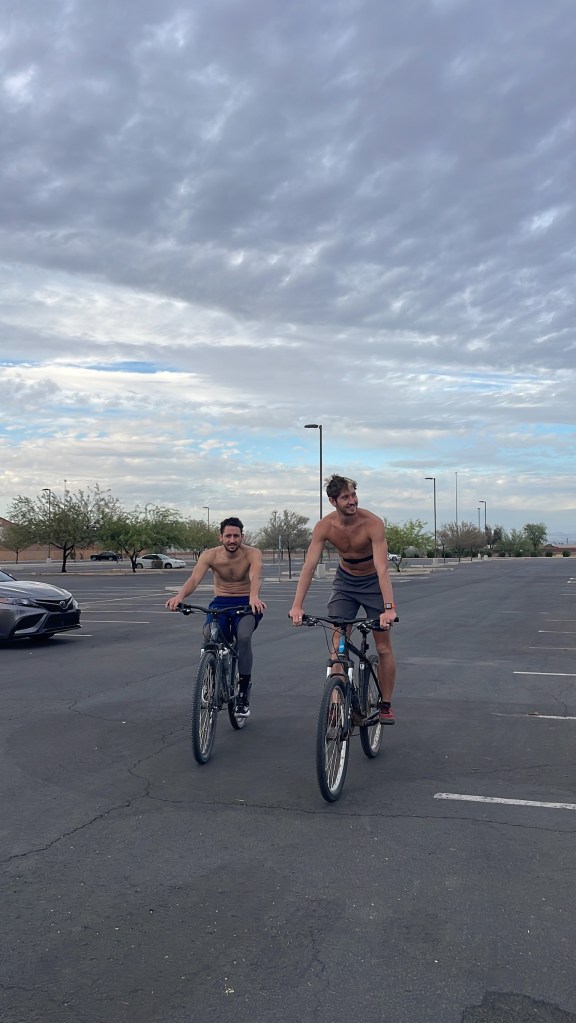
We drove to P+R Power Road. My dad, Garrick, Easton, and I mounted our bikes and started for the mountains to Butcher Jones Recreation Area:
We biked 16.55 miles in 1 hour and 23 minutes.
There were stretches during this 16.55 miles that I thought, “This is it? Surely Garrick planned something harder than this.” Careful what you wish for.
I spent much of that 16 miles breathing, meditating, and praying in gratitude for a family that not only let me do crazy things but planned crazy things for me to do.
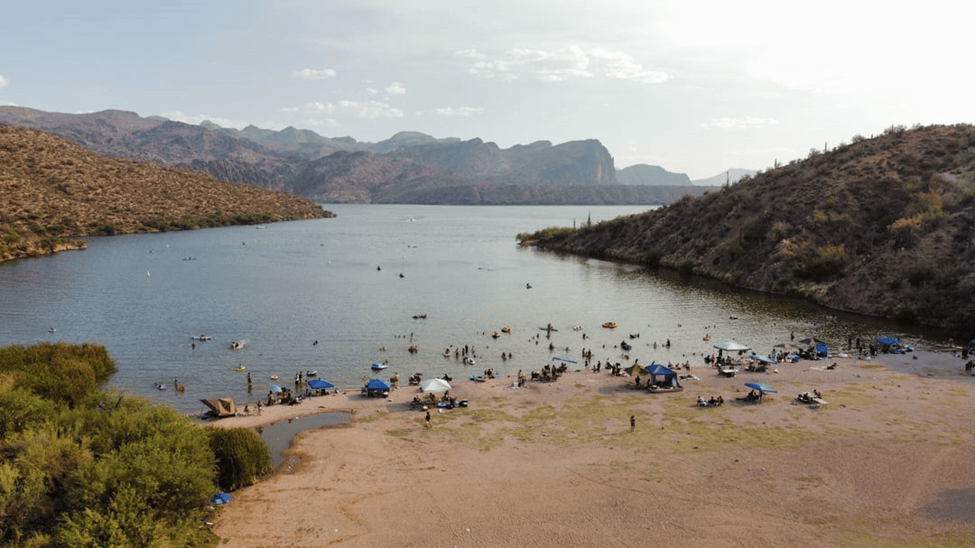
We got to Saguaro Lake. I’d never been there. It was a beautiful lake.
I was told we were swimming. Before I changed into my swimsuit I emphasized that I wasn’t sure I could swim at all. But I’d try. Our trail car had gone ahead and we took a kayak into the water to make sure we didn’t drown.
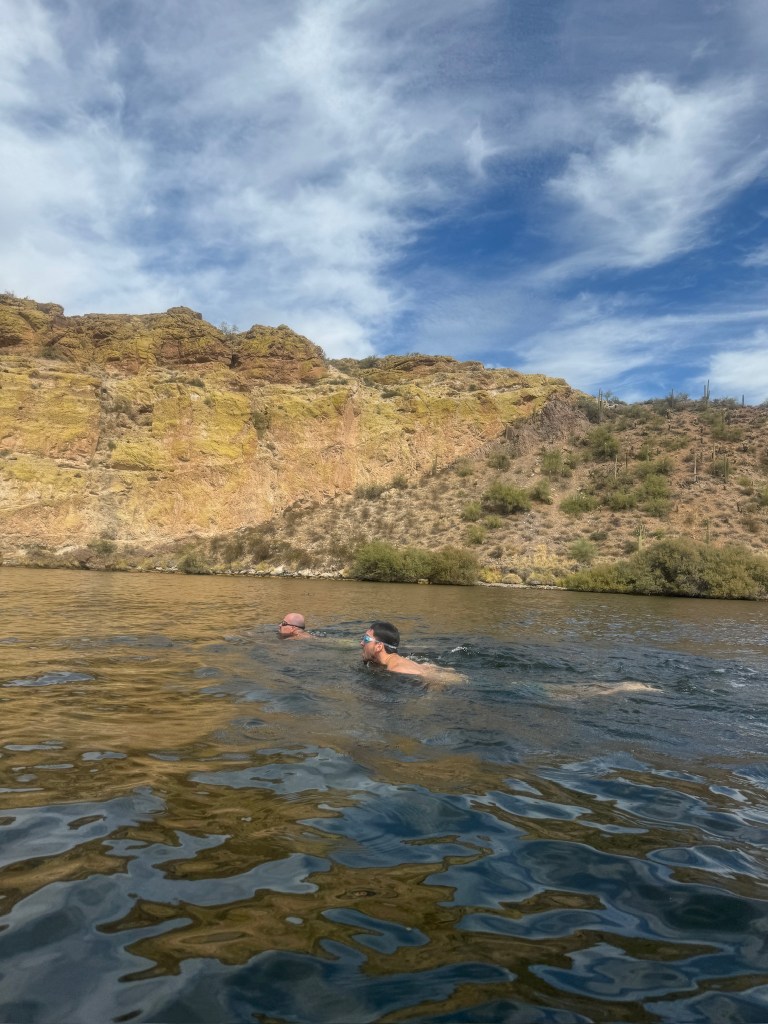
As we stepped into the water, it was freezing. Remember this was November. Garrick said it was the perfect temperature for a long-distance swim. He almost convinced me. We started swimming. We swam along the side of the lake. We swam out to the edge and Garrick said we could swim back. I realized we didn’t have a destination, just a distance to accomplish.
We swam back toward shore and started swimming back out again. On the way back out to the edge I asked Garrick, for the first time in any of this, how long we were swimming. He said 1 mile. Oh, great, we could do that no problem. How far had we swum? I asked. I was thinking we’d already done half a mile and I could easily do what I’d done so far one more time. 0.2 miles was the response. What?!
We started swimming out around the edge. We lost Easton. He stopped along the side of the hill next to the water. The rest of us went out into open water. Multiple parts of my body were starting to cramp. We got to a rocky shore around the edge and all of us started to shiver uncontrollably.
In hopes that movement would warm us up, we dove out into the water again. I realized movement was not helping. I was completely numb. We’d done roughly half a mile and I was shaking uncontrollably. Garrick finally admitted it was cold. We had swam .5 miles in 40 minutes.
We got back to the rocky side shore, apparently less than .2 miles from starting shore, and were ferried back one at a time as my groin/hamstring/leg/neck cramped repeatedly. My dad’s feet were white/blue. Garrick was practically convulsing with shivers.
When I got taken to shore I went and sat on a park bench in the sun to warm up. I found myself staring in fascination at ants. I think my brain was low on oxygen or something. I felt funny.
We got back to the car and I was told the joke made earlier – that we were biking back – wasn’t a joke. I said I seriously didn’t think I could do that. Most of the final mile or two of that 16.55 miles to Saguaro Lake was straight downhill. So, being the brilliant person I am, I realized the first two miles out of here would be straight uphill.
For the second time that day, after saying I didn’t think it was possible, I mounted my bike and tried.
Easton decided not to join us on this stretch of the bike ride.
Those couple miles uphill were moderately strenuous. But I realized it was a relatively moderate incline. From there it was an easy 2-mile coast to our next checkpoint.
I was feeling great. Bring on the world.
We did a quick water/nutrient refill. Easton, having bailed on the last bike ride, was having major regrets so he joined back up for the next stretch.
We discussed our options. The plan was to take a more scenic route back to our original starting point at P+R Power Road instead of going the way we had come. Bring it on. Little did we know.
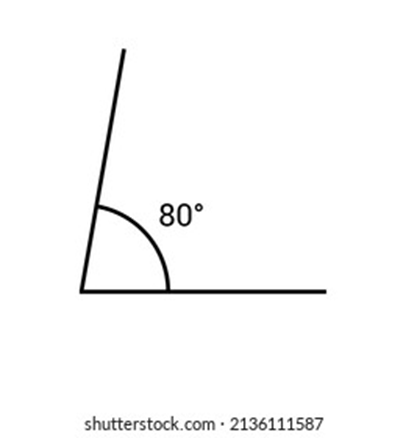
Usery Mountain Pass. It must have been an 80-degree incline
For those who don’t understand math, that’s a joke. Point is it was steep. It was straight uphill. We didn’t know that until we kept going… and going… and going… and going… all uphill.
At one point we finally took a break. Legs were about to give out. Chests were rupturing with exploding lungs. Hearts were failing.
“It’s gotta be downhill at the end of this last incline, at that curve up ahead.”
Yeah… sure, Garrick. Just like that water at Saguaro Lake wasn’t cold. In our hearts, we knew better. We’d all thought the last dozen curves up ahead would lead to our desired downhill. They all continued to go upward.
That was 4 miles straight uphill. We took two breaks. It was brutal.
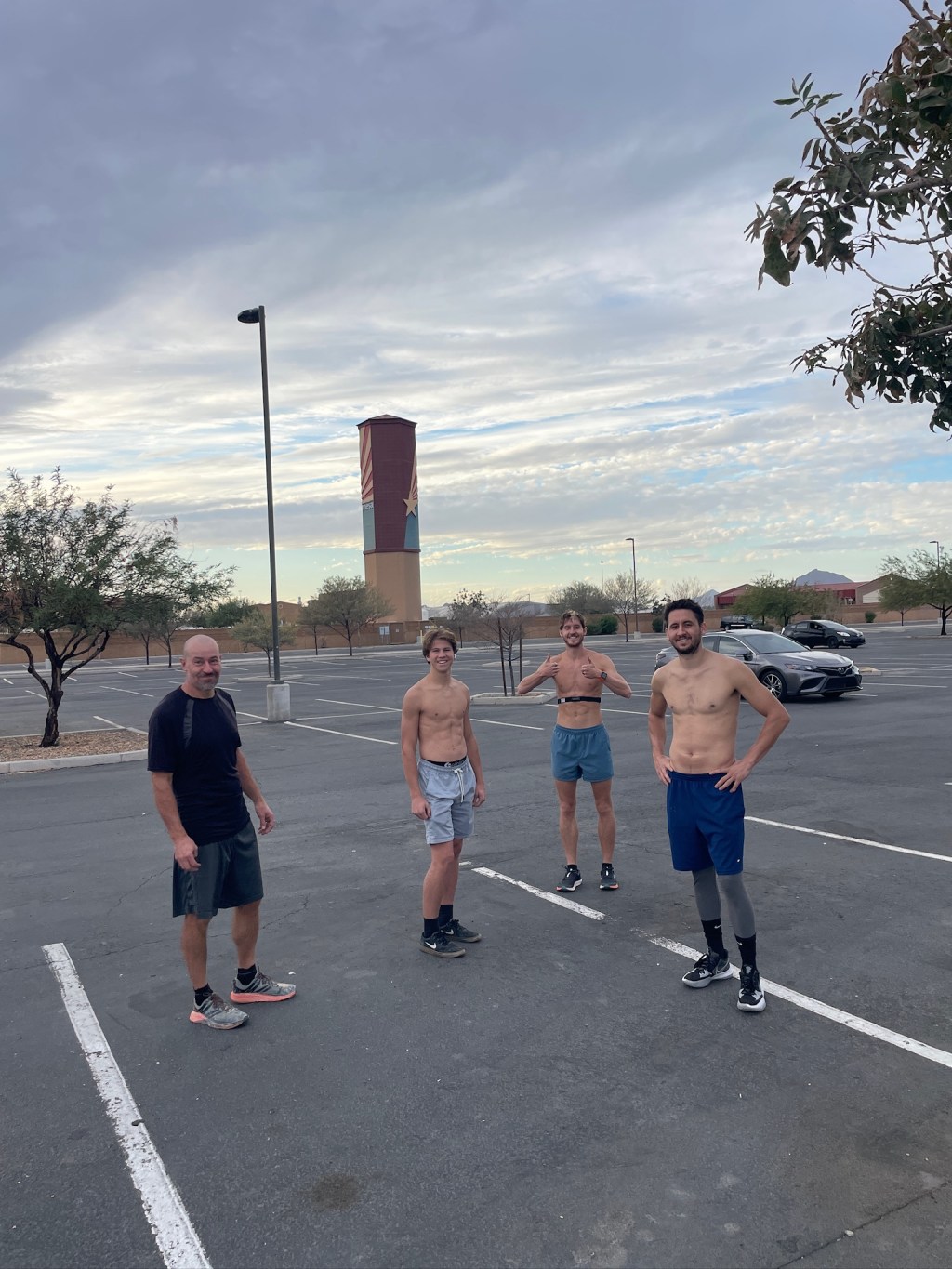
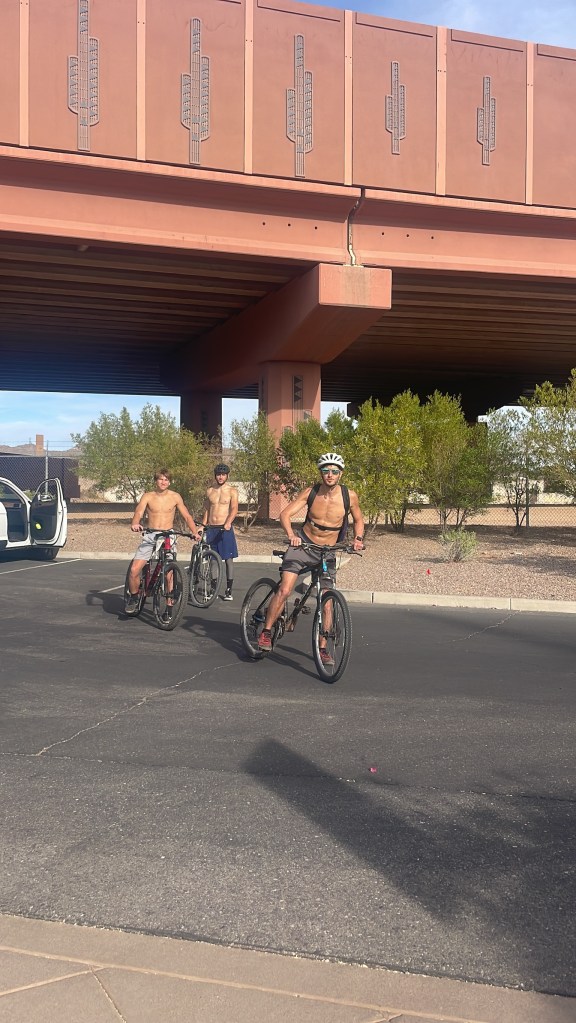
It was so strange coming out of the trail back into society. It’s not like we travelled out into a wilderness but… I guess we kind of did. We went from this mountain pass to starting to see a smattering of houses, to suddenly going over a highway overpass. I wondered what we looked like to civilized folk. Disheveled, shirtless, covered in lake and other gunk. We were suddenly thrust back onto paved roads with real bike paths.
The good thing about going up is you then get to go down. Though, those four miles were so long and arduous I did start to question the laws of physics. Eventually, we did come to a peak. The way down was much more enjoyable.
We got back to our car where my mom and Arielle were waiting.
Remember, I never knew what was coming next. Like biking straight uphill, with the thought of a peak and downward slope to come, I approached every checkpoint wondering if this was the end, or at least close to it.
I cautiously monitored reactions, trying to get a read on the situation. Garrick was constantly making jokes about what was next. It wasn’t until the very end of the Misogi Challenge that I realized Garrick was never joking. His comments just seemed so ludicrous and impossible that I assumed they were jokes.
As we sat around the car, me gauging the situation, Garrick said we had 20 miles to go on the bike.
“Not going to happen.” My reply.
But, my body hadn’t given up yet. I asked if there were any 4-mile uphill stretches to contend with. I was assured it was level ground to our next stop.
Here’s the thing, when you haven’t been on a bike for more than a 30-minute stretch in at least 5 years, miles 30-50 are pretty hard, no matter the terrain or steepness.
My dad decided to take a break. Seemed like his bike was vastly underperforming to the other three so it was a smart decision. Garrick, Easton, and I mounted our bikes and started off.
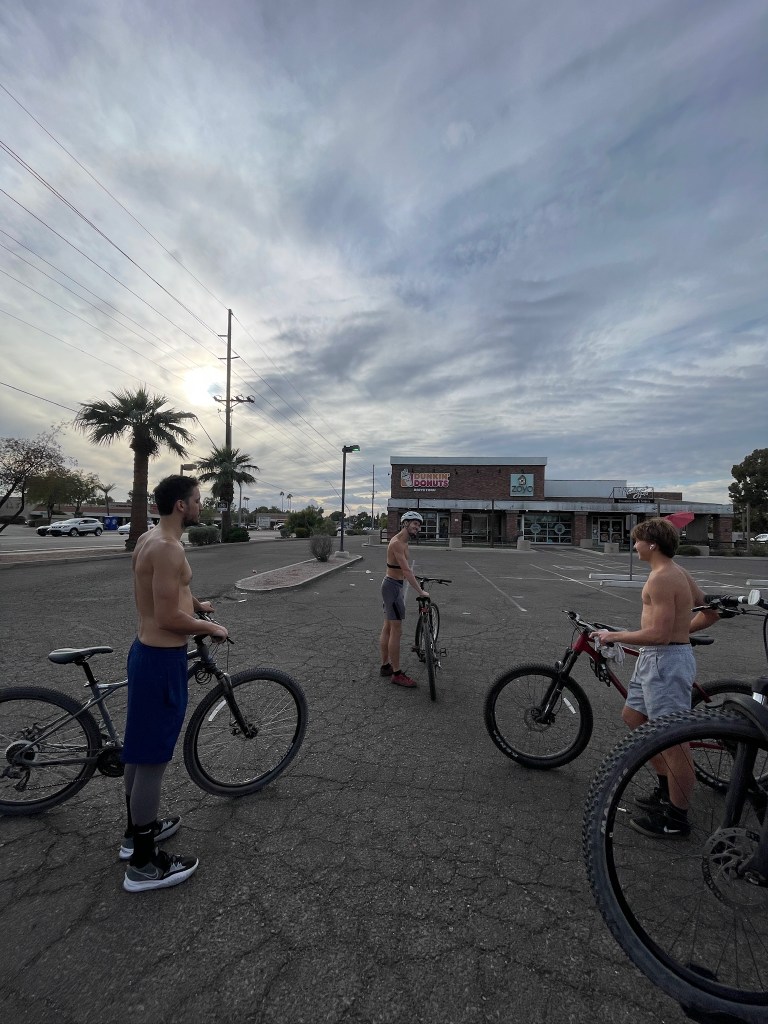
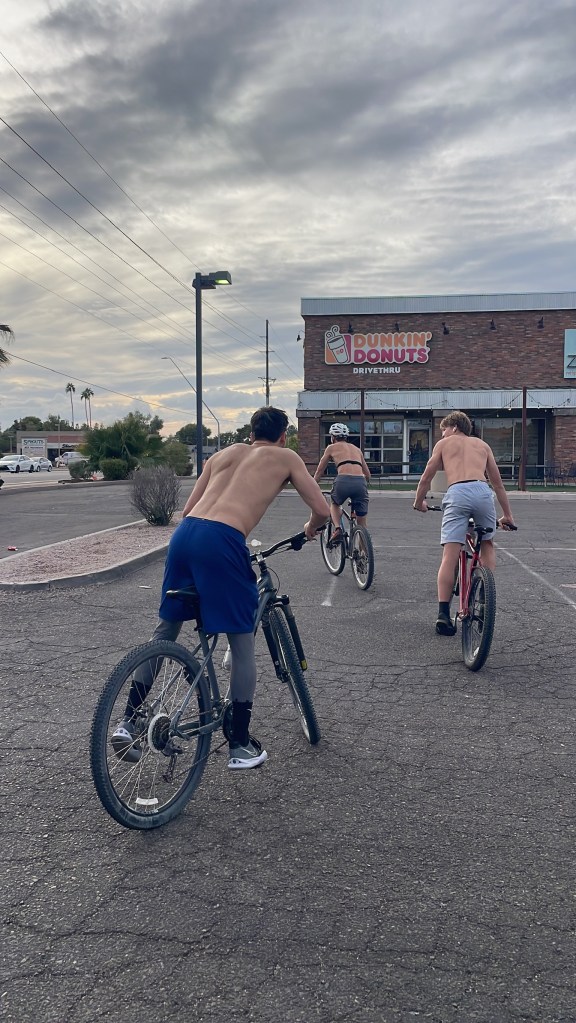
We rode 10 miles to a Dunkin Doughnuts. As we approached the Dunkin my hamstrings started to cramp so bad that I had to stretch full length any chance I got to coast on my bike, which wasn’t often. The thing with level terrain is you’re peddling almost nonstop.
At Dunkin I chugged as much water as I could. I felt like I drank too much water and might throw up. I told everyone I would try the last 10 miles but warned our trail car to be ready to come pick me up. The water chugging apparently saved my cramping for another 10 miles. I only had to stop once and stretch my legs. After that, I was able to make it.
Proof of Dunkin Stop
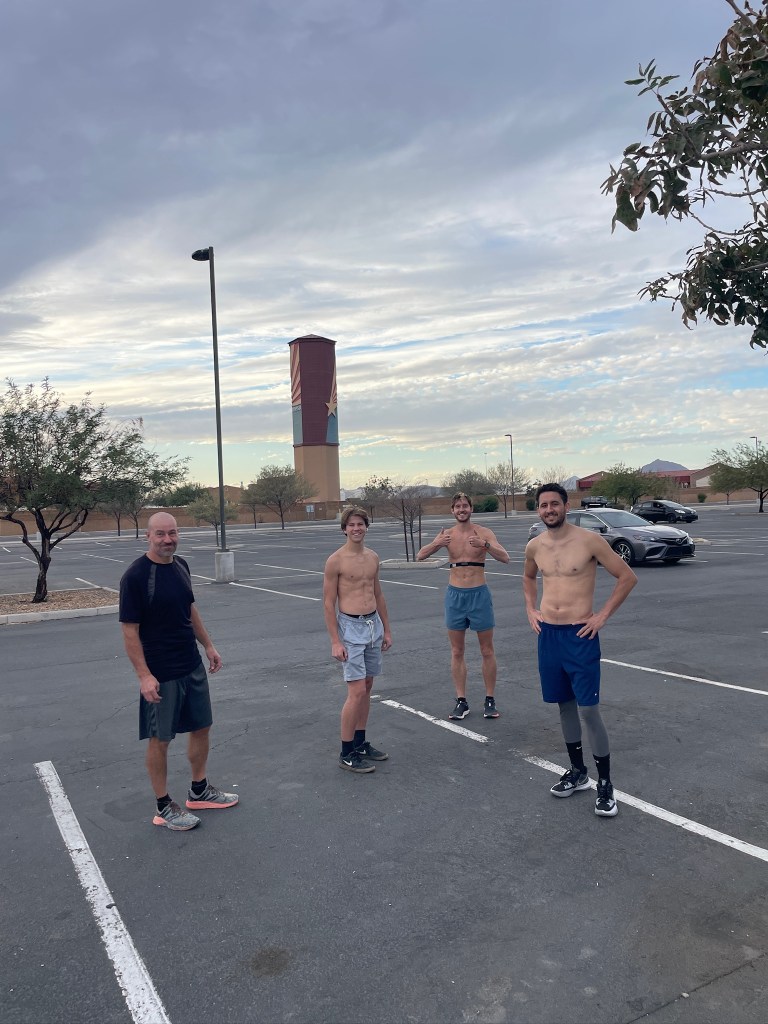
We rode our bikes to a parking lot at a park near Rio Salado Pathway. As we approached the car, I asked Garrick how many miles we had done total on our bikes. 49.25. That’s no good. So we rode around the parking lot 3 times to hit an even 50 miles on the bike.
Tally so far:
50 miles on bike.
½ mile freezing swim.
I could barely walk.
What now?
Garrick asked me the most continuous miles I had ever run. I said probably 2 miles. Everyone laughed.
A 13-mile run was planned.
Again I thought he was joking. How many times during this adventure had I said, “Not going to happen”?
Yet again, I decided I’d try. This was the point of a Misogi after all.
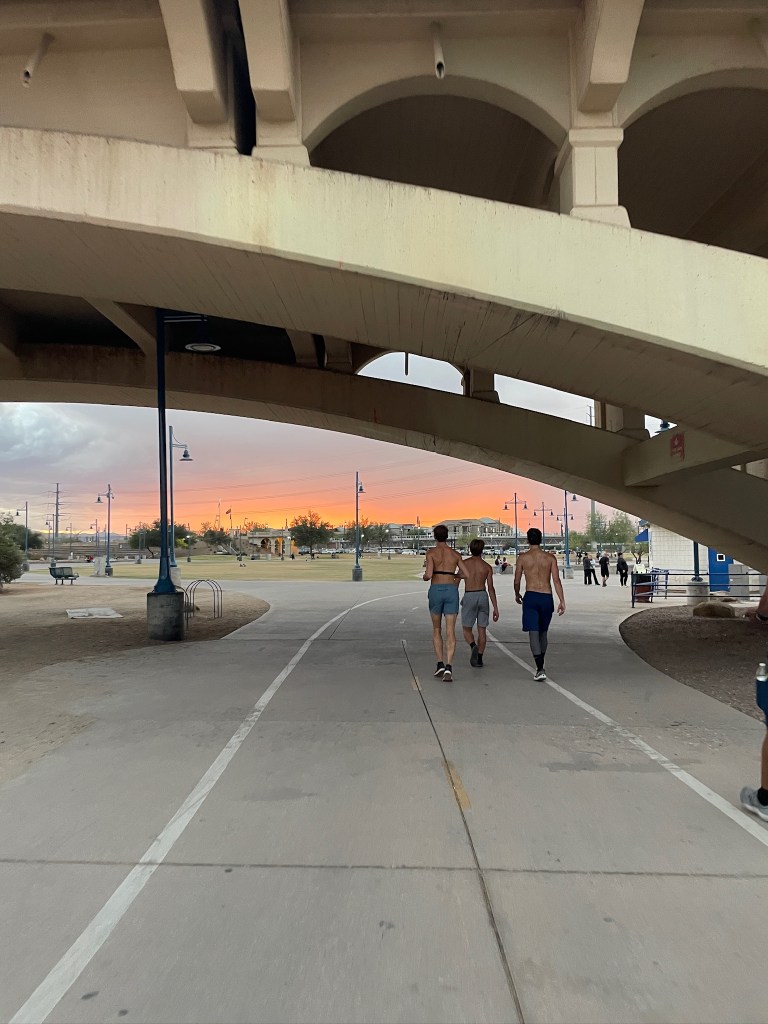
My mom and Arielle rode bikes along with us on the trail as we started jogging. “Jogging” may be a generous term. I was putting one foot in front of the other, I’ll say that.
I did roughly 0.75-1 mile jog, 0.25 mile walk for 11 miles. It was going to be 10 miles but somehow we missed our turn on the way back and ended up going half a mile further than intended. All I can say is my mind wasn’t functioning at full capacity.
By the end, jogging was nearly impossible for my body. I won’t say impossible. But a lot of things were starting to give out.
We coordinated dinner and met Beth at a Mexican restaurant. When we arrived Sage was screaming but happy to see me. I almost turned down holding her, afraid I would fall with her in my arms. For the last time that day, I did something I wasn’t sure I could do. I held Sage and stayed standing, one step in front of the other, to go get a table reserved.
We started our journey at around 9:30am and walked off Rio Salado Trail around 7:30pm.
What I learned:
As with any Misogi, I learned the primary lesson: we can do much more than we think we’re capable of. Our bodies are capable of amazing things.
Another thing I learned was how much a break could do for the body. When we were on that uphill climb on Usery Mountain Pass, I was sure I would need to start walking my bike. My legs felt like they were completely done. I wasn’t sure I could walk my bike, but I “knew” I couldn’t ride it. We took a 2-minute break and I felt like a new man. It encouraged me to know that, no matter how much it seemed like my body was giving out, all it really needed was a short reprieve to be able to pick right back up.
The same thing happened in those last ten miles of biking. When my hamstrings were both cramping, all I needed was 5 bottles of water and a 5-minute break and my body was able to keep going. When I thought I would die jogging, I would start walking, and I could jog again within a couple minutes.
The whole day was more a mental battle than a physical battle. If I’d known what was in store, I may have given up much earlier in the day. I always thought, “Maybe this is it,” which kept me putting one foot in front of the other.
There are already whispers of plans for next year’s Misogi Challenge.
I often make the comment around certain individuals who I know will understand my meaning (like my wife, close friends, people from church), that God will provide/protect/etc.
An example of this recently was when my tires were extremely worn. Beth took them to get them checked and the mechanic was shocked. He said he was shocked a tire didn’t blow on the drive over. Beth let me know and I responded, “I looked for a gif of “God protects” or God saves” or “God will provide” but they’re all blasphemous. But for real. Love that guy.”
The blasphemous part is why I’d be careful how and who I’d say this around. I wouldn’t want anyone to think I’m taking this lightly or making a joke of it.
I live my life with a serious belief that God is watching out for me daily. I firmly believe He kept a tire from blowing up on my car even though it probably should have.
I know that if bad things happen to me, they’re for my growth and ultimate benefit. I know that when good things happen to me, God is blessing me and watching out for me.
Now, I know that someone with no faith or someone who doesn’t understand my way of thinking would look at this as a naïve, blissfully ignorant way to live life. I, on the other hand, think living without faith is a sad way to go through life.
I know that all things have a purpose. I know this life is extremely significant, every single moment of it. I know good or bad is ultimately for my good. Isn’t that kind of amazing? It is to me.
I recently did a meditation that I couldn’t get myself into, I disagreed so much with the premise. I can usually go with the flow with any guided meditation, at least the ones I’ve done. Often the guided meditations lead to spiritual thoughts. This meditation led to a spiritual thought, but not in the normal way.
The voice leading the meditation stated, basically, that we are on this big rock floating through space. None of us know why we’re here or what the true purpose of all this is. The meditation continued advising to set that aside for a moment and focus on your breathing, etc.
I stopped right there. In my mind I thought, but I do know why I’m here, I do know the purpose of all this. I couldn’t get behind the premise. It’s a common theme of my writing. Where we come from, why we’re here, where we’re going. It hit me that 99% of people listening to that meditation probably don’t bat an eye at that statement. Most people probably gloss right over it like, “Yeah, I don’t know what the meaning of all this is.” That makes me sad.
I just started a new book that talks about the temporal nature of this life and how silly it is to one, not believe in the things we can’t see, and two, put so much stock into the things we can see, even though they’re so temporary.
The book asked what I ate 2 weeks ago. I had no idea. It made an interesting point. Food and water are the most critical thing to our survival. We can’t survive without them. Yet, what did you eat 2 weeks ago? You don’t even remember. What about the car that you love then 8 years later is a clunker. Or the house you cherish but inevitably becomes dirty, beat up, and cluttered with other stuff that is inconsequential. The book talked about how much stock we put into these things.
How many of us consider why we’re here or where we’re going? How many in the world live in complete ignorance, not wanting to consider these great questions? It amazes me.
We can’t see or describe heartache, fear, doubt, love, the wind, and yet they exist. Faith exists. Our soul exists. Eternity exists. God exists. These are the things that matter. I wish our society could spend a little less time with a Netflix special they won’t remember a year from now and consider more the purpose of this life.
The purpose of this life is God’s plan to make us stronger, better, and more like Him. We knew God before we came here. We will remember Him when we leave here. This life is so important. Not for food, or water, or cars, or homes, or Netflix, but for the faith we build, the experiences we go through, and the families and relationships we cultivate. I wish this is something we could all remember more.