Author: Brayden Quackenbush

  • Defense of Love You Forever

    Defense of Love You Forever

    Love You Forever written by Robert Munsch and illustrated by Sheila McGraw.

    Beth made a big mistake and I’m calling her out here. She has criticized Love You Forever. For those unfamiliar with this fabulous children’s book, you can watch a 5-minute video HERE to have it read out loud to you. Or you can just read my quick summary here. I suggest you watch the 5-minute read-aloud video, but prepare for the waterworks.

    Love You Forever takes you through the life of a baby boy, who turns into a toddler, who turns into a teenager, who turns into an adult. Throughout the book the mother occasionally comes into her son’s room at night and rocks him to sleep singing:

    “I’ll love you forever,

    I’ll like you for always,

    As long as I’m living

    my baby you’ll be.”

    I won’t spoil the ending for you, but that is the gist.

    I’m just going to say it: I have a hard time getting through this book when I read it to Ivy or Sage. It’s emotional thinking about them growing up to have their own house and yet, still being my babies.

    Beth, on the other hand, has orchestrated an all-out assault on the precious, nostalgic, loved book. I tried to reach out to Beth for a record of that social media post. Apparently, she burned the evidence.

    Recently Beth shared a mom forum post from a couple people who agreed with me. They said the book made them emotional. This led to Beth and I discussing the book, yet again. You’d be surprised how much this book has been discussed between us. Enough for me to take it to the blog!

    Beth says it’s weird that the mother in the book is breaking into the house of her son as a grown man and rocking him to sleep. I say she needs to understand and appreciate the metaphor in this story. Obviously, the mother isn’t breaking into her grown son’s home. It’s metaphorical. It is a beautiful, powerful, and emotional metaphor.

    I told her she’d rue the day she attacked this book.

    So, Beth and I were discussing it yet again. We were talking about the book over text. There was mudslinging going on. Threats of keys being given to her dad with approval to come into our home and rock Beth to sleep. Claims of emotional vacancy and lack of metaphorical understanding.

    Amidst these joking exchanges, we were also discussing an upcoming trip. I was driving with Ivy that day after work to Las Vegas. Beth was flying to Utah to surprise her sister for a bridal shower. Beth was taking Sage with her. It was going to be the first time Beth was ever away from Ivy for any serious amount of time.

    That’s when, right in the middle of our Love You Forever discussion, Beth said this:

    ”Take good care of her. I know you will but it’s hard to let go. Remember truck stops are not safe places. And don’t forget to keep the back door shut so she doesn’t slip into the pool when people are busy playing games. Listen to her stories and give her hugs when she’s sad. It’s okay to help her be tough but also needs love. Drive extra safely. She’s my life! FaceTime me!”

    Apparently, Beth is lacking in irony awareness along with metaphorical awareness. The irony was not lost on me.

    I replied, “It’s like you’re metaphorically still going into her room every night to rock her to sleep. Are you going to be ok? (You attacked the wrong book).”

    And with that statement, I won. What do you think about Love You Forever? Who’s got it right? Is it creepy or beautiful?

    **Mandatory disclaimer for those who may misinterpret my jest as actual insults. Beth is the smartest, most intelligent, most aware, and understanding person I know. That’s why I married her. This is all in good fun. I don’t actually think she doesn’t understand metaphor. Now sarcasm… that she definitely struggles with.

  • Ivy Thoughts Part 2

    Ivy Thoughts Part 2

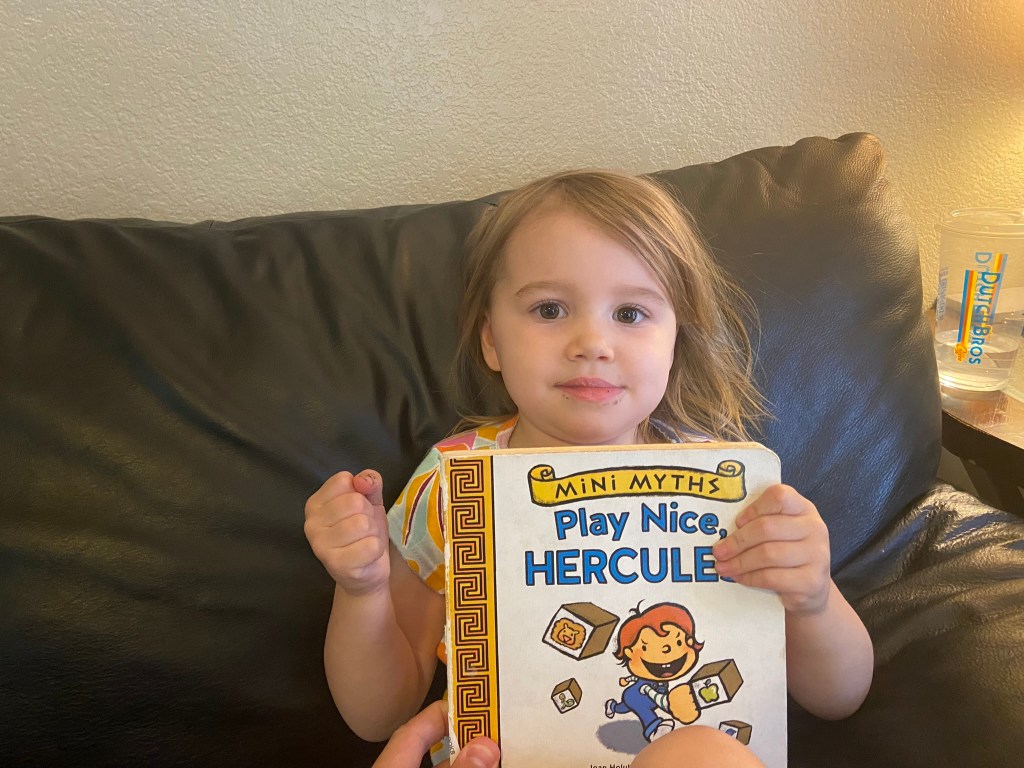
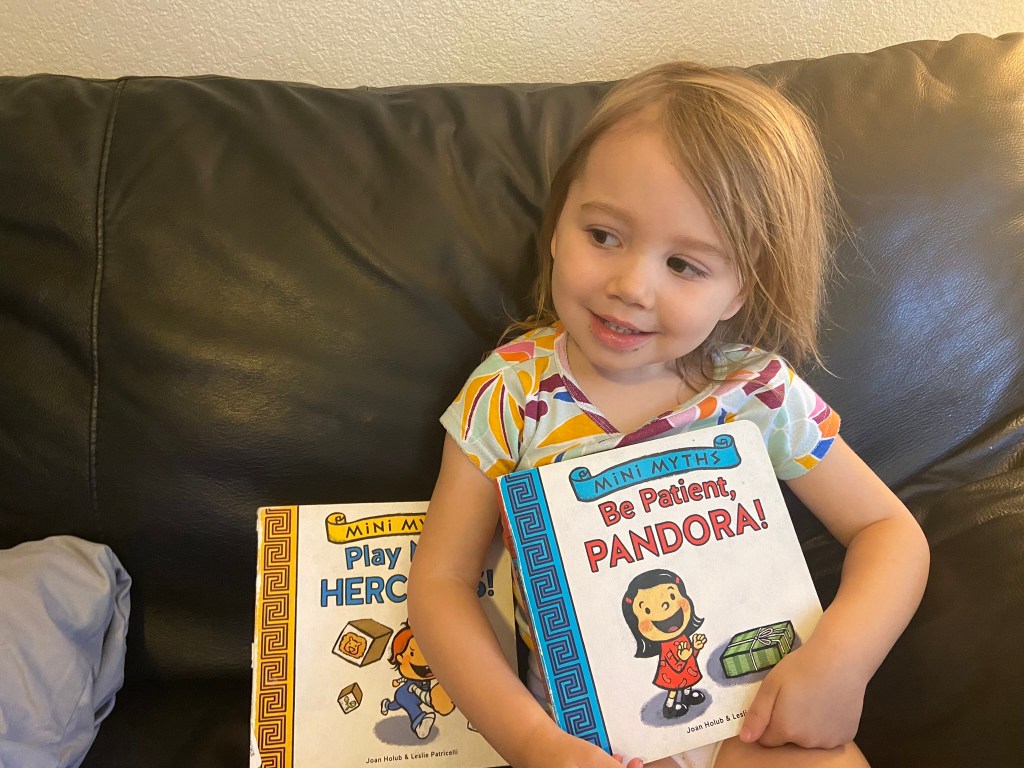
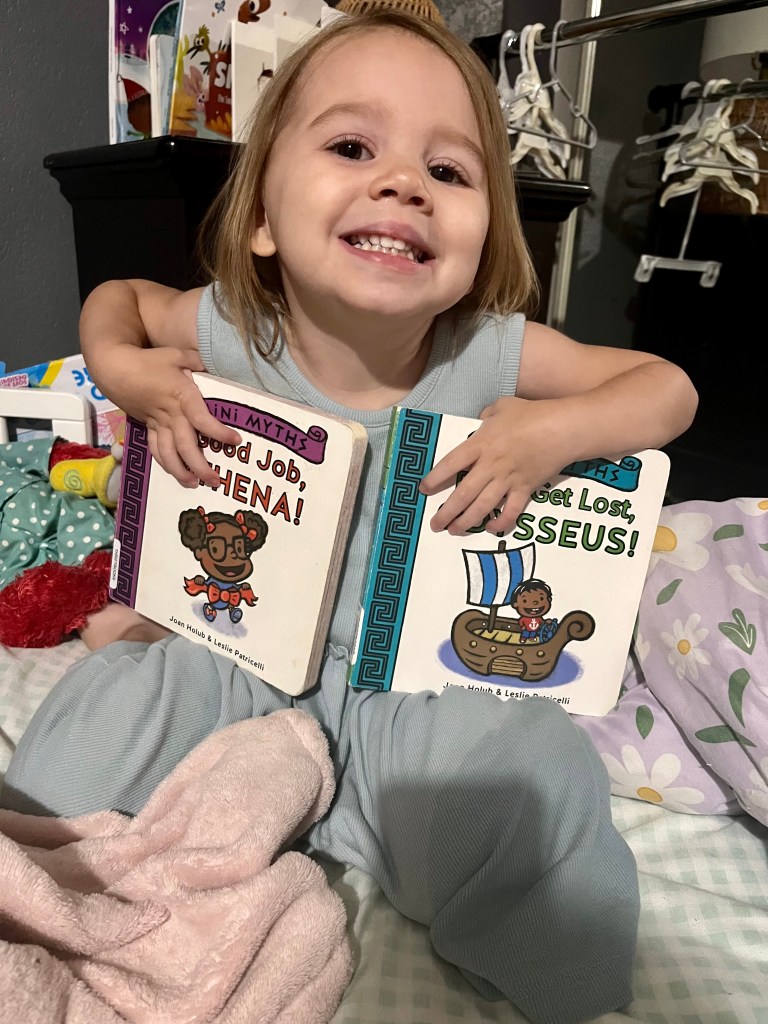
    There’s this book Ivy loves called “Icarus.” We learned there are a series of these books that take Greek legends and makes them into children’s stories with a lesson. Icarus, for example, flies his kite too high until it hits trees, similar to the Greek legend of Icarus flying too close to the sun. Anyways, we learned about the series, and ordered a few of them. We got one about Odysseus. Remember how Ivy often wants to be called “teacher”? That’s been replaced by “Ivydysseus.” Beth and I never said that. She came up with that on her own.

    It’s not the only nickname Ivy has come up with either. We read a book about Baby Beluga. Ivy, on her own, started calling Sage “Sagey Beluga.” My family loves giving nicknames. I’m never referred to as “Brayden” by my parents. I am either Lewis or Fly. Adie is Sassafrass, Garrick is Dude, Dresdan is Jiggles, Cambria is Barbara, and Easton is Goose. Ivy apparently has the Quackenbush gene of giving nicknames.

    I’ve mentioned Ivy teaching Sage how to pray. Ivy says her prayer every night before bedtime. Last night she said her normal prayer, “Thank you for Jesus, thank you for Mudder (she learned she could call Beth “mother”), thank you for Daddy, thank you for blankie, thank you for super cozy (code for being comfortable in bed), thank you for water. Amen.” Then she says, “Billy’s turn.” Billy is her stuffed bobcat. I get Billy from the floor and hand him to her. Ivy gets back into kneeling position on her bed and says, “Thank you for Ivy. Amen.” Of course, Billy has to say his prayer and the only thing he’s grateful for is Ivy.

    We dog-sit a dog named Chicago. Ivy LOVES Chicago. Today Ivy “called” Chicago’s owner on the phone during her lunch. Here was what she had to update Chicago’s owner on: “Yeah Mommy’s with Sage. Chicago’s just sleeping. Yeah Chicago…Chicago…Chicago…okay bye.”

    More on nicknames. You can get in big trouble for not being aware of Ivy’s current persona. At this moment in time, there are many. At any given moment she can be a completely different attitude depending on her name. “Ivydysseus,” as mentioned, indicates she’s feeling adventurous. Ivy teacher means she’s teaching you something, or potentially cooking you some food. There’s Ivy, which obviously means she’s not in character. There is Ivy James. I’m not sure what Ivy James indicates. But DON’T get caught calling her by the wrong name. If you call her Ivydysseus while she’s clearly reading you a book, you will get a firm, “No, I Ivy teacher.” When you reply, “Oh, sorry, Ivy teacher” she will reply, “Good job.”

    There are things Beth isn’t allowed to say, but I am. We haven’t figured out why that is or any sort of pattern yet. But if Beth says something like, “Oh, sorry Ivy.” It’s common for Ivy to reply, “No, no, no, you no say ‘sorry Ivy.’ Dada say ‘sorry Ivy.’” This goes for all sorts of things. “No, no, no, you no say ‘OK’, Dada say ‘OK’”. That one really puts Beth in a tough spot because the natural reaction to that statement is to reply “OK” again. Beth’s really got to watch herself because if she says “OK” again… man is she going to hear about it.

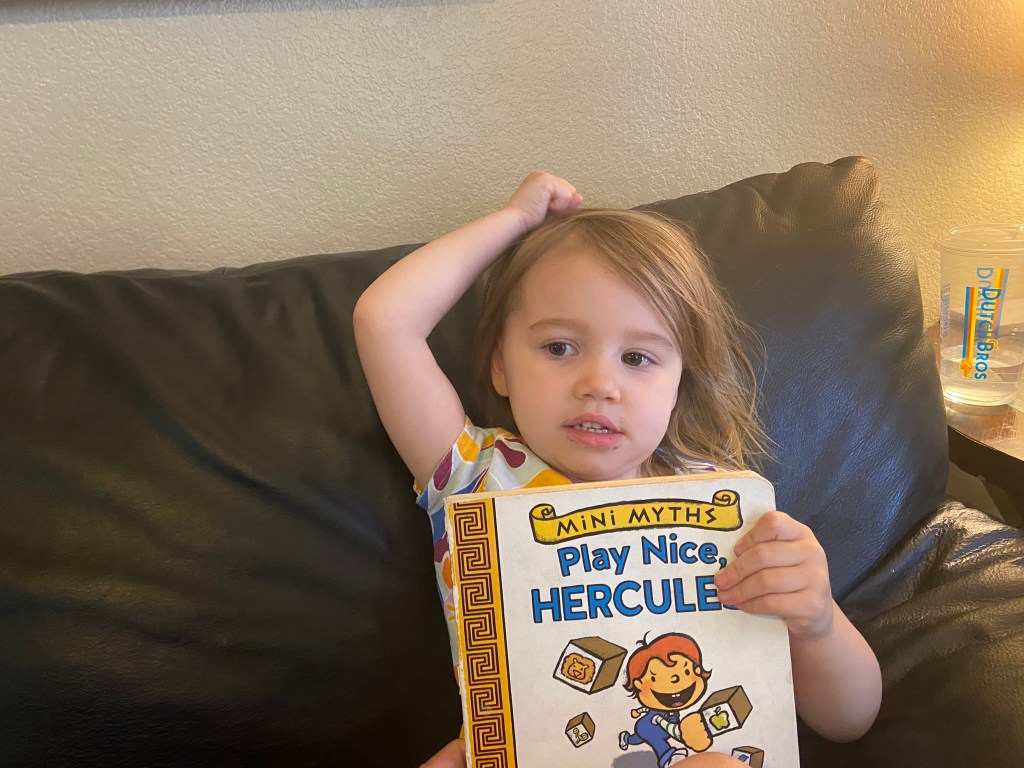
    Those Mini Myths books, mentioned earlier, are awesome. I already talked about the Icarus and Odysseus ones. We have a couple others. But one of those books has been causing problems. It is the Hercules version. In the Hercules version, Hercules has a little sister. At one point Hercules’s father (Zeus? Doesn’t look like him in the book but whatever) says, “Hercules, are you playing nice?” Hercules responds, “I’m strong, I’m not nice.” Hercules proceeds to destroy his sister’s tower. The book has a happy ending, of course. Hercules learns to be strong and nice. He reconstructs his sister’s tower. Ivy, unfortunately, has forgotten the ending. All day she is picking up stuff and saying, “I so strong. I not nice.” I told Beth we need to start skipping that page.

    On this same note, Ivy is super susceptible to messages from books or TV. The most well-intentioned media, like the Hercules book or the show Daniel Tiger’s Neighborhood (which does a ton of good) can have a negative impact. If Ivy sees anger in a show, she goes through it herself.

    There is a Daniel Tiger episode where he learns how to handle anger. He pauses, takes a deep breath, and counts to four, with a little jingle attached. This is awesome. Ivy does this deep breath and counting pretty much every day. What’s crazy is that when Ivy watches the show she goes through the full emotional roller coaster Daniel Tiger goes through in the show. When he gets angry, she gets angry. It’s kind of fake anger on Ivy’s part, kind of not. I’ve seen that anger carry on after the episode is finished.

    One night I was reading Ivy a book called I was so Mad before bedtime. I altered the entire book to “I was so happy” because I knew if I read “I was so mad” over and over while Ivy was in bed, she’d actually get mad. It’s interesting how much those little minds are impacted by external influences.

    This wraps another “Ivy Thoughts.” Part 3 is already in full swing. Stay tuned for more.

  • The Lesser Talked about Sacrifice of the Atonement

    The Lesser Talked about Sacrifice of the Atonement

    One of the tragedies the trinitarian belief (that God, Jesus Christ, and the Holy Spirit are one being) has taken away is appreciation and understanding of God’s part of the sacrifice in the Atonement.

    “For God so loved the world that He gave His only begotten son.”

    Doesn’t mean much if there isn’t actually a God giving up his Only Begotten Son, right?

    We talk so much about the sacrifice that Jesus Christ did for us, for good reason. His Atonement paved the way for us to return home. He suffered, bled, felt the crushing pain of a universe of sickness, pain, and sin, and died for us. He did that. There’s reason we talk about Him. He is the only way to God, our Heavenly Father.

    Speaking of God’s part in that sacrifice shouldn’t diminish what Christ Himself did for us.

    I’m a father.

    The other day Ivy was on the top of the couch and fell backward to the cushion. She wasn’t hurt at all. She was fine, but try telling her that. She was scared, and she was screaming and freaking out. She was fine, but she was still upset.

    Now, if Ivy was really hurt, if she fell from the cushion down to the floor, I would have moved so fast. I would have been there. As it was, I stayed in my seat and tried to tell her how awesome a fall that was.

    If Ivy or Sage are in real pain, I’m there.

    I can’t imagine the torment, the suffering, the heart-wrenching anguish of watching my children suffer. I can’t imagine it.

    God can.

    God watched His Son be spit upon, scourged, beaten, slapped, ridiculed, and finally nailed to a cross to die a slow, painful, and seemingly humiliating death.

    Words from Jeffery R. Holland in a 1999 talk:

    “I am a father, inadequate to be sure, but I cannot comprehend the burden it must have been for God in His heaven to witness the deep suffering and Crucifixion of His Beloved Son in such a manner. His every impulse and instinct must have been to stop it, to send angels to intervene-but He did not intervene. He endured what He saw because it was the only way that a saving, vicarious payment could be made for the sins of all His other children from Adam and Eve to the end of the world. I am eternally grateful for a perfect Father and His perfect Son, neither of whom shrank from the bitter cup nor forsook the rest of us who are imperfect, who fall short and stumble, who too often miss the mark” (“The Hands of the Fathers,” Ensign, May 1999, 14).

    What I realize is that God knew His Son. He knew Jesus Christ was going to fulfill His destiny. He knew what His Son, Jesus Christ, would do on the cross. LIke me on the couch, knowing Ivy was ultimately going to be OK, God knew Jesus Christ would be OK. He knew that Christ so loved us, that He would suffer it all for us. Why did God do it though? Why didn’t He send angels to intervene? Wouldn’t that be what a loving Father would do? He didn’t intervene because He so loved the world. The world is us. He loves us so much that He was willing to suffer this pain of watching His Son suffer. The ultimate sacrifice, of Father and Son.

    If that doesn’t bring you to tears, I don’t know what will.

    God loves you.

    I don’t know how it all works. I don’t know how the celestial kingdom, heaven, a place of infinite joy and peace, can also have weeping. But I know that my God weeps.

    Don’t let us forget that God suffered that day too. He suffered an anguish hardly imaginable. The anguish of watching His only begotten in pain.

    In the case of the suffering of Jesus Christ, the payment had to be made to save us. In some grand cosmic mystery that I don’t yet understand, we can’t return home until we are perfected through the blood of Christ. God allowed that sacrifice, and contributed His sacrifice, because he loves the world. He loves us.

    I believe God does weep over the evil, heartache, pain, suffering, and sadness in this world. He weeps over sin. He weeps over us.

    But ultimately, we have fallen to a soft cushion. We are safe. We are secure. We are secure in the blood of Jesus Christ. We are secure only because of Jesus Christ and what He did for us.

    While God wants to come comfort us, He doesn’t stop suffering because we’re still on the couch cushion. And if it helps us grow, does that make it any easier for Him to watch us suffer? Maybe. I knew Ivy wasn’t really suffering. I knew it was temporary fear she felt. I was always there for her.

    This is my reminder to you: God is there for you. He will never leave you. He is always aware of your hardships. In addition to God, Jesus Christ isn’t only there with your hardships, He already felt your hardships. He understands it all, because He felt it all.

    God loves you. Jesus Christ loves you. They love you so much that they sacrificed for you. Don’t forget that. It will give you strength.

  • What do we believe in?

    What do we believe in?

    My Aunt Lindsey often asks the question, “What do you know?” I usually respond, “Not much.”

    What do we really know? Anything?

    While reading Mosiah chapter 26, I came across an interesting commentary from Hugh Nibley, one of my favorite scholars. The commentary was on Mosiah 26:15 which reads:

    “Blessed art thou, Alma, and blessed are they who were baptized in the waters of Mormon. Thou art blessed because of thy exceeding faith in the words alone of my servant Abinadi” (emphasis added).

    In considering that phrase, “in the words alone of Abinadi”, Hugh Nibley asks, “Now what about childish faith? What about being gullible, etc.? Alma believed in the “words alone”? Alma saw no evidence, no proof, or anything like that? And it wasn’t the words of God; it was the words of Abinadi alone that he believed in? What’s going on here? Why is there merit in this?”

    He continues, “There is merit because Alma believed in his words alone. I would emphasize his. You are blessed because of the things you choose to believe-not by the act of believing, not just by faith. You weren’t blessed because you believed, but because you chose what to believe. Everybody chooses what to believe. The atheist is a very strong believer. He is the most passionate arguer you can possibly find, and the positivist. Where will you find greater faith and firm conviction than among economists? . . . You must believe in something, and everybody does. But the Lord said, blessed are you [Alma] because of the things you chose to believe; you chose to believe in the things that Abinadi taught.”

    I’ve written before about The Faith of an Atheist.

    What do we believe in?

    This is an interesting statement by Hugh Nibley. The idea that it isn’t our faith that is important. Everyone has faith in something. It is what we have faith in. What do we choose to believe? Do we choose to believe that this is all one dumb coincidence and we’re all here for no real reason? Or do we believe in a Savior who redeems us, a Father who loves us, and an eternity of potential?

    Like a lot of things, it’s really about agency. What do we choose to believe in? Alma chose to believe in something good, hopeful, eternal.

    People who leave the church – are they better for it? This is going to upset some people. But in my opinion, no, people aren’t better for leaving the Church. That’s not absolute, of course. Some who leave the church still donate constantly to good causes, serve others, love others, and use their time in helping others. More often than not, I don’t think that’s the case.

    Many who leave the church, instead of turning their focus to good, hopeful, and helpful things, spend the rest of their lives trying to bash, destroy, and talk negatively about the church. Why is that? If leaving the Church of Jesus Christ is a good thing, why doesn’t more good come from it instead of more negativity? Why is tearing down something, whatever your feelings on it, that brings others hope and joy, a good result?

    Is it easy to be a member of the Church of Jesus Christ? With the number of people my age deciding they don’t care for the Church, or any church, I’d say membership in the Church of Jesus Christ is not super easy. A lot of people say, “The church doesn’t do anything for me.” The Church isn’t about what it can do for you. It’s about what you can do for others. When you leave the Church, what do you do for others?

    Leaving the Church is complicated. I’m not trying to oversimplify it too much. But what I think gets lost sometimes is that leaving the Church is often a selfish choice. At least it was for me. I don’t want to have to get up early for church on Sunday. I don’t want to use my Saturday morning helping an elderly person move their belongings. I want to drink. I don’t have time for a church calling like teaching a class, working with the youth, or organizing group activities. I definitely don’t have time for ministering. Yeah, checking on a couple people every so often to make sure they’re doing OK, and really help them if they say they need something, don’t have time for that. I don’t want to pay 10% of what I earn anymore. The list goes on. Someone leaving the Church NEVER thinks this way (or won’t admit it). It’s about historicity or “what they feel” or feeling lied to or CES letter blah blah. I’m not trying to say that those things can’t be hard for people. They are, and I understand that. But often, it comes back to I, when the Church’s main goal is to help us see outside of ourselves.

    Now let’s be clear. Simply going to church isn’t enough. There are plenty of people who go to church on Sunday, leave, and call themselves stalwart disciples of Christ. You may be worse off than the nonbeliever in that case. It may be worse to believe and turn away the sick and needy than to choose not to believe.

    Does some small historical question, or some big historical question, distract you from a plan called “the Plan of Happiness”? Do you choose to worry about a statement by Brigham Young or some question about Joseph Smith? Do you disregard the miraculous book that was written, the testimony of a Savior of the world, an account of that Savior visiting His children in America? Do you ignore the hopeful and positive miracles because you have doubts?

    What do you choose to believe in?

  • Thomas Edison and the Unimaginable

    Thomas Edison and the Unimaginable

    How do you imagine something unimaginable?

    This thought is motivated by an awesome podcast called “How to Take Over the World.” I highly recommend it.

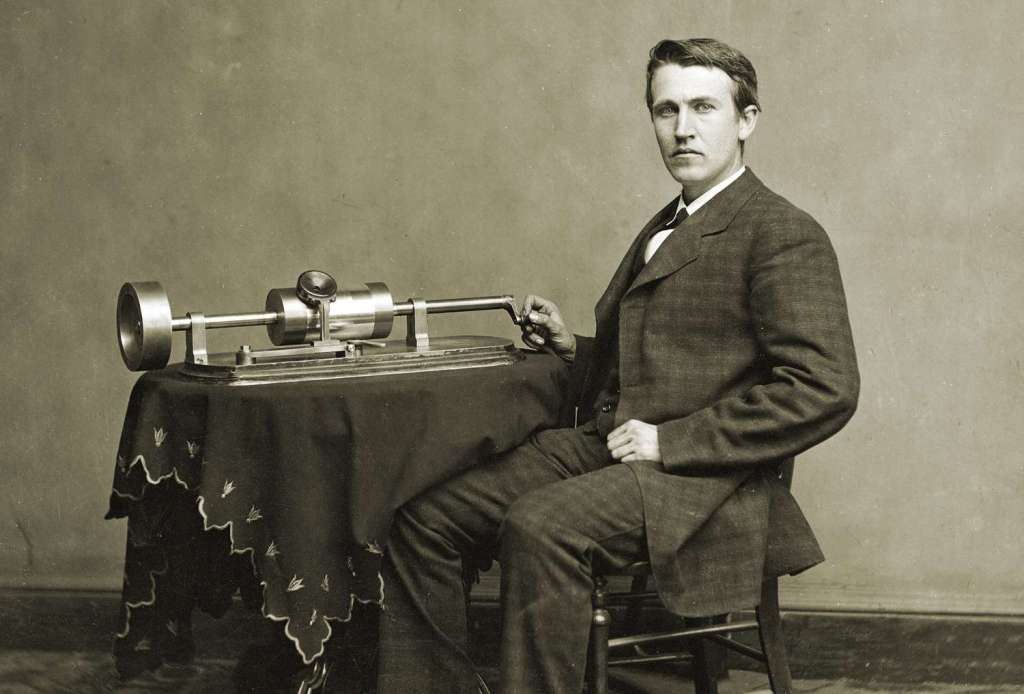
    When Thomas Edison discovered the ability to replay the voice using an invention that would become the phonograph, people couldn’t begin to fathom what they were hearing.

    When Edison started showing his new invention to individuals who had never seen anything like it before, this was a regular occurrence:

    A person would come in. Edison’s invention would be used to play back some recorded statement. The person would be asked what they just heard. The person would have no idea.

    The person would then be told that what they were about to hear was a human voice. The same recording would be replayed. The person would be able to repeat every word from the recorded statement.

    People who had never “seen” (heard) this before literally couldn’t fathom what was happening, so much so that their brains couldn’t even quantify it. How crazy is that? Makes you think how amazing it is that hearing the recorded voice has become so second nature to us. Up until 150 years ago, no human ears had ever heard the human voice from anything other than a human mouth.

    This new invention led to tons of confusion and misinformation about this device. People thought that dead spirits were speaking or the machine itself was talking. People just couldn’t wrap their minds or imaginations around the human voice being replayed.

    There is even a story of a scientist writing Edison after reading an article about the new invention/wonder in a magazine. The scientist asked Edison to issue a public statement refuting the absurdity, as it was not scientifically possible.

    This invention created a worldwide phenomenon. Thomas Edison became a celebrity overnight.

    This story leads to many interesting thoughts.

    The first interesting thing to consider is the idea of thinking about something that you can’t comprehend. When was the last time you were truly shocked by something? In the day and age we live in, nothing shocks us anymore. We’ve become numb to the fantastic world we live in. Moving stairs, cold boxes for food, flying tubes of steel, speeding metal squares: these things are amazing. We don’t even marvel at UFOs anymore, for crying out loud.

    I’m fascinated by inventors. I’m fascinated by people that can create something most of us never even dreamed possible. That was the phonograph, that was playing the human voice. Think how second nature the recorded voice has become to us. But back then, it was UNFATHOMABLE.

    The second thought that came to me from this story was, what do we really know about the world around us? We consider our society so intellectually mature and advanced, and yet, what do we really know about science? When we discover a fourth dimension, will we be shocked? When we learn there’s a spiritual realm all around us that we can’t see, how amazed will people be?

    This is also a lesson in trusting our senses. People back then couldn’t believe their eyes or ears. Today this has become a saying flippantly thrown about: “I couldn’t believe my eyes.” No, back then, they really couldn’t believe their eyes or ears. How much trust do we put in our senses? When it comes down to it, we can so quickly feel like our senses are deceiving us.

    Another noteworthy thing about this story is what the public latched onto when they heard of this invention. People got it into their heads that what was being played when the phonograph spoke were the voices of the dead. This kind of made sense. It was such a foreign concept to them, they just went to the most fantastical thing. Soothsayers and fortune tellers have existed for millennia. The natural assumption by people at that time was, if an unexplainable, miraculous, disembodied voice is speaking, it must be the dead talking.

    Not only did people jump to the conclusion that it was the dead speaking, they latched to the idea with an abundance of enthusiasm. Our fascination with the dead is endless, especially today. Why are we so enthralled by the idea? Why is it so important to us? Well, I believe, it’s because the hearts of the fathers are being turned to the children and the hearts of the children being turned to the fathers (Malachi 4:6, D&C 2, D&C 110:13-16, D&C 138:46-48, JSH 1:37-39).

    It’s our natural hope and desire to speak to our loved ones on the other side. We are drawn to them.

    There is an invention today, also from the 1800s, that is magnitudes more magnificent than the phonograph. This invention is equally as mystifying. In 1836 Joseph Smith, Jr. dedicated a temple to the Lord. This “invention” allowed the sealing of families for eternity. This miraculous invention, like the phonograph, is little understood by the world. Much of the world doesn’t realize this “invention” exists. Coincidentally, the phonograph was invented in 1877. The oldest standing Temple of God is the St. George temple which was dedicated in 1877.

    How amazing to see the temple work of this dispensation where so many of our hearts are turned to our progenitors who have already passed through the veil. When temple work is done for a family member, a real bond is created. We are all connected.

    This, I believe, is why people were hopeful the phonograph was a way for them to speak to their dead.

    The phonograph is an invention that has blessed the lives of so many with the ability to communicate here on Earth. Temples bless every person who has ever lived, does now live, or will ever live. The temple is eternal. I’m grateful to live in a time when we know of temples and of their eternal significance. I’m grateful to have temples nearby. I’m grateful to be sealed to my family for eternity. I’m grateful to know I will see all my loved ones again.

    How powerful is that? How amazing is that? We get to do work for our dead, be linked to them forever, and create a connection for eternity. Now that’s an amazing invention.

    Columbus, Ohio Temple