Author: Brayden Quackenbush

  • Little Red Mark

    Little Red Mark

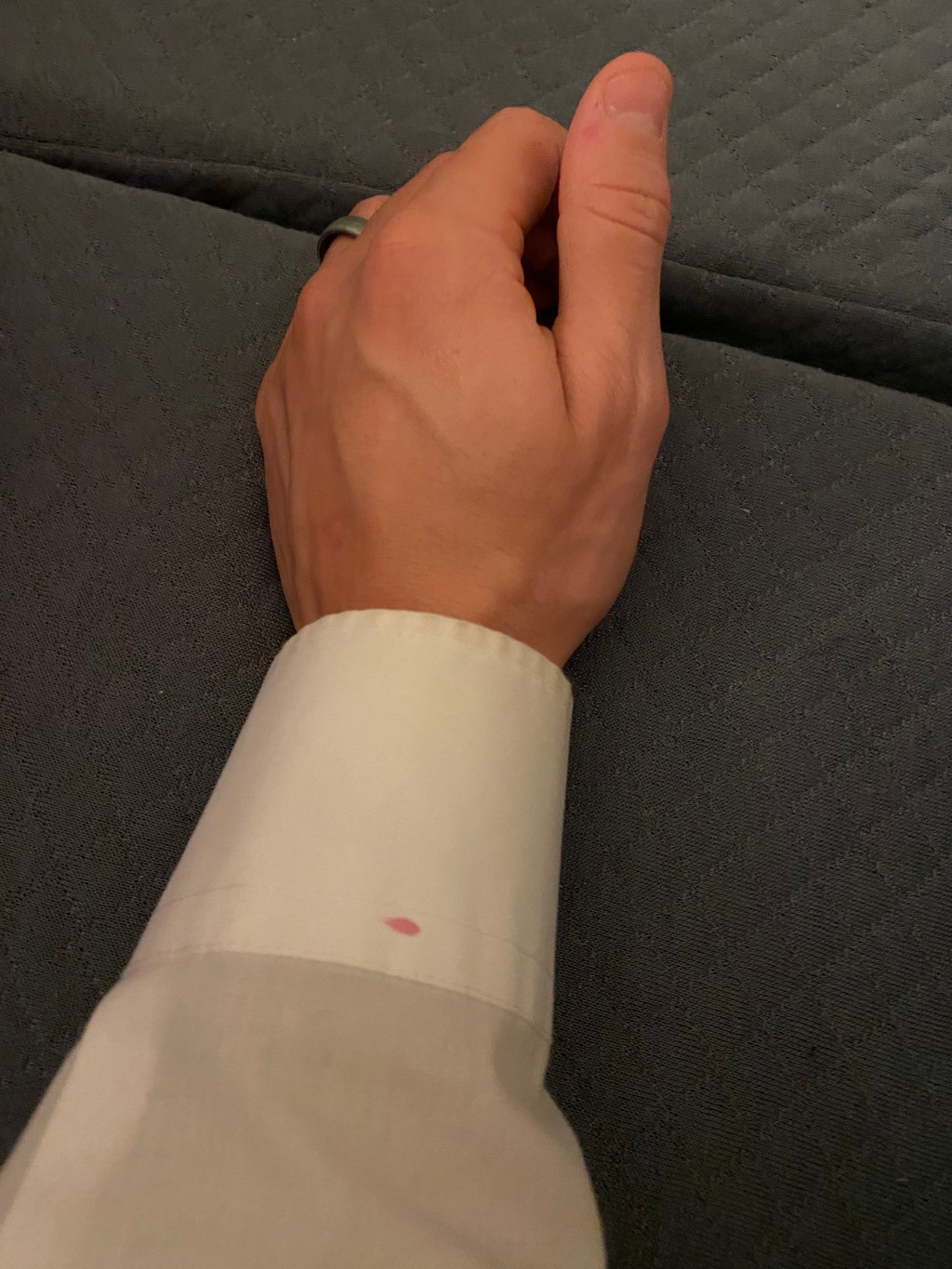
    I have a white church shirt with a little red permanent mark on the left cuff.

    A few years ago, in the Young Single Adult (YSA) Ward of my church, there was a young girl that started coming every so often. She had a family ward she more often went to, but every once in a while, would visit the YSA. She had a young son. He was a toddler, probably two years old.

    I was drawn to this girl. I could imagine how difficult it was for her to bring her young son with her to the YSA ward, a place full of single people with entirely different life situations. I could imagine how she felt judged and out of place. I could relate to how she felt. I’d been her a short year or two before. 

    At the time, I was the Sunday School President. That meant that once a month myself and my counselors led a teacher’s council with all the teachers in our ward to discuss how we could be better teachers, and how we could teach in the Savior’s way. 

    Whenever this young girl came to our ward, I would try to get her to stay for second hour and go to Sunday School. That was my job as Sunday School President, after all. More than that, it was my job as a disciple of Jesus Christ. 

    One Sunday I was inviting this girl to go to one of our Sunday School classes. The difference this week was I wouldn’t be going with her. I had my Teacher’s Council. I could tell that she was going to leave if I wasn’t going to attend the class with her. She was clearly worried about how her young child might be a distraction in class. So, I invited her to my teacher’s council. It took some explaining, letting her know it was open to anyone and she was completely welcome. She came to our council that day.

    I don’t remember anything we taught. I don’t remember an enlightening teaching moment or momentous thing learned on how to be a more Christ-like teacher, though I’m sure some of that occurred. I don’t remember it.

    What I do remember is spending time with that girl’s young son. My counselors were leading most of the discussion so I could spend time with him at the white board with markers, letting him play and keeping him occupied. When I did need to get up front and talk for a bit, I brought him with me. I look back at this moment fondly as a parent now with two daughters I’m constantly bringing to the front with me.

    I didn’t care if he was a distraction to the class. Some things are more important.

    That’s the point, right?

    At one point while watching him, he accidentally marked my white shirt with a red marker. I’ve thought about throwing that shirt out. It’s not a huge or extremely noticeable mark, but it’s there, and it is noticeable. I’ve kept that shirt. I wear it often. I use it as a reminder that some things are more important than a marked shirt.

    I sometimes wonder if someone might see that mark on my shirt and think, “how tacky, throw that shirt out, it has a red mark on it.”  Then I think about that young boy, his mother, and what’s more important, and decide it’s worth wearing that marked shirt.

    Reminder to everyone that we all have little red marks on our shirts. Sometimes they’re self-inflicted and sometimes they’re not. It doesn’t matter. The point is to not judge and to love without bounds.

    I recently got to see a young man that young girl was dating enter the waters of baptism. I hadn’t seen her little son in a few years. It’s crazy how quickly a two-year-old becomes an active, thinking, 5-year-old. I said hi to the now five-year-old boy. He, of course, didn’t remember me. But I showed him that mark on my shirt. It’s probably my imagination, but I saw recognition in those eyes. Like, whether or not he actually remembered making that mark (probably not), somehow, he recognized the significance. I felt like his eyes said, “I made that mark, and you kept it?” I told him I kept the shirt to remember him. He smiled.

    That young girl watched a man she had been dating get baptized. They were civilly married and as soon as they were able to, got sealed in God’s temple. They will be sealed in a temple for time and all eternity. That young boy will be sealed to them. Forever. That’s what it’s really all about, right?
  • Suns Experience

    Suns Experience

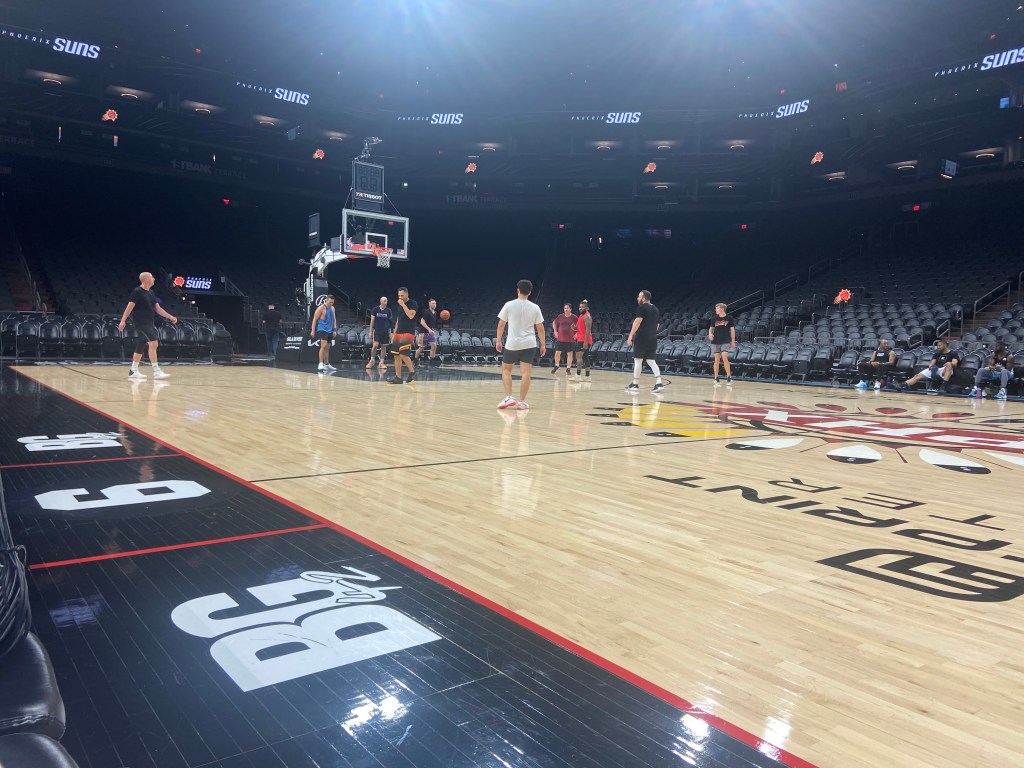
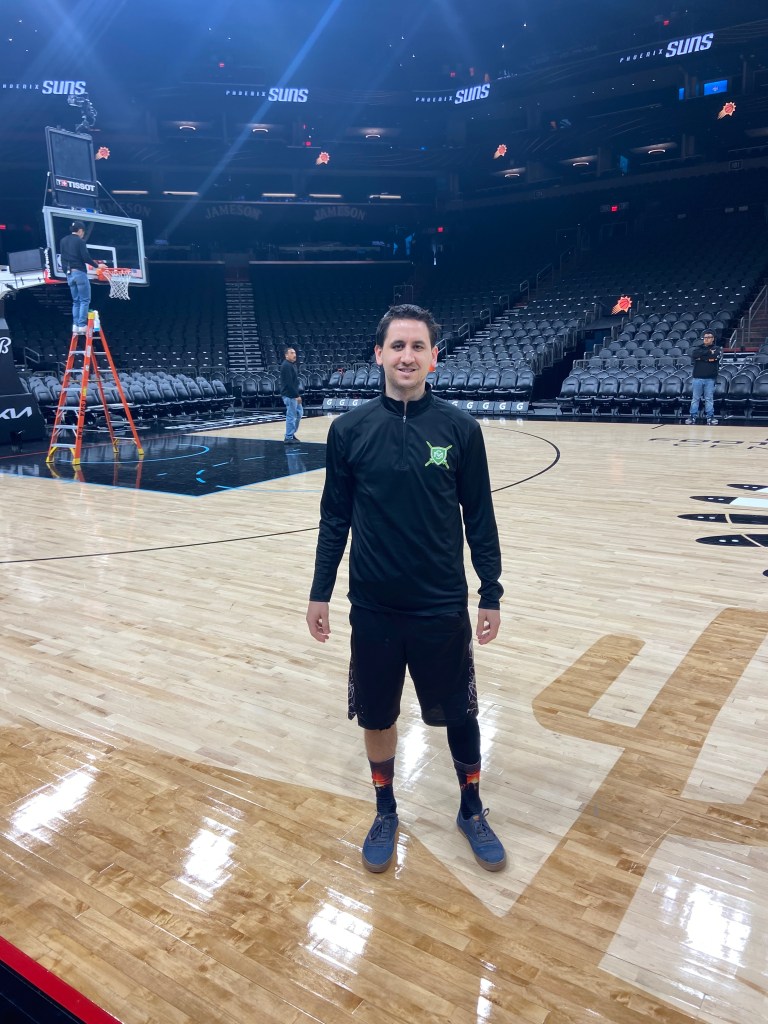
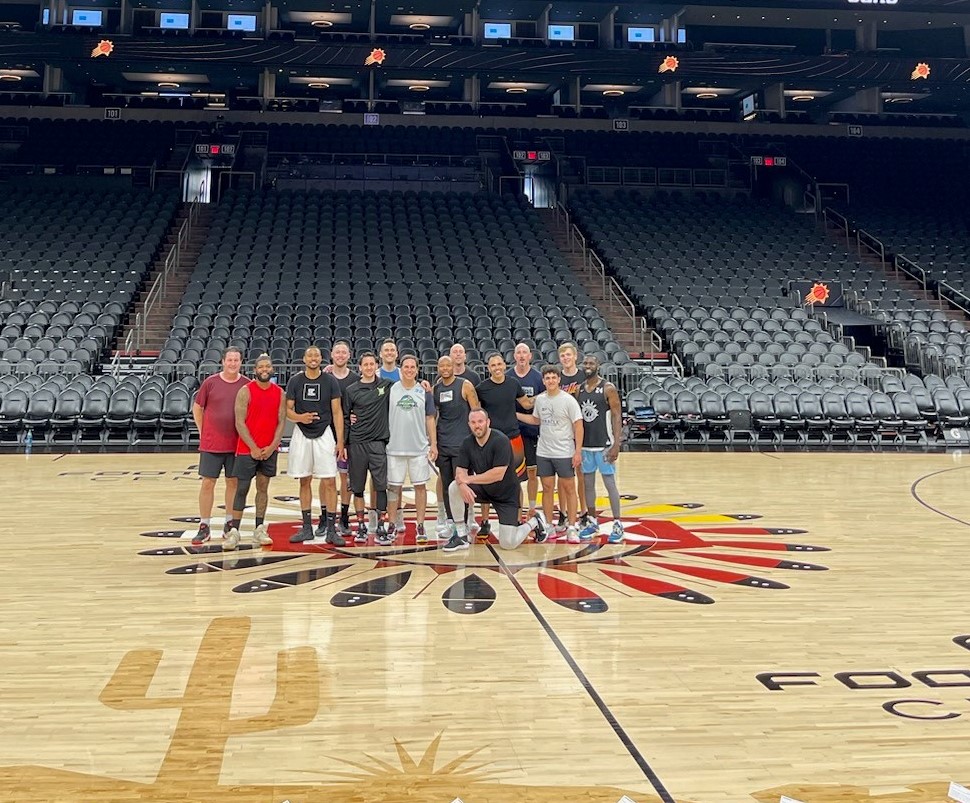
    Last week I got to play on the Phoenix Suns court. It was an awesome experience, one of the coolest things I’ve ever gotten to do. Huge shoutout to Robert, his wife Brooke, and Blake for making it happen. We got exclusive access to the court and were able to play pickup for three hours. Well, some of us were able to play for hours… more on that later.

    Some basketball thoughts from playing on a real NBA court.

    First, those lights are bright. When I’d shoot from the corners, if I watched the ball arc up before it got to the rim, I’d be blinded by the lights. If I looked up unconsciously while playing, I got blinded. Never thought about what it would be like to actually play under the “bright lights.”Speaking of the corners, it is a tight fit. Shooting an NBA three from the corner gives barely enough room for your feet. If you take a step back at all to try to explode toward the hoop, you’re stepping out of bounds. I have size 10 shoes. I don’t know how the size 20s even do it.

    Speaking of the lights, part of the package with getting to play on the court was we got to watch the Suns play that night against the Orlando Magic. We got to watch from the suite level with food and drink included. I’ve been to many Suns games, but this was a unique game to watch due to having been on the court just hours earlier. These things I mentioned like the lights and the tight space from the corner were things I considered more than I ever had before. The other thing that stood out to me that I’d never thought about before was how hectic an environment this was for NBA players to play basketball in.

    Basketball is a refuge for me. It’s therapeutic. Playing on an NBA court with thousands of people watching cannot be therapeutic.

    An NBA game is a chaotic and hectic experience. Of course, there are the thousands of people watching, yelling, and trash-talking. That’s crazy in and of itself. But what struck me the most after having played on the court was how loud the music was. While we played, we had a pretty chill March Madness game playing on the big screen with the volume on what I’d guess was around medium. It was still distracting. Watching that game later against the Magic I was focused on the NOISE, the MUSIC, and the BASS.

    It is pandemonium at an NBA game. For some reason I’d always thought the NBA players were a bit sheltered from the noise. After playing on the court, I realized it’s the opposite. They are at the bottom, center of a dome. All the noise and chaos are amplified on the court. It gave me my first true appreciation of home-court advantage. That chaos is one thing, but when it’s a chaos you’re not used to, (on the road visiting another stadium) with fans heckling you the whole time, it’s complete sensory overload.

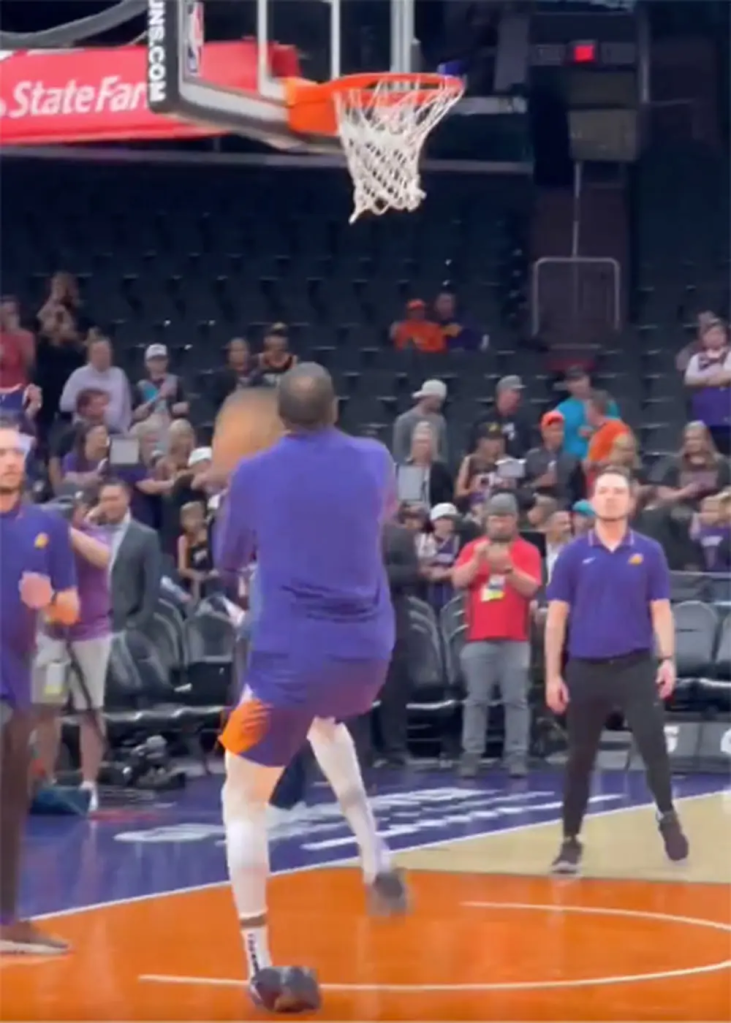
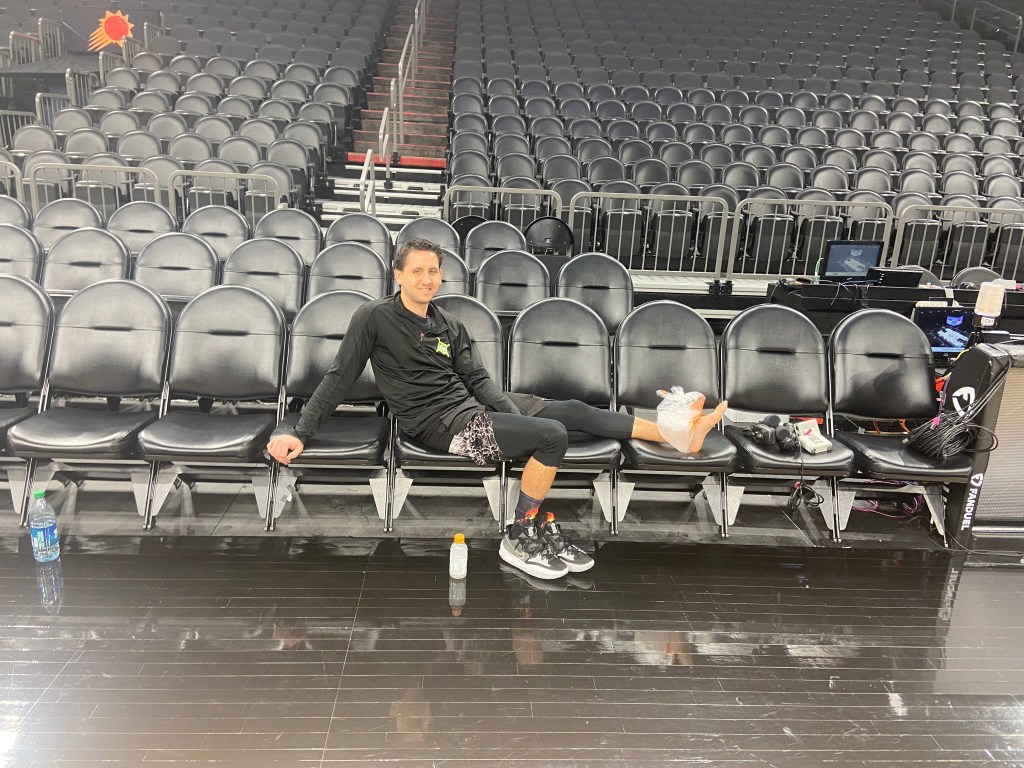
    So, back to my time on the court, unfortunately I got hurt the beginning of the second game. I was running and just stepped wrong and twisted my ankle bad. It actually happened at almost the exact spot where Kevin Durant twisted his ankle while doing a routine warm-up layup a couple weeks earlier.

    Probably exactly what my ankle looked like, same spot.

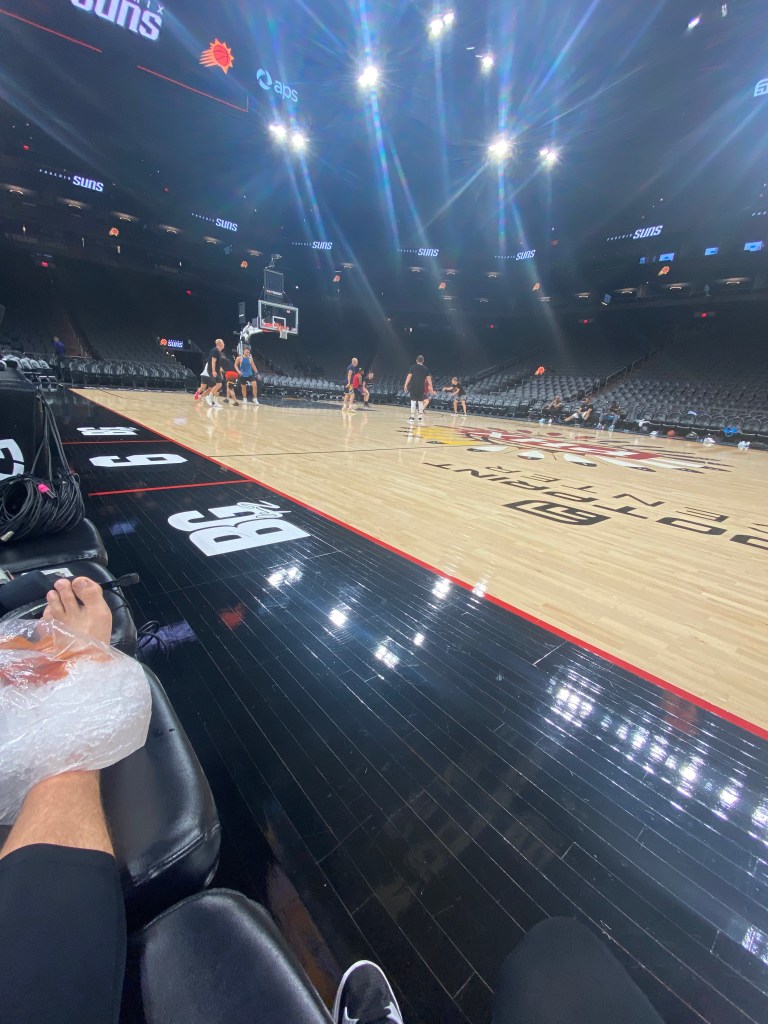
    After I rolled my ankle, I at least got to see what it was like to be treated like an NBA player for a moment. Multiple trainers checked on me and brought me ice. It was a bit embarrassing. I got to spend the rest of the pickup session jealously watching with ice on my ankle from the sideline.

    Here’s the part where I insert what I learned spiritually from this experience.

    I’ve twisted that ankle at least 3 dozen times, not exaggerating. It’s never fun. It’s always painful.

    That night, I was laying in bed with my ankle propped up on pillows. I’d already discarded the ice that was on it. It was the middle of the night and my foot was THROBBING. It hurt.

    It hurt badly enough that I started praying for relief. I don’t want to be dramatic. I know that on the pain scale, what I was experiencing was pretty mild. But still, it hurt. That’s when I started thinking about every groin pull, every sprained ankle, every concussion, every headache, every upset stomach, every scalping, every stitch, every ingrown toenail, every scratch, every bruise, every heartache, every heartbreak, every disappointment, every fear, every doubt.

    How could He have felt it all?

    Here I was, writhing in pain, whining, praying for relief, over a sprained ankle. And He felt every sprained ankle of every person that ever did or would exist, all in a moment. He felt it all. How?

    I ponder often on the Atonement. I’ve tried to wrap my head around it. It’s not something we can wrap our heads around. That’s the point. He did something unimaginable. He did something incomprehensible. And he did it for us.

    I believe (I know) that Christ felt it all that night at Gethsemane. I don’t know how; I can’t understand it. But I know He did. It’s why I write about Him, it’s why I think about Him, it’s why I serve Him. Because for a long time, I tried to forget what He did for me because of guilt, or incomprehension, or selfishness. But now I think the most important thing I do outside of anything with my family is write about Him.

    I think the most important thing I do for my daughters is teach them about Him. Few things bring me as much joy as when Ivy sees a picture, I ask, “who’s that?” And she replies, “Jesus.” I hope someone reads this that needs to remember Him and what He did for us. When you think about what He did for us, ultimately it must make us more loving because we’re considering a love that is unfathomable. That makes us better.

  • What’s in it for Me?

    What’s in it for Me?

    “Ask not what your country can do for you – ask what you can do for your country.”

    John F. Kennedy’s famous quote given in 1961. I think this has become a great weakness of humans today, and society as a whole. There are so few asking, “what can I do for you” and so many asking, “what’s in it for me?”

    There seems to be a great falling away from the Church of Jesus Christ of Latter-day Saints. There is a great falling away from religion in general. I think part of this falling away is based on this “me first” way of thinking. What does a church do for me?

    I believe there might be a plague in the Church of Jesus Christ of this way of thinking. We all know someone who has left the church for whatever reason. All the reasons aside, there’s often a statement included that the church wasn’t doing it for them anymore, the church wasn’t helping them, or they didn’t see the need of the church.

    I would say, ask not what your church can do for you, but what you can do for your church.

    Now, to be clear, the Church of Jesus Christ of Latter-day Saints is the greatest blessing in my life, both temporally and eternally. It saved me from the gutters of this life. It has provided me all that is wonderful and beautiful about life. It has provided me a stable family that loves me. It has provided me a wife and daughters who I love. It has provided me a foundation to hold to in a world that tosses us all around. More than all these blessings here, it has also blessed me eternally with a perspective on why I’m here, where I’m going, and what’s truly important. It has provided me light. It has provided me hope. It has provided me love. It has provided me everything. 

    I say again: the Church of Jesus Christ of Latter-day Saints which is how I know of the Gospel of Jesus Christ and Christ’s love for me is the greatest blessing in my life. Both here and for forever. 

    That said.

    The Church (and gospel) of Jesus Christ is not here on the earth for what it can do for me. It is here for me to learn what I can do for others. The Church of Jesus Christ is not here because of what it can do for you. It’s here to help you learn what you can do for others. The Church is a vehicle by which you can learn to be like Jesus Christ. I wrote about this in my post Do We Really want to be like Jesus.

    I think when we truly understand this, the world changes. It’s no longer, “what do I get out of this?” It becomes “what can I do to help someone else get something out of this?” This is what it’s all about. Love. Fellowship. Support. That’s why the Church is here. Not to bless your life. So you can bless lives.

    I’ll conclude with one last question, I hope you will truly ponder: did Jesus ever ask, “what’s in it for me?”

  • Importance of Promises (and Covenants)

    Importance of Promises (and Covenants)

    Since as long as I can remember, promises have been important to me. I’ve always said I would never break a promise for any reason. Period. I’m sure at some points in my life I have broken promises. I have this vague recollection of a broken promise or two that still eat at me. I don’t remember the details, but I remember the feeling of not keeping my word. For whatever reason, promises are something I’ve always considered immensely important, I’m not sure exactly why. Deep down inside, I’ve always thought promises were important to keep. Otherwise, what was the point? Otherwise, words were hollow and how could you be trusted?

    In Alma 23:16-25:2 of the Book of Mormon, there is the story of the Anti-Nephi-Lehis. This is the story of the Lamanites who converted unto the Lord and from then on turned away from their past traditions of murder and bloodshed. They buried their weapons of war and covenanted to shed blood no more. They took their new covenant so seriously that when other Lamanites came to war against them, rather than break their newly made covenant, they knelt before their former brothers and gave up their lives.

    As I read this story recently, a question arose: how seriously do we take our covenants? What does our word mean to us? How about when our word is a promise to God? How important do we deem that pact?

    Covenants are important. Covenants are serious. Keeping covenants is a serious thing.

    The converted Lamanites, or Anti-Nephi-Lehis, made a covenant to shed blood no more. Full stop. No excuses. When their lives were at stake, did they reconsider? Did they say to themselves, “well I promised this, but surely I’m not supposed to lie here and die over a promise”? They thought the exact opposite. Their covenant was worth more than their mortal life. These Anti-Nephi-Lehis understood the significance of covenants. There were no excuses. They had faith. They knew that if they died keeping their word to God, they would inherit a glory and reward that would be well worth the earthly sacrifice.

    Covenants with God are greater than death.

    So, I ask again, how seriously do you take your covenants?

    Have I been perfect in keeping the covenants I’ve made with God? Let’s review the first covenants I made with God when I was baptized at age 9. I covenanted to:

    1. Take upon myself the name of Jesus Christ.
    2. Keep His commandments.
    3. Serve Him to the end.

    Have I been perfect in this? Of course not. None of us are perfect yet. But I’ve tried. I often wonder how much my baptism and the Gift of the Holy Ghost at age 9 strengthened me and helped me to return. I often wonder how my upbringing influences my deep respect for promises. Though I haven’t been perfect, I always took these covenants seriously.

    I now take further covenants I’ve made very seriously. For example, my covenant with my wife, to be faithful to her, to love her, to serve her, to be there for her. That is the most important promise I’ve made in this life and I intend to die before breaking it.

    In a world of promise-breaking and commitment to nothing, I am ever-grateful for the covenants I’ve been privileged to make. I’m grateful for the Church of Jesus Christ that provides the proper authority for me to make promises with God. I’m grateful to be linked to God. I’m grateful for the strength covenants provide in a shaky and uncertain world.

    If you’ve made covenants that you’ve broken, I implore you to reexplore those promsies. Satan leads us to believe that once broken, we can’t mend our word. When our promise is with God, that is true, we can’t mend it. But He can. Jesus Christ suffered the Atonement so that we can come back even to make up for the promises we’ve broken. He knows we aren’t perfect. He will make the difference. I fell into that trap for stretches in my life. Thinking I’d gone too far away from God, I’d broken too many promises, disregarded too many commandments, and I couldn’t come back. The feeling of reuniting with God is the most comforting feeling in the world. Reunite with Him. He will always take us back. He will always reestablish our covenants because He loves us that much.

    Come back to Him and feel His peace.

    I am grateful for covenants and that God allows me, an insignificant little speck, to align and connect myself with Him. What power. What comfort.

  • What if I saw Jesus in a Fight?

    What if I saw Jesus in a Fight?

    A friend asked an interesting question: “If you saw Jesus fighting somebody, what would you do?”

    No context, I had many follow-up questions. Has the second coming happened? Why is Jesus here? How do I know he is Jesus?

    But, ok, I can follow along with the exercise.

    My response was, “I would assume he was fighting Satan. I would assume that the person Jesus would be in a fist fight with would have to be Satan taking over a body… but then that doesn’t make sense, because Jesus could simply rebuke Satan, he wouldn’t need to fist fight him…”

    I was interrupted by the friend who reminded me this was a fun what-if and to not go overboard. He then asked again, “But what would you DO?”

    I thought for a moment, then I said, “I guess I’d watch.”

    My friend laughed and then jokingly said, “You’d record it, WORLDSTAR.”

    He made a good point: sitting and watching didn’t seem good enough. So I told the friend, “You’re right, if I saw Jesus fist-fighting someone right now, I would say a prayer to God, asking if this was OK, did Jesus need help, should I do something?”

    It was then asked, “what if Jesus punched Beth?”

    That one made me laugh. I said if that happened, I’d know I was being deceived in some way because Jesus wouldn’t punch Beth in the face.

    This was a fun exercise. I think God will forgive us for any irreverence. I think it’s good if you bring Jesus into a normal conversation, even if in a slightly irreverent way.

    This silly question did lead me to think more deeply about a serious question, though. In this silly context, “What would you do if you saw Jesus in a fistfight?” I realized my first answer was, “I would watch.” I realized that was my first reaction because my first reaction would be that Jesus doesn’t need my help. This is what led me to the more serious thought. How often do I think Jesus doesn’t need my help? How often do we think there’s nothing we can do for Jesus? Now, I’m not trying to get into the faith and works discussion, of course we can do nothing to save ourselves without the atoning sacrifice of Jesus Christ. But, we can still do things for Jesus. 

    We are here on this earth for a reason.  gain, how often do we think, “Jesus doesn’t need my help. I can’t do anything for Jesus. I’m not good enough to do anything for Jesus.” I think sometimes we forget that we are here to do things for Jesus, we’re here to promote Jesus, talk about Jesus, lead others to Jesus, help Jesus in any way we can. We do that by loving others. Jesus does want our help. Whether He needs it is another question. But He has asked us that know of Him to share Him, to be His servants, to be His feet on the ground in a way.

    So, when I think about that question again, “What would you do if you saw Jesus in a fight?” my answer has changed. 

    I would pray. Then I would jump in. At least I hope that’s what I would do.