All of Ivy’s life, when she’s been upset or crying, I’ve said, “Dontcha know I know?”
This is my way of saying jokingly, “Don’t you know I know what it’s like to not want to get dressed, not want to eat certain food, to be hungry, to be tired, to be upset, etc.?”
Today was Sunday. I woke up from a nap and I watched a video depicting the Atonement that Jesus Christ performed.
Sage started crying in the other room. She’d been having a rough day. We think she has some acid reflux and stuff like that. Sometimes her tummy gets upset. This day seemed to be hard for her.
Sage likes to tilt her head way back and stretch out her stomach. Apparently, this is a sign of acid reflux. I went to the other room and picked up Sage and put her into her favorite position. Head in my hands tilted back, stomach stretched, looking up at a ceiling fan (she LOVES looking up at ceiling fans).
This provided a little relief, but she was still crying on and off.
When Sage was still fussing, I started to say my automatic, “Dontcha know…”
And that’s where I stopped.
I didn’t know what it was like to have acid reflux, and for my stomach to hurt like hers did, and to not be able to find relief whatsoever on my own, and to only attain some relief if Mom or Dad came to hold me a certain way. Even if I had that experience as a baby myself, I don’t remember. I didn’t know or remember what Sage was feeling.
But someone did. I believe that Christ, during that infinite and indescribable Atonement, even felt the pains of an infant with acid reflux. I believe He felt it all.
I couldn’t know what Sage was feeling. Dontcha know I didn’t know. But He knows, and He felt it, and He remembered it.
When Sage cries she’s communicating to us that she needs help. It’s me and Beth’s job to come to her aid and help her with what she can’t help herself with. How many things, as adults, do we need help with that we can’t do ourselves? As adults, we think of ourselves as so independent. But all we do relies on the Lord. We rely on Him to allow our breath to work within our bodies, water to hydrate us, food to nourish us. These things don’t happen of ourselves but because of Him.
God and Christ come to our aid when we need it and especially when we ask for it. Christ knows how to hold us just right to help ease our pain and give us relief. Rely on Him for aid just as little children rely on their parents. Be ye as little children (Matthew 18:3).
Christ felt it. Christ remembers it. Christ experienced it. Turn to Him and He will help all our pains, challenges, and afflictions.
These are thoughts from a book I read recently called A Miracle that Changed the World. It was an awesome book that laid out just how spectacular the establishing of America was. This was a section of the book I had some thoughts on. I’m quoting sections of the book with my thoughts.
p. 52:
“The Tide of Reform
“Many Americas became extremely self-conscious about their lack of “public virtue” because of non-involvement in the affairs of government. They began to acknowledge their obsession with self-interest, the neglect of public affairs, and their disdain for the needs of the community as a whole. Gradually, a spirit of “sacrifice and reform” became manifest in all thirteen colonies.”
This occurred in America in the couple of years leading up to the Declaration of Independence being signed. Is it any coincidence that a spirit of sacrifice, public virtue, and selflessness preceded the greatest revolution in the history of the world and the rise of the greatest nation ever to exist on earth? God needed a self-sacrificing and humble people to inherit the new world. When they exhibited these qualities, they became His chosen people to enact this major event. This led to a revolution and the freedom from tyranny that allowed the explosion of religious freedom that God planned, that couldn’t have happened under the rule of a monarchy. It started with sacrifice, service, and humility.
“In the eyes of the Whigs, the two or three years before the Declaration of Independence always appears to be the great period of the Revolution, the time of greatest denial and cohesion, when men ceased to extort and abuse one another, when families and communities seemed peculiarly united, when the courts were wonderfully free of that constant bickering over land and credit that had dominated their colonial life.”
Two things especially stand out to me from that statement –
“families and communities seemed peculiarly united.”
From the Family Proclamation: “We call upon responsible citizens and officers of government everywhere to promote those measures designed to maintain and strengthen the family as the fundamental unit of society.”
As the fundamental unit of society, strong families make for strong society. No wonder Satan has so adamantly attacked the family. Look at divorce rates, look at what has happened to the American family. The dismantling of families is the the beginning of the downfall of a great society, and we’re seeing it happen right before our eyes.
“the courts were wonderfully free of that constant bickering…”
Could the 13 original colonies have broken from the greatest world power at that time, colonies v. Greatest World Power, if they were busy bickering amongst themselves? It took unity for the freedom of America to be established.
D&C 38:27: “be one; and if ye are not one ye are not mine.”
This is what we need – Americans to become self-conscious about how selfish we’ve become. This is the eternal principle of unity. America needed to be united under one cause and one heart before they could break free from tyranny. God wants us to be one. What has happened to that unity?
I read in a Doctrine and Covenants commentary how early church members, going back to the very earliest days of the church, were advised to avoid courts. It was said that if a dispute couldn’t be resolved by arbitration, then there was discord and discontent too strong amongst the parties, and they needed to evaluate what they truly valued. One early church leader, Oliver Cowdery, was chastised for becoming too involved in the courts, and it ultimately began to descent towards his excommunication.
“When Oliver moved to Missouri in 1837, he sought to alleviate personal debts by starting a legal career. Witnesses testified that Oliver had urged people to sue others in court who “fired guns in town,” who broke “the Sabbath day,” he “frequently solicited for business in collecting debts,” and “urge[d] on lawsuits with others.””
There can’t be unity where there is constant bickering and lawsuits. Those needed to be removed from public standards before the 13 colonies could think to stand up against Britain.
The book continues:
“How the Moral Reform Accelerated the Revolution
“Many Americans became so impressed with the improvement in the quality of life as a result of the reform movement that they were afraid they might lose it if they did not hurriedly separate from the corrupting influence of British manners. They attributed this corruption to the monarchal aristocracy of England. Even Americans such as John Jay, Robert Morris, and Robert Livingston were beginning to see that the people were exhibiting a potential capacity for virtue and morality which would guarantee the success of a free, self-governing society. Therefore, it became popular to express the sentiment that the sooner they became independent the better” (emphasis added).
The underlined portion is the part that stood out to me. Imagine if society today could be said to have such a high standard of virtue and morality. This is what guaranteed the success of the United States: A virtuous and morally upright people. This is why they could self-govern themselves, because they self-governed in righteousness. Imagine describing our society like that today – excess of virtue and morality.
The definition of virtue is “behavior showing high moral standards.”
The definition of morality is “principles concerning the distinction between right and wrong or good and bad behavior.”
We couldn’t be farther from such a standard. We’ve gone so far off the path that we have reversed morality so that right is wrong and wrong is right. We have molded morality to be what we want it to be. The early Americans who established this nation were moral and upright in all their dealings, which allowed them the honor of being the people to establish the most free, most righteous, and most powerful nation in history. Freedom and righteousness are power.
Another motivating factor for the colonies wanting freedom from England was to avoid developing all the negative attributes of the British.
“British influence was already taking its toll. One alarmed American wrote, “Elegance, luxury and effeminacy begin to be established.” David Ramsay declared that if Americans had not revolted “our frugality, industry, and simplicity of manners, would have been lost in an imitation of British extravagance, idleness and false refinements” (emphasis added).
America has gotten closer to extravagance, idleness, and false refinements than frugality (look at our national debt), industry (look at our bail outs), and simplicity (look at social media).
It’s time for unity in America. It’s time for virtue and morality. It’s time to protect and re-establish the importance of the family. It’s time to return to frugality, industry, and simplicity. If America can return to these values, maybe it stands a chance to stay a chosen nation and be protected from the tribulations that are to come.
We were in Flagstaff after New Years. We drove up the morning of 1/2/23 in a brand new year. We met my family, who drove from Las Vegas, for lunch. My family included Mom, Dad, Dresdan, Kodi Joe, and Easton. After lunch, we found some little hills at a park to go sledding. Ivy loved sledding. It’s possible she loved it a little too much. The moment the sled stopped at the bottom of the hill, and sometimes before the sled even stopped, she would be saying, “again, again, again.” If I paused a moment to catch my breath she’d get upset.
After sledding, we went back to our hotels to get cleaned up. My family came to our hotel and we played games.
The next day we went sledding again. It was interesting how quickly Ivy turned on sledding. She was excited to get out there, and after we went down one hill I received the normal, “again, again, again.” After the second time down the hill, she was done.
“Do you want to go again?” I asked.
“No.”
Just like that, Ivy was done sledding. We did a little more sledding, which she tolerated. Then Ivy saw the park and swings that were nearby. All she wanted to do was swing after that. Ivy loves swings.
We all had lunch after sledding and parted ways. The drive to Las Vegas is nearly four hours and it was pretty stormy. It had been snowing for some time and the temperature was around 25 degrees.
Beth and I sat in the parking lot trying to decide what to do. We were in Flagstaff primarily for a St. Mary’s basketball game. We still had some time before we needed to be at the gym. The plan had been for us to drive home after the basketball game. Beth was worried about driving home after it had been raining and snowing with the roads being icy. My lack of concern came not from bravery but from a complete ignorance of snow.
Beth had strong feelings against driving home at night on unsafe roads which trumped my blissful ignorance. We audibled to finding a hotel room for the night and then went to the gym.
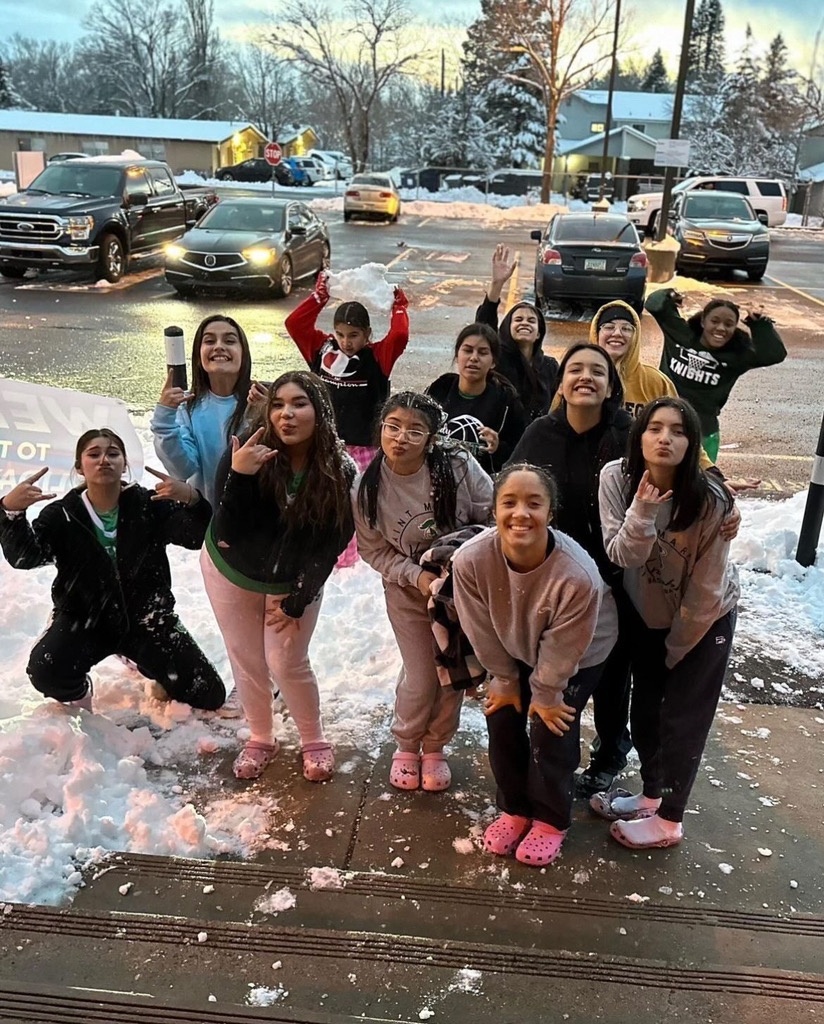
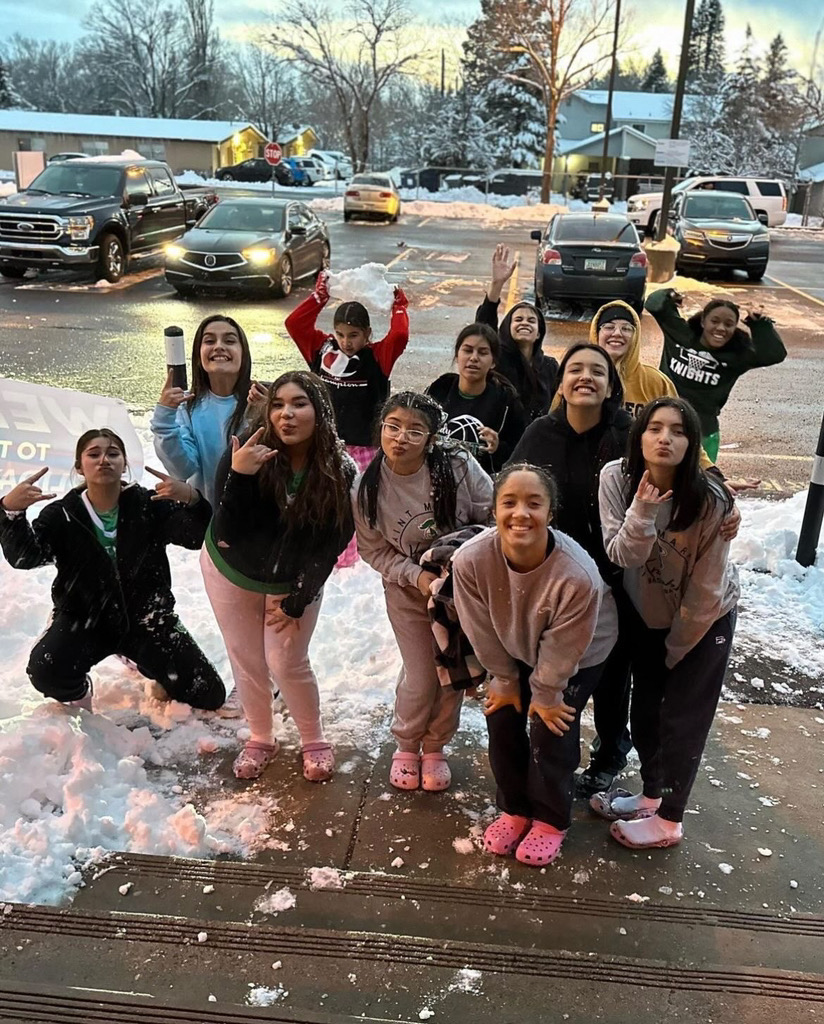
The team was late due to bus troubles but ultimately arrived safely and we were able to have a basketball game. All I’ll say about this game was Flagstaff High School, on top of having a very good team, also had a significant home-court advantage. You try getting a bus of Phoenix high school girls that never see snow to focus on a basketball game after driving up in a snowstorm. After the game, the Flagstaff High School team looked confused as our team ran outside to roll around in the snow. We overheard, “they must not see snow much” as we walked to our car.
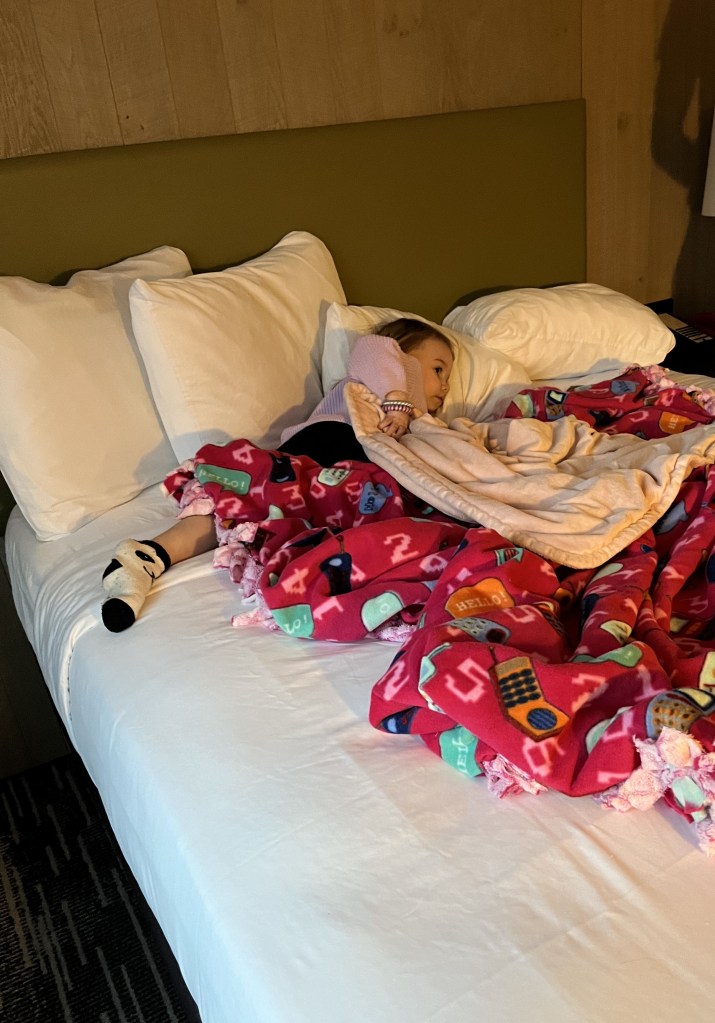
We checked into a new hotel that night. Hotels with Ivy are fun. She gets so excited. She likes to walk around the room and be present with the whole family. Ivy and I share a bed while Beth and Sage get the other.
Sleeping in the same bed as Ivy is an extreme adventure. I never know when I’m going to get kicked or slapped. Every time I wake up and look at Ivy she’s in a completely different position.
At some point in the middle of the night, I awoke to a thump sound on the opposite side of the bed. You know how when you’re awoken by a noise, it usually takes your brain a minute or two to understand what it just heard? That didn’t happen with this sound. I knew exactly what happened the moment my brain woke up to it. I can’t remember how I got to the other side of the bed. I don’t know if I jumped to all fours on the bed like Spiderman and leaped to the other side, or if I jumped off the bed and ran around. It was most likely the latter. However I got there, I arrived before the tears even started.
I found Ivy’s shape on the floor with my hands as it was pitch dark and I couldn’t see anything. I scooped her into my arms as she started to cry. I held her head to my should and told her it would be ok. As I rocked her I told Ivy that we were going to get back in bed but I would hold her and she would be safe. She stopped crying immediately and said, “yes.” We got back into the bed and I slept the rest of the night with Ivy in my arms.
As I thought back on this, I was struck by something. I was struck by how quickly Ivy stopped crying. The moment I told her I was going to hold her and she was going to be safe, her simple reply “yes” and she was completely at peace. I was so glad I could be there for her and make her know she was safe.
I think in this life we can often feel like God isn’t there to hug us and make us feel safe as quickly as we’d like. I think we forget that in God’s time, His reaction is instant. It just feels longer for us. I believe God is always there ready and willing to wrap us in a protective hug, whether we realize it or not.
Another thing I was struck by was how quickly I reacted. If there was ever any doubt in my mind about whether I would jump in front of a moving vehicle to save my daughters, that doubt is gone. I would throw myself in front of danger for my girls without hesitation. I know that.
Back to that Flagstaff High School basketball game, I wasn’t skimming over the details of that game only because I wanted to move creatively through the story. I didn’t want to talk too much about how badly we got our butts kicked.
We’ve had mostly close games this season and a couple bad blowouts to two of the best teams in Arizona. Thinking back on that game, I realized how proud of the team I was. The first half was the lowest low. Our team gave up and practically stopped playing. Their heads were down and they were resigned to a bad loss. We had a serious talk with them at halftime about doing their best no matter what the score was. I pulled some girls aside that were leaders on the team and told them I was disappointed in their reaction to losing. I told them I knew they were disappointed, frustrated, upset, and embarrassed; so was I. But they had to be leaders, stay positive, and encourage their teammates.
The second half we were like a different team. We still weren’t the better team, but we were a better team. I got slightly emotional thinking about how big a turnaround those girls showed in the second half. Instead of continuing to pout and give up, they encouraged each other and really tried to be better.
I don’t get emotional like that thinking about the average game. It’s the intensely adverse games that I think back on and get very proud of our teams.
I would never wish for Ivy to fall off the bed. But I’d be lying if I said I wasn’t kind of glad it happened. It was a chance for me to see how quickly I would react to the pain of my daughter. It gave Ivy a chance to see I am there for her and I will protect her. Will I always be able to react that quickly? No. But Ivy is starting to learn I am always there.
I think this life is about learning God is also always there.
Would I ever wish my basketball team to get beaten by an obscene amount of points? Of course not… except, well, it gives them the greatest opportunity to grow. Getting blown out is a real opportunity to see what kind of person each girl is. I truly believe getting blown out in a basketball game is teaching those girls a valuable lesson about getting your teeth kicked in in real life and how you react to it.
Moth’s come to a flame because it is warm and comforting. While the flame is warm and comforting, eventually warmth and comfort make you stagnant, and before you realize it, you’re stuck or worse, burnt. It’s the adversity and challenges in life that shape us and keep us on our toes.
Adversity can give us amazing opportunities to see what kind of person we are. It’s easy to be kind, encouraging, and happy when life is all good and nothing difficult is happening. It’s a little more challenging when life is throwing all the roadblocks your way.
I know (Doctrine and Covenants 121) that this is how God feels about adversity. He doesn’t love that we have to go through it, but He knows we have to go through it.
Adversity is our greatest opportunity to see what we’re really made of. As I get older and more “mature” I can say with more and more honesty that I am grateful for adversity as it gives me the best opportunity to find out what kind of person I really am.
Find yourself a wife that is kind, caring, and good.
Find someone you know will be a good mother not by any one action or by any words but by their being; who they are.
Find someone who will love, uplift, and support you through everything you want to accomplish.
Here’s an important one: find someone that will love you conditionally. The world says to find someone that loves you unconditionally. That’s too easy. Where is the growth and progression in being loved unconditionally? Find someone who wants you to improve and be better as much as you yourself want to improve and be better.
Find someone who also wants to be better.
When two people independently want to be stronger and better, they collectively become stronger and better.
As important as someone who loves you conditionally, find someone who loves the Lord unconditionally. Find someone who has a testimony of what is important in this life. While the world moves and shakes, find someone with a foundation. So that if ever your foundation becomes weak, you have someone whose foundation is strong.
Keep your foundation strong for that person as well, so that they can rely on you when their foundation needs shoring up.
Find someone who wants God to be a part of your life, family, and home. If God is in your home, your home can never fail.
Find someone with faith. Find someone with devotion. Find someone you can trust.
“I say unto you, that likewise joy shall be in heaven over one sinner that repenteth, more than over ninety and nine just persons, which need no repentance.”
Why does heaven rejoice over a returned sinner?
Why does Christ love a returned sinner? This should be obvious. Christ loves a returned sinner because they’re utilizing His Atonement, the great gift He gave them. He suffered for that gift. Why wouldn’t He rejoice over it being used?
It’s very important to point out that this doesn’t make the returned sinner any better than the constantly faithful. Do you think God is up there thinking, “you were always upright. Too bad you didn’t sin some more so I could have increased joy”? Of course not. God loves the consistently faithful. I think another important point here is that we’re all sinners. So, by this scripture we can know, that God loves all who repent of sins. We all sin.
An individual from history who was a clear sinner, making evil choices, even if he didn’t realize it, was Paul. Paul ended up being one of the greatest missionaries ever but started as the greatest persecutor of the church. Paul received a miraculous visit from Jesus Christ. This converted him and he instantly changed his ways. As we read the scriptures, Paul’s change seems instant. But I believe there was a reason he had to travel blind for three days. I believe his change was actually slow and required a lot of humility.
Paul became an obvious example of Luke 15:7, heaven rejoicing. Paul was such a go-getter of persecution; the Heavens must have been excited to have him on their team once he converted. Imagine how the angels rejoiced when Paul turned to the Lord because they now knew how ferocious he would be for the Lord.
Peter can be seen as another example of someone who didn’t always make the right choices. Isn’t it amazing to read the New Testament and consider how flawed the individuals were who Christ chose to spread His word and be His ministers? Peter was no exception. You can look to Peter’s three denials of Christ as a great scriptural moment representing needing to learn a lesson, repent, and double down on conversion and commitment.
Peter made a huge, and life-altering mistake by denying Christ those three times. It was life-altering for how it helped Peter change his life. It could have been life-altering in how it turned Peter away from Christ. He could have gone the other way. Christ knew He wouldn’t. That’s why Christ picked Peter.
The show “The Chosen” does an interesting job of depicting Peter. What if Peter was kind of a bad guy? Not a bad heart, but did some bad things. A rough guy. A guy that made a lot of mistakes before he met Jesus and fell in as one of his apostles. Then, slowly, over much time around the Master, Peter became His primary apostle. Peter eventually became the president of Christ’s church.
The student manual for the book of Mark notes:
“Mark, more than the other Gospel writers, recorded the disciples’ shortcomings (see Mark 4:36-41; 6:52; 8:14-21). The disciples’ weaknesses stand in contrast to their greath faith and successes, which are depicted in the book of Acts, helping us appreciate the transformation brought about by the Resurrection and the outpouring of the Holy Ghost.”
Never judge a sinner. They can become the most kind, most gentle, most Godly person. We all have Godhood in us. One day our sins will be in great contrast to our faith and successes when we ultimately attain our full potential.
The Bible Dictionary definition of “conversion” states:
“Denotes changing one’s views, in a conscious acceptance of the will of God (emphasis added, Acts 3:19). If followed by continued faith in the Lord Jesus Christ, repentance, baptism in water for the remission of sins, and the reception of the Holy Ghost by the laying on of hands, conversion will become complete and will change a natural man into a sanctified, born again, purified person-a new creature in Christ Jesus (see 2 Cor. 5:17). Complete conversion comes after many trials and much testing (emphasis added, see Luke 22:32; D&C 112:12-13). To labor for the conversion of one’s self and others is a noble task, as in Ps. 51:13; Dan. 12:3; James 5:19-20; Alma 26; D&C 18:15-16.”
The part that stood out to me most from that definition was that complete conversion comes after many trials. I know it did for me. I had to experience the bitter to appreciate the sweet. I had to see how dark life could feel to appreciate Christ’s light. I know my testimony is stronger because I had to learn how dark it can be.
Did Peter experience his change through trials? Did Paul? I think they did. Those who go through the greatest trials and then turn to the Lord become his most devout followers. Paul was blind. That’s quite a trial. But when he saw the light, he never turned away from it again.
We all don’t receive miraculous visitations from Jesus Christ like Paul did, or get to work with Christ side-by-side like Peter, but we can still feel His presence, serve Him, and feel what it’s like to have Him by our side. Imagine how different your actions would be day-to-day if Christ was with you? Well, He is.
Sometimes I worry that faithful, day-one-never-wander latter-day saints are missing this. This devotion to the cause. This understanding of how much you need Him. It’s why trials happen. Otherwise, we’d all walk merrily through this life, never understanding the true depth of the Atonement and how desperately we need Him.
Now, trials come in all shapes and sizes. Just because someone appears to never have gone through “it”, doesn’t mean they’ve never gone through it. We never know the internal struggles, challenges, and difficulties someone faces in their faith. It’s usually not on the outside. But if you see a devoted person to God, you can assume they’ve been through something. It’s those somethings that bring us to Him.
God loves a returned sinner. Remember that whenever you make a mistake. While we don’t want to make mistakes, we always want to do our best, God will welcome us back with open arms when we make mistakes and repent. It’s a comforting thought whenever we mess up. God knows our heart. Part of making mistakes and repenting is truly regretting it. This doesn’t mean beating yourself up about it or getting too down on yourself, but it does mean truly feeling regret and remorse for mistakes. This can’t be faked. God knows your heart.
I think we can learn something really neat from examples like Peter and Paul. No matter how far we stray, God has a place for us. God doesn’t look at what we’ve been or what we are, but what we will be. He knows what we will be. He sees that in us. I’d guess it’s His greatest desire that we see in ourselves what He already knows is there.
Be like Peter and Paul. Be someone Christ can pick.