Tag: Atonement of Jesus Christ

  • Forgiveness, Doves, and The Chosen

    Forgiveness, Doves, and The Chosen

    Surprisingly I haven’t written about the Chosen yet.

    I’m about to finish season 3. I think this is an important TV show.

    In this season, there is a moment when Mary is talking to Tamar, a woman from Ethiopia.

    Mary voices jealousy towards Tamar for seemingly being able to push her way into the group without any hardships. Mary points out that she needed demons cast from her and to be pulled drunk from a tavern to get to her current place with Jesus. Mary seems to think Tamar is lacking humility due to her lack of trials.

    It was at this point that Tamar said something that jumped out at me while I watched:

    “Jesus forgave you, but you choose to hold on to it.”

    An episode later we get a look into Matthew’s past. Matthew is my favorite character.

    We see a flashback to when an old man came to Matthew during Matthew’s time as a tax collector. The man brazenly admits to legally accumulating tons of debt in an effort to help his children. The man will be sentenced to a prison camp because he’ll never be able to pay back the debt. He doesn’t care; he is an old man.

    The man then gives Matthew some prayer tassels. They are seemingly worthless, but the meaning of the old prayer tassels was significant to the old man. To him, those tattered tassels were priceless.

    The man gives them as a gift to Matthew telling him that one day he may regain his faith and need them. Matthew insists that he will never need those prayer tassels. The man insists.

    Matthew held onto those tassels and Mary found them.

    When Mary asked about them, Matthew told her the story. He didn’t understand why the man gave this sentimental item to him. Mary explained that the old man wasn’t giving some prayer tassels to Matthew, he was giving his faith to Matthew.

    Matthew’s response:

    “Why would he do that for someone like me?”

    Mary then told a story about a time she was going to kill herself. The only thing that stopped her was a dove. She saw it in the distance and took it as a sign that she shouldn’t do what she was considering.

    She told Matthew that man who gave away his prayer tassels was Matthew’s dove.

    These scenes from this powerful show gave me a lot to ponder.

    I often feel like Mary and Matthew.

    “Jesus forgave you, but you choose to hold onto it.”

    “Why would he do that for someone like me?”

    I pondered on whether I’m holding onto anything. Are you?

    The second question is a question I ask myself often. Why would God do this for someone like me? Why did Christ suffer, for me?

    Are we too hard on ourselves?

    I think back on some of my doves.

    Love is Powerful.

    The Inspiration.

    RIP Coach.

    Sometimes I think I’m like Mary, holding onto guilt that Christ no longer wants me to hold. That said, I have an interesting relationship with my guilt. I don’t dwell on it. I think a lot of it has left me. Still, sometimes I think I feel unworthy.

    We all hold onto things we should let go, becuase Christ already forgave us.

    We are surrounded by doves, those people that see our potential. We can always be the dove to someone else when they feel like they’re coming up short.

    We all feel unworthy sometimes, even though those around us see our potential. And God always sees our potential.

  • Sickness

    Sickness

    I’d like to share a poem by Boyd K Packer.

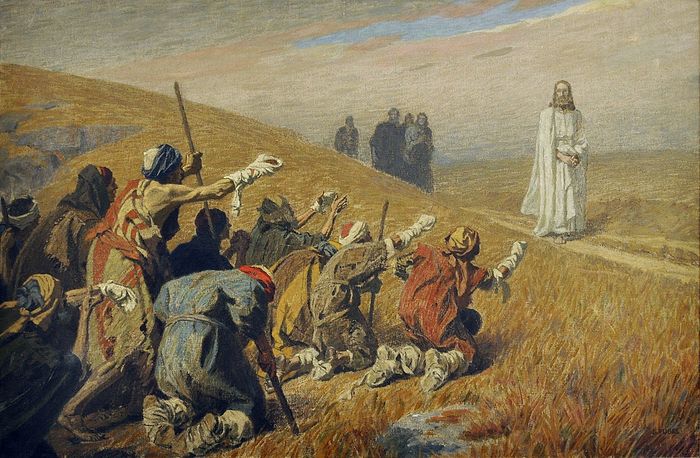
    In ancient times the cry “Unclean!”
    Would warn of lepers near.
    “Unclean! Unclean!” the words rang out;
    Then all drew back in fear,

    Lest by the touch of lepers’ hands
    They, too, would lepers be.
    There was no cure in ancient times,
    Just hopeless agony.
     · · · · · · · · · · · · · · · · · · ·
     But there was One, the record shows,
    Whose touch could make them pure;
    Could ease their awful suffering,
    Their rotting flesh restore.
     · · · · · · · · · · · · · · · · · · ·
     The day He made ten lepers whole,
    The day He made them clean,
    Well symbolized His ministry
    And what His life would mean.
     However great that miracle,
    This was not why He came.
    He came to rescue every soul
    From death, from sin, from shame.
     · · · · · · · · · · · · · · · · · · ·
     What must be done to make us clean
    We cannot do alone.
    The law, to be a law, requires
    A pure one must atone.
     He taught that justice will be stayed
    Till mercy’s claim be heard
    If we repent and are baptized
    And live by every word.
     · · · · · · · · · · · · · · · · · · ·
     If we could only understand
    All we have heard and seen,
    We’d know there is no greater gift
    Than those two words—“Washed clean!”

    Leprosy was a terrible disease. The skin rotting before the afflicted’s own eyes.

    One day we will stand before Christ and feel how unclean we really are. How grateful will we be for the Atonement in that moment? I’m grateful that we can be washed clean from all our misdeeds, errant thoughts, unkindness, and mistakes. All because He suffered our folly for us.

    While I’m not overexcited to see all my shortcomings, it will be a powerful moment to truly see and understand what Christ did for me. I have an idea now. One day I’ll see and know.

    He died for me.

  • The Refiner’s Fire

    The Refiner’s Fire

    *I wrote this in March of 2022.

    One of Newton’s Laws of Motion states “For every action, there is an equal and opposite reaction.”

    In life, for every sorrow, there is equal and opposite capacity for joy. For all our abilities to cause pain and suffering, there is an equal and opposite capacity in us to provide joy and comfort to others.

    This brings up a thought: Without sorrow in general, we would lose the ability to provide an equal and opposite amount of joy. If there were no sorrow in the world, we couldn’t equally counter it with joy. This puts sorrow in a somewhat different light.

    Without our personal sorrows, we could not help others through their personal sorrows. This is why, among infinite other reasons, Jesus Christ’s sacrifice was so significant. He knows all the sorrow. He has experienced it. He can help us through all our sorrows.

    For some reason this week I’ve been studying Einstein’s General Theory of Relativity. The followoing thoughts and things I’m going to write probably won’t make sense. Scientifically, what I’m about to write may be nonsense. But they mean something to me, so I will try to elaborate.

    I read that Einstein came up with one of his theories when he was looking out a window at someone on a ladder. He wondered what would happen if that person fell off the ladder?

    While watching the short video The Refiner’s Fire, Ivy was in my lap. I was in a rocking chair. She was watching with me. I rocked while I held the phone, and we watched the video. My elbow was propped on the chair so as the chair moved, my body moved, and the phone moved. I wondered if Ivy was having to keep up with the phone, trying to trace it as it moved. I realized, probably not. Like me, she was moving with the chair that moved the phone. She was lying flat against my chest so as I moved, she moved, and the phone stayed right in her field of vision, in her eyes to see.

    Then, near the end of the video, Ivy, as toddlers are known to do, got impatient and sat up in my lap. Now she wasn’t flush with my chest. As I rocked and tried to hold the phone steady, she rocked back and forth, tossed about by the flow of the chair but no longer in sync with me in any way. In addition, I had to move the phone farther away, one to try to keep it steady, and two to keep Ivy from grabbing it.

    As I’ve studied Einstein’s theories I’ve been struck by the religious implications. Spacetime bends around the object with the most mass. That object pulls all smaller objects to it. They are drawn to it. Time and space literally bend to the will of the biggest object.

    God is our biggest object. He is the biggest object of the universe. He is, literally, a celestial body of such force that from many lightyears away our sun, our planet, and we are drawn to Him. He is the force that keeps us moving. He is the force that keeps us living.

    As I rocked in this chair, I realized the chair was God. He was the force I was rocking with. And as I was rocking with Him, it was easy to focus on whatever I needed to focus on. If I was flush with Him and in sync with Him, I could focus on that video easily as it rocked with Him. Ivy also, as she stayed flush with me, could focus on the bigger picture – represented by that video. But as she was dependent on me (flush with my body which was flush with the chair – remember God is the chair), when she lifted off me, it made it harder for her to see the picture. She’d disconnected from me and therefore disconnected with God. In addition, if I raised myself from the chair, I disconnected us both from the chair, from God, and we both lost the vision. We both got distracted, we both couldn’t follow the video, we both got tossed about by the swinging momentum, trying to stay flush with the chair (God) but having disconnected ourselves from Him.

    What does this teach me?

    1. In this moment, it is profoundly important for me to stay flush with God.  Ivy (and now Sage) are relying on me.
    2. It is profoundly important for me to teach Ivy, Sage, and our future daughter to become flush with God themselves, so they don’t need to rely on me. What happens when I’m not here?

    How does this tie into The Refiner’s Fire video that started this thought?

    We can create joy to counter sorrow. It is up to me to stay flush with God so that when Ivy, Sage, and my future daughter go through their refiner’s fires, they have somebody they can completely trust. In my life I have a great capacity to cause joy or sorrow. I think the greatest joy I can create in my daughters’ lives is teaching them that God loves them, they are His, He is watching them, and no matter what happens in their life, He will always be there for them. If I don’t teach this to my daughters, it would result in a great sorrow.

    Ivy, Sage, and future daughter will go through their refiner’s fires just as I did. They will need God in their lives at that time. We all need God as we go through the refiner’s fire. Then, when we come out properly molded, we can be flush with the chair (God) and help others as they stay flush with us, until they, themselves, can connect themselves to God. 

    It is our greatest responsibility, and the greatest joy we can provide, to teach others that God loves them. They are children of God with a divine inheritance. No matter what happens to them in this life, He is always there, and it will be okay in the end.

  • Are Stupid Decisions Sins?

    Are Stupid Decisions Sins?

    I was listening to the story of a guy who was riding his motorcycle 140mph when he lost control and crashed. His body skidded across the pavement at an unknowable speed when he hit a pole. I won’t go into the details of his injuries or how he survived. I’ll only say that he survived, and his injuries were extensive. He’s missing parts of his body, can’t use the restroom, his body is destroyed.

    This led me to a thought: was it a sin for him to drive his motorcycle at that ridiculous speed?

    What separates sin and stupidity?

    Let’s break down that first question a little more, was it a sin to drive a motorcycle at an unsafe speed? Is it a sin to break the speed limit? Is it a sin to break a law? The answer is no, it is not necessarily a sin to break the law.  Men and governments make laws and men and governments are corrupt. I could elaborate on this, but I think we all agree. There were some “laws” in WW2 Germany that were evil. Enough said there.

    So it wasn’t a sin to speed on a motorcycle.

    But was it stupid?

    I think the answer is a resounding YES. It was stupid to drive a motorcycle at 140mph.

    Was it a sin to put his body, a gift from God, in such a dangerous position? His decisions that led to destroying a gift from God, were those sinful decisions?

    When I had my ATV accident was I sinning? No, I don’t think I was…and yet… Yet, was it stupid to be on an ATV without a helmet? In hindsight, of course. Most would say of course even without hindsight.

    Is it a sin to do something stupid, knowing it’s stupid, and not caring? I don’t know… I think I knew it was stupid to ride on an ATV without a helmet, and I still did it. Am I stupid or was I sinning? Or both?

    I return to the question, was it a sin for someone to make decisions that he knew were dangerous and ultimately led to destroying a gift from God?

    I think the answer is no. I think that’s the answer because he didn’t know he was going to destroy his body and that wasn’t ultimately his goal. I didn’t know not wearing a helmet that day would actually risk my life, even if I knew there was a chance, I didn’t know it would flip and I would get seriously injured.

    Here’s where an important line is drawn. Sin is knowingly doing something wrong, knowing that what one is doing is wrong, and still doing it. Sin is conscious, intentional wrongdoing.

    An interesting point to make is that sin is always stupid. This is true on so many levels. Sin is knowing an all-loving Father who only wants your best has advised you of something, and you ignore it, whether due to a belief that you know more than Him or simple disobedience. This assumes a person understands that God loves them and wants the best for them. If the person doesn’t understand that, it makes their decisions less likely to be sins. This is where the principle of: with added light and knowledge comes added responsibility, comes in. More light and knowledge means more awareness of how decisions are sins.

    I believe this is why some in the church feel an overwhelming feeling of guilt that they often blame the church for. Blaming the church is kind of like blaming God. They are mad that they know what they’re doing is wrong, they still want to do it, and this causes a conflict in their soul. This is why many might leave the church.

    Back to the topic.

    Stupidity is not always sin.

    This led me to thinking more about sin. Sin is always stupid. No matter what, sin is stupid. Sin leads to hurting yourself or others in some way.

    Stupid decisions aren’t necessarily sins. Sins are always stupid decisions.

    This is why God has given us this life. It’s a training ground. It’s a chance to prove ourselves worthy of more. If we can’t handle the trials and challenges of this testing ground, how can we be trusted with more in eternity?

    I’m grateful for the life and the opportunity it gives me to be tested, with less at stake. My soul is safe because it is in the hands of Christ. All my mistakes will be paid for by Christ, they have been paid for. I just need to turn to Him. I’m immensely grateful for that.

  • Will Hitler be Forgiven?

    Will Hitler be Forgiven?

    Before I share this, I will state the obvious. Hitler the man did heinous, horrible acts. He caused as much pain and heartache as any soul ever has on this earth. In writing this silly thought experiment I in no way intend to make light of the horrible choices of others. I believe I will have a hard time forgiving some of the acts I see during life reviews at the great judgment. Forgiveness, thankfully, won’t be for me to decide. I don’t know who will be forgiven for what. I know some will need to ask for forgiveness and likely won’t. I know some will receive forgiveness that we can’t comprehend. I trust in God. Now onto my silly post. Please don’t take the main character too seriously.

    I had a thought while I was in the shower, and it stemmed from this question – will Hitler be forgiven? The mere mention of the idea is enough to get me canceled. 

    The beauty of the plan of salvation and something only the Church of Jesus Christ proposes an answer to, is that God will save all His children and how that could be accomplished.

    The thought I had in answer to this question was – maybe Hitler will be forgiven, only God knows. If someone like Hitler could be forgiven, what change would need to take place in a soul like that for that to happen?

    We see momentous changes in mortality. We can see transformations over small courses of time. Think of someone you’ve seen change over the course of 5, 10, or 50 years. A lot of changes can happen to a spirit over the course of 50 years. Now imagine 1000, 5000, and 10,000 years. How about 3 billion years? Those numbers are hard to imagine. What amount of change could happen in a millennium? A lot, I imagine.

    On the other hand, that amount of time can also show the great weaknesses of a character. A lot of change can happen in a billion years and if there are any flaws in character, cracks become gulfs. Eternity is a long time so luckily we have a long time to change. But if we aren’t working toward perfection, our flaws will grow.

    I have read comments in near-death experiences about the malleability of the soul during mortality compared to after death. I’ve read analogies that compare the soul while here on earth to wet cement while the soul post-death being like settled cement. I believe that’s what makes mortality so critical. Our lack of knowledge and need for faith one way or the other, in a way I don’t understand, allows us to change in ways not possible once this life is over.

    The beauty of the plan of salvation is that God will save all His children that want to be saved. That’s the critical part. The desire to be saved. That’s also something becoming increasingly scarce in our society, the ability to forgive.

    Christ and God will know and understand all, and they will be forgiving beyond all measure.

    Which leads to the question, if we’re going to use Hitler as our abstract understanding of evil: will Hitler want to be saved? Will Hitler want to stand before God and Jesus Christ, Jesus Christ, the one who had to suffer for Hitler’s sins, who had to suffer for all the pain Hitler caused? Will Hitler want to stand before Jesus Christ? Will he have the humility to seek that forgiveness? If the evils of Satan touched his heart and soul as deeply as they seemed to – desire for power, hate, etc., will Hitler want to stand before them?

    Will Satan want to be forgiven? No. He won’t. Envy, evil, and hatred have poisoned his once angelic soul (Isaiah 14:12).

    No one can be forgiven if they willingly continue to deny Christ and ”crucify” Him anew.

    Will Hitler have the humility to bow before Christ and beg His forgiveness?

    I can’t imagine that level of change. It’s hard for me to picture that from someone who did such horrible things and strayed so far from the light. That is millenniums of change which is change my mind can’t fathom.

    What I also can’t imagine is how I can ever be made perfect. Me, with all my flaws, judgements, unkindnesses, shortcomings, deceits, greed, and selfishness. How can I be made perfect? I believe it will take a long time.

    Maybe Hitler will change and be forgiven for his sins. I believe if that’s possible it will take time.

    If we love the gospel plan and Heavenly Father and Jesus Christ’s ability to forgive us for our mistakes, we have to accept that they will forgive others too.

    The gospel plan is beautiful. For one and all.

    None of us deserve the redeeming love and a sacrifice willingly given of a God. Jesus Christ, spit upon and bleeding, shed his mortal blood and gave up his immortal spirit so we can live again. I am grateful for what He did for me and I recognize every day that I don’t deserve it. It makes me love Him all the more.

    Forgiveness isn’t something that should be taken lightly. It is serious.

    But when I stand before Him, and I humbly kneel, I believe He will forgive me. And for that moment, I’ll give anything.