Tag: baptism

  • Repentance

    Repentance

    3 Nephi 11:32 reads: 

    “And this is my doctrine, and it is the doctrine which the Father hath given unto me; and I bear record of the Father, and the Father beareth record of me, and the Holy Ghost beareth record of the Father and me; and I bear record that the Father commandeth all men everywhere to repent and believe in me.” 

    3 Nephi 11:37-38 reads:

    “And again I say unto you, ye must repent, and become as a little child, and be baptized in my name, or ye can in nowise receive these things. 

    And again I say unto you, ye must repent, and be baptized in my name, and become as a little child, or ye can in nowise inherit the kingdom of God.” 

    These were some of the first recorded words Jesus Christ spoke to His other flock in the Americas (John 10:16).

    Hugh Nibley says, 

    “Who is righteous in the Book of Mormon? There’s a very simple definition of righteousness in the Book of Mormon, as in the book of Ezekiel. One is righteous because he is repentant, and a person who is not repenting is a person who is not righteous. That’s all there is to it, because we’re all wicked and we all need to repent all the time. “Say nothing but repentance to this generation” (D&C 6:9). The first word of the Lord to the Nephites was, “This is my doctrine…and I bear record that the Father commandeth all men, everywhere to repent…” (3 Nephi 11:32). You have to do that. And as Ezekiel tells us, if a person has been righteous all his life but he’s not repenting any more, he’s wicked (see Ezekiel 18:20-32). Of course, he may have been wicked all of his life, and if he’s repenting now, he’s righteous. It makes no difference. So, always repent, always keep repenting. “But behold, all nations, kindreds, tongues, and people shall dwell safely in the Holy One of Israel if it so be that they will repent” (1 Nephi 22:28).

    I’ve thought a lot about that Hugh Nibley quote since I read it. 

    Can it be that simple? Is it that black and white? 

    Good person = someone repenting 

    Bad person = someone not repenting 

    Does this mean deathbed confessions are adequate? Does this mean if you confess your sins and repent the day before you die that you are righteous? 

    Yes and no. 

    I believe Hugh Nibley’s point is powerful. Repentance=righteousness. Unrepentance=unrighteousness.  

    There’s another part of this equation. Repentance=change. 

    I think back on the eight years I was inactive from church. One of the most distinct aspects of that time period was not praying. I never prayed. Praying made me feel guilty. Since I was not praying, naturally I was also not repenting. At the time I couldn’t repent. Not only due to the fact that I wasn’t praying, but also because I wasn’t ready. I wasn’t going to stop doing the things I was doing. I couldn’t repent and then go continue to do what I was doing. I hope I’ve never taken for granted the Atonement of Jesus Christ. I know I do. But I try so hard not to. 

    As I’ve been back at church these last 10 years, I haven’t missed a day of repentance. I repent at least once and sometimes two or three or four times a day. My nightly prayers have a consistent feature, no matter what – asking for forgiveness for the mistakes I’ve made. I often try to think back through my day and think of the mistakes I made and the things I could have done better. 

    Repentance causes change. If I repented during the years of my inappropriate behavior, it would have been insincere, or it would have led to change. I wouldn’t have been trying to change. My repentance started when I was ready to change. That isn’t to say I should have waited as long as I did. But I do believe Heavenly Father has an unimaginable amount of patience with us. I think we’ll one day marvel at how much love and patience He possesses.  

    Repentance has a negative connotation. It shouldn’t. Repentance makes us better. As Ivy put it one day when I asked her, “Why do we want to be like Jesus?” 

    “Because He is nice.” Repentance makes us nicer. Repentance makes us better. It isn’t a negative thing at all.  

    Are there nice people that don’t “repent.” Of course. But repentance is bigger than that. It’s a humility. It’s recognizing our faults. It’s recognizing we have nothing without all that God has given us. It is a desire to change and be even better than we were the day before. 

    So are deathbed confessions valid? That’s not for me to decide. I know repentance results in change. Ultimately God will decide. It’s not for us to judge. And that’s the most important point to make. When someone shows up to church for the first time, someone who has made a million mistakes and a million bad life choices; when that person shows up to church, you love them. You love and accept and forgive. Leave the rest for God to decide. A person coming to church and trying to change should be shown as much love as a church congregation can muster.

    The miracle of the Atonement is that it is eternal – backwards and forwards. Forever. Christ is always there waiting for us when we’re ready. When we’re ready to start repenting, then we are ready to start changing, and then we can start to be ready to go see Him again. Hopefully, through so much repentance, we can become like Him. That’s the ultimate goal.  
  • The Hearts of the Fathers

    The Hearts of the Fathers

    I always thought about the mission of Elijah (turn the hearts of the fathers to the children and children to the fathers) from my perspective, as one of the “children.” I hadn’t thought about it from the other perspective.

    What happened when Christ preached to those who had died? He talked of His gospel and returning to heaven which was predicated on their baptism. This likely caused a stir amongst the dead. You can see the shudder through the countless number, “Baptism? But how can we be baptized without bodies?” Then Christ explained temple work, vicarious baptisms for the dead, and that they could be saved by their progenitors, their families. Imagine the excitement this caused.

    Those who Christ preached to had been dead for hundreds, some for thousands of years. When was the last time they’d thought about mortality? Did they think about mortality? Had they moved on? Like someone who has a vacation in Mexico but returns to their home, had they settled back into “life” amongst the dead and slowly stopped thinking about mortality? 

    If they had settled back into death, this news from Jesus Christ surely made them re-focus their attention on the living. 

    What then transpired? Did they begin ministering to their living loved ones? Were they sent out to influence the living? Were they ushered out to beg spiritually for help to be saved? 

    I’d always thought about how our hearts here on earth were turned to our dead loved ones when Elijah came and instituted the keys of the sealing power. 

    I hadn’t thought about how the hearts of the dead turned back to us and what that looked like. 

    Love. 

    Love and sacrifice and covenants bind us. 

    We, without them, cannot be made perfect. They, without us, cannot be made perfect. 

    Our ancestors laid the entire foundation for all that we have. Whether we want to give them credit, blame them, or forget them, we can’t deny that we are where we are and we are who we are because of them. 

    It’s amazing to see the modern-day genealogical work being done in the world and particularly amongst the saints. 

    We are creating a bonding link, a welded connection back to Adam. I don’t know exactly how, but this keeps the world from being smitten with a curse. 

    I believe it has to do with love. It has to do with connection. It has everything to do with why we’re here and what we’re meant to learn. 

  • Grandpa Frank

    Grandpa Frank

    My most vivid memory of Grandpa Frank, aside from the “Wogs” (the nickname he had for me) and sitting on his lap as a kid, being squeezed into a ball, and being told I would grow up that way, is a few years ago when he bore his testimony in a church meeting. Paraphrasing, Grandpa said:

    “I miss my wife. I miss my daughter. I miss them so much. But this Gospel tells me I will see them again. That means more to me than anything. And I know it’s true, and that brings me so much comfort.”

    As the legend goes, Grandma Leach converted to the Church of Jesus Christ of Latter-day Saints in her early 30s. While Grandma lugged kids to church every Sunday, Grandpa Frank would watch football, golf, or go fishing. He seldom attended. He showed little to no interest in church.

    Again, as legend goes, after over a decade of this, the bishop of Grandma’s ward came to the door one day.

    “Are you excited for this Saturday?!” He asked.

    “What is happening Saturday?” Grandma asked, confused.

    “Frank’s baptism!” The bishop exclaimed.

    Grandma had no idea. For months, on the sly, Grandpa Frank had been meeting with the missionaries and studying the Book of Mormon. He decided it was true. I have no idea why he never told Grandma. I don’t think anyone knows. Maybe this is where I get my secretive, stubborn, frustratingly independent qualities (sorry Beth).

    That Saturday he got baptized and proceeded to go to church with the family from then on.

    What is the Gospel of Jesus Christ, really?

    Change. A man who preferred football, golf, or fishing realized the most important thing in his world was his family. He sacrificed what he wanted to do on Sunday for them.

    What is the Gospel of Jesus Christ, really?

    Faith. A man who decided to believe something extraordinary: he could and would spend eternity with those he loved most.

    What is the Gospel of Jesus Christ, really?

    Love.

    I didn’t cry when I heard Grandpa died. I know I’ll see him again. I know where he is. I know he’s happy.

    As I write this, a vision comes to my mind.

    Grandpa Frank sees Grandma Sandra. He smiles. He is overjoyed to be reunited with the love of his love, his constant companion until the previous four years separated them temporarily. He embraces her. “It’s really true, Sandra?”

    “You always knew it was,” Grandma tells him.

    Others come. Grandpa is surrounded by Laura, Mike, Henry, Olivia, parents, grandparents, friends, loved ones, and Bengie, of course. They rejoice. People (and a dog) he missed so much, but always knew he’d see again.

    As I picture this reunion, and I think about where I am, similarly stubborn and obnoxious as Grandpa Frank, I think about my daughters, and this family I’ve been given. I think about the faith I’ve gained because I’ve seen examples of real faith. Faith as tangible as this keyboard I now type on. Grandpa Frank’s faith was real. I think about those I’ll one day see again. I think about those I have in my life now, that I’ll be able to have in my life forever. As I consider this all, I cry tears of joy.

    This is the Gospel of Jesus Christ.

    I know that Grandpa knew it and I know where he is now.

    What greater comfort is there than this?

    Thank you, Grandpa, I’ll see you soon.

  • A Kingdom Divided

    A Kingdom Divided

    The first step for Zion is to stop distinguishing ourselves from one another. We are first Children of God.

    President Russell M. Nelson has been clear about the three primary identities we should all focus on for ourselves. Those three identities are:

    First – children of God.

    The first identity is for every person on the face of the earth. Whether they realize it or not, every person is a child or God. The second and third identities are for members of the Church of Jesus Christ of Latter-day Saints. But this does not exclude anyone. The second and third identities are an invitation to the world.

    The second identity is child of the covenant.

    The third identity is disciple of Jesus Christ.

    President Nelson has stressed that anything we give precedence over these three identities distracts from our true potential. As children of God, children of the covenant, and disciples of Jesus Christ, we have a divine inheritance and royal home to return to. Any other worldly designation distracts from our ultimate goal of becoming everything we can be.

    Some of the other designations the world assigns include sexuality, status, race, and political affiliation. There are countless self-defined categories we assign ourselves. None of these things matter, they won’t matter at all when the veil is lifted, and we are reminded of what we always were.

    Zion are the pure in heart (D&C 97:21), Zion are one.

    All who believe in Christ are the children of Christ. But how is Zion established? How can there be unity in Christ given the divisive nature of the world and Christianity?

    A search for all the sects of Christianity brings up THOUSANDS of results. Thousands. How can one know the truth when there are so many claiming to be true? How can Christianity be united under Christ when there are thousands battling for attention, power, and patrons.

    How can God be a God of such confusion and disorder?

    In Luke 11:17 Jesus Christ says:

    Every kingdom divided against itself is brought to desolation; and a house divided against a house falleth.

    How would Jesus Christ feel about the state of the religion that espouses His name?

    I’ve heard it said that Christianity is united, despite its differences, in its faith in Christ. I think this is an admirable way to look at it. In fact, it’s how I try to look at it. It’s my opinion and belief that our faith in Jesus Christ is important and unites us. That said, what really unites us? What enduring principle is it that unites all Christians?

    Is it our belief in what Christ taught? There are a million different interpretations of what Christ taught.  

    Is it our belief in who Christ was? That couldn’t be a more divisive topic. Was He who He claimed to be? Was He the Son of God or wasn’t he?

    Is it our belief in the Atonement of Jesus Christ and what it accomplished? Again, there are different interpretations of Christ’s Atonement, why it was needed, and what it accomplished.

    Surely we can agree on Christ’s resurrection? Was Christ resurrected with His body or wasn’t He? Was there significance to Him eating fish with His disciples after His resurrection? Again, there is contention on this topic.

    What can Christianity be united on? It seems nothing.

    I believe the Church of Jesus Christ of Latter-day Saints provides the only solution to this problem. What Christianity can be united on is a connection to Jesus Christ. A real connection. Not a belief in Him, what He taught, or who He was. The connection must be real and tangible. The connection must be a welding link. The connection must have veracity on earth and in heaven (Matthew 18:18). That connection must be through a covenant.

    A covenant is a two-way promise.

    A covenant binds us to Him.

    When we get baptized, we promise to take upon us the name of Christ, and He becomes our shepherd. From that point on we are inseparably linked with Him.

    Latter-day Saints are a covenant people. The saints of God have always been covenant keepers.

    In the podcast Church History Matters, the hosts were speaking about the early history of temples in the Church of Jesus Christ. Something they said stood out to me as I’ve been working on writing this post.

    “…through the ordinances given to both men and women, living and dead, the human family is being knit or woven or let’s just use the word sealed together into one eternal holy order which we can call the family of God, we can call it the Kingdom of God, we can call it the Church of the Firstborn, we can call it the Celestial Kingdom, or simply the priesthood.”

    In the most recent General Conference of the Church of Jesus Christ of Latter-day Saints, Elder McCune of the Seventy said:

    Joy and eternal perspective come through being bound to the Savior by making and keeping covenants through Christlike discipleship.

    Adam, Abraham, Moses, and Peter; they made covenants with the great Jehovah and became His, and received of His power. Over time, they became more like Him. Over time they became one with Him. Enoch created Zion and was so connected to the Lord that he and his city were taken up to Him. This connection is made through covenants.

    What can unite Christianity? It is a covenant with Jesus Christ.

    Christ’s Church has temples where these covenants can be made.

    We must strive to be one with our brothers and sisters. We can only truly be one as we are united under one banner. The disjointed nature of Christianity is unacceptable. Covenants are needed. It is the banner of covenants with Jesus Christ that will unite Christianity, and nothing else. He died for us. In return, He asked us to believe in Him, follow Him, repent, and be baptized. That was His request of us. There is only one baptism that is acceptable to God the Father and that is the baptism with His authority in the name of His Son. No other baptism is acceptable to Him because it is a baptism not by His authority.

    I wish the Christian world could see that it is covenants that unite us to God. It is covenants that can re-unite us.

    I know as the Millenium approaches that one day all knees will bow and every tongue confess. At some future date the children of God will know and understand the covenants needed to unite the heavenly and eternal family.

    It is here for us now. But the world does not listen. Jesus was sent to this world, but He was not of it. This world struggles with the eternal nature of what God has in store for us. One day the world will have to understand what was always offered to us. What is offered to us is unity under Christ. Eternal families, eternal potential, eternal happiness, eternal inheritance. That is what will come when the world covenants to join with Jesus Christ and be Zion.

  • Sickness

    Sickness

    I’d like to share a poem by Boyd K Packer.

    In ancient times the cry “Unclean!”
    Would warn of lepers near.
    “Unclean! Unclean!” the words rang out;
    Then all drew back in fear,

    Lest by the touch of lepers’ hands
    They, too, would lepers be.
    There was no cure in ancient times,
    Just hopeless agony.
     · · · · · · · · · · · · · · · · · · ·
     But there was One, the record shows,
    Whose touch could make them pure;
    Could ease their awful suffering,
    Their rotting flesh restore.
     · · · · · · · · · · · · · · · · · · ·
     The day He made ten lepers whole,
    The day He made them clean,
    Well symbolized His ministry
    And what His life would mean.
     However great that miracle,
    This was not why He came.
    He came to rescue every soul
    From death, from sin, from shame.
     · · · · · · · · · · · · · · · · · · ·
     What must be done to make us clean
    We cannot do alone.
    The law, to be a law, requires
    A pure one must atone.
     He taught that justice will be stayed
    Till mercy’s claim be heard
    If we repent and are baptized
    And live by every word.
     · · · · · · · · · · · · · · · · · · ·
     If we could only understand
    All we have heard and seen,
    We’d know there is no greater gift
    Than those two words—“Washed clean!”

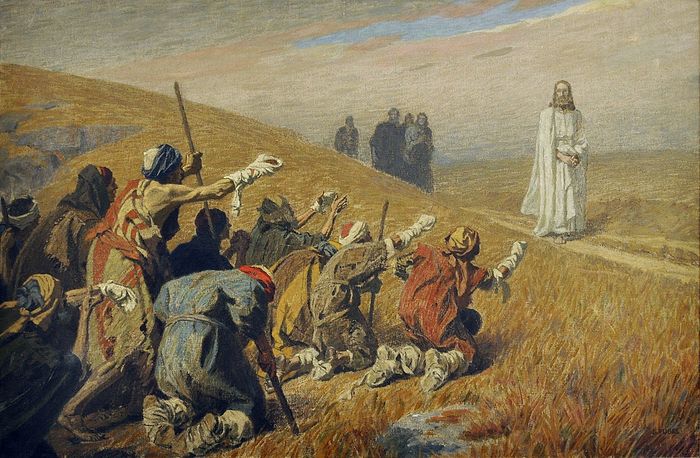
    Leprosy was a terrible disease. The skin rotting before the afflicted’s own eyes.

    One day we will stand before Christ and feel how unclean we really are. How grateful will we be for the Atonement in that moment? I’m grateful that we can be washed clean from all our misdeeds, errant thoughts, unkindness, and mistakes. All because He suffered our folly for us.

    While I’m not overexcited to see all my shortcomings, it will be a powerful moment to truly see and understand what Christ did for me. I have an idea now. One day I’ll see and know.

    He died for me.