Tag: bible

  • What Really Happened with Noah’s Curse of Ham/Canaan?

    What Really Happened with Noah’s Curse of Ham/Canaan?

    There’s a story from the Bible that’s never sat right with me. The Bible tells of Noah and his three sons after the flood. As the story goes, Noah planted a vineyard after the flood waters receded. He then drank of the fruit of the vine, got drunk, and passed out naked.

    Ham, finding his father naked, brought his brothers Shem and Japheth in, presumably to mock and make fun of their father.

    This disrespect to Noah is undeniable. What Ham did in this story was wrong.

    But did it warrant this?

    (Genesis 9:24-27 my additions in parentheses):

    24 And Noah awoke from his wine, and knew what his younger son (Ham) had done unto him.

    25 And he said, Cursed be Canaan (Ham’s son, Noah’s grandson); a servant of servants shall he be unto his brethren.

    26 And he said, Blessed be the Lord God of Shem (Noah’s other son); and Canaan shall be his servant.

    27 God shall enlarge Japheth (Noah’s other son), and he shall dwell in the tents of Shem; and Canaan shall be his servant.

    Was Ham’s sin so egregious that his son and their descendants deserved to be “servant of servants” to his brothers?

    Ham did something wrong, but this seems extreme.

    Bible scholars will say Ham violated the edict to honor his father. True. But all his descendants cursed for the rest of time? This is the part I’ve never understood. Seems too harsh a punishment for something that borders on immature and insensitive at worst.

    Which leads to something I read from Hugh Nibley. I read this in a lecture Hugh Nibley gave and he was citing some information he read. (Reference to this story is also in the Book of Jasher).

    “A very early Christian writing tells how Noah’s descendants waged bitter war among themselves after his death, to see who should possess his kingship; finally one of the blood of Ham prevailed, and from this the Egyptians, Babylonians, and Persians derive their priesthood and kingship. “From the race of Ham,” says the text, “came one through the magical (as opposed to the holy) succession named Nimrod, who was a giant against the Lord.”

    First of all, note the vague “before the Lord” of the King James Version (Genesis 10:9) conceals the true meaning, rendered “against the Lord” by the Rabbinical and early Christian writers).”

    Hugh Nibley continues (my emphasis bolded):

    “Nimrod claimed his kingship on the ground of victory over his enemies. His priesthood, however, he claimed by virtue of possessing “the garment of Adam.” The legends of the Jews assure us that it was by virtue of owning this garment that Nimrod was able to claim power to rule over the whole earth, and that he sat in his tower while men came and worshiped him.”

    Doesn’t this give Lord of the Rings vibes? A man in a tower making the peoples of the earth come to worship him. I had to say that, anyways…

    Let’s recap quickly the genealogy of Nimrod:

    Noah begot Ham. Ham had four sons – Canaan, Cush, Mizraim, and Phut. Nimrod was a son of Cush. Remember that Canaan is the one specifically mentioned in the curse of Noah in Genesis 9.

    But let’s continue with Hugh Nibley (emphasis bolded again):

    “The Apocryphal writers, Jewish and Christian, have a good deal to say about this garment. (“the garment of Adam” mentioned above). To quote one of them: “the garments of skin which God made for Adam and his wife, when they went out of the garden, were given . . . after the death of Adam . . . to Enoch”; hence they passed to Methuselah, and then to Noah, from whom Ham stole them as the people were leaving the ark. Ham’s grandson Nimrod obtained them from his father Cush. As for the legitimate inheritance of this clothing, a very old fragment recently discovered says that Michael (AKA Adam, the original owner of the garment) “disrobed Enoch of his earthly garments, and put on him his angelic clothing,” taking him into the presence of God.

    This idea is interesting. When Enoch and his city were taken up to God (Genesis 5:24), he apparently received new “angelic” clothing. This clothing must have been Terrestrial while the garment of Adam given to him from God was Tellestial, as that was the world he was entering. This would mean the garment of Adam, which was handed down to Enoch, would have been held until…

    “This garment of Enoch was supposed to be the very garment of skins that John the Baptist wore, called by the early Christians “the garment of Elias.” An Arabic “Life of John the Baptist” says that Gabriel (AKA Noah, which makes sense, it was stolen from him originally) brought it to John from heaven as “the garment of Elijah”. “It went back,” says John Chrysostom, “to the beginning of the world, to the times before which Adam required covering. Thus it was the symbol of repentance. . . .”

    So let’s recap. The garment belonged to Adam and was handed down to Enoch until it was taken from him when he went to Heaven. It was then given to Noah who may have had it stolen by his son Ham. It was lost to time until the angel Gabriel (Noah) returned to give it to John the Baptist. The part I want to focus on, if you haven’t guessed, is Ham stealing the garment from his father Noah.

    “Incidentally, the story of the stolen garment as told by the old rabbis, including the great Eleazer, calls for an entirely different rendering of the strange story in Genesis 9 from the version in our King James Bible. They seemed to think that the erwath of Genesis 9:22 did not mean “nakedness” at all, but should be given its primary root meaning of “skin covering.” Read thus, we are to understand that Ham took the garment of his father while he was sleeping and showed it to his brethren, Shem and Japheth, who took a pattern or copy of it (salmah) or else a woven garment like it (simlah) which they put upon their own shoulders, returning the skin garment to their father. Upon awaking, Noah recognized the priesthood of two sons but cursed the son who tried to rob him of his garment.”

    Does Ham’s taking of the garment of his father, trying to strip him of it, remind you of anyone?

    “Behold, here am I, send me, I will be thy son, and I will redeem all mankind, that one soul shall not be lost, and surely I will do it; wherefore give me thine honor”.

    Moses 4:1

    -Satan

    Now read Genesis 9:22-23 considering this rabbinical story:

    22 And Ham, the father of Canaan, saw the nakedness of his father, and told his two brethren without.

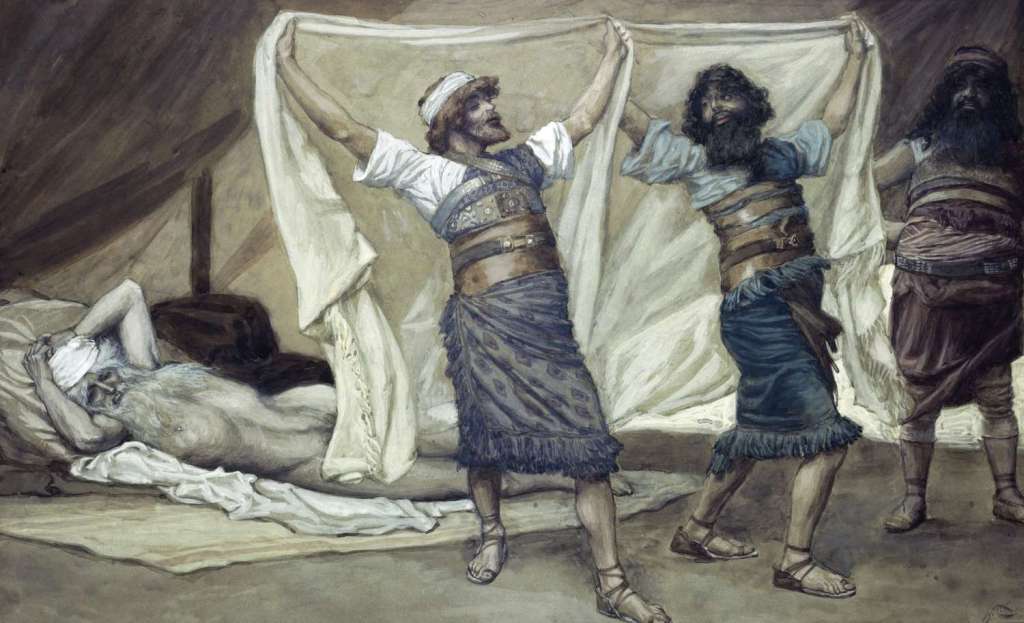
    23 And Shem and Japheth took a garment, and laid it upon both their shoulders, and went backward, and covered the nakedness of their father; and their faces were backward, and they saw not their father’s nakedness.

    It seems plausible that what Ham did wasn’t simple mockery. It seems he might have stolen something from his father. Shem and Japheth, wanting to be like their father, try to replicate the garment Ham stole. But unlike Ham, they return it to Noah.

    Of course there are some unanswered questions with this theory – how did Ham get it back and hand it down to his sons if it was returned to Noah? Why was it Caanan cursed and not Cush or Ham himself? Still, there is something here that seems to add to this story of why Ham and all his descendants were cursed.

    Let’s continue to theorize..

    If this garment that Ham stole was the original garment of Adam, and signified the power, priesthood, and patriarchy of Noah, doesn’t that make more sense why he would have cursed Ham and his descendants? Noah might have sensed what Heavenly Father sensed (knew) when Satan demanded his honor. Ham might have desired power over those around him. This adds some new potential context to Noah’s great-grandson Nimrod’s story:

    “Nimrod claimed his kingship on the ground of victory over his enemies. His priesthood, however, he claimed by virtue of possessing “the garment of Adam.” The legends of the Jews assure us that it was by virtue of owning this garment that Nimrod was able to claim power to rule over the whole earth, and that he sat in his tower while men came and worshiped him.”

    The parallels to Satan continue.

    The rabbis (through Hugh Nibley) continue:

    “By an extremely common type of substitution, the simlah of Genesis 9:23 could very easily stand for an original tsimlah, a copy, imitation, pattern, or by an equally common type of transposition for Salmah, a garment or mantle, as in Micah 2:8. Even as it stands simlah means only a woven garment and can hardly refer to the original skin article. This is, apparently, the source of the widespread legend that Ham stole the garment of Noah and claimed to possess the priesthood by virtue of his illegal insignia. Ham’s descendants, Cush and Nimrod–both Africans, though Nimrod in his wandering moved to Asia–made the same claim. It is interesting that according to certain ancient scriptures which the Latter-day Saints claim have been restored by revelation in our own age, Pharaoh (who represents the Afro-Asian line of Cush-Nimrod) was blessed as to the kingship but cursed as to the priesthood, and he offered Abraham the privilege of wearing his own royal insignia in hope that Abraham would return the compliment by allowing Pharaoh to wear his priestly ones” (Abraham 1:26-27).

    I would suggest the possibility that Pharaoh wasn’t just trying to get Abraham to return the favor by letting him where his royal insignia. Maybe Pharaoh was trying to get Abraham to worship him in his counterfeit insignia of the priesthood. Abraham ultimately sought after the true priesthood, not the counterfeit.

    It continues…

    “According to a very old tradition, Pharaoh coveted the priesthood of Moses exactly as his ancestor Nimrod did that of Abraham, and it was said that the Pharaohs of Egypt dressed in a skin garment “to show that their origin was older than time itself. (Note, Abraham’s refusal to make the exchange was the real reason for his being expelled from Egypt, according to apocryphal writers.)

    Whatever the details, the priests and kings of antiquity certainly wore such garments, and the skin garment was often imitated in woven materials (see footnote below), in fact, the skin garment was itself held to be a substitute for a still older garment made of the leaves of the ficus religiosus.”

    Footnote (pertinent sentences to this discussion bolded):

    In later times the Egyptian priest wore “no real leopard-skin but a close-fitting coat of fine linen in the form of a leopard-skin,” H.R. Hall, “The Bronze Statuette of Khonserdaisu in the British Museum,” JEA 16 (1930): 1, cf. T.J.C. Baly, “Notes on the Ritual of Opening the Mouth,” 178. The Syrian Christians said that the garment given to Adam was of cotton, the “skin” of the tree, Eisler, Iesous Basileus, 2;34; this doctrine, they say, was known only to Moses, “who called cotton ‘skin’ because among trees it takes the place of skin”‘ hence the idea that John the Baptist took his clothes from trees. The Jews retained traces of the older garment in their phylacteries and in the Sisith, the four strings that every Jew once had on the edge of his garment, Ferris J. Stephens, “The Ancient Significance of Sisith,” JBL 50 (1931):59-70. Compare the Irham of the Moslems in John L. Burckhardt, Travels in Arabia, 2 vols. (London: Colburn & Bently, 1831), 1:104-05; 163-64.

    I provided this extra information from the mentioned footnote because I found it interesting and it added more context. But back to the point –

    It seems there is more to this story in Genesis 9.

    What actually happened with Ham and Noah?

    Was Noah’s nakedness symbolic?

    Was there a cloak or some sort of clothing that held significance that was stolen?

    We currently don’t know the answers to these questions but I find the questions fascinating.

    For now I hope anyone reading enjoyed where these thoughts took them, as I enjoyed the exercise. Possibly there’s more to know and understand about this story of Noah and his sons. There might be a great significance to the priesthood power that the ancients so desired, a significance we’re only scratching the surface of.

    One day we’ll know the answers to these questions.
  • My Ignorance and Further Light and Knowledge

    My Ignorance and Further Light and Knowledge

    I have an embarrassing story I’m going to share. I’m not that embarrassed by it or else I wouldn’t share. Though, part of the reason I’m not embarrassed by it is probably due to how I’ve progressed from the ignorance I had at that point.

    Early on when I was coming back to church I started meeting with the missionaries and an individual who was curious about the church. One day after months of meeting together and discussing the Book of Mormon, he sat us down for a serious chat. The friend that had been meeting with us for months informed us that it wasn’t true. That’s a story for another day.

    There was a moment that has stuck with me that I haven’t forgotten. This friend, and he is a friend to this day, talked about the unity of the Christian faith. He talked about how LDS doctrine was way off, and most of Christianity, outside of us, agreed on the most important things.

    I wholeheartedly disagreed with this and still do. I see little unity in Christianity. See my post two weeks ago, A Kingdom Divided.

    This is the embarrassing part. At that time, I believed that Godhead vs. Trinity beliefs were roughly split 50/50 in Christianity. I thought for every Trinity leaning Christian sect there was a Godhead leaning sect. This was pure ignorance on my part. I had no idea that there were basically only two sects of Christianity that believed in the Godhead, and the rest followed the Trinitarian belief.

    To illustrate the divided nature of Christianity, I used the worst example. Based out of my ignorance, I stated that the issue of the Godhead vs. the Trinity was a perfect example of an important disagreement between Christianity. This friend who was essentially a Bible scholar looked at me like I was growing a second head. It was like he suddenly realized I had no idea what I was talking about and I lost all credibility.

    He said, “You know the LDS church is one of the only Christian churches that believes in the Godhead right?”

    I really didn’t. Now I did. Of course, it’s actually not that straight forward. While the belief that Heavenly Father, Jesus Christ, and the Holy Spirit are three separate and distinct beings is a minority belief, there are still many, many sects that believe in the Godhead.

    There was something important I learned from this experience, though. I’ll never know enough. There will always be things I don’t know. There will always be things I’m ignorant of. There will always be someone smarter than me. There will always be someone who understands history and the Bible and Christianity better than me.

    That said, if that “smarter,” “more learned,” or “Biblical scholar” doesn’t have the additional light and knowledge of the restored Gospel of Jesus Christ, whether they realize it or not, I will always have more than them. Even if I might not be what the world would call more learned on the subject, I’ve been introduced to truth and light from Heaven. Those that are biblical scholars are studying a dead text. The Bible is important, and wonderful, and a guider, but it is dead. It is no longer living. The Church of Jesus Christ of Latter-day Saints, Christ’s restored church , is a living church. Further revelation and knowledge will always beat studying an ancient and sometimes misunderstood text.

    I have confidence in what I know. But I am not cocky in my understanding. I know there is so much I don’t know. I know I can’t Bible bash with the best of them.

    What I can do, and I hope I do, is rely on the Holy Spirit, the living spirit of revelation, to help me to teach others the truth I know. I may not know everything, but the Holy Spirit does. As long as I have Him with me, and preach and teach with His guidance, I can be confident. I can be confident not in what I know, but in what the Spirit knows and what He can reveal to me.

    I’m grateful for that embarrassing moment. It taught me to never be cocky. It taught me who I need to rely on.

    Ultimately, you can battle over interpretations of Bible verses until you’re blue in the face. The truth is, Christianity is the thing that Christ preached against more than anything – separated, disjointed, contentious. Christianity doesn’t agree because Christianity no longer relies on the Holy Spirit for revelation and truth.

    This led to mass confusion and misunderstanding in Christianity. The things “Christianity” are often the most consistent on (like the Trinity) were decisions made by men who had rejected God and His guidance.

    We need God to reveal truth to us. If we push Him out, He’ll let us fumble about. We’ve seen Christianity fumble about since it rejected Christ’s apostles and started to have their debates and creeds.

    The more I study the Nicene Creed and how the Trinitarian belief came about, the more confused I get. It’s something I hope to write about. But honestly, not sure I ever will because it’s such an ambiguous and ridiculous process that led to this “unanimous” belief.

    We need answers from heaven or we are lost. Christ’s church isn’t dead. It is living. Without that living church, we are lost.

  • A Kingdom Divided

    A Kingdom Divided

    The first step for Zion is to stop distinguishing ourselves from one another. We are first Children of God.

    President Russell M. Nelson has been clear about the three primary identities we should all focus on for ourselves. Those three identities are:

    First – children of God.

    The first identity is for every person on the face of the earth. Whether they realize it or not, every person is a child or God. The second and third identities are for members of the Church of Jesus Christ of Latter-day Saints. But this does not exclude anyone. The second and third identities are an invitation to the world.

    The second identity is child of the covenant.

    The third identity is disciple of Jesus Christ.

    President Nelson has stressed that anything we give precedence over these three identities distracts from our true potential. As children of God, children of the covenant, and disciples of Jesus Christ, we have a divine inheritance and royal home to return to. Any other worldly designation distracts from our ultimate goal of becoming everything we can be.

    Some of the other designations the world assigns include sexuality, status, race, and political affiliation. There are countless self-defined categories we assign ourselves. None of these things matter, they won’t matter at all when the veil is lifted, and we are reminded of what we always were.

    Zion are the pure in heart (D&C 97:21), Zion are one.

    All who believe in Christ are the children of Christ. But how is Zion established? How can there be unity in Christ given the divisive nature of the world and Christianity?

    A search for all the sects of Christianity brings up THOUSANDS of results. Thousands. How can one know the truth when there are so many claiming to be true? How can Christianity be united under Christ when there are thousands battling for attention, power, and patrons.

    How can God be a God of such confusion and disorder?

    In Luke 11:17 Jesus Christ says:

    Every kingdom divided against itself is brought to desolation; and a house divided against a house falleth.

    How would Jesus Christ feel about the state of the religion that espouses His name?

    I’ve heard it said that Christianity is united, despite its differences, in its faith in Christ. I think this is an admirable way to look at it. In fact, it’s how I try to look at it. It’s my opinion and belief that our faith in Jesus Christ is important and unites us. That said, what really unites us? What enduring principle is it that unites all Christians?

    Is it our belief in what Christ taught? There are a million different interpretations of what Christ taught.  

    Is it our belief in who Christ was? That couldn’t be a more divisive topic. Was He who He claimed to be? Was He the Son of God or wasn’t he?

    Is it our belief in the Atonement of Jesus Christ and what it accomplished? Again, there are different interpretations of Christ’s Atonement, why it was needed, and what it accomplished.

    Surely we can agree on Christ’s resurrection? Was Christ resurrected with His body or wasn’t He? Was there significance to Him eating fish with His disciples after His resurrection? Again, there is contention on this topic.

    What can Christianity be united on? It seems nothing.

    I believe the Church of Jesus Christ of Latter-day Saints provides the only solution to this problem. What Christianity can be united on is a connection to Jesus Christ. A real connection. Not a belief in Him, what He taught, or who He was. The connection must be real and tangible. The connection must be a welding link. The connection must have veracity on earth and in heaven (Matthew 18:18). That connection must be through a covenant.

    A covenant is a two-way promise.

    A covenant binds us to Him.

    When we get baptized, we promise to take upon us the name of Christ, and He becomes our shepherd. From that point on we are inseparably linked with Him.

    Latter-day Saints are a covenant people. The saints of God have always been covenant keepers.

    In the podcast Church History Matters, the hosts were speaking about the early history of temples in the Church of Jesus Christ. Something they said stood out to me as I’ve been working on writing this post.

    “…through the ordinances given to both men and women, living and dead, the human family is being knit or woven or let’s just use the word sealed together into one eternal holy order which we can call the family of God, we can call it the Kingdom of God, we can call it the Church of the Firstborn, we can call it the Celestial Kingdom, or simply the priesthood.”

    In the most recent General Conference of the Church of Jesus Christ of Latter-day Saints, Elder McCune of the Seventy said:

    Joy and eternal perspective come through being bound to the Savior by making and keeping covenants through Christlike discipleship.

    Adam, Abraham, Moses, and Peter; they made covenants with the great Jehovah and became His, and received of His power. Over time, they became more like Him. Over time they became one with Him. Enoch created Zion and was so connected to the Lord that he and his city were taken up to Him. This connection is made through covenants.

    What can unite Christianity? It is a covenant with Jesus Christ.

    Christ’s Church has temples where these covenants can be made.

    We must strive to be one with our brothers and sisters. We can only truly be one as we are united under one banner. The disjointed nature of Christianity is unacceptable. Covenants are needed. It is the banner of covenants with Jesus Christ that will unite Christianity, and nothing else. He died for us. In return, He asked us to believe in Him, follow Him, repent, and be baptized. That was His request of us. There is only one baptism that is acceptable to God the Father and that is the baptism with His authority in the name of His Son. No other baptism is acceptable to Him because it is a baptism not by His authority.

    I wish the Christian world could see that it is covenants that unite us to God. It is covenants that can re-unite us.

    I know as the Millenium approaches that one day all knees will bow and every tongue confess. At some future date the children of God will know and understand the covenants needed to unite the heavenly and eternal family.

    It is here for us now. But the world does not listen. Jesus was sent to this world, but He was not of it. This world struggles with the eternal nature of what God has in store for us. One day the world will have to understand what was always offered to us. What is offered to us is unity under Christ. Eternal families, eternal potential, eternal happiness, eternal inheritance. That is what will come when the world covenants to join with Jesus Christ and be Zion.

  • Ministering of Angels

    Ministering of Angels

    I read something from Hugh Nibley recently that stood out to me. It was very simple, but it jumped out at me. I think there is a profound truth about our existence in the vast universe behind this simple realization.

    What I was reading was a lecture from Nibley’s Book of Mormon class in the 1990s.

    Hugh Nibley asked a question:

    What is it that angels do when they minister to an individual?

    His answer – “It’s quite simple. They talk to them.”

    When Christ was on the mount of transfiguration with Peter and John and He was ministered to by angels, what did they do with Christ at that time? They spoke to Him.

    When Nephi was taken up in vision atop a mountain and spent time with an angel, what did the angel do? Talk to him.

    When Daniel was in the Lions’ Den, the angel shut up the mouths of the lions, but what else did he likely do? Do you imagine the angel and Daniel just sat there looking at each other? I think not. I think it likely the angel was talking with Daniel while they were in the den together.

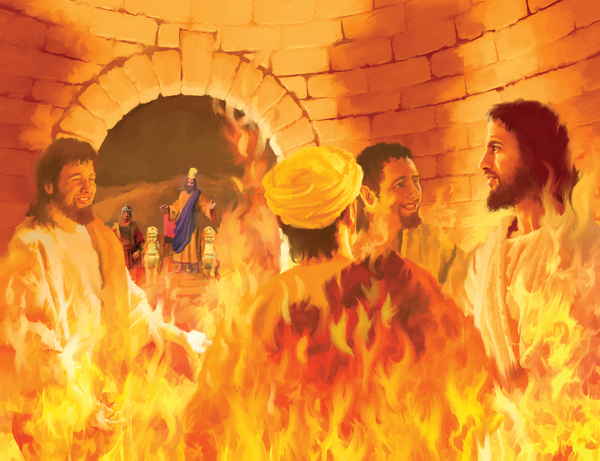
    Same goes with Shadrach, Meshach , and Abednego who were thrown in the fiery furnace. Do you imagine the angel was standing and staring at them? I don’t.

    What is the significance of this?

    What is the ministering of angels? The ministering of angels is quite often angels simply conversing with mortals.

    What is the point?

    Angels come from another realm to visit mortals, and what do they do? Talk.

    Yet we’re surrounded by mortals all day every day. How often do we really talk?

    The Church of Jesus Christ of Latter-day Saints has a ministering program. I think this program gets overcomplicated. All the program really asks is for us to talk to each other. Angels come from other dimensions to do it. We can pull out a phone and have someone on the other end of a line in seconds. We can be angels every day. All it takes is talking to people.

    I think this a profound thing to consider. All it takes for you to be someone’s ministering angel is to reach out and talk to them. This can be the difference in someone’s life.

  • Why is the Book of Mormon Needed?

    Why is the Book of Mormon Needed?

    In honor of General Conference this weekend, I’m going to post a short and simple message.

    I know that we take the Book of Mormon for granted. I know that there are infinite purposes and benefits to us having the Book of Mormon on earth.

    Why do we need the Book of Mormon? Below is one critical reason.

    The Lord declared that there would be a sign before the gathering of His people, and before He started to establish Zion.

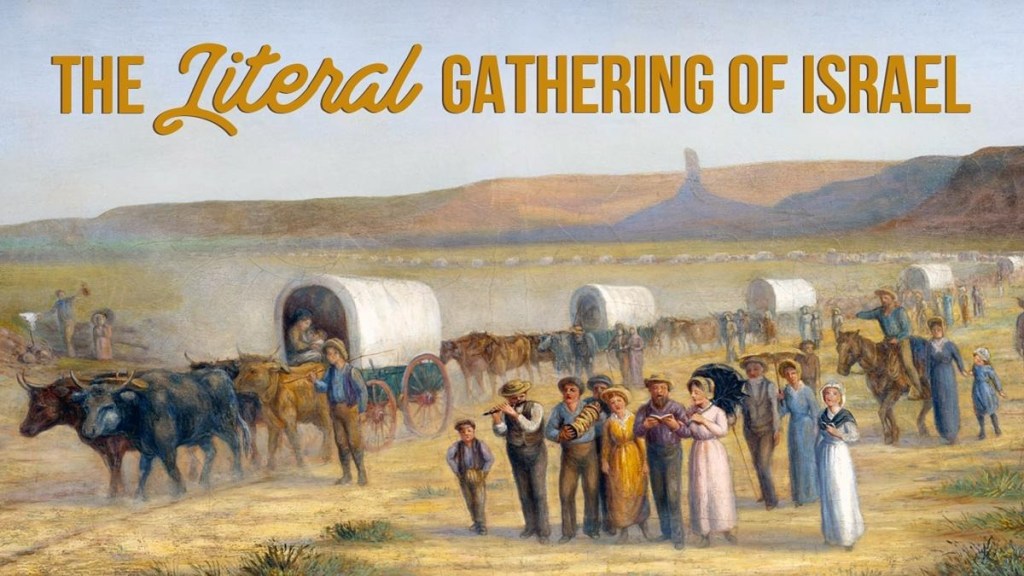
    The Book of Mormon is that sign. It is God’s sign that the Abrahamic covenant is still in force. The elect of the Lord are being gathered. This has been prophesied.

    This is why we need the Book of Mormon.

    “In fact, if there were no Book of Mormon, the promised gathering of Israel would not occur.”

    -President Russell M. Nelson

    Or else where are people gathering? Do we see any other gathering in the world today? Surely it must be happening. God can’t be a liar.