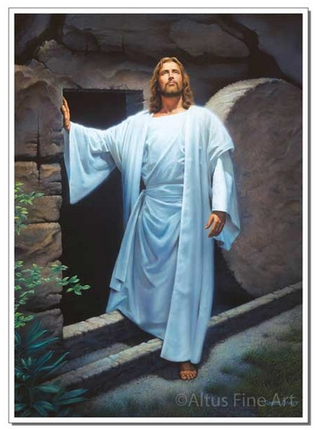
Tag: eternity

  • He Lives

    He Lives

    The Book of Mormon.

    The Apostles, Prophets, Bishops, leaders.

    The Prophet Joseph Smith.

    The temples.

    The missionaries.

    Knowing why I’m here.

    Knowing where I’m going

    These things are all amazing.  These are all fruits of the gospel.

    But.

    Why are they amazing?

    After seeing a great vision of eternity, of all the heavens, of the glory, love, and light we will all receive in the next life, after this vision, Joseph Smith and Sydney Rigdon wrote this:

    “And now, after the many testimonies which have been given of him, this is the testimony, last of all, which we give of him: That he lives!

    For we saw him, even on the right hand of God; and we heard the voice bearing record that he is the Only Begotten of the Father.” (Doctrine and Covenants 76:22)

    How I wish I could scream this to the world.  Jesus Christ lives!  He died for you, for each of us.  He died so you need not fear death, trials, or tribulations.  You needn’t fear anything.  He died for your reassurance.  He died for your comfort.  He died for your sins.  He died for you.

    All those things mentioned at the start are amazing, glorious, and wonderful because they point to one thing:  Him.  Jesus Christ.  The Savior of the world.  Without Him all of it would be for nothing.  Temples, prophets, scripture, what good are they?  They are only good for what they point us to.  The light and love of this world.  Jesus Christ.

    I wish the world could see this.  I wish the world could see that all these things are just tools pointing to someone far greater.

    Ultimately the gospel of Jesus Christ brings comfort.  The Plan of Salvation brings peace.  The Plan of Happiness makes this life a joy.  How could this life be anything less when you know the bigger picture?

    I don’t fear trials because I know they help me grow.

    I don’t fear tribulations because I know they benefit me for eternity.

    I don’t fear death because I know where I’m going if I continue to look to Christ.

    I wrote this months ago. Now I’m coming off a situation that has been a trial and tribulation.  I believe I can say with a little more confidence today that I don’t fear death.

    It can be naïve to say I welcome trials and tribulations when life is wonderful and peaceful.  I appreciate that my life is wonderful and peaceful because of the Gospel and the peace it preemptively brings me before trials.  It’s easy to say these things when everything is going well. I’m glad I can say them when things are hard as well. 

    Despite current challenges, I feel so blessed.

    Of course, I don’t want tests and trials, but I know when they come, they are for a great purpose.  I hope when opportunities come for my faith to be tested it can feel like an open book test.  I hope I can face trials in life as if I have the answers, which I believe I do.  It’s easy to say until a true tragedy hits my life.  I don’t hope for a true tragedy, but I hope for the strength and faith to endure tragedy if it comes.

    Coming off the accident I had, I still don’t feel like I’ve gone through a tremendous trial.  It has been challenging, but not overly.  I don’t feel like it has been that difficult at all.  I don’t know how much of that is the fact that the challenge wasn’t actually difficult or due to all the support I have around me, especially the support of God.

    These are all the benefits of the Gospel of Jesus Christ.  I wish the world had this same peace I have been profoundly blessed to be given.

    He lives!
  • Lectures on Faith – Lecture 2: The Object of Faith

    Lectures on Faith – Lecture 2: The Object of Faith

    A main theme throughout the Lectures on Faith is God’s perfect attributes.  Logically, for us to be able to have any faith in God He must be perfect.  We must know that we can trust God and, in turn, His Son, Jesus Christ. 

    The major theme I took away from Lecture 2 specifically is how we have attained faith throughout history.  Lecture 2 presents the profound idea that our faith in God is always dependent, or comes initially, from the faith of another.  Consider this, if no one in your life ever mentioned any sort of higher being, any sort of God, any sort of creator, would you come up with the thought on your own?  You think about God because He is someone we have been taught about since Adam.

    Even if your parents aren’t the ones who teach you about God, you learn about God from someone.  I would venture to say that in the world today every single person on the face of it has heard of the concept of a supreme being.  Why is this?  Where does our innate belief/consideration of God come from?

    Lecture 2 points out that there was an unbroken chain of testimony that started from Adam and was handed down through Abraham.  If you read Genesis carefully and do the math you will see that ancient prophets handed the knowledge of God down for generations.  It continues today.

    Adam knew God in the Garden of Eden.  When he left the Garden Adam still knew God.  We know Adam’s sons knew God.  Abel provided sacrifices to God.  Cain spoke to God even after murdering his brother.  This shows us that God spoke to men even after the fall and continued to speak to them as they continued to fall into transgression.  There is something significant here that I’d never considered.  Abel first got his knowledge of God from his father, Adam, as did Cain.  After they were told about God by Adam, then they had to develop their own faith in God.  They had to learn, trust, and depend on Him, or not. 

    The important thing to remember from this: we all start our faith by leaning on the faith of another.  We possess dependent faith.  This leads to another profound truth: God possesses independent faith.  God’s faith is not reliant on any outside source.  As discussed in lecture one, God’s faith is perfect.

    I’ve been studying the lectures alongside a video series that I will link at the bottom.  There were many amazing thoughts and ideas presented in that video, related to this second Lecture on Faith.

    Faith is faith until it happens, then it is knowledge. Since God has perfect faith, He doesn’t need to wait for something to happen for Him to know it.  He knows it is going to happen.  His faith is perfect therefore His knowledge is perfect.  It’s simple when you think about it in these terms, but it’s so critical.  It’s why we can have perfect faith in Him, BECAUSE we know His faith is perfect.

    IMPORTANT:  God is not still progressing.  This is important for us to understand.  God is not still learning.  If He was, we couldn’t have perfect faith in Him.

    God is Perfect - Ottawa Church of Christ

    This leads to a question: isn’t life boring for God if He has mastered everything?

    In the video they gave an awesome analogy.  Imagine you’re an accountant.  You master every aspect of accounting there is.  You have a perfect knowledge and ability in accounting.  Would you get bored with accounting?  Probably.  So, what would you then do?  You would teach others how to also master accounting.  God is the master accountant.  He has attained all knowledge on life, faith, eternity, creation – so what does He do?  He teaches us.  What a thought!  We are being tutored by the God of the universe.  That’s what makes this life so important.  When we consider that we are learning and being personally groomed by God Himself, what power it adds to our existence here!

    This leads to another important thought.  What was Christ’s ultimate message while here?  I think it would be service.  Love through service.  Give through service.  Charity.  Without charity you are nothing (1 Corinthians 13:2, Moroni 7:44)  Why did Christ teach this ever-important principle?  Because His Father, our Father, God is the ultimate server.  He is doing everything He does to teach us.  We truly are “His work and His glory” (Moses 1:39).

    I want to conclude with two last realizations: 

    1. The scriptures help develop our faith by teaching us of God.  This is important.
    2. Faith comes by hearing the word of God through the testimony of the servants of God, that testimony is always attended by the spirit.

    You aren’t told to have a testimony.  You’re not made to know Jesus is the Christ.  These are things you must come to a knowledge of through the spirit.  Think about it.  Christ, in His whole ministry, never told anyone He was the Son of God.  He always let them come to that conclusion on their own.  One example is Peter who He told, “blessed art thou for flesh and blood hath not revealed it unto thee, but my Father which is in heaven” (Matthew 16:17).   Another example is Christ to the woman at the well (John 4).  Christ didn’t go telling people who He was.  It had to be revealed by the spirit.  This is why signs come by faith, and not the other way around (D&C 63:7-12).

    Our hearts must be open for us to receive the testimony of Jesus Christ.  2 Nephi 33:1 “When a man speaketh by the power of the Holy Ghost the power of the Holy Ghost carrieth it UNTO the hearts of the children of men.”  Not INTO but UNTO.  It’s then on the heart of the individual to accept or reject the testimony.  The system is in place.  The system has been in place for God’s children to develop faith in Him from the beginning.  Once the testimony is carried to the heart It’s then on the agency of the individual to receive or reject that testimony. 

    God has perfect faith.  We are here to develop our faith so that we can be like Him.  He is the great accountant, and we are his protégés.  It is His hope, His glory that we can become like Him.  As we develop our faith here it will benefit us for the rest of eternity.  I know I say it a lot, but, what a thought.

    Video 3 (Lecture on Faith 2):  https://www.youtube.com/watch?v=F-o59d9ioGA&list=PLc5yYrpPFm2umksQf3jgULxoV4YIXTd2h&index=3

    Lecture on Faith 2: http://lecturesonfaith.com/2/

  • Lectures on Faith

    Lectures on Faith

    Lectures on Faith – Introduction and Lecture 1: Faith Defined.

    I’ve been watching a series of videos on the Lectures on Faith as supplemental material to my study of the Lectures.

    If you’re not familiar with the lectures on faith, you can read them all here:

    https://lecturesonfaith.com/

    It’s unclear who officially wrote the Lectures on Faith, though they were approved of and taught by Joseph Smith.  At a minimum, the concepts and theology of them comes from revelation given to Joseph Smith.  Yet another example and evidence of his calling as a prophet.

    I write here my notes and thoughts on these videos and the lectures.  There are seven Lectures.  The 10 video series I’ve been watching spans almost 5 hours and reviews each of the Lectures.  In writing this it will help me put together my thoughts and understanding on what Joseph Smith tried to teach us about faith.  Through this process I know my faith will grow by studying these principles.  What Joseph Smith taught about faith is beyond profound, it is revelatory. I will need to study his words and all supplemental material for the rest of my life to get a grasp of the profound and eternal nature of faith.  I look forward to reading over my notes here many times to refresh my mind and expand my knowledge on the subject.

    Video 1 was an introduction to the Lectures.  Video 2 was all about Lecture 1 – Faith Defined. 

    First, what are the Lectures on Faith?  They are principles put together by Joseph Smith to help early elders to share the gospel.

    What do the seven lectures cover? (from Video 1)

    Lecture 1 What is faith?

    Lecture 2 Links the principles of faith and the doctrine of revelation.  The power of human testimony is the medium with which the gospel is passed from generation to generation.

    Lectures 3 and 4 The character and attributes of God.  If we don’t understand the attributes of God, we can’t have confidence to exercise proper faith in Him.

    Lecture 5 The Godhead, nature of the members of the Godhead.

    Lecture 6 The Law of Sacrifice.

    Lecture 7 The fruits of faith.

    What is the plan for the Lectures on Faith?

    1. Teach what faith is.
    2. Teach how to obtain faith.
    3. What happens if you obtain faith?
    Lectures on Faith: The Exalted Nature of the Godhead (Part ...
    Bob Millet

    My favorite part from the first video was this suggestion from Bob Millet, one of the panelists. His suggestion was this: read the Lectures on Faith 20 times then you can start to study them.

    Now that I have an overview on what all 7 lectures will cover and teach, I can get into Lecture 1.

    Lecture 1: Faith Defined

    Obvious question to start, what is faith?

    Faith is the first principle in revealed religion and the foundation of righteousness.  Faith is the substance of things hoped for but not seen (Hebrews 11:1).  The lecture starts broad – faith is the belief that something will come to pass.  Then it gets more religious in tone: “the principle of action in all intelligent beings.”

    Faith is a principle of action.  Faith implies works, it implies activity, both physical and mental.  Just as faith is the moving action in all things temporal, so it is with spiritual (paragraph 12). 

    By faith God formed the earth.  I think this is the most profound point from Lecture 1.  That it is God’s faith that is His power.  Take faith from God and He would cease to exist (paragraph 16).  I know to many this seems like outright blasphemy.  But before rejecting the idea without thought, consider what is being said.  Faith is a principle of power.  It is the power by which God formed the earth.  Take away His faith, take away His power, He ceases to be God.  Luckily for us God’s power cannot be taken away.

    God’s faith and knowledge are equivalent.  It is God’s perfect faith that allows His perfect knowledge.  Consider: faith is believing in something that you haven’t yet seen.  Since God’s faith is perfect what He has faith in will be, it will exist.  We mortals look at faith as weak, unproven, unscientific.  It is God’s trust in the Plan of Salvation that makes Him create worlds. It is God’s perfect faith that created those worlds. It is God’s perfect faith that makes Him the Almighty.

    Again, faith is the power of God.  If faith is that important, it adds a whole new meaning, explanation, and understanding to this life.  Why do we move through life as if through a misty darkness, unsure of everything?  Why the veil that covers our eyes and fogs our minds to so much that we used to know?  Why don’t we know where we come from?  Why don’t we know where we’re going?  Why doesn’t God send angels down to tell us which church is true?  Why doesn’t God allow profound miracles to occur before unbelievers’ eyes so they can KNOW that He exists?  The reason God doesn’t do these things is due to the importance of faith.  We are here to learn faith, develop faith, grow faith; because it is that important.  God does not want to take that opportunity of growth and development away from us.  He won’t.  He knows how critical it is.

    Faith, then, is the first great governing principle which has power, dominion, and authority over all things: by it they exist, by it they are upheld, by it they are changed, or by it they remain, agreeably to the will of God.  Without it, there is no power, and without power there could be no creation, nor existence!” (Paragraph 24).

    Link to Lecture 1: https://lecturesonfaith.com/1/

    Link to Video 1 An Introduction on the Lectures: https://www.youtube.com/watch?v=MiV4dCY9OEA&list=PLc5yYrpPFm2umksQf3jgULxoV4YIXTd2h&index=1

    Link to Video 2 What is faith?: https://www.youtube.com/watch?v=S_EXFQK-KJE&list=PLc5yYrpPFm2umksQf3jgULxoV4YIXTd2h&index=2

  • First year of marriage during a pandemic-oh my!

    First year of marriage during a pandemic-oh my!

    Beth and I have been married for 15 months.  If you’re doing the math, you’re realizing that our first 12 months of marriage included 3 months of quarantine.  It seems silly for someone married 15 months to give marriage advice.  But I’ll remind you, we’ve survived the great pandemic and quarantine period of 2020!  I’d like to write some things I learned in the first year of marriage.

    First let me comment on the pandemic.  While being stuck with someone and quarantined with them for 6 months may be miserable for some, it’s made me realize how lucky I am to have a wife I love to be around.  Beth and I have joked about how quarantine has been quite a blessing for us.  We basically haven’t left each other’s side for 6 months.  It’s crazy to think about.  What’s even crazier is I love it.  It’s given me a chance to appreciate her, talk with her, and be with her.  We went through a stretch when the weather was nice where we were biking almost every day.  That was great.  As the heat set in, we transitioned into conversations and TV series together.  It’s been nice. 

    It hasn’t been all roses and bliss.  While we rarely fight, there are still frustrations.  I’ll mention one (and don’t worry, this will be proofread by Beth before I post it).

    Early on in our marriage I noticed a frustration setting in.  If I cleaned a bathroom, or did laundry, or vacuumed the living room I would find myself resenting her.  I would wonder why she didn’t help or do this or that. 

    I was letting this frustration build when I turned to someone for advice.  This wise advice giver presented me with thoughts that completely turned around my way of thinking.  He said that when he got married (39 years ago, congrats!) he was given some advice that he took to heart.  He said he struggled with something similar early in marriage where he would fold the laundry and then expect his wife to do something in return.  Someone explained to him that you don’t fold the laundry to keep a leg up or hold something over on your wife.  You fold the laundry because you love your wife and you want to do it for her and yourself, without any thought of repayment.

    My advice giver talked about the Savior and how He is our greatest example.  He reminded me Jesus Christ never did anything with any hope of getting something in return.  Christ served only to serve.  He reminded me we’re here to become like Christ.  Folding the laundry or doing the dishes, with zero expectations of getting something back, was our small way of becoming like Christ. 

    It hit me how dumb I’d been.  Here I was doing good stuff like picking up around the house but doing it without good intentions.  I was essentially nullifying my “good deed.”  I was reminded we don’t serve to get pats on the back, we serve because we love.  It reminded of the advice of our bishop, Bishop Nelson, when Beth and I met with him before getting married.  He said, “If you always do whatever you can to make the other person happy, you will always have a happy marriage.”  I’ve realized how difficult that is in practice, but how rewarding it is to try to live thinking about Beth first.

    I realized after this advice that I’d really let some negative feelings set into my heart.  Looking back, I think it would have been a short skip and a jump to negative feelings turning into resentment, resentment turning into animosity, and animosity turning into a really unhappy home.  I’m extraordinarily grateful to two wise advice givers that helped me be a *slightly better husband early on.

    Let me be clear about something.  I am far from a perfect or I’d say even a decent husband at this point.  While Beth is the epitome of love and kindness, I know my tendency to be stoic and un-affectionate.  I am lucky to be married to someone who understands my flaws.  I’ve mentioned some of the patience I’ve developed but I’m well aware of Beth’s out of this world patience with me.  I know I am not easy to live with and I feel so lucky to have her. 

    Since I received the advice, I can say my heart has changed.  Every once in a while, if I’m vacuuming, I’ll get an inkling of frustration.  I have to stop myself and remember.  Am I vacuuming so I’m owed something?  No.  I’m vacuuming because I want to clean up and I love my wife.  She does so much around the house and does so much for me.  There’s no keeping score.  Truth is I’m lucky we don’t keep score, or I’d probably be losing.

    The moral of the story I learned is we control how we feel.  We can control our thoughts and our emotions- especially frustration.  It’s not always easy,  but it’s possible.  It’s what we’re here to learn.  We’re here to learn patience and love.  I’m still working on being a more loving husband and look forward to the years where Beth teaches me how to be more loving. 

    I see a sad trend in our society and the world today.  We give up too easy.  Love and marriage aren’t easy.  If it was easy it wouldn’t be rewarding.  We’re in a world that has decided if things are difficult, they’re not worth it.  It makes me sad.  Committing to marriage should be the most serious commitment of our life.  Too many people give up too quickly.  It’s sad and I wish it wasn’t that way.

    I know that my marriage will end up being the greatest catalyst to my growth in this life.  From my marriage I will soon be blessed with a daughter which will also provide vast opportunities to mature in many qualities.  I’m grateful for my marriage.  I’m grateful that my marriage is for eternity.  I can’t imagine vacuuming all these floors and taking out all this trash just to have this marriage end when I die.  I’m earning brownie points for eternity 😉.  (Just kidding!  Were you paying attention?  No brownie points!)

    I’ll conclude with a great quote.  The quote comes from Jenkin Lloyd Jones and has famously been quoted by Gordon B. Hinckley.  I share it because I think it’s important to remember, especially when marriage becomes difficult. 

    There seems to be a superstition among many thousands of our young who hold hands and smooch in the drive-ins that marriage is a cottage surrounded by perpetual hollyhocks, to which a perpetually young and handsome husband comes home to a perpetually young and ravishing wife. When the hollyhocks wither and boredom and bills appear, the divorce courts are jammed.

    Anyone who imagines that bliss is normal is going to waste a lot of time running around shouting that he’s been robbed. The fact is that most putts don’t drop. Most beef is tough. Most children grow up to be just ordinary people. Most successful marriages require a high degree of mutual toleration. Most jobs are more often dull than otherwise. . . .

    Life is like an old-time rail journey—delays, sidetracks, smoke, dust, cinders, and jolts, interspersed only occasionally by beautiful vistas and thrilling bursts of speed. The trick is to thank the Lord for letting you have the ride.”

  • Depression

    ** The following is a guest post written by my wife**

    It’s such a part of who I am and the course of my life, yet I’ve struggled to ever really discuss it with anybody aside from my therapists and maybe a few of my family members. Even then, I’m not sure I’ve ever really, openly discussed all the intricacies of my depression. It is difficult for me to completely explain the seemingly unexplainable. I’ve been plagued with a feeling of toxic perfectionism that doesn’t allow me to be vulnerable in letting others know that I may not lead a near-perfect life. Yet, as I’ve had loved ones seek to understand my condition, and others that suffer through depression around me seek someone to empathize with them, I’ve tried to bring myself to do it. Bit by bit, I’ve opened up. Sometimes in frustration, I just want to sum it up as “if you know, you know” and call it good. But that is not enough. Individuals, family members, institutions, others with depression need to know.

    So what does it really feel like? There’s no good, singular answer. I’ve labored over the answer to this question many times. For me, it is not a weight laying heavily on me. I don’t feel like the people in the commercials that have a dark rain cloud following over their head wherever they go. If I do feel glimpses of emotion, they are always lined with sadness and exhaustion. Most of the time though, it’s a feeling of nothing. Absolutely nothing. Emptiness. Darkness. Sometimes I cope by being super goofy so that I don’t have to feel nothingness for just a moment. It can be napping literally all day because, even with the guilt and self-loathing that comes with wasting an entire day, it’s better than facing that feeling of not feeling. And when I can get up, any attempt I make at getting anything done is overwhelmed by an extreme inability to focus on anything.

    My dad could always see when I was going through really bad depression. He said I never actually looked sad. In fact, I just looked dead behind the eyes. He said that out of sadness for me and with love. It came somewhat close to describing how I felt, or rather didn’t feel, in those times. Eventually, when you’re in the midst of a depressive episode, you begin to convince yourself that this is the new you. You will never be successful again. You will be a burden and failure for the rest of your life. I was very lucky to never feel like I wanted to end my life but, with feelings like that, it isn’t difficult for me to see how people get there.

    So why don’t you just get up? Go on a hike, play a game, talk to someone, you’ll feel better.

    While all of those suggestions can help, they often served as a constant reminder that I couldn’t even manage the most basic methods of self-care. It made me feel that people would never really understand. I continue to wonder why people really need to understand how it feels. I ask, can you still support me and sympathize with me even if you can’t understand? While that seems like a fair compromise, I still think I can try to help others get a glimpse of my perspective. We can meet in the middle.

    My message to loved ones wondering what they did wrong: You’ve done nothing to cause this. Even I’ve done nothing to cause this. Do not burden yourself with the feeling that you could have done something to stop me from having depression. What you can do is love. Sometimes that means lowering expectations for a while. Sometimes that means just learning to listen instead of feeling like you must come up with the solution. Sometimes that means you’re only able to say, “I love you and I want you here.”

    There is such a lack of support for mental health institutionally that I wouldn’t even attempt to address it in depth. But as each of us listen more and learn more we can be a solution. I remember in the worst of my depression I had to withdraw from an entire semester at Arizona State University. It was such a difficult process to navigate even if I had been fully healthy. You had to jump through numerous hoops, get that documentation, speak to this person, go here and there. I’m not sure I would have been able to do it without my parents there and some semblance of functionality. Even though I was privileged enough to get treated by a medical professional and continue to graduation, I’ll always have a “withdrawal” on my transcript. I felt pain and guilt about that for a long time. We need to understand better.

    While my depression has been well controlled for years now, it’s never truly gone. It can sneak in when I least expect it. I make sure to take my medication daily and be mindful of triggers and warning signs. I try to be vocal with my husband when I feel it creeping in. It causes me sometimes paralyzing fear. I’m sometimes afraid to do things I would like to do because I’m not sure when is the next time it will hit hard. I’m hesitant to take steps in my career, steps in building a family, and to make big commitments. I’ve had to learn how to continue with life without limiting myself. But I also must know when it’s time to take a step back and to accept that it’s okay that I don’t feel okay.

    A bout with depression is something that comes and goes. Sometimes it’s here for a few weeks, sometimes for years at a time. Maybe it will come back tomorrow or in 5 years. I don’t know. The only thing I know is that the pain we feel with depression is temporary. When I think of eternity, I know I’m capable of living past this painful moment. I’ve done it before and I will continue to do so. I can consider it a blessing that through my Savior, Jesus Christ, and my understanding of the Plan of Salvation, my depression has taught me how to truly persevere.