Tag: god

  • Abraham’s Faith

    Abraham’s Faith

    I had a thought (shocker).

    I shared last week about Abraham’s shared experience of almost being sacrificed by his father.

    Here’s another way to look at it.

    We marvel at the faith of Abraham to sacrifice his son. He didn’t know that God would stop him moments before he went through with it. For all Abraham knew, his son would be dead, gone. And yet, he was still willing to do what God asked him to do.

    We marvel at this faith to do the impossible.

    What about God, when it came to sacrificing His only Son? Well, we would say, God knew the end. He knew His Son would conquer death and be resurrected. He knew His Son’s death would only be temporary. He’s God. He has nothing to worry about. Abraham was just a man. Abraham had no such knowledge.

    Or did he? 

    Faith is the “assurance of things hoped for, the evidence of things not seen” (Hebrews 11:1). Faith, by its nature, is to not have a perfect knowledge of things. Was Abraham’s faith so perfect that he did know, just like God knew with Jesus Christ, that everything would be ok?

    Abraham had a promise from God. God promised Abraham that his seed would be as numerous as the stars in the heavens and the sands of the sea. Abraham had some understanding of the eternities. It didn’t matter to him when the promises of God would be fulfilled. He trusted God. He had a perfect knowledge that God would keep his promises. 

    Now. The gut-wrenching, heart-tearing, indescribable and impossible act of losing your son. The pain. What about that? Abraham had faith that God would even make that right. Abraham had faith that God would only allow him to do what ultimately he needed to do to become who he could become. Abraham trusted God enough to do anything. Why? I think because he knew God loved him. Abraham didn’t have faith that God loved him, didn’t hope that God loved him, didn’t believe that God loved him. He knew. 

    Maybe faith proceeds knowledge.

    If we truly understand God’s love for us, His children, we can do anything, and endure anything.

    Abraham didn’t know the exact result of the sacrifice of his son. But he did know that God kept His promises. And hew knew that God loved him. And whatever the result, it would all work out for their benefit, glory, and growth in the long run. 

    That is faith.

  • Abraham’s Sacrifice

    Abraham’s Sacrifice

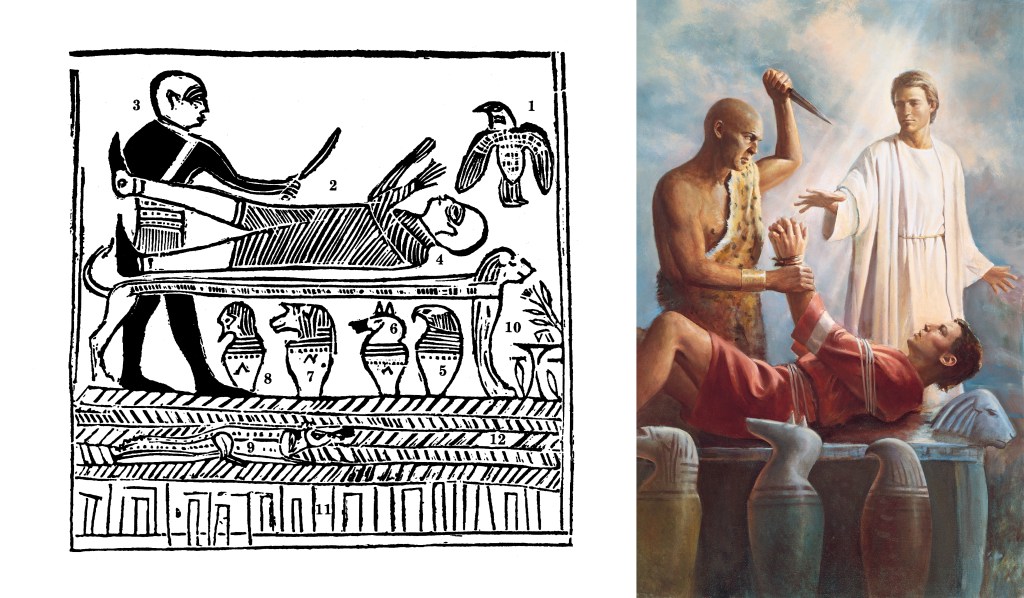
    “Yet Abraham himself came from a troubled family – his father, who had abandoned the true worship of God, tried to have Abraham sacrificed to false gods.”

    Come Follow Me Curriculum

    And you thought your parents were bad. They ever try to sacrifice you to false gods? 

    When I read that above quote, I thought about something I’d never connected in my mind before.  

    The story of Abraham almost sacrificing his son Isaac is a well-known biblical story of true faith. What I’d never connected with this, though, was the almost sacrifice of Abraham by his father many years prior. 

    There’s a lot to unravel there. 

    What occurred to me was this: Not only was this an unbearably difficult test Abraham was given; to sacrifice and kill his most precious, only son. It also, likely, spurred up painful memories of when Abraham’s father offered him as a sacrifice. (If all things are a type and a shadow of greater things, and Abraham represents God in sacrificing His only begotten son, what does this say about God?) 

    In that moment, with the added guilt and pain of losing his precious son, did Abraham also wonder about the damage he was causing his son? If by some miracle Isaac surived, how would he feel about almost being sacrificed? Abraham went through the same with his father.

    Another way to think about this – Abraham’s father is demonized for his part in almost sacrificing his son. Abraham is revered for his almost role in sacrificing his son. What is the difference? Well, the difference, I assume, is the intent, the heart, and the being to whom the sacrifice was being offered. 

    But how, in that moment, did Abraham have such faith, such trust, such knowledge, such understanding to know he was doing the right thing and sacrificing his son to the right God? Didn’t his father believe the same thing once upon a time? 

    This is one of those blog posts where I don’t have answers to my own questions. This is something I will have to ponder upon, research, and think more about.   

    If anyone has comments or can enlighten me, please do. 

  • The Room and Freedom

    The Room and Freedom

    I just finished the book The Room. Without spoiling too much, it’s about a woman who is captured and kept locked up in an 11 foot by 11 foot room with her five-year-old son who is born into captivity.

    It is a good book. The most interesting part is that it’s written from the perspective of the five-year-old.  

    At the end of the book there was a “Reading Group Guide” with questions to consider. One of them was, “Why do people tend to be so fascinated by stories of long-term confinement?” 

    I pondered this a bit. The obvious answer is that our freedom is so precious to us, we can’t imagine something so terrible, so we’re drawn to it. Like watching a train crash or the modern true crime craze. 

    There is a longer answer, though.  

    Our freedom, our agency, is the most important thing in the world to each of us. Our ability to choose and make our own choices is more important to us than anything. It’s more important to God than anything, also. That’s why we’re here. 

    I think this fascination with confinement and the inability to choose is a fascination with something we know to be inherently wrong.  

    Every one of us here on earth chose to come here, to Earth. There were some who didn’t choose this. There was one that tried to take away our freedom, to force us to choose his way. He phrased it as a way to save us all, but really, what he was proposing was enslavement. Satan proposed the plan that would have us all return to heaven. The catch was that we would have no say in the matter. We would be compelled to follow him, to do it his way. We would be his puppets. In return, he would ensure we got back safely. 

    God always wants us to choose. 

    We even chose to be able to choose. We are here because we chose agency and freedom.  

    I think that’s why these stories are so fascinating to us. We already chose freedom. Being here on Earth was a choice. God will always give us a choice. Not being given a choice feels wrong because it is wrong.  

    We already chose to reject Satan and come here and use our agency. 

    Don’t forget that. You’ve already chosen.   

  • Guilt

    Guilt

    Every once in a while, I feel guilt for things I did, the person I used to be, the people I hurt, the pain I caused, the horrible things I was a part of. I know it seems…like I haven’t really changed if I only feel that guilt every once in a while. Guilt is an interesting thing. 

    Every once in a while, I look back on who I was. I’ll feel some guilt for the worst things I was a part of. I think I’ll always feel that, in this life, to some extent. It’s like a prick in my side, as the scriptures would say. It stays with me because I need to be reminded of where bad choices lead.

    The most interesting thing about the guilt of my past is it’s not really there, anymore. By this I mean, when I think about it, I more think about the people I hurt, and I feel sorry. But those feelings have become distant, like an old me.

    I know there will be, or I hope there will be, some people who read this that I did hurt. I know they’re going to read this and scoff. “Oh good for you, you’ve been forgiven. What about me? The person you hurt.” That’s the guilt that still hits me sometimes.

    I have tried to reach out to some people from my past, especially early on. There were things I had to say and people I had to speak to before the weight of my guilt could be lifted off me. It’s intrersting…for years I didn’t let go of some of the weight I was carrying. And it was a weight. It was slowly killing me.

    I haven’t been forgiven because of myself. I haven’t chosen to forgive myself.

    I know a lot of my friends who have only known me in the last few years read this. They might sometimes wonder what makes me so passionate about church, God, the gospel, etc.

    I know a lot of my friends and people who knew me back when I was in full “of the world” mode and they now wonder, “What the heck changed? When did he become a God nut?”

    I know there are people from high school who will think similar things.

    I hope this explains a little bit about why I’ve become so passionate to share about Jesus Christ, to talk about Jesus Christ, to write about Jesus Christ. I hope for everyone who knew me in high school, everyone who knew me through college, everyone who knew me through church, I hope this can explain why I can’t stop talking about Jesus Christ.

    At least once a week I cry in gratitude. Because when I think about my past, it’s not really there anymore. Like I said, some guilt will always be there. But the overwhelming sadness at who I used to be is gone. I shed tears once a week asking God why. Why did He save me? What am I worth to Him?

    I can’t be ashamed of Jesus Christ anymore. I was ashamed and embarrassed to be a believer and outward worshiper of Him for too long.

    Today, I feel with an all too real sensation that He died for me. He suffered, and bled, and was scourged, and was insulted, and humbly took it, for me. Without Him that guilt would still be killing me. I’ve been washed clean by His blood. And that’s why I’ve changed. For all those who used to know me, that’s why I am the way I am now. Because the feeling of what Christ did for me is too real of a feeling.

    This forgiveness didn’t come over night. I didn’t one day feel great. It was months and months of being on my knees, crying, begging. It was reaching out to certain people. It was being humble enough to admit I made so many mistakes. And over time, I don’t know exactly when it happened, but one day my guilt was a thing of the past. Sometimes I feel guilt because my guilt is a thing of the past.

    Guilt is an interesting thing.

    I still make many, many mistakes.

    If there is anyone reading this that is still scoffing, thinking, “Well you were a jerk to me, screw you.” Please forgive me. You can comment here anonymously and really lay into me. I know there are still things I might need to make up for. Christ forgave me but others might still have to. Please reach out to me if I ever hurt you so I can try my best to ask for your forgiveness.

    For anyone reading this who thinks their choices are who they are. Your choices make you only if you continue to make them. As soon as you decide to change someone will be there to change you. Guilt doesn’t have to be with you forever. It can be washed away. Trust me, it’s a miraculous feeling. 

    I sometimes wonder how I could change so drastically. Being a person who said things like “washed clean in the blood of Christ” or “Christ saved me.” I never thought I would say things like that. They sound so corny. Then, in quiet moments by myself I’m overwhelmed by God’s love and that He gave His Son to die…for me. Then I decide I’ll be as corny as I have to be. I can’t be embarrassed anymore. I just can’t. Because I know Christ was never embarrassed to claim me. Through all my mistakes and through all the moments He should have turned His back on me, He never would, He never did. He always loved me. 

    I haven’t been forgiven because of myself. I’ve been forgiven because of Him. It’s the greatest gift I’ve ever been given and it’s free to us all. 

    It’s why I still cry EVERY time I hear this song: 

    And I Stand All Amazed:

    Video “Remembering in Whom We Have Trusted” by Elder Allen D. Haynie 

    *I wrote this sometime around 2019. As I edited it to post in 2026, I felt some sadness at things that are less true than they were 7 years ago. For example, I no longer cry at least once a week. I think about this sometimes. I really used to cry once a week, during the sacrament, when I thought about what Christ did for me. It’s less often now.

    While I want to retain that passion and that burning feeling of gratitude within me for what Christ has done for me, it’s also kind of beautiful that I’m less emotional. Part of the reason I’m less emotional is because I feel less guilt about past deeds. I think over time the Atonement of Jesus Christ has more and more healed my soul and my guilt.

    I still owe Him a tremendous debt of gratitude. I still owe Him everything. I hope to hold to those emotions while also being able to let go of past guilt as best I can. It’s a balance. A balance afforded me by the Great Healer.

  • Simplified Husbandship

    Simplified Husbandship

    These are the highlights I typed up for myself from a book called Simplified Husbandship | Simplified Fathership by Richard M. Eyre. I typed this up mostly for myself to refer back to.

    This is only on the simplified husbandship portion of the book. These are the quotes, summaries, and most important points I found from the book.

    “To become a better husband –

    change yourself

    not your wife.”

    “The home should be the center of growth, happiness, of excitement. If your home isn’t a happier place now than it was a year ago, you’re not progressing.”

    “A marriage of oneness should have a Venn diagram that is as circular as possible in the middle. When the marriage doesn’t have enough oneness, the middle is like a football.”

    “This type of marriage, like a football, is erratic and hard to predict. There is no telling where it will bounce.”

    “The best way for a husband to pursue this kind of oneness lies not in efforts to change his wife or even in efforts to change the marriage relationship. His best chance lies in changing himself.”

    Partnership-Plan-Pray

    Communication – “Oneness is an impossibility between two who share only part of what they feel.” This one really hits home for me. I’m not a great communicator.

    Inspiration – “The third partner should be the Lord.”

    One strategy for partnership –

    Wife handles the “inside partnership” of inside-the-home things such as home, children, personal kingdom, etc.

    Husband handles the “outside partnership” of outside-the-home things such as money, providing necessities, involvement in outside causes like church and civic, etc.

    In the above example, the wife would be general manager of inside partnership and husband participating partner and vice versa.

    Each night before prayer each gives a brief report on their stewardship, and receives comments, questions, or insight from the participating partner. Both participate, but one is in charge of each.

    During scheduling, attempt is made to find an hour where roles are reversed. Husband spends time with the children on the inside and wife shifts to outside activities, church, civic, or personal. (This seems extremely structured, to the point that it might border on unrealistic, practically speaking. But I still like the premise).

    Partnership – “day planning” – evening prayer.

    Each has a role and the Lord is the supervising partner.

    Partnership meeting is simple and shouldn’t take more than 10 minutes. The results:

    1. Each learns more about the arena where he or she did not spend the day (and becomes more appreciative of what the other is doing).
    2. Each gives input and ideas for the other’s benefit.
    3. Each thinks about what he or she will do the next day in both the general and the limited role.
    4. The prayer becomes far more specific and meaningful (because it is about things just discussed).
    5. Both sleep better when the next day is clear and challenging rather than hazy and uncertain.

    Things I personally could talk about with the outside responsibilities:

    1. Schedule for work / coaching / gym / church calling / projects
      • Go over my daily items
    2. Investments and status
    3. Finances – budget (handled by Beth, could be a part of her report).

    Once a month dinner date, reviewing the month. Review the past month and set goals for the month ahead.

    Once a year “honey-moon” vacation to review the last year and the year ahead.

    Principles:

    1. Total communication and openness
    2. Complementary roles (separate but shared responsibility)
    3. Shared goals and plans
    4. Adding the Lord to your partnership through earnest, regular prayer together

    “If exaltation is the goal, marriage partnerships must fold together in purpose and communication until they become one. We often imagine that temple marriages differ from civil marriages in quantity (they last longer), but, in fact, their quantity will be great only if their quality is great, only if oneness is obtained.”

    “Agreeing to disagree on some things is fine among friends and business partners but not between marriage partners striving for oneness.”

    “Partners are separated when they compete in any context other than fun.”

    “Emerson said, “Marriages do not fail, people fail. All marriages do is show those failures up.””

    Partnership-Plan-Pray Summary:

    • My wife is my partner in all I do.
    • We share everything, including our deepest feelings.
    • We plan our time together and share objectives for our lives inside and outside our home.
    • We pray together regularly, and preceding the prayer is a discussion of our partnership.

    Protect-Pamper-‘Preciate

    “A woman’s ego is no weaker than a man’s, but hers works in a slightly different way. Hers usually is best fed when she is cared for, complimented, appreciated, protected – even pampered a bit – not with the patronizing implication that she is weaker, less able, but with the implication that she is more special, important, and genuinely valued. A wife who receives sincere compliments, who is appreciated, who feels needed and cherished and protected, seems to gain a soft strength, a kind of clear-headed fulfillment that raises her toward her full potential in many areas.”

    “It’s the old notion of “out-giving” that can make marriages even more beautiful. Have you ever watched what happens to a basketball team when one player is so unselfish that he is always looking for a teammate to get the ball to? Other players respond in kind. The ball moves faster; everyone gets better shots. The teamwork of marriage can be similar.”

    Me – This is similar to the advice I received early in my marriage. When I confided in someone about my frustrations with doing household chores, that someone asked me point blank, “Why are you doing chores?” They asked if it was to one-up or get an edge on my wife. They asked how the Savior served. They pointed out that this life is meant for us to become like the Savior. The Savior never asked for anything in return when he served others. If I’m cleaning the house or doing something so that I’m owed something or appreciated by my wife, what’s the point? It’s not service, it’s a way to get an advantage. They said to love and serve my wife for that simple purpose. Because I love her and I want her to be happy, and for no other reason. My life and marriage are better when I realize and remember this.

    “It is not the addition of responsibility and children that destroy romance. It is the subtraction of courtship, of chivalry, of living to make the other person happy.”

    Protect-Pamper-‘Preciate Summary:

    • I love my wife deeply and understand her need to feel cherished and loved. 
    • I feel tenderness toward her and want to find meaningful ways to compliment her, to be chivalrous and protective of her. 
    • I watch her closely and notice the time she needs the “lift” of a tender kiss, a word of sincere appreciation, a helping hand, a date.” 

    Patriarch-Priesthood

    A wife is asked, “What would you do if your husband were to ask you to do something you didn’t agree with, not something unrighteous, but something you didn’t want to do?” 

    She responds, “I would tell him I didn’t want to, and we would discuss it.” 

    “Yes, and most things you would work out and agree on. But let’s say in this instance you still didn’t agree. You thought it was the wrong decision, but he still wanted it. What would you do?  

    She says, “I wouldn’t do it.” 

    “That’s what I want to talk to you about. You would have two options in that situation. One, to refuse. Or two, to say, ‘Yes, you know my feelings, but if you still feel it is right, I will accept your decision.’ If you take the first option you get into a power struggle and minimize his chance to change or repent if he is wrong (his ego, if you defy him, will lock him into his wrong choice). If you take the second option, you show trust and giving, and you maximize his chance to change if his decision is wrong. (The other side of the husband’s ego is the one which feels the responsibility to protect and be fair with his wife who puts her confidence in him.)” 

    The husband is then asked, “Would you ever do that? Demand that your wife do something she did not agree with? If you do, you will sooner or later destroy your relationship. If you force decisions on her, you abuse her trust and become a tyrant. That is what you do if you demand.” 

    If either the husband or wife remembers this, it will work. If the wife respects the priesthood, the husband will use it well. If the husband counsels and communicates rather than demands, the wife will respect the husband and they will be one, with the priesthood belonging to both together. 

    I would add that this example works the other way around as well. If the wife decides on something and doesn’t respect the disagreement of the husband and the husband refuses to compromise, it becomes a problem.

    “In a baseball game the pitcher throws the ball, the catcher catches it. The roles are equal but different. They could rotate, the catcher throwing every other pitch, but they would do less well in the game. In the patriarchal order, the husband holds the priesthood and the wife shares it. The “head of the home” (the husband’s role) and the “heart of the home” (the wife’s role) are equal but different in that both draw on the great, inherent strengths of each.”

    To be a strong priesthood leader in a home:

    1. Take the lead in planning the week together each Sunday. 
    1. Use the priesthood more in the home (for blessings, etc.). 
    1. Have a short personal interview with each child on Sunday evening. 
    1. Hold a good family prayer each morning and a “partnership prayer” with your wife each night.  

    Patriarch-Priesthood Summary:

    • My wife shares the priesthood with me, and we are equal partners. But I hold that authority and I have the righteous strength that helps her feel secure and fulfilled in her support. 
    • I take the lead in planning and goal-setting, in family prayer, and in personal interviews with each of the children. 
    • I realize that there is no intervening link in the priesthood chain between myself and the Lord. As a father I am entitled to direct inspiration for my wife and children. I ask for that inspiration and receive it. 
    • use the priesthood often in my home for personal blessings and to keep the Lord’s Spirit present.  

    Priority 

    “Lack of commitment is Satan’s key tool in destroying relationships. Without commitment, little problems and disagreements can become final ones.” 

    A “planning” husband: “In addition to planning with my wife, I consciously ‘prioritize’ my wife in my personal planning. When I plan my week, I think about her first, and the fist thing I put on my calendar is our Friday night date. Then I ask her about her schedule and try to work out when she might need me. I try to plan at least one little surprise for her each week.” 

    A less planning husband, “I just watch Pattie and try to notice when she needs a little pick up. Also, and I don’t always remember this, I try to make my last thought of the day, just before I got to sleep, be of Patti. I think, ‘What can I do for Pattie tomorrow?…It’s fun to try to think of her for a moment each night just as I doze off.” 

    Priority Summary:  

    • My wife comes first in my plans, my schedule, my priorities. 
    • When I have decisions to make, my first thought is always how they will affect her. 
    • I consciously try to find “little things” to do for her on a regular basis.  

    Becoming these things 

    “Most husbands, busy with jobs, callings, and concerns of all varieties, cannot be constantly thinking of their roles as husbands. Therefore, becoming these four qualities to the point where you live them naturally is the only practical, workable way to improve your husbandship.” 

    “Self-programming” is the idea of making these qualities subconscious, so they don’t have to constantly be thought about. The point is to become these husband qualities.  

    Methods of self-programming 

    1. Running 
    1. Meditation 
    • The same kind of self-programming can be done in meditation. Simply sit comfortably in a quiet place, close your eyes and quiet your mind as best you can. Then begin – “I put my wife first,” etc. 
    1. Shaving 
    1. The last thought of the day. 
    • The quiet night, with no light or distraction, is a good time to say, “I am the patriarch of my home. I lead righteously through the priesthood. Last week I gave a priesthood blessing to little Nell. I watch for opportunities to use the priesthood.” And so on. 

    “Each method of self-programming can be strengthened by prayer. We have great power to change ourselves, but our Heavenly Father is the true changing force.”