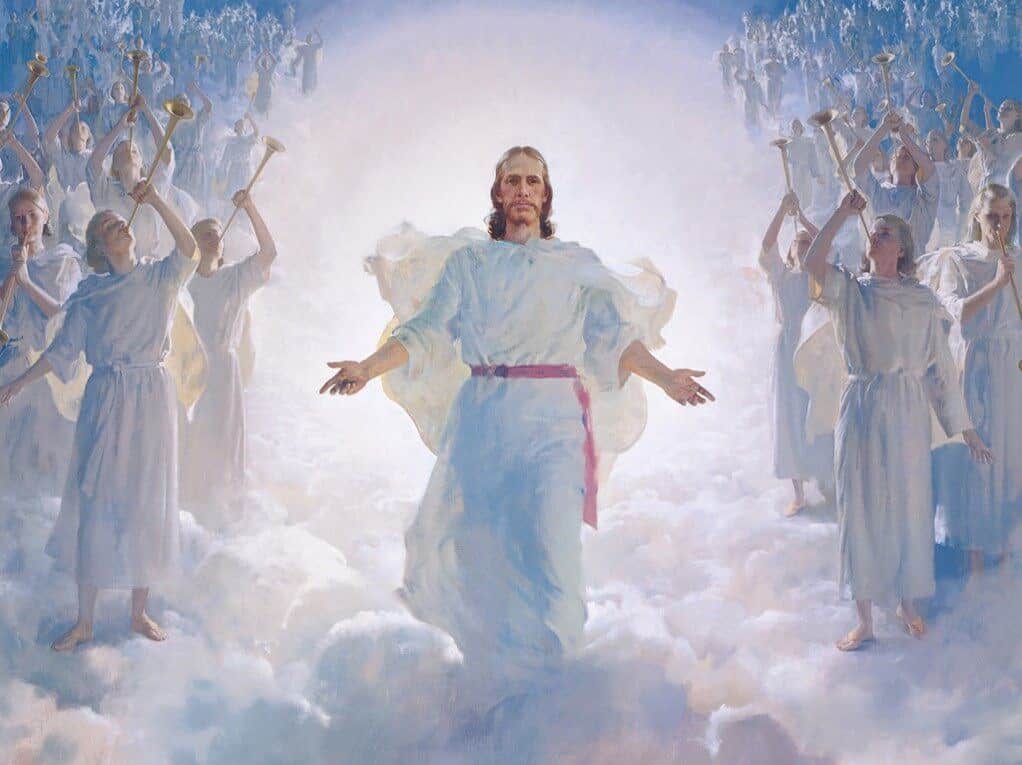
Tag: jesus christ

  • Who was Jesus Christ

    Who was Jesus Christ

    I may have written about this idea before, but given we just celebrated Christmas I’m going to share the thought again.

    If you’re reading this, you chose to come to earth. You don’t remember this choice, but trust me, you did.

    If you’re reading this, you knew to some extent what coming to earth would entail. To be clear, you couldn’t fully understand what you were getting into. But I imagine you knew it would be hard. You knew you would suffer. You knew you would fail.

    Then you discussed an option. Maybe someone could atone for every mistake you would make so you could be forgiven and return home again.

    Someone stepped forward and you accepted Him.

    Who was that person that you put your entire eternal salvation, destiny, and future into? Who did you trust enough to literally put the fate of your soul on the line? Who was this person that you trusted so much, who you knew loved you so intensely, who was so upright, so kind, so seemingly perfect that you actually believed and trusted He would go down and continue to be perfect. You believed He would go down and do something impossible so you could be saved. I assume you knew Him to be so perfect that you believed He could continue to be perfect with all that mortality could throw at Him. Impossible. It seemed impossible and yet you trusted Him.

    Who was this person?

    What was His character?

    What was He like?

    How could He be so magnificent, so powerful, so kind, so loving, so perfect that you were willing to bet your existence on it?

    Who was He?

    Did He know what He was getting into way back then?

    I don’t think He did.

    Matthew 26:39:

    “And he went a little farther, and fell on his face, and prayed, saying, O my Father, if it be possible, let this cup pass from me: nevertheless not as I will, but as thou wilt.”

    Matthew 26:42:

    “He went away again the second time, and prayed, saying, O my Father, if this cup may not pass away from me, except I drink it, thy will be done.”

    Matthew 27:46:

    “And about the ninth hour Jesus cried with a loud voice, saying, Eli, Eli, lama sabachthani? that is to say, My God, my God, why hast thou forsaken me?”

    The heavens cried for joy when He accomplished the impossible.

    You cried for joy knowing He accomplished the impossible.

    Did Christ know He would accomplish His mission on earth? Was His faith a perfect knowledge? With the importance of agency, I believe there was a chance that Christ would fail.

    But He didn’t.

    We knew He wouldn’t.

    Who was this character?

    This Being.

    This Entity.

    This Savior.

    This Brother.

    This Person that we so trusted.

    I’m grateful He was born. I’m grateful He accomplished His mission. I’m grateful that He knew I wasn’t going to be perfect and so He did the hard thing for me. I’m grateful for His love. I’m grateful that He loved me so much that He refused to fail, even though it was unimaginably hard. I know He refused to fail because He knew what was at stake.

    Merry Christmas.
  • Purpose and What Did You Eat Last Week

    Purpose and What Did You Eat Last Week

    I recently did a meditation that I couldn’t get myself into, I disagreed so much with the premise. I can usually go with the flow with any guided meditation, at least the ones I’ve done. Often the guided meditations lead to spiritual thoughts. This meditation led to a spiritual thought, but not in the normal way.

    The voice leading the meditation stated, basically, that we are on this big rock floating through space. None of us know why we’re here or what the true purpose of all this is. The meditation continued advising to set that aside for a moment and focus on your breathing, etc.

    I stopped right there. In my mind I thought, but I do know why I’m here, I do know the purpose of all this. I couldn’t get behind the premise. It’s a common theme of my writing. Where we come from, why we’re here, where we’re going. It hit me that 99% of people listening to that meditation probably don’t bat an eye at that statement. Most people probably gloss right over it like, “Yeah, I don’t know what the meaning of all this is.” That makes me sad.

    I just started a new book that talks about the temporal nature of this life and how silly it is to one, not believe in the things we can’t see, and two, put so much stock into the things we can see, even though they’re so temporary.

    The book asked what I ate 2 weeks ago. I had no idea. It made an interesting point. Food and water are the most critical thing to our survival. We can’t survive without them. Yet, what did you eat 2 weeks ago? You don’t even remember. What about the car that you love then 8 years later is a clunker. Or the house you cherish but inevitably becomes dirty, beat up, and cluttered with other stuff that is inconsequential. The book talked about how much stock we put into these things.

    How many of us consider why we’re here or where we’re going? How many in the world live in complete ignorance, not wanting to consider these great questions? It amazes me.

    We can’t see or describe heartache, fear, doubt, love, the wind, and yet they exist. Faith exists. Our soul exists. Eternity exists. God exists. These are the things that matter. I wish our society could spend a little less time with a Netflix special they won’t remember a year from now and consider more the purpose of this life. 

    The purpose of this life is God’s plan to make us stronger, better, and more like Him. We knew God before we came here. We will remember Him when we leave here. This life is so important. Not for food, or water, or cars, or homes, or Netflix, but for the faith we build, the experiences we go through, and the families and relationships we cultivate. I wish this is something we could all remember more.

  • The Refiner’s Fire

    The Refiner’s Fire

    *I wrote this in March of 2022.

    One of Newton’s Laws of Motion states “For every action, there is an equal and opposite reaction.”

    In life, for every sorrow, there is equal and opposite capacity for joy. For all our abilities to cause pain and suffering, there is an equal and opposite capacity in us to provide joy and comfort to others.

    This brings up a thought: Without sorrow in general, we would lose the ability to provide an equal and opposite amount of joy. If there were no sorrow in the world, we couldn’t equally counter it with joy. This puts sorrow in a somewhat different light.

    Without our personal sorrows, we could not help others through their personal sorrows. This is why, among infinite other reasons, Jesus Christ’s sacrifice was so significant. He knows all the sorrow. He has experienced it. He can help us through all our sorrows.

    For some reason this week I’ve been studying Einstein’s General Theory of Relativity. The followoing thoughts and things I’m going to write probably won’t make sense. Scientifically, what I’m about to write may be nonsense. But they mean something to me, so I will try to elaborate.

    I read that Einstein came up with one of his theories when he was looking out a window at someone on a ladder. He wondered what would happen if that person fell off the ladder?

    While watching the short video The Refiner’s Fire, Ivy was in my lap. I was in a rocking chair. She was watching with me. I rocked while I held the phone, and we watched the video. My elbow was propped on the chair so as the chair moved, my body moved, and the phone moved. I wondered if Ivy was having to keep up with the phone, trying to trace it as it moved. I realized, probably not. Like me, she was moving with the chair that moved the phone. She was lying flat against my chest so as I moved, she moved, and the phone stayed right in her field of vision, in her eyes to see.

    Then, near the end of the video, Ivy, as toddlers are known to do, got impatient and sat up in my lap. Now she wasn’t flush with my chest. As I rocked and tried to hold the phone steady, she rocked back and forth, tossed about by the flow of the chair but no longer in sync with me in any way. In addition, I had to move the phone farther away, one to try to keep it steady, and two to keep Ivy from grabbing it.

    As I’ve studied Einstein’s theories I’ve been struck by the religious implications. Spacetime bends around the object with the most mass. That object pulls all smaller objects to it. They are drawn to it. Time and space literally bend to the will of the biggest object.

    God is our biggest object. He is the biggest object of the universe. He is, literally, a celestial body of such force that from many lightyears away our sun, our planet, and we are drawn to Him. He is the force that keeps us moving. He is the force that keeps us living.

    As I rocked in this chair, I realized the chair was God. He was the force I was rocking with. And as I was rocking with Him, it was easy to focus on whatever I needed to focus on. If I was flush with Him and in sync with Him, I could focus on that video easily as it rocked with Him. Ivy also, as she stayed flush with me, could focus on the bigger picture – represented by that video. But as she was dependent on me (flush with my body which was flush with the chair – remember God is the chair), when she lifted off me, it made it harder for her to see the picture. She’d disconnected from me and therefore disconnected with God. In addition, if I raised myself from the chair, I disconnected us both from the chair, from God, and we both lost the vision. We both got distracted, we both couldn’t follow the video, we both got tossed about by the swinging momentum, trying to stay flush with the chair (God) but having disconnected ourselves from Him.

    What does this teach me?

    1. In this moment, it is profoundly important for me to stay flush with God.  Ivy (and now Sage) are relying on me.
    2. It is profoundly important for me to teach Ivy, Sage, and our future daughter to become flush with God themselves, so they don’t need to rely on me. What happens when I’m not here?

    How does this tie into The Refiner’s Fire video that started this thought?

    We can create joy to counter sorrow. It is up to me to stay flush with God so that when Ivy, Sage, and my future daughter go through their refiner’s fires, they have somebody they can completely trust. In my life I have a great capacity to cause joy or sorrow. I think the greatest joy I can create in my daughters’ lives is teaching them that God loves them, they are His, He is watching them, and no matter what happens in their life, He will always be there for them. If I don’t teach this to my daughters, it would result in a great sorrow.

    Ivy, Sage, and future daughter will go through their refiner’s fires just as I did. They will need God in their lives at that time. We all need God as we go through the refiner’s fire. Then, when we come out properly molded, we can be flush with the chair (God) and help others as they stay flush with us, until they, themselves, can connect themselves to God. 

    It is our greatest responsibility, and the greatest joy we can provide, to teach others that God loves them. They are children of God with a divine inheritance. No matter what happens to them in this life, He is always there, and it will be okay in the end.

  • Be like Little Children

    Be like Little Children

    There is a Neil deGrasse Tyson video that I watched early on in my parenting journey that has helped me ever since. In the video, Tyson points out that when a child makes a mess, or destroys something, or does something seemingly with the only purpose being to drive a parent insane, they’re really just experimenting. Everything around a child is new to them. When a child throws their plate off the table for the tenth time, they’re doing their tenth experiment to see how that plate flies, where it lands, and how the food splatters.

    Children aren’t trying to make a mess. They’re trying to experiment. When you realize this fact you can also realize that being too harsh on a child making a mess sometimes discourages them from experimentation that can help their mind grow.

    It goes without saying that sometimes you need to draw the line: some experiments can be dangerous, and that eleventh plate throw doesn’t necessarily need to happen.

    I couldn’t find the exact Neil deGrasse Tyson video I saw those years ago, but these three videos share similar messages that I believe are extremely beneficial for parents to see, especially new parents.

    1 – The puddle

    2 – The egg and kids as scientists

    3 – Clean house

    “Except ye be converted, and become as little children, ye shall not enter into the kingdom of heaven” (Matthew 18:3).

    I think about this scripture often. There are so many traits of children. Which ones were Jesus Christ primarily referring to?

    Humility.

    Kindness.

    Trust.

    Faith.

    Joy.

    Enthusiasm.

    Curiosity.

    Forgiving.

    Energetic.

    I read this quote recently:

    “Your child is endlessly curious — maybe you’ll learn something, too. Your child is so enthusiastic — maybe some of that energy will rub off on you. Your child is forgiving — no matter what happens today, you can count on a 3-year-old to start tomorrow with a fresh outlook and ready smile. Your child sees the world with wonder.”

    I think that quote sums up what Christ meant when He said we should be like children.

    Curious.

    Enthusiastic.

    Forgiving.

    Fresh outlook.

    Ready smile.

    Wonder.

    In the midst of being a parent – the chaos of day-to-day life – sometimes it’s easy to forget the miracle that children are. I’m glad I have my kids to look at every day and see the wonder, the ready smiles, the fresh outlooks. The forgiveness, the enthusiasm, and the curiosity.

    As I sit here finishing writing this and Sage slowly walks around a coffee table with a little toy motorcycle, and sees me looking at her, and excitedly holds up the motorcycle and says “Look Daddy!” And Ivy, pretending to be Luna Lovegood, brings me, Harry Potter, a new “project” of French fries and dominos on a paper plate, and happily gives it to me, I’m reminded that I need to be a little more childlike today.

    I’ll put this away now so I can go be a child with my girls.

  • Are Stupid Decisions Sins?

    Are Stupid Decisions Sins?

    I was listening to the story of a guy who was riding his motorcycle 140mph when he lost control and crashed. His body skidded across the pavement at an unknowable speed when he hit a pole. I won’t go into the details of his injuries or how he survived. I’ll only say that he survived, and his injuries were extensive. He’s missing parts of his body, can’t use the restroom, his body is destroyed.

    This led me to a thought: was it a sin for him to drive his motorcycle at that ridiculous speed?

    What separates sin and stupidity?

    Let’s break down that first question a little more, was it a sin to drive a motorcycle at an unsafe speed? Is it a sin to break the speed limit? Is it a sin to break a law? The answer is no, it is not necessarily a sin to break the law.  Men and governments make laws and men and governments are corrupt. I could elaborate on this, but I think we all agree. There were some “laws” in WW2 Germany that were evil. Enough said there.

    So it wasn’t a sin to speed on a motorcycle.

    But was it stupid?

    I think the answer is a resounding YES. It was stupid to drive a motorcycle at 140mph.

    Was it a sin to put his body, a gift from God, in such a dangerous position? His decisions that led to destroying a gift from God, were those sinful decisions?

    When I had my ATV accident was I sinning? No, I don’t think I was…and yet… Yet, was it stupid to be on an ATV without a helmet? In hindsight, of course. Most would say of course even without hindsight.

    Is it a sin to do something stupid, knowing it’s stupid, and not caring? I don’t know… I think I knew it was stupid to ride on an ATV without a helmet, and I still did it. Am I stupid or was I sinning? Or both?

    I return to the question, was it a sin for someone to make decisions that he knew were dangerous and ultimately led to destroying a gift from God?

    I think the answer is no. I think that’s the answer because he didn’t know he was going to destroy his body and that wasn’t ultimately his goal. I didn’t know not wearing a helmet that day would actually risk my life, even if I knew there was a chance, I didn’t know it would flip and I would get seriously injured.

    Here’s where an important line is drawn. Sin is knowingly doing something wrong, knowing that what one is doing is wrong, and still doing it. Sin is conscious, intentional wrongdoing.

    An interesting point to make is that sin is always stupid. This is true on so many levels. Sin is knowing an all-loving Father who only wants your best has advised you of something, and you ignore it, whether due to a belief that you know more than Him or simple disobedience. This assumes a person understands that God loves them and wants the best for them. If the person doesn’t understand that, it makes their decisions less likely to be sins. This is where the principle of: with added light and knowledge comes added responsibility, comes in. More light and knowledge means more awareness of how decisions are sins.

    I believe this is why some in the church feel an overwhelming feeling of guilt that they often blame the church for. Blaming the church is kind of like blaming God. They are mad that they know what they’re doing is wrong, they still want to do it, and this causes a conflict in their soul. This is why many might leave the church.

    Back to the topic.

    Stupidity is not always sin.

    This led me to thinking more about sin. Sin is always stupid. No matter what, sin is stupid. Sin leads to hurting yourself or others in some way.

    Stupid decisions aren’t necessarily sins. Sins are always stupid decisions.

    This is why God has given us this life. It’s a training ground. It’s a chance to prove ourselves worthy of more. If we can’t handle the trials and challenges of this testing ground, how can we be trusted with more in eternity?

    I’m grateful for the life and the opportunity it gives me to be tested, with less at stake. My soul is safe because it is in the hands of Christ. All my mistakes will be paid for by Christ, they have been paid for. I just need to turn to Him. I’m immensely grateful for that.