Tag: joy

  • Why Do I Care?

    Why Do I Care?

    I’ve been thinking recently. Why I care about this?

    This being – the Gospel, the Church of Jesus Christ, the Church of Jesus Christ of Latter-day Saints, Jesus Christ in general.

    Let’s start with Jesus Christ in general. I feel like I write about this constantly and it’s the constant conclusion to one of my posts, so I’ll be brief here. I care about Jesus Christ in general because He has given me everything. The least I can do in return is share Him, follow Him, try my best to be like Him.

    Let’s go broader. Why do I care about the Gospel and the Church of Jesus Christ? That, I think goes in line with why I care about Jesus Christ Himself. If I care about Him, then I would care about His church, and I’d want to share His gospel. That lines up.

    You’ll notice I distinguished the Church of Jesus Christ with the Church of Jesus Christ of Latter-day Saints. This is what I want to focus on and think about here.

    Why do I care to share that I’m a member of the Church of Jesus Christ of Latter-day Saints? Why do I invite people to church? Why do I invite people to activities? Why do I share Book of Mormons? Why do I invite people to meet with the missionaries? Why do I share being a latter-day saint? Why do I talk about it? Why does it matter? Why do I care? Why do I keep doing it with such little success?

    It’s something I think about relatively often. The why?

    How do I stay motivated to write spiritually themed blog posts every week not very many read and fewer still are interested in?

    Why do I keep having gospel discussions with people and trying to convince them that this is the restored Church of Jesus Christ – when everyone I talk to disagrees, or worse, doesn’t care?

    Why do I keep inviting people to church and activities when they never come?

    Why do I keep sharing scriptures and conference talks that no one reads or listens to?

    Why is being a “Mormon” important?

    Hmm.

    Sounds depressing right? Sometimes it’s hard. Being a member missionary is hard. It’s discouraging. It seems like an endlessly fruitless effort.

    And yet I’m not being persecuted or crucified so I have really nothing to complain about compared to saints from earlier times.

    So, I’ve distinguished “The Church of Jesus Christ of Latter-day Saints” from “The Church of Jesus Christ” but that’s really the answer to the question of why. I do all these things, no matter how hard or discouraging, because I believe the Church of Jesus Christ of Latter-day Saints is the Church of Jesus Christ. I believe they are one and the same. I believe this is Christ’s restored church. I believe it is the way back to Him. I believe I was called and sent here to share it. That’s why I do it. That’s why I care.

    I have a friend who converted to this church who once said something I found fascinating. He said, basically, “Whether it’s true or not, I don’t care. This church brings me happiness. It’s made my life better. It’s made me a better person. It’s made me feel closer to God. Is it true? Is it the One True Church? I don’t know. Really, I don’t care.”

    He doesn’t care because for him it’s about his well-being. This church has helped his life and brought him joy. What does he care about the rest of it? While I think in a completely different way, I can appreciate this line of logic, this way of thinking. This person is an extreme pragmatist. So when he said this statement, it told me a lot about him.

    Does what this individual said make him any less of a latter-day saint and disciple of Christ than me? I’ll say, I think it could, but it doesn’t. This person is still one of the most faithful, serving, selfless, Christ-like individuals I know. Ultimately his why doesn’t matter as much as who he is becoming, which is more like Jesus Christ.

    I consider that person’s why somewhat temporal. ‘This church has been good to me and brought me joy, I’m for it.’

    My why is different.

    My question is, what if the church doesn’t bring you joy? What if it makes your life worse? This friend of mine might leave if that were the case. Right now he has no reason to leave.

    Maybe this is why so many leave. They don’t see how the church is benefitting them.

    This friend and I have a mutual friend. The mutual friend is very interested in religion and so we’ve had religious conversations together. After a few discussions, my friend said the mutual friend would never join the church. He said the mutual friend had too much to lose. His family would disown him, his wife would hate him, his whole life would change. It would be too hard. Should that person join the church?

    My friend would say no.

    Again, my why is different.

    I look at that and say, “Is it true?”

    Response from hypothetical person, “Well…”

    “No well, is it true?”

    If it’s true, if God sent a prophet, and that prophet established a church, and it’s Christ’s church – if it’s true – what else matters?

    Is it true?

    I believe it is.

    That’s why it matters. That’s why I care. That’s why it’s so important to me.

    I’ll write more on the temporal vs spiritual benefits of the church another time. But for now, I wanted to share that.

    Is it true?

    Yes.

    Then it matters. It matters more than anything else on this entire earth.
  • This is Repentance

    This is Repentance

    Sometimes I struggle with the idea that my sins have been made completely white through the Atonement of Jesus Christ, that I’m completely forgiven for everything I’ve done.

    I know this disrespects the Atonement of Jesus Christ and that’s part of my biggest struggle. The last thing I ever want to do is belittle what Christ did for me.

    The thing is, sometimes I still dwell on my past sins. Sometimes I still think about them. Sometimes I still feel remorse and guilt. Sometimes I wonder if I’ve paid the full penitence to those I hurt. Have my sins been washed away? Are they completely gone if I still remember them?

    I rationalize this, and I believe it’s true, that I remember them for my benefit. I have to remember them or I might return to them. It’s the remembrance of guilt that keeps me from wanting to go back to being that person.

    I understand this intellectually.

    Still, sometimes it’s hard for me to understand how Christ can have forgotten my sins, washed them away as if they never happened, when I can’t forget them myself.

    The young men I work with and I recently studied Isaiah chapter 1.

    Isaiah 1:18 reads:

    “Come now, and let us reason together, saith the Lord: though your sins be as scarlet, they shall be as white as snow; though they be red like crimson, they shall be as wool.”

    After reading that I emphatically emphasized something to those young boys. What I emphasized was this:

    “When you truly repent, and show remorse, and try your absolute hardest to not do it again, Christ forgives and forgets your sins. Period. White as snow. It’s as if they never happened. Don’t be deceived. Satan will have you believe you can never be forgiven for a mistake. This is the great lie. You can be forgiven. If you repent, Christ will forgive. Not only that, He won’t even remember it. It’s like it never happened. I can’t stress this enough.”

    That’s what I said to my young men, and I believe it’s true.

    But… do I believe it’s true?

    Given what I just wrote?

    I had a thought today for the first time ever. I often think about the time of judgement. That time when we stand before Christ and have our life reviews. I’ve never feared that moment. The thought that occurred to me today is: why don’t I fear that moment? I have so much to be embarrassed by, so much to be ashamed of in my past behavior. Why haven’t I worried about it before? It occurred to me that one day my wife, Beth, will see how I once was. I’ve tried to tell her, but I don’t think she gets it. Then it occurred to me that my family will see it too. I will be so ashamed! Why haven’t I feared this before?

    Then it hit me.

    Maybe that’s repentance.

    Repentance is knowing – yes, I did those things. Yes, I made many mistakes. But though my skins be scarlet (they are and were) they shall be as white as snow. As I type this, I hold back tears. That’s what Christ has done for me. That’s what repentance is.

    Luke 15:7:

    “I say unto you, that likewise joy shall be in heaven over one sinner that repenteth, more than over ninety and nine just persons, which need no repentance.”

    D&C 18:13:

    “And how great is his joy in the soul that repenteth!”

    I am that soul. I don’t know how the life review will go. If my sins are forgiven and forgotten, are those parts reviewed? I don’t know. But what I realized was, and why I’ve never feared that moment, is even if all my abhorrent behavior is shown, it will be ok. It will be ok because I changed.

    That thought of Beth seeing how I used to be? It occurred to me that maybe she’ll love me even more after seeing all of it because she’ll see how much I changed. She’ll be able to see the full picture of how far I came to be a semi-decent husband and father.

    I think that’s what repentance is. Knowing that even if all your sins are laid out, you’re still forgiven.

    That’s repentance.

  • Infant baptisms, Salvation, and the Atonement of Jesus Christ

    Infant baptisms, Salvation, and the Atonement of Jesus Christ

    One of the great fallacies of Christian belief is what happens to people who die without being baptized, especially those who never, in mortal life, had an opportunity to be baptized.

    The Church of Jesus Christ of Latter-day Saints is sometimes accused of diminishing God through the beliefs He has revealed to us. For example, the idea that we can become like Him. Other Christian sects look at this as some sort of disrespect towards God. Like us trying to be like our Father is an insult to Him. We’re similarly criticized for diminishing Christ’s Atonement in the faith and works discussion.

    What of children who die without baptism? How many children have died without the opportunity to be baptized?

    We’re criticized for diminishing Christ’s Atonement.

    What’s more disrespectful to the price Christ paid for ALL of us than saying Christ’s Atonement doesn’t cover the billions of people – billions of babies and children, that have died without baptism? What a corrupt and sad view of the Atonement of Jesus Christ to say that it doesn’t protect innocent children who never could be baptized. He died for all of us.

    So, I would like to share beautiful truths as revealed by God to his prophets in this dispensation that pertain to little children, salvation, the resurrection, and Christ’s Atonement.

    The following are some frequently asked questions concerning the status of children who die before the age of accountability.

    Are they automatically saved? 

    Elder Bruce R. McConkie wrote: “To this question the answer is a thunderous yes, which echoes and re-echoes from one end of heaven to the other. Jesus taught it to his disciples. Mormon said it over and over again. Many of the prophets have spoken about it, and it is implicit in the whole plan of salvation. If it were not so the redemption would not be infinite in its application. And so, as we would expect, Joseph Smith’s Vision of the Celestial Kingdom contains this statement: ‘And I also beheld that all children who die before they arrive at the years of accountability are saved in the celestial kingdom of heaven.’ [D&C 137:10.]

    “It is sometimes asked if this applies to children of all races, and of course the answer is that when the revelation says all children it means all children. There is no restriction as to race, kindred, or tongue. Little children are little children and they are all alive in Christ, and all are saved by him, through and because of the atonement. …

    “They are saved through the atonement and because they are free from sin. They come from God in purity; no sin or taint attaches to them in this life; and they return in purity to their Maker. Accountable persons must become pure through repentance and baptism and obedience. Those who are not accountable for sins never fall spiritually and need not be redeemed from a spiritual fall which they never experienced. Hence the expression that little children are alive in Christ.…

    “Truly it is one of the sweetest and most soul-satisfying doctrines of the gospel! It is also one of the great evidences of the divine mission of the Prophet Joseph Smith. In his day the fiery evangelists of Christendom were thundering from their pulpits that the road to hell is paved with the skulls of infants not a span long because careless parents had neglected to have their offspring baptized. Joseph Smith’s statements, as recorded in the Book of Mormon and latter-day revelation, came as a refreshing breeze of pure truth: little children shall be saved. Thanks be to God for the revelations of his mind where these innocent and pure souls are concerned!” (“The Salvation of Little Children,” Ensign, Apr. 1977, pp. 4, 7.)

    Even though little children will be saved, does that mean they will have eternal life?

    Elder McConkie explained: “Eternal life is life in the highest heaven of the celestial world; it is exaltation; it is the name of the kind of life God lives. It consists of a continuation of the family unity in eternity. … children will be saved in the celestial kingdom. Salvation means eternal life; the two terms are synonymous; they mean exactly the same thing. Joseph Smith said, ‘Salvation consists in the glory, authority, majesty, power and dominion which Jehovah possesses and in nothing else.’ (Lectures on Faith, pp. 63–67.) We have come to speak of this salvation as exaltation—which it is—but all of the scriptures in all of the standard works call it salvation. I know of only three passages in all our scriptures which use salvation to mean something other and less than exaltation.” (“Salvation of Little Children,” p. 5.)

    President Joseph Fielding Smith added:

    “The Lord will grant unto these children the privilege of all the sealing blessings which pertain to the exaltation.

    “We were all mature spirits before we were born, and the bodies of little children will grow after the resurrection to the full stature of the spirit, and all the blessings will be theirs through their obedience, the same as if they had lived to maturity and received them on the earth.

    “The Lord is just and will not deprive any person of a blessing, simply because he dies before that blessing can be received. It would be manifestly unfair to deprive a little child of the privilege of receiving all the blessings of exaltation in the world to come simply because it died in infancy.…

    “Children who die in childhood will not be deprived of any blessing. When they grow, after the resurrection, to the full maturity of the spirit, they will be entitled to all the blessings which they would have been entitled to had they been privileged to tarry here and receive them.” (Doctrines of Salvation, 2:54; see also Mosiah 15:25.)

    Why do some children die and others live? Are those who die better off than those who remain in mortality?

    Elder McConkie wrote:

    “We may rest assured that all things are controlled and governed by Him whose spirit children we are. He knows the end from the beginning, and he provides for each of us the testings and trials which He knows we need. President Joseph Fielding Smith once told me that we must assume that the Lord knows and arranges beforehand who shall be taken in infancy and who shall remain on earth to undergo whatever tests are needed in their cases. This accords with Joseph Smith’s statement: ‘The Lord takes many away, even in infancy, that they may escape the envy of man, and the sorrows and evils of this present world; they were too pure, too lovely, to live on earth.’ (Teachings, pp. 196–97.) It is implicit in the whole scheme of things that those of us who have arrived at the years of accountability need the tests and trials to which we are subject and that our problem is to overcome the world and attain that spotless and pure state which little children already possess.” (“Salvation of Little Children,” p. 6.)

    Will children who die before the years of accountability ever be tested in the way that other mortals are tested? 

    President Joseph Fielding Smith said: “Satan cannot tempt little children in this life, nor in the spirit world, nor after their resurrection. Little children who die before reaching the years of accountability will not be tempted.” (Doctrines of Salvation, 2:57; see also D&C 29:4745:58.)

    What will happen to children in the Resurrection?

    President Joseph F. Smith wrote: “Joseph Smith taught the doctrine that the infant child that was laid away in death would come up in the resurrection as a child; and, pointing to the mother of a lifeless child, he said to her: ‘You will have the joy, the pleasure, and satisfaction of nurturing this child, after its resurrection, until it reaches the full stature of its spirit.’ There is restitution, there is growth, there is development, after the resurrection from death. I love this truth. It speaks volumes of happiness, of joy and gratitude to my soul. Thank the Lord he has revealed these principles to us.” (Gospel Doctrine, pp. 455–56.)

    Thank the Lord He has revealed these principles to us. Amen.

  • God Loves a Returned Sinner

    God Loves a Returned Sinner

    Luke 15:7 reads:

    “I say unto you, that likewise joy shall be in heaven over one sinner that repenteth, more than over ninety and nine just persons, which need no repentance.”

    Why does heaven rejoice over a returned sinner?

    Why does Christ love a returned sinner? This should be obvious. Christ loves a returned sinner because they’re utilizing His Atonement, the great gift He gave them. He suffered for that gift. Why wouldn’t He rejoice over it being used?

    It’s very important to point out that this doesn’t make the returned sinner any better than the constantly faithful. Do you think God is up there thinking, “you were always upright. Too bad you didn’t sin some more so I could have increased joy”? Of course not. God loves the consistently faithful. I think another important point here is that we’re all sinners. So, by this scripture we can know, that God loves all who repent of sins. We all sin.

    An individual from history who was a clear sinner, making evil choices, even if he didn’t realize it, was Paul. Paul ended up being one of the greatest missionaries ever but started as the greatest persecutor of the church. Paul received a miraculous visit from Jesus Christ. This converted him and he instantly changed his ways. As we read the scriptures, Paul’s change seems instant. But I believe there was a reason he had to travel blind for three days. I believe his change was actually slow and required a lot of humility.

    Paul became an obvious example of Luke 15:7, heaven rejoicing. Paul was such a go-getter of persecution; the Heavens must have been excited to have him on their team once he converted. Imagine how the angels rejoiced when Paul turned to the Lord because they now knew how ferocious he would be for the Lord.

    Peter can be seen as another example of someone who didn’t always make the right choices. Isn’t it amazing to read the New Testament and consider how flawed the individuals were who Christ chose to spread His word and be His ministers? Peter was no exception. You can look to Peter’s three denials of Christ as a great scriptural moment representing needing to learn a lesson, repent, and double down on conversion and commitment.

    Peter made a huge, and life-altering mistake by denying Christ those three times. It was life-altering for how it helped Peter change his life. It could have been life-altering in how it turned Peter away from Christ. He could have gone the other way. Christ knew He wouldn’t. That’s why Christ picked Peter.

    The show “The Chosen” does an interesting job of depicting Peter. What if Peter was kind of a bad guy? Not a bad heart, but did some bad things. A rough guy. A guy that made a lot of mistakes before he met Jesus and fell in as one of his apostles. Then, slowly, over much time around the Master, Peter became His primary apostle. Peter eventually became the president of Christ’s church.

    The student manual for the book of Mark notes:

    “Mark, more than the other Gospel writers, recorded the disciples’ shortcomings (see Mark 4:36-41; 6:52; 8:14-21). The disciples’ weaknesses stand in contrast to their greath faith and successes, which are depicted in the book of Acts, helping us appreciate the transformation brought about by the Resurrection and the outpouring of the Holy Ghost.”

    Never judge a sinner. They can become the most kind, most gentle, most Godly person. We all have Godhood in us. One day our sins will be in great contrast to our faith and successes when we ultimately attain our full potential.

    The Bible Dictionary definition of “conversion” states:

    Denotes changing one’s views, in a conscious acceptance of the will of God (emphasis added, Acts 3:19). If followed by continued faith in the Lord Jesus Christ, repentance, baptism in water for the remission of sins, and the reception of the Holy Ghost by the laying on of hands, conversion will become complete and will change a natural man into a sanctified, born again, purified person-a new creature in Christ Jesus (see 2 Cor. 5:17). Complete conversion comes after many trials and much testing (emphasis added, see Luke 22:32; D&C 112:12-13). To labor for the conversion of one’s self and others is a noble task, as in Ps. 51:13; Dan. 12:3; James 5:19-20; Alma 26; D&C 18:15-16.”

    The part that stood out to me most from that definition was that complete conversion comes after many trials. I know it did for me. I had to experience the bitter to appreciate the sweet. I had to see how dark life could feel to appreciate Christ’s light. I know my testimony is stronger because I had to learn how dark it can be.

    Did Peter experience his change through trials? Did Paul? I think they did. Those who go through the greatest trials and then turn to the Lord become his most devout followers. Paul was blind. That’s quite a trial. But when he saw the light, he never turned away from it again.

    We all don’t receive miraculous visitations from Jesus Christ like Paul did, or get to work with Christ side-by-side like Peter, but we can still feel His presence, serve Him, and feel what it’s like to have Him by our side. Imagine how different your actions would be day-to-day if Christ was with you? Well, He is.

    Sometimes I worry that faithful, day-one-never-wander latter-day saints are missing this. This devotion to the cause. This understanding of how much you need Him. It’s why trials happen. Otherwise, we’d all walk merrily through this life, never understanding the true depth of the Atonement and how desperately we need Him.

    Now, trials come in all shapes and sizes. Just because someone appears to never have gone through “it”, doesn’t mean they’ve never gone through it. We never know the internal struggles, challenges, and difficulties someone faces in their faith. It’s usually not on the outside. But if you see a devoted person to God, you can assume they’ve been through something. It’s those somethings that bring us to Him.

    God loves a returned sinner. Remember that whenever you make a mistake. While we don’t want to make mistakes, we always want to do our best, God will welcome us back with open arms when we make mistakes and repent. It’s a comforting thought whenever we mess up. God knows our heart. Part of making mistakes and repenting is truly regretting it. This doesn’t mean beating yourself up about it or getting too down on yourself, but it does mean truly feeling regret and remorse for mistakes. This can’t be faked. God knows your heart.

    I think we can learn something really neat from examples like Peter and Paul. No matter how far we stray, God has a place for us. God doesn’t look at what we’ve been or what we are, but what we will be. He knows what we will be. He sees that in us. I’d guess it’s His greatest desire that we see in ourselves what He already knows is there.

    Be like Peter and Paul. Be someone Christ can pick.

    God loves a returned sinner.

  • Lost

    Lost

    I wrote this our first Sunday at church with Sage.

    I don’t know what I wanted out of life as a teenager. I wasn’t someone who pictured certain things. I don’t remember picturing what my ideal life would be.

    Today we sat in church for the first time with Sage. She is 8 days old. She was next to me in her car seat, sound asleep. Ivy was on the other side of me and Beth was next to her.

    Then it hit me. This is everything I could want out of life.

    I grew up in an LDS household. My family went to church. I have lots of siblings. I don’t know if back then I realized how much I would want this. There were large portions of my life where I convinced myself that wasn’t what I wanted. But it was always there, inside me, whether I acknowledged it or not. A deep desire to have a family.

    I realize now, I always wanted a family. Right now, with my two daughters and my wife, being at church, there is nothing more I could ask for in life. This is joy.

    I work with the 11-15 year old boys in our church. After that thought came to me in sacrament meeting, I got to share it with them.

    I don’t know what those boys want out of life. I didn’t know at that age. I was able to bear my testimony to them that there is no greater joy in this life than having children, and I wished it for each of them. I told them they need to figure out what they want out of life. I told them I hoped they could find the joy I’ve been able to find.

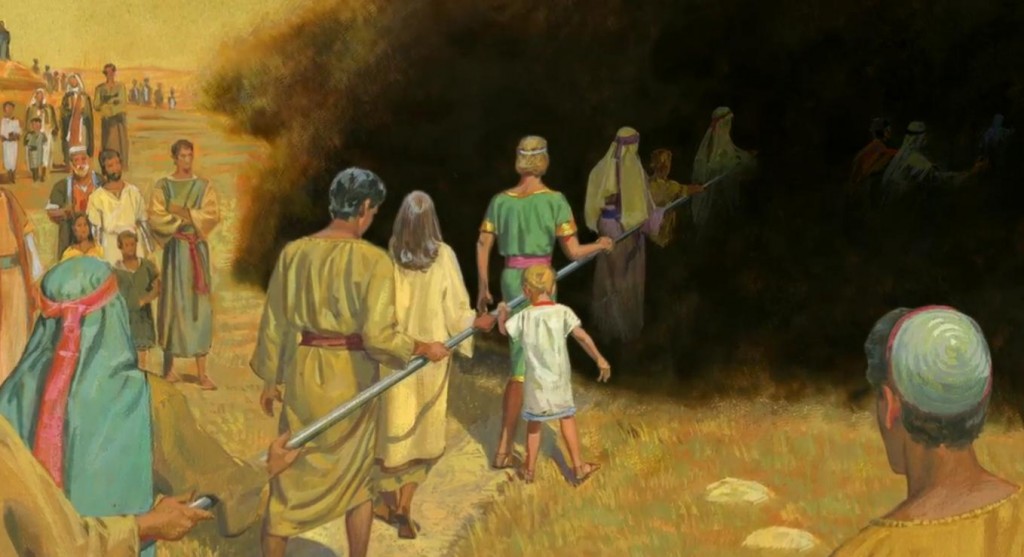
    It was a long journey for me to get here. In that same class with the boys we had a lesson on Isaiah and the iron rod was brought up as a symbol of something greater. One of the boys asked the question: how does the iron rod, which represents the word of God, help us get to the tree of life, which represents Heaven? I told him, it is so easy to get lost. And without the word of God and His commandments, getting lost is almost inevitable. I told this boy I hoped he never had to get lost.

    I got lost. There were many times I didn’t know if I’d ever make it back.

    I often wonder why I deserve so much that God has given me. The answer must be that I don’t deserve anything. He just loves us so much, He’s willing to give us what our hearts truly desire. Whether that be in this life or the next, God has given us everything and will continue to do so. It took me a long time to realize what my heart truly desired. God let me take the long winding road here probably so I could truly appreciate it.

    I do appreciate it.

    I am grateful for the family God has given me. I am grateful for His Church. I am grateful that I’m no longer lost. I couldn’t ask for anything more.