Tag: lds

  • Ivy and Jesus with the Light

    Ivy and Jesus with the Light

    I was working on my laptop and Ivy saw a picture. It was an abstract-looking drawing of a long-haired individual meditating.

    Ivy said, “It’s Jesus.”

    Her and Sage say this if they see pretty much any image of a long-haired individual.

    It makes me happy every time.

    I chuckled.

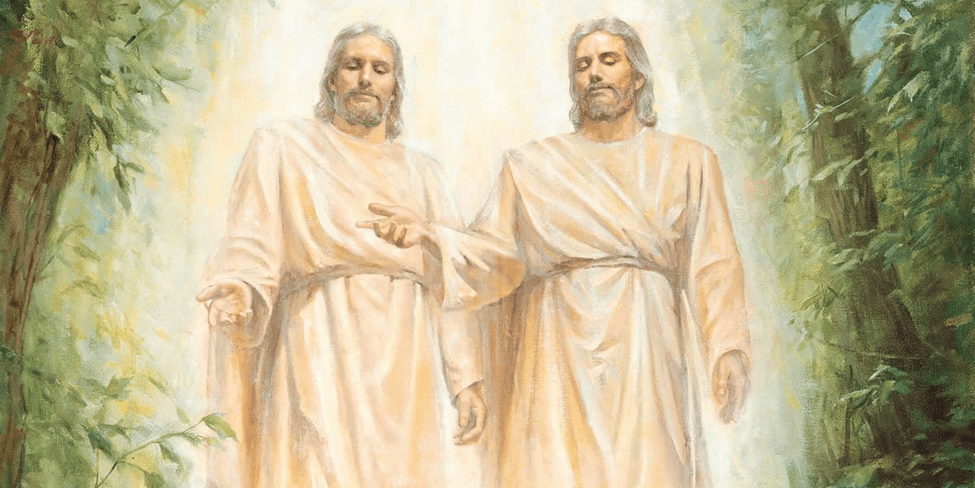
    Then Ivy said, “Show Jesus with the light.”

    I paused like you often have to do when talking with 4-year-olds to figure out what she meant.

    Jesus with the light…

    Hmm…

    Then it came to me what she meant. I pulled up this image and showed it to her:

    “Yes! That’s it!” She looked fondly at the picture.

    My happiness turned to joy.

    This picture has a special place in my heart as it was once an answer to prayer that I’ve remembered ever since.

    When I was just returning to church, I attended a fireside one Sunday evening. I dragged Chris along with me. As he and I were walking around the church building halls before the meeting got started, we paused at the above picture, which is present in so many of our church buildings.

    We both looked at it.

    “Why do they look the same?” Chris asked.

    Huh. I’d looked at this picture at least 346,000 times but never really realized or thought about it. They did look the same. I didn’t know the answer.

    Chris shrugged and moved on. I was kind of annoyed I didn’t know the answer to a question I felt I should know. Or at the very least something I should have noticed in my 346,001 viewing of the painting.

    We went into the fireside.

    The speaker was introduced and he stood to speak. He powered on a projector and an image was displayed behind him. 

    Drum roll please.

    You guessed it.

    The image displayed was none other than the painting Chris and I had just been observing in the hall.

    The speaker began, “Does anyone know why the figures in this image look so much alike?”

    My head jerked to look at Chris next to me. Was he hearing this?!

    The speaker went on to explain that the scriptures tell us that Jesus Christ is in the express image of His father. Jesus Christ and our Heavenly Father look alike. Makes sense, He is His Son, after all.

    I can’t remember why the speaker talked about this. It wasn’t a major point. It was something I think he assumed most of us knew (I didn’t!). He proceeded onto his main point that I can’t remember.

    I was shocked.

    Chris asked a question. We received an answer.

    I considered this a miracle.

    I think Chris shrugged and thought, ‘what a coincidence.’

    I have joy today because I came back to church. I have joy today because I consider every day what Jesus Christ did for me yesterday, today, and tomorrow. I have joy today because Ivy and Sage say “Jesus!” every time they see an image of a long-haired man.

    NoCoincidences.

  • Why can’t Anyone go in an LDS Temple?

    Why can’t Anyone go in an LDS Temple?

    In the Church of Jesus Christ of Latter-day Saints, our temples are sacred. Many people know this by the fact that they aren’t allowed in. This can, understandably, cause some negative emotions. Nobody likes to be excluded from anything.

    I heard an anecdote that really stuck with me.

    A man was telling a story about when he was a missionary and held Q&A sessions with local churches in the Bible Belt south. One of these sessions, a nice little elderly woman asked a not so nice question, “Why is your church exclusionary and doesn’t let people into your temples?”

    The man explained that he immediately realized this woman wasn’t able to attend the sealing of someone she cared about, which created this understandable animosity. He asked the old woman and learned she wasn’t able to attend the temple sealing of a beloved granddaughter.

    A somewhat standard response to this question is that it is about worthiness, that you must be worthy to enter the temple. Many Biblical examples can be used to illustrate this point.

    As the man was about to respond this way, he felt an impression to not give this standard response. He realized talking about worthiness wouldn’t be right with this woman. This was a Bible loving, Christ loving, Bible belt evangelical Christian. Telling her she wasn’t worthy wouldn’t be fair.

    Personally, I would have explained covenants in this moment. That one needs to make sacred covenants to enter certain places. This man received an altogether different impression, and this is the part that struck me.

    He asked her, “Do you believe that the Book of Mormon is the word of God.”

    She replied, “No offense, but no.”

    He asked her, “Do you believe this is Christ’s true church on the face of the earth?”

    She replied, “No offense, no, I don’t believe that.”

    He asked her, “Do you believe that Joseph Smith is a prophet?”

    She replied, “No offense, no.”

    Each time he told her he didn’t blame her for not believing it. That if it weren’t for the witness of the spirit to him, he wouldn’t believe it himself. He then asked her, “Do you believe that ancient prophets came to earth to bestow the keys of the sealing power to bind on earth what is bound in heaven as Matthew details in chapter 16?”

    She replied, “That’s in Matthew 16? I never thought of that. But no, I don’t believe that.”

    The man told her that’s OK, but he does believe all those things. Then he transitioned somewhere I did not expect, the story of Jairus’s daughter being raised from the dead (Mark 5:22-43, Luke 8:40-56).

    The man asked her if she knew the story and of course this avid Bible studier knew it.

    He directed her attention to the moment when Christ arrived at the home. The girl was dead. Those there mourning mocked Christ when He said she was just sleeping.

    Then what did Christ do?

    He “put them all out.”

    Christ had to remove all the lack of faith from the room. Christ, the Master. He let Peter, James, and John stay. He let the mother and the father stay. They had faith. He removed all those that didn’t believe.

    The man explained that when he goes to a temple, it’s not a marriage ceremony. It’s not until death do us part. Just like when Christ brought that girl back from the dead, telling death that it had no power before Him, the same is happening in temples. The priesthood power of temple sealing is telling death, “You can’t have this couple. This couple is protected. This couple is sealed. Even in death, death can not split them up. They are one. They are united.” It’s as if Christ Himself is saying, “They are mine, and you cannot have them.”

    That is what happens in Christ’s temples. Couples are sealed.

    The man then explained that when he attends a temple sealing, his faith becomes part of it. He contributes his faith to that couple. His provides his belief that they will be sealed for eternity.

    He then explained, “You admitted you don’t believe these things. Would you mingle your lack of belief in a place of faith? Would you have Christ keep the nonbelievers in the room to see the miracle?”

    Now, this isn’t the only reason people who aren’t members of the Church of Jesus Christ of Latter-day Saints can’t enter temples. Worthiness is a part of it. As I already mentioned, covenants are a part of it.

    But I loved this part I’d never thought about, faith is also part of it.

    I am grateful that God provided a plan and His Son so that I can be sealed to my family for eternity. I love my family. I never want to leave them. Now I look at Ivy, Sage, Beth. I can’t fathom a life without them. They are everything. I thank God every day for the sealing power and the gift He has allowed me to be sealed to them for time and all eternity.

  • Me and Moses

    Me and Moses

    Before you start reading, I will be comparing my WEAKNESS to Moses’s weakness. Don’t worry, I’m not comparing myself to Moses in a good way.

    I liked that title for this blog post because it gives off a good ‘ole image of Moses and I getting ready to go do some fishin’ or somethin’.

    There is never a moment I feel more like Moses than when I’m asked to speak in public, especially in church.

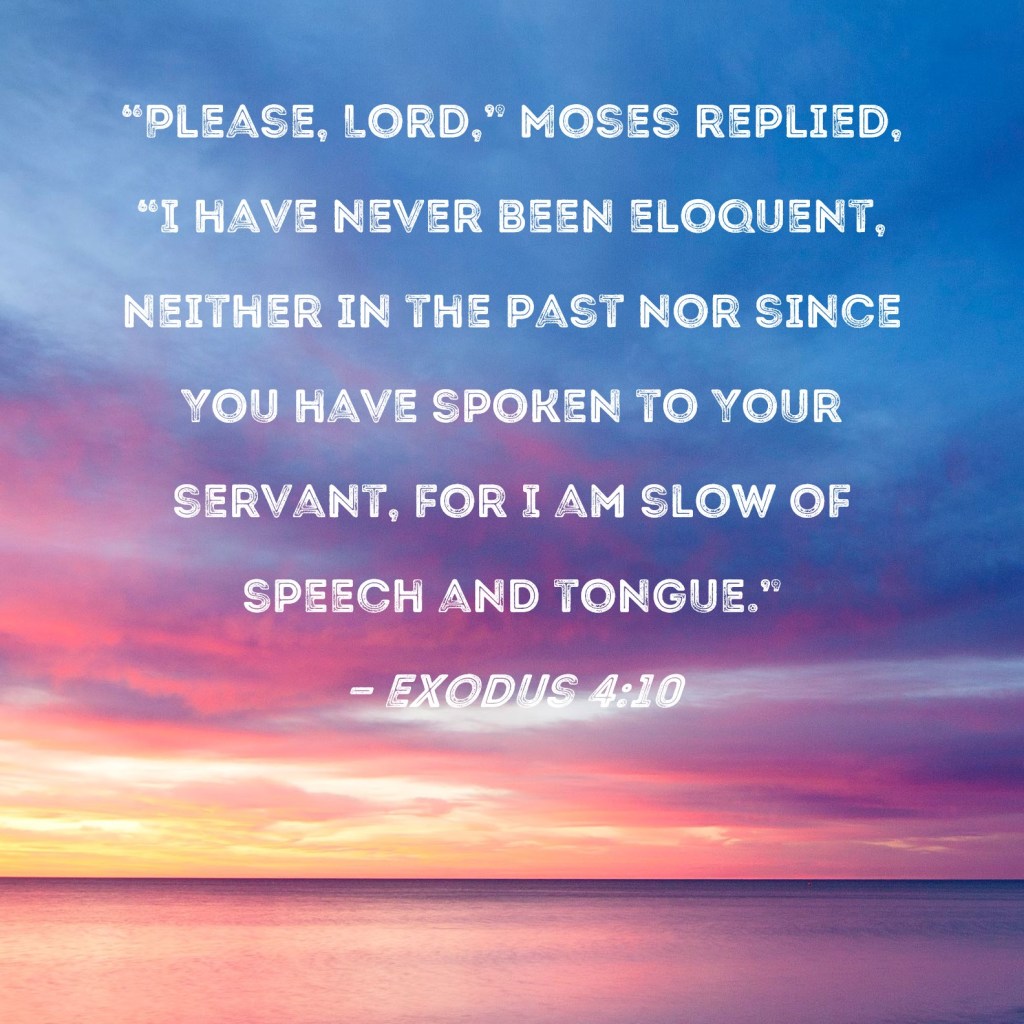
    I’m referring to Exodus 4:10:

    10 And Moses said unto the Lord, O my Lord, I am not eloquent, neither heretofore, nor since thou hast spoken unto thy servant: but I am slow of speech, and of a slow tongue.

    When I first thought about coming back to church in ~2011 there was one overwhelming obstacle in my path: what if I’m asked to speak??? I know to many this seems absurd. But I hope it goes to illustrate how big a fear this was (and still is) for me. I have memories of being a deacon (12–13-year-old) in church and dreading a Sunday School class I learned would be spent reading scripture out loud. It filled my entire body with fear. It made me lock up. It made my throat tight. It made me gulp over and over. It made me sweat. I would start to feel like I might throw up.

    Some of you think you have a fear of public speaking.

    Now do you get how big a fear this was and still is?

    I know others have it worse than me.

    When I did finally come back to church in ~2015, I had to make a decision early on. That decision was that I would not let my fear of speaking hold me back. God had brought me back and I had experiences to share and people to help. Not only that, but I had to learn to lessen the control fear had on my life.

    I decided when I was asked to speak in church, I would accept. That was until that first text came in one morning asking me to give the opening prayer in church that day. I froze. Instead of responding to the text, I called a mentor (I miss you Jessie) and talked it through. He reminded me that if I said no today, when would it stop? By the time I responded to the bishopric member who asked me to give the prayer, he had already reassigned it to someone else. I was off the hook that day, but I promised myself the next time I was asked to speak, I would accept without hesitation, before I could let the fear and excuses set in.

    Little did I know how much that next call would try my faith.

    I was in the middle of studying for a work certification. I’d already failed the test once and this next test was extremely important. I’d been studying for weeks. The test was a couple weeks away when I got the call. I was asked if I could speak in church in two weeks. The excuses flooded my mind: I have this test I’m studying for, I can’t write a talk, and besides, the added stress…! I can’t, I’ll have to accept next time.

    Then I remembered the promise I made myself. 

    “Yes, I will speak.”

    That taught me an important lesson. If we let our fears control us, they will. There are always excuses why NOT to do something that makes us uncomfortable. I spoke two weeks later in church. Beth still talks about that day, hearing me speak, as being the first day I caught her attention.

    From that day forward if I was asked to bless the sacrament, give an announcement in church, say the prayer, teach a lesson, or speak, I always answered yes without hesitation. It petrified me every time. I remember one day I gave someone the Holy Ghost which entailed laying my hands on a friend’s head and giving her a priesthood blessing in front of our entire church. That same day I also blessed the sacrament in front of the whole church, and I gave a talk in front of the whole church.

    Any one of those things in a given day would have given me nightmares.

    Before sacrament, I started to feel sick to my stomach. I thought I was going to be physically ill. I went to an empty classroom, I knelt, and I prayed for help.

    “Please, Heavenly Father, please, just help me get through this. I need you.”

    That may have been the day I solidified my knowledge that I can’t do anything without God, I’m nothing without Him.

    When I gave that blessing to the friend, bestowing the Holy Ghost upon her, I walked up with knees shaking. I thought I was going to, at a minimum fall over, and possibly faint. My throat was dry, and it hurt. I’ll never forget the feeling when I put my hands on her head, with the whole congregation, heads bowed, waiting for me to speak.

    I’ll never forget feeling like a cold bucket of water was poured over my head. From my head down to my toes I felt a tingling. Calm overcame me.

    My grandpa used to say his favorite thing in the world was to give a priesthood blessing because it was the closest he ever felt to God. He said he could feel God in those moments speaking through him.

    That’s what I experienced that day.

    I wrote this on a day that I was speaking in church. I still get kind of sick to my stomach. I still get extremely nervous. I still have to fight back the panic.

    Sometimes people tell me they can’t tell I’m nervous when I speak. I appreciate that, but sometimes I just wish everyone knew. There’s power in putting it out there.

    For others who have this fear, and I know there are many, my biggest advice is to put it out there. Don’t shy away from your fear. When I’m extra nervous, I might just say, “I’m really nervous right now.” Then I feel like I’ve removed the question from those watching and from myself worrying about it. I’ve found this to really help when public speaking.

    I’m grateful for my fear of speaking. It’s assured me, and is a constant reminder, that I can’t do anything without God.

    For those wondering, on the day I wrote this, I did end up speaking and it did go OK. I was supposed to speak for 10 minutes and spoke for 22 due to an excess of time being available. I feel that with practice anything can become more comfortable, and that’s definitely the case with me and public speaking.

    I’ve now taken to challenging myself a little more, to see just how far I can take this reliance on God. The last time I was asked to speak in church I intentionally put zero preparation into my talk. I was asked to speak last minute, a couple days beforehand, due to someone canceling, and the topic was “personal revelation,” so I thought it was a fitting time to try it.

    I got up before the church with little idea of what I was going to share. As I looked around at the congregation, I knew what I wanted to share.

    I’m grateful for the opportunity to speak in church. I’m grateful to be able to share my thoughts and experiences. This fear is a constant reminder that I need God, and I’m grateful for this weakness. Every time I’m asked to speak I’m reminded how weak and silly I am. We can look at all our weaknesses this way, as a reminder of how much we need Him. I know as we do this we come closer to God and better appreciate all He has done and continues to do for us.

  • Doctrine vs. Practice

    Doctrine vs. Practice

    I want to go over something I’ve always had a hard time understanding. 

    What is a doctrine? What are the core doctrines of the Church of Jesus Christ of Latter-day Saints? What is the difference between a doctrine and a practice?

    Doctrines and practices are much different, though they often get confused.

    The simplest way I learned to differentiate a doctrine from a practice is this simple rule: A doctrine is eternal, it never changes. Practices can be changed.

    According to the First Presidency, there are three guidelines to follow when determining if something is a doctrine or just a practice:

    1. Doctrine is eternal, never changing.
    2. The First Presidency and Quorum of the Twelve is unified on a doctrinal subject.
    3. Doctrines are salvific, it is pertinent to our salvation.

    It’s important to remember that these criteria don’t necessarily confirm something is doctrine. Just because the 15 members of the First Presidency and Quorum of the Twelve are unified on the subject DOES NOT necessarily make it a doctrine.

    Let’s look at a couple examples.

    The sacrament that we take each week is a practice. It has changed in multiple ways over time, throughout history. For example, it used to be the practice of the church to use wine for the sacrament. We now use water. This is just one example of how the sacrament has changed over time.

    The doctrine associated with the sacrament would be the Atonement of Jesus Christ. The Atonement of Jesus Christ is eternal and never changing. It is a doctrine. 

    Priesthood is a doctrine but who holds it is a practice. The priesthood itself is eternal. It is God’s power on the earth. In 2018 we saw a change in who can hold the priesthood when the required age changed from 12 years to 11 years. Another example is when the sons of Aaron were the only holders of the priesthood before it was opened up to the Gentiles in this dispensation. This makes who holds the priesthood a principle.

    I know what you’re thinking. Does that mean women can/should/will one day hold the priesthood independent of any man? I don’t know. I won’t delve into that anymore at this time. I will just say, it will take a revelation from God for that to happen.

    In conclusion, I would like to share the 9 basic doctrines of the Church of Jesus Christ. These doctrines are:

    9 core doctrines:

    1. Godhead
    2. Plan of Salvation
    3. Atonement of Jesus Christ
    4. Dispensation, Apostasy, and Restoration
    5. Prophets and Revelation
    6. Priesthood and Priesthood Keys
    7. Ordinances and Covenants
    8. Marriage and Family
    9. Commandments
  • Agency and Mistakes: Was Brigham Young Wrong?

    Agency and Mistakes: Was Brigham Young Wrong?

    Let’s start with an assumption.

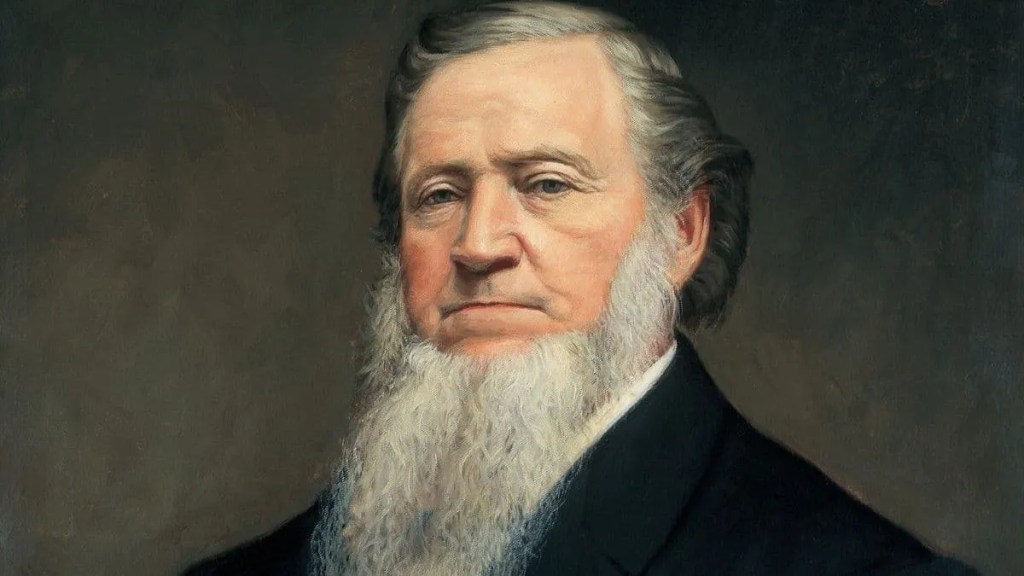
    What if Brigham Young incorrectly instituted the practice of the priesthood ban for black people?

    We always think in this way that God can do anything, however He wants to. Why didn’t He fix the priesthood ban for blacks issue immediately after Brigham Young if it was in fact a mistake by Brigham Young?

    We sometimes neglect to think that, if God were to fix things however He wants to, that would likely supersede our agency. This whole life is about us making choices. It would be a problem if God started correcting everything on this earth, especially with our many mistakes and shortcomings as mortals. It was never in God’s plan to supersede our agency, that was Lucifer’s plan.

    But let’s take a bigger perspective on this.

    What if God did correct this issue of black men not receiving the priesthood in the 1800s and early 1900s? What if He corrected it an eternity ago, when He created the Plan? God’s plan is perfect. God doesn’t always fix things the way we think He should fix things. In fact, He probably never fixes things the way we think they should be fixed. That’s what makes Him God and us tiny mortals trying with all our might to be like Him, but inevitably falling short.

    God’s Plan was established well before black men were denied the priesthood through Earth’s late 19th and early 20th centuries. His plan allows all those who would have faithfully accepted the priesthood while in this life to lose out on nothing. This is in precisely the same way His plan accounts for His countless children who didn’t have access to the saving ordinances of the Gospel in life, whether that be due to the gospel not being present on earth, never hearing about it, or a child dying before reaching the age of accountability. God’s plan is perfect. He’s already thought it through. I assume those who have an issue with the delay in the Church allowing black men to have the priesthood also have an issue with the tens of millions of infant deaths each year. In that case, your issue is with your faith in God, not in any church policy.

    I understand that these things are hard to understand while here. Some reading this may respond, “Yes, that’s precisely the issue I have: That many noble and worthy men weren’t allowed the priesthood and the millions of innocent children that die unfairly.” I understand this challenge. This is where faith comes in. I have faith in God, His Plan, His love, and that He will make all these things we don’t understand right. If we don’t have faith in those things, then yes, God is a monster that we should not worship. The God I know loves us and one day all these things will be understood.

    Something to us, here, simple and short-minded on earth, that looks like a huge mistake – it’s not a mistake to God. All those who couldn’t get the priesthood due to an incorrect policy will receive it.

    What if Brigham Young did make a mistake and what if the Church really would have collapsed if that mistake was corrected in the 1860s? THEN God’s church wouldn’t be on the earth. That seems like a real mistake. Again, God has thought these things through.

    We have an example of this principle in the policy change instituted by Wilford Woodruff banning plural marriage. In Official Declaration 1 of 1890, now in the Doctrine and Covenants, Wilford Woodruff says,

    “The question is this: Which is the wisest course for the Latter-day Saints to pursue—to continue to attempt to practice plural marriage, with the laws of the nation against it and the opposition of sixty millions of people, and at the cost of the confiscation and loss of all the Temples, and the stopping of all the ordinances therein, both for the living and the dead, and the imprisonment of the First Presidency and Twelve and the heads of families in the Church, and the confiscation of personal property of the people (all of which of themselves would stop the practice); or, after doing and suffering what we have through our adherence to this principle to cease the practice and submit to the law, and through doing so leave the Prophets, Apostles and fathers at home, so that they can instruct the people and attend to the duties of the Church, and also leave the Temples in the hands of the Saints, so that they can attend to the ordinances of the Gospel, both for the living and the dead?

    “The Lord showed me by vision and revelation exactly what would take place if we did not stop this practice. If we had not stopped it, you would have had no use for … any of the men in this temple at Logan; for all ordinances would be stopped throughout the land of Zion. Confusion would reign throughout Israel, and many men would be made prisoners. This trouble would have come upon the whole Church, and we should have been compelled to stop the practice. Now, the question is, whether it should be stopped in this manner, or in the way the Lord has manifested to us, and leave our Prophets and Apostles and fathers free men, and the temples in the hands of the people, so that the dead may be redeemed.”

    Sometimes we live with this thinking that God can do whatever so why doesn’t He? This, I think, is the basis of so many losing faith in Him. I look forward to the day when we are all reminded that we came to earth willingly, that we knew the Plan, and that we were eternally grateful for the opportunity to have freedom of choice and to learn right from wrong, away from Him (God), where it was completely up to us to make choices.

    Again, we fall into this thinking, I think, that God can do anything He wants however He wants. Maybe. But God still works through us. God still gives us our agency. God still lives by laws. God said He allows plural marriage in the case where he wants to raise a righteous generation unto Himself (Jacob 2). What would we have had God do if He needed to grow the church membership in one generation? Import a couple hundred thousand men and women from space? The answer is – God works with us. He works within the world He has given us.

    God allows us the bounds to make mistakes. Within those mistakes, God’s Plan works. I have faith in the truth of that. God takes our worst, and it becomes part of the Plan. He prefers our best, but He knows us better than we know ourselves.

    On the question of if Brigham Young did make a mistake – again, maybe the answer is yes, but I will refer again to the Official Declaration 1 – this was Wilford Woodruff speaking, “The Lord will never permit me or any other man who stands as President of this Church to lead you astray. It is not in the programme. It is not in the mind of God” (emphasis added).

    It is not in the program. It is not in the mind of God.  

    I believe in giving God all the power we actually try to take away from His power. God doesn’t watch things unfold her and go, “Oh crap, I need a righteous generation, let’s implement polygamy.”  Or, “Oh man, Brigham isn’t listening, this is bad.” This was worked out long ago. Just because we don’t like the way God did things makes it all the more likely He did it perfectly, because we are dumb, and so limited in our view. We cannot comprehend the workings of God.

    Did Brigham Young make a mistake? I don’t know.

    I know who didn’t make a mistake. That’s where I put my faith.